To avoid these ads, REGISTER NOW!

Garage Build Thread: DIY Questions

OP
R

RossAustin

Well-known member
Joined
Oct 17, 2021
Messages
46
Location
El Campo Texas
So concrete is finally going in today. Now that is off my mind Im thinking ahead to framing, and realized I may have missed an important detail. The garage will attach to the house where an existing porch and utility room is located. Once built I plan to close off the remaining open end of the porch and create a mud room. The missing detail is the sheathing on the portion of the garage wall that butts up to the house. I intended to attach the garage wall top plates to the house end wall truss, but I now dont think that will meet the required shear value for the wall. Attached is a 3d rendering looking into the garage at the wall in question. If this wall does need sheathing (more than drywall) can it go on the inside face of the wall? Or will attaching the top plate to the house truss and installing a diagonal wall brace be enough?

Im not sure what to do here, it was missed by me and whom ever else was supposed to be approving the plans... ie. the city...

Shearwall.PNG
 
To avoid these ads, REGISTER NOW!
OP
R

RossAustin

Well-known member
Joined
Oct 17, 2021
Messages
46
Location
El Campo Texas
Here is same picture with the wall portion in question hatched in RED for clarification. 30' will be up against the house and 10' extends beyond the house, which will be sheathed on the outside like normal.


Shearwallhatch.png
 
OP
R

RossAustin

Well-known member
Joined
Oct 17, 2021
Messages
46
Location
El Campo Texas
So slab has been poured, I expected better but more on that later. Still working on resolving the issue above, and have ran into another.

I started stud layout and wouldn't you know, plumbing drain line is exactly in the same spot as a stud. I measured 4 times when laying out the plumbing so it would land between studs...

Stud layout is the same regardless of which end I start from, so how does one go about framing around the 2" drain line? I haven't been able to find any examples of this online.
 

firebirdparts

Well-known member
Joined
Jun 8, 2016
Messages
10,618
Location
Kingsport, TN
Common stud location only matters to break your sheeting on the stud. Even that doesn’t mean life and death; inside and outside sheeting don’t agree anyway.
 
OP
R

RossAustin

Well-known member
Joined
Oct 17, 2021
Messages
46
Location
El Campo Texas
Common stud location only matters to break your sheeting on the stud. Even that doesn’t mean life and death; inside and outside sheeting don’t agree anyway.
Right so stud on both sides. It's load bearing and happens to have a roof truss landing on it.

Here is what I'm thinking. Stud both sides 3" apart, 90 the pipe one into open stud bay and take vent up through top plate. Fill in 3" gap above 90 with two "blocks" to transition load to the 2 full studs.

Sheathing happens to also land here, so I could start with a half sheet which would shift the edge.

Would you put a metal nail guard the width of the 2 studs vertically to protect the pipe until it transitions?
 

billconner

Well-known member
Joined
Jul 20, 2021
Messages
6,964
Location
Thousand Islands NYS
Will vent need to be 2" or maybe 1 1/2", making it easier to drill through stud above T. Then just header it off and put stud above header back on 16" spacing.

If it has to be 2" all the way, a Simpson Strong-Tie Stud Shoe might help.
 
OP
R

RossAustin

Well-known member
Joined
Oct 17, 2021
Messages
46
Location
El Campo Texas
Drain has to be 2" to the stub out, vent from there I believe can be 1 1/2".

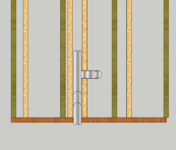
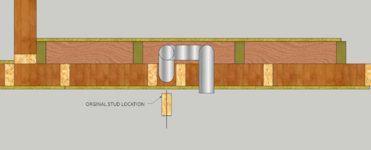
I may have an odd solution, this area is a double wall and the studs are off set. If I put a "dog leg" in the drain and take it into the other wall cavity I can then go around the outer stud and not have to bore any holes. From what I can find in the code a "dog leg, jog, kick" whatever you want to call it is ok as long as its below the lowest fixture drain. I did a quick sketchup to illustrate, hope it makes sense, if I'm thinking wrong please let me know.

First is birds-eye looking down and second is profile.

Drain Mod.PNGDrainModProfile.PNG
 
OP
R

RossAustin

Well-known member
Joined
Oct 17, 2021
Messages
46
Location
El Campo Texas
After looking at it for a minute, I could just stub out the 2" right where it is and then dog let the vent out through the other wall cavity... its just a wash tub in the garage so the location being off a few inches isn't critical.
 
OP
R

RossAustin

Well-known member
Joined
Oct 17, 2021
Messages
46
Location
El Campo Texas
I think you can't use the sharp 90' on the drain. OK for vent. But your second solution with a sanitary T and then 1 1/2" vent is fine.
Right, I would use 2 long 45s for the kick vertical, sani tee to go horrizontal and long sweet 90 to stub back out the wall. The 2d drawing makes it look funny.

But you're right, just sani tee to stub and then vent is much simpler.
 
OP
R

RossAustin

Well-known member
Joined
Oct 17, 2021
Messages
46
Location
El Campo Texas
Yes, interior wall between garage and house, will be insulated to keep the cold in 😄 other than the freak freeze last February we never get below 32 for more than a few early morning hours.
 

CraigStu

Well-known member
Joined
May 22, 2014
Messages
4,030
Location
Blacksburg, Va
I 'think' that you will need fire resistant drywall on the inside of the garage wall where your red diagonals are. It will probably need to go up to the gable portion also. One more detail to remember.
 
To avoid these ads, REGISTER NOW!
OP
R

RossAustin

Well-known member
Joined
Oct 17, 2021
Messages
46
Location
El Campo Texas
I 'think' that you will need fire resistant drywall on the inside of the garage wall where your red diagonals are. It will probably need to go up to the gable portion also. One more detail to remember.

Yeah code here requires 2 hours fire resistant "barrier", I planed to put up 5/8 X rated drywall on the interior. But you are correct, it needs to cover the entire height of the garage wall.

I seem to have gotten myself into an unusual construction situation. The garage wall that attaches to the house effectively created a double wall, it seemed easier this way rather than having the garage trusses sit on the existing house exterior wall.
House wall is 8' garage wall is 9'-3.5" so it would have needed a pony wall in the attic...

I now have two issues, 1) does the red hatched area need shear panels, ie. osb sheathing, can I use let in angle bracing instead, will metal brace strapping be enough? I do plan to attach the 9' wall top plate to the gable end house truss with a ledger of some sort but I dont know if that will be enough.

Which now brings me to the second new issue, if the fire rated drywall needs to cover the entire height of the 9' garage wall it has to go on the inside of the garage or between the garage wall and house wall. I did not want to do drywall on the interior of the garage, however if its easier then I could always just cover it with whatever I decide put on the walls. I wanted to do tongue and groove pine but... prices will have to come down first.

Sorry for thinking out loud but I find problem solving in this way promotes ideas.
 

CraigStu

Well-known member
Joined
May 22, 2014
Messages
4,030
Location
Blacksburg, Va
Pretty sure that convention, and probably code, says it needs to go on the inside (garage side) of the garage wall. If it went between the 2 walls the garage wall framing would be unprotected from fire in the garage.
 
OP
R

RossAustin

Well-known member
Joined
Oct 17, 2021
Messages
46
Location
El Campo Texas
That makes sense, and easier to do. Do you know where in the code where it talks about this. I want to know if it's OK to cover the drywall with something more "decorative".

Now the only question is if that portion of the wall that's doubled needs shear panels.
 

billconner

Well-known member
Joined
Jul 20, 2021
Messages
6,964
Location
Thousand Islands NYS
Assuming IRC as opposed to IBC, I believe "something more decorative" is allowed as long as flammability is considered. However, the 2 hour wall leads me to think this is a business and using IBC, and wall coverings are more restrictive.
 

jkuro

Well-known member
Joined
Apr 28, 2009
Messages
552
You need to go to your City, County or governing municipality and find out which code book they use. All are not the same. Then each community will impose their own local codes you must abide by.
 
Last edited:

CraigStu

Well-known member
Joined
May 22, 2014
Messages
4,030
Location
Blacksburg, Va
In both cases where I have had an extra bay added to an existing garage the wall attached to the house had to have the fire resistant drywall installed before the next stage of county inspection would be handed out. Both the deal was for me to do the rest of the drywall on my own at a later time. My point is that the proper dry wall will already have been inspected and passed and you can then do what you want over top of it.
 

billconner

Well-known member
Joined
Jul 20, 2021
Messages
6,964
Location
Thousand Islands NYS
I attach the IRC requirements for dwelling and attached garage separation. This is not a firewall in the usual building code sense. Firewalls are tested assemblies: studs, fasteners, everything; with specific restrictions for openings, that these walls don't have to comply with. Nothing wrong with 5/8" type x, just not required by IRC.
 

Attachments

  • SECTION_R309_GARAGES_AND_CARPORTS (1).pdf
    37.1 KB · Views: 2
OP
R

RossAustin

Well-known member
Joined
Oct 17, 2021
Messages
46
Location
El Campo Texas
Not sure where I got the 2 hour number from. City worker directed me to a "unified development code" and only requires 1/2" drywall. I find this kinda disturbing, I will at a minimum put a layer of 5/8 X on both sides of any wall adjacent to the house, including the gable end roof area, as well as mineral wool batts. This will help with noise as an added benefit.

I didn't want drywall in the garage, humidity here destroys it in a few years, but it is the safest way to go.
 
OP
R

RossAustin

Well-known member
Joined
Oct 17, 2021
Messages
46
Location
El Campo Texas
Been making some progress lately. Disappointed with the contractor that did the concrete, more on that later.

Currently framing the gable end wall and trying to decide/figure best sheathing arrangement. I've been doing the 9 foot walls vertical and its working great. I got to thinking that if the sheathing on the gable truss lapped the wall it would be exponentially stronger. However I can't seem to come up with a sheathing pattern that doesn't waste. Google didn't reveal any online "layout calculators" either. I've got 9' and 8' sheets to use, wall is 30' wide x 9' tall, gable is also 30x9, 7/12 pitch. Open to suggestions, am I over thinking? Just sheath it like I've been doing and be sure to secure gable truss with plenty of bracing and GRK's?
 

matt_i

Well-known member
Joined
Mar 14, 2008
Messages
10,727
Location
SE Michigan
On my gable ends, I had "endwall trusses" with essentially 2x4s - flat on 24" centers. After messing with some ideas, I ended up placing a full sheet, 8' wide and 4' tall on the centerline of the gable. I think I nipped the corners on the sheet placed directly above, and then filled in the triangles. My walls were 10' minus 8" stem wall height so I was able to lap the sheathing over the top-plate joint. Essentially, I didn't really see an advantage in lapping the sheathing in a "woven" pattern on the gable truss.
 
OP
R

RossAustin

Well-known member
Joined
Oct 17, 2021
Messages
46
Location
El Campo Texas
Well I figured out why its being difficult. The truss is framed with 2x4s flat on 16" centers... starting from the center outwards. I framed my walls front to back left to right. None of my wall studs match up with the truss studs. I don't think I'll be lapping it solely because of the amount of blocking required at the sheathing seams (hurricane/windstorm requirement) since none of them would land on studs properly.

While I know its stronger to lap, I'll make up for it with retrofit studs and lateral bracing.
 
OP
R

RossAustin

Well-known member
Joined
Oct 17, 2021
Messages
46
Location
El Campo Texas
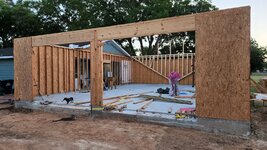
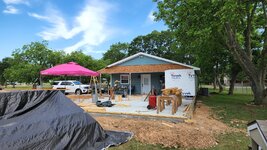
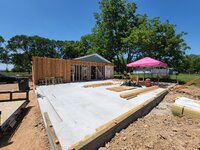
Update with a few questions. Baby #3 showed up in June and Im just now getting back to working on the garage. Here's a few progress photos.

GarageConcrete.jpgGarageFirstWall.jpgGarageDoorRO.jpgGarageTruss.jpgGarageNight.jpg

At this point Ive sheathed the walls and gable end trusses, braced the trusses and put down decking in the attic storage area. Getting ready to put in fly rafters for overhand and sheet the roof.

Originally I ordered the truss gable ends dropped for a 2x fly rafter on its edge, however the city rejected the plans because they only had a 120 mph wind rating and my area requires 140mph. No big deal the truss manufacture updated the truss plans (added a diagonal between two gable studs...) had it stamped by an engineer and city approved. I missed the part where the gable truss was no longer dropped.... sooo contacted truss builder and they said gable truss is non-structural... and I could cut in 1.5" and lay the fly rafters flat. We all know a 2x is stronger on edge, I sister'd a 2x on the back of the gable top chord below the notch to make me feel better. I plan to put a 2x vertical screwed to the flat fly rafter (like an L shape) on the overhang to prevent sag.

I said all that to ask this question. The overhang at the back will match the house @ 16", in order to conserve material I calculated a 20" overhang at the front. However I didnt take into account where the 4x8 sheeting would land on a truss. If I make the front overhang 24" I waste less material but, the first sheet on the second course (cut in half 4'x4' to offset) would cover the overhang, gable truss and first common truss. Is this OK? Or does the sheeting need to cover 2 common trusses?
 
To avoid these ads, REGISTER NOW!
Top Bottom