To avoid these ads, REGISTER NOW!

Garage Floor Demo & Repour- insulation question

mcbooya

Member
Joined
Aug 27, 2020
Messages
6
Location
North Dakota
I have torn out my old attached garage slab and am prepping to get it repoured but want to add some perimeter insulation for my cold midwest winters in case I add gas heater. What is the recommended way to insulate the perimeter, given that my stem walls have a 1.5" lip that the old slab sat on? Should I use a 1.5" thick foam to insulate from the lip up to the top of the stem wall. Then a second piece that will run from the bottom of the lip down 2' along the stem wall?
slabpic.PNG

Would it be ok to have the slab not sit on that lip if it is filled with foam?
And what do you do with the foam board that might be above the slab along the stem wall?
At the overhead door, does the foam just go vertical from under slab down 2' or should some horizontal be done as well?
 
To avoid these ads, REGISTER NOW!

ConCretin

Well-known member
Joined
Jan 20, 2011
Messages
3,378
Location
Central Maine
The new slab doesn't need the shelf for support. In fact, I'd rather see to no perimeter shelf so the slab is uniformly supported by the base.
Unless you are doing radiant in-slab heat, it's unlikely you will ever recoup the cost of under-slab insulation. I'd probably run vapor barrier over the shelf (it will double as a bond break) and install 1/2" expansion foam around the perimeter.

I know it's a lot of work but I'd like to see rigid insulation run vertically on the inside face of exterior perimeter walls from frost elevation to bottom of slab. This prevents the frost from pushing through the wall, freezing your base material and possibly heaving the slab.

Check out mu Guide to Floor Slabs in the link below for some additional thoughts on the process. Good luck and congrats on the new floor.
 

wssix99

Well-known member
Joined
Mar 2, 2011
Messages
5,160
Location
Chicago, IL
Ideally, you would have the interior slab completely isolated from all other surfaces. In my garage, I have foam around the entire perimeter. Along the walls, you can cover it with molding or other trim. Along the garage door and other thresholds, I use SlabGasket https://slabgasket.com/ which has performed phenomenally well. After the floor cured, I carved out a little bit of the foam and then tapped the gasket in.

Your slab doesn't need to sit on those lips. The less it does, the better. (Your slab is "floating" and should be independent of the rest of the structure.)

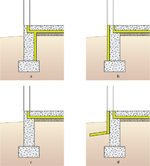
This article shows you options for insulating: https://foundationhandbook.ornl.gov/handbook/section4-1-insulation.shtml

^ You are looking at option "c" right now, but if you have the ability to add more insulation to the foundation, you will trap more heat underneath the slab in the future and save even more on heating.

4-4_no-cap.png
 

wssix99

Well-known member
Joined
Mar 2, 2011
Messages
5,160
Location
Chicago, IL
Unless you are doing radiant in-slab heat, it's unlikely you will ever recoup the cost of under-slab insulation.

There's also the source of comfort. If the foundation is uninsulated, I would expect the floor to be more comfortable if the building was heated and one had to be on the floor doing work.

If the heating would only be temporary space heating (for a detached garage), I agree that the cost of the insulation is unlikely to ever be recouped. An attached garage with living space above, would be something different.
 
OP
M

mcbooya

Member
Joined
Aug 27, 2020
Messages
6
Location
North Dakota
Thanks for the input.
In those diagrams, it shows the insulation running horizontally. Is that better than running it down say 2' vertically below the slab? This garage will really just be for parking in the winter, as I have a detached garage that can be used as a workspace, so am looking for cheap and simple since I have the opportunity now before I repour. Frost footing depth here is like 5', more than I want to dig down to.

I am still a little unclear about insulating at the overhead door perimeter. My slab will be resting on the foundation wall at that point, as the foundation wall has been cut down to the height of the bottom of the slab, and the driveway starts at the outside edge of the foundation wall.
 
To avoid these ads, REGISTER NOW!

ConCretin

Well-known member
Joined
Jan 20, 2011
Messages
3,378
Location
Central Maine
Keep in mind that insulating under the slab is a double edged sword. At those times the garage isn't heated, it will block the natural heat from the ground from reaching the garage. It's not uncommon for my unheated garage without under slab insulation to remain above freezing when the outside temps are well below.

If the slab isn't heated, there is no reason to worry about insulating the edge at the door or anywhere else for that matter. Just pour the slab out over the wall and call it good. Just don't forget to pitch the surface outside the door away so water doesn't come under your door.

The only insulation that will provide a benefit is the vertical insulation I referred to earlier.
 
OP
M

mcbooya

Member
Joined
Aug 27, 2020
Messages
6
Location
North Dakota
Any tips on how to handle the overhead door area? I am filling in the shelf with vertical insulation so the slab can float, but at the overhead doors the slab will be resting on the foundation wall that has been cut down .
- Would you run the slab to the apron and let it sit on the stem wall at both the rear and front overhead doors?
- or make the threshold area on top of the overhead door foundation cutouts its own separate, small slab (8" wide x 7') This would allow the main slab to truly be floating, the threshold to sit in place, and the apron to be on its own as well.
 

wssix99

Well-known member
Joined
Mar 2, 2011
Messages
5,160
Location
Chicago, IL
Make the threshold area on top of the door foundation cutouts a separate small slab. This is how I did mine and they are performing great. I use that slab gasket on on the area between the floating slab and the mini-slab under the door.

Just pin the mini slab to the foundation to keep it from moving around under tire loads and you are good to go. (You might also consider a dust lip as this is probably the place where you would want to add that feature, as well.)
 

NUTTSGT

Super Moderator
Staff member
Joined
Sep 14, 2009
Messages
50,942
Location
Northern Central Ohio
At my overhead door, I stopped the insulation at the top of the block laid up for the foundation.

Do I lose a little bit there, yes but I lose some heat with the O/H door too.

I insulated the inside of the foundation wall with 3/4 or 1" foam, the outside with the same thickness but blue instead of pink insulation. (Dow vs Owens Corning) The exterior stops below grade. The pink interior is what was used to screed the new floor to when poured.

I was going to take a torch and melt the top edge and fill with some Sika-Flex but haven't yet.
 
To avoid these ads, REGISTER NOW!
Top Bottom