Purchased new home and noticed the bottom corners of the garage has gaps that let in wind and whatever rodents and insects decide to come in. I don’t know what this is called, but read online that it’s per building code to prevent wood from rotting on the concrete. How should I seal these? Attaching picture to show what it looks like.


You are using an out of date browser. It may not display this or other websites correctly.
You should upgrade or use an alternative browser.
You should upgrade or use an alternative browser.
Garage Gap Bottom Corners
- Thread starter chilow
- Start date


Viper98912
Well-known member
I had the same issue, so I filled it with Great Stuff expanding foam to close up the gap. It isn't perfect, but nobody is looking at it and it stops most of the critters
Viper98912
Well-known member
I honestly didn't notice a difference because of it, but I wasn't really thinking about it either. I mostly did it for the critters we kept getting in.
Well, that is B.S.! They make treated lumber, or PVC trim boards, sheet metal flashing. There are many ways to enclose that gap.Purchased new home and noticed the bottom corners of the garage has gaps that let in wind and whatever rodents and insects decide to come in. I don’t know what this is called, but read online that it’s per building code to prevent wood from rotting on the concrete. How should I seal these? Attaching picture to show what it looks like.
Can you extend weather strip all the way to the ground? The over head doors are weather stripped aren't they?
Renegade1LI
Well-known member
See if you can get the builder to repair it correctly, otherwise you need to patch it, don’t rely on foam or caulk. Like poorub said use pt wood or pvc , are the doors weather stripped? Can’t tell from the pic.
Juiced06GTO
Well-known member
I have a similar problem on my new barn, except the damn rodents ate the weather stripping and came in. I placed a box of poison right at the hole to deter them. Unfortunately, the weatherstripping is part of the garage door trim and the only correct way to fix it is to replace the entire piece. I may see if I can glue a heavy piece of rubber to it once it warms up out this way and see if that seals it up and looks decent.
CraigStu
Well-known member
I would look at the PVC wood at HD or lowes. You can find some trim pieces that are only about 1/2 inch thick so you could pull the trim seal off and add a thin PVC board that goes all the way to the concrete. You could also find a piece of PVC that you could cut into a shape matching the current board and shove it into the gap. Garage trim/seal isn't that expensive. I see it in kits and also in long pieces. 7ft is $10 and 9ft is $12.
You could replace the entire strip or buy one of the 7ft and cut a couple of 2ft sections to splice into your existing one to get the seal all the way to the concrete.
You could replace the entire strip or buy one of the 7ft and cut a couple of 2ft sections to splice into your existing one to get the seal all the way to the concrete.
jrsavoie
Well-known member
We put bait boxes outside. It has helped reduce rodent issues to almost nothingI have a similar problem on my new barn, except the damn rodents ate the weather stripping and came in. I placed a box of poison right at the hole to deter them. Unfortunately, the weatherstripping is part of the garage door trim and the only correct way to fix it is to replace the entire piece. I may see if I can glue a heavy piece of rubber to it once it warms up out this way and see if that seals it up and looks decent.
Milton Shaw
Well-known member
- Joined
- Feb 11, 2011
- Messages
- 4,868
Great stuff makes a rodent resistant foam. It has something in that taste bitter to the rats, squirrels, etc.
racecougar
Well-known member
You can copy this quite easily with a little trim coil.
wolfhawk73
Well-known member
The wood (treated) on mine goes all the way to the concrete. The house is 23 years old with zero signs of rot. In my area, your issue would be considered very poor build quality.Purchased new home and noticed the bottom corners of the garage has gaps that let in wind and whatever rodents and insects decide to come in. I don’t know what this is called, but read online that it’s per building code to prevent wood from rotting on the concrete. How should I seal these? Attaching picture to show what it looks like.
When the lower garage door seal shrank and opened up gaps on both ends, I had a food chain issue. Bugs > lizards > frogs > SNAKES. Four snakes in the matter of four weeks. I can't imagine how big a critter could go through the gap on yours.
LeonardY
Well-known member
If it's a new home, it should be warranted. Talk to the builder.
It would help to see the outside too.
Why does the door step down below the garage floor?
It would help to see the outside too.
Why does the door step down below the garage floor?
65ranchero
Well-known member
Done that,
You can copy this quite easily with a little trim coil.
And that concrete pour, as shown in the 1st photo, looks to be of very poor quality.In my area, your issue would be considered very poor build quality.
larry4406
Well-known member
The depression in the concrete at the garage door we refer to as a weatherlip; useful when driving winds try to blow against the garage door and helps prevent water intrusion and gives a void for interior water drainage to pool if door is closed (garage floor drains verboten). Very common in my VA/MD area but am guessing its a regional thing?
The weatherlip is typically a vertical jump of around 1-2" (usually a 2x4 form board is used so nets 1.5" or so). I hate them as its a PIA to roll jacks over, trip hazard, etc. But they are on our approved plans and it is the company standard, so the concrete guy puts them in place. I work for a production builder so assume the OP's builder does same. (I deleted them at my house and mother-hen'd a sloped transition at the break point with door.)

We typically stop our wood framing about 1/4" from the concrete weatherlip "floor" so that it can't wick up (these are fillers while the structural items are on adjacent elevated stem walls). However, we use PVC 1x trim on the jambs and that goes tight to the concrete; this appears lacking in the OP's pics. The flex weatherstrip seal by the garage door vendor is then applied over the PVC trim to seal the door tight to the trim and concrete; this also appears lacking in the OP's pics.
We do not see those kinds of gaps in our new houses. Some light passes but much less than the OP's.
Garage door might also need to be adjusted to **** the bottom in tighter to the jambs.
The weatherlip is typically a vertical jump of around 1-2" (usually a 2x4 form board is used so nets 1.5" or so). I hate them as its a PIA to roll jacks over, trip hazard, etc. But they are on our approved plans and it is the company standard, so the concrete guy puts them in place. I work for a production builder so assume the OP's builder does same. (I deleted them at my house and mother-hen'd a sloped transition at the break point with door.)
We typically stop our wood framing about 1/4" from the concrete weatherlip "floor" so that it can't wick up (these are fillers while the structural items are on adjacent elevated stem walls). However, we use PVC 1x trim on the jambs and that goes tight to the concrete; this appears lacking in the OP's pics. The flex weatherstrip seal by the garage door vendor is then applied over the PVC trim to seal the door tight to the trim and concrete; this also appears lacking in the OP's pics.
We do not see those kinds of gaps in our new houses. Some light passes but much less than the OP's.
Garage door might also need to be adjusted to **** the bottom in tighter to the jambs.
rancherbill
Well-known member
That's a contractor problem. Threaten to put a claim into the New Home Warranty program.How should I seal these?
racecougar
Well-known member
You can copy this quite easily with a little trim coil.
I actually went home and did this last night since it was fresh on my mind. Easy peasy.


Nutria
Well-known member
I trimmed some scrap Trex to fit with the bandsaw. Around here, rodents eat expandable foam as an appetizer.
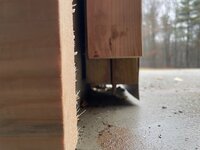
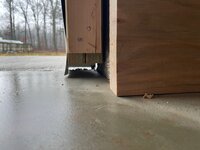
I know this is an old thread but I am compelled to share.
These gaps are in a not quite finished 40 x 50 garage I am having built by a contractor. When I told him that they were unacceptable and that I wanted them filled in with PT studs that went down to the floor and that I do not want fillers. His response was: "air sealing/foam is usually done by the insulation contractor, but I'll add fillers and air seal in this case"
So he has no interest in doing as I asked and I understand why as the outside is already wrapped with aluminum and he surely doesn't want to destroy that and have it down again by his siding sub.
So before I demanded he do it ( or remove the siding and do it myself), I decided to reach out to the building inspector. His response? "There is no code requirement for this scenario. I have seen contractors put the jack studs tight against the concrete or leave a gap. Gaps are typical when the studs are installed prior to the concrete floor being poured ( which is what happened here) Gaps are also preferred by some so the end of the studs do not wick moisture due to concrete contact and rot out from the moisture"
My response to the inspector was that while there may be no code requirement, who would protect a less observant owner of a building but a third party like a building inspector? Is'nt a tight building envelope an expectation for a new build? I got no response from that.
Note that had I not brought this up to the builder, he had no intent to do anything about this. What say you?
These gaps are in a not quite finished 40 x 50 garage I am having built by a contractor. When I told him that they were unacceptable and that I wanted them filled in with PT studs that went down to the floor and that I do not want fillers. His response was: "air sealing/foam is usually done by the insulation contractor, but I'll add fillers and air seal in this case"
So he has no interest in doing as I asked and I understand why as the outside is already wrapped with aluminum and he surely doesn't want to destroy that and have it down again by his siding sub.
So before I demanded he do it ( or remove the siding and do it myself), I decided to reach out to the building inspector. His response? "There is no code requirement for this scenario. I have seen contractors put the jack studs tight against the concrete or leave a gap. Gaps are typical when the studs are installed prior to the concrete floor being poured ( which is what happened here) Gaps are also preferred by some so the end of the studs do not wick moisture due to concrete contact and rot out from the moisture"
My response to the inspector was that while there may be no code requirement, who would protect a less observant owner of a building but a third party like a building inspector? Is'nt a tight building envelope an expectation for a new build? I got no response from that.
Note that had I not brought this up to the builder, he had no intent to do anything about this. What say you?
Attachments


racecougar
Well-known member
Is that an overhead door opening? It looks like there is a stem wall on the side but not the front? It's difficult to tell what is going on in those photos; maybe a few photos taken from a couple steps back would help.
rayra
Well-known member
... Is'nt a tight building envelope an expectation for a new build? I got no response from that. ....
Note that had I not brought this up to the builder, he had no intent to do anything about this. What say you?
It is a wholly unreasonable expectation for a GARAGE. You can make it a requirement in a custom home. But in a spec house? Get screwed.
/home ownership is not for the OCD / neat freaks, germ-phobes or others with unreasonable expectations or demands.
There was no upside for your inspector in giving your question / point the answer it deserved.
No room is perfectly square, no wall is perfectly plumb, gaps and misalignments occur. If you can't or won't accept that, the burden of your 'happiness' shouldn't be anybody else's to bear.
It's a heated garage with valuable assets that need to be protected from rodent infestation. Should I also accept concrete pads that tilt inward allowing water to run into the garage? Should not one expect to have some level of protection from rodent infestation?
No germaphobe or OCD here, just someone who expects quality. I own a business where our motto is "treat it like you owned it" We work on assets valued at millions of dollars and do work that is unquestionably superior to others. I know what quality and attention to detail looks like and that's not what I'm seeing. I do appreciate your viewpoint though even if it's not what I expected.
No germaphobe or OCD here, just someone who expects quality. I own a business where our motto is "treat it like you owned it" We work on assets valued at millions of dollars and do work that is unquestionably superior to others. I know what quality and attention to detail looks like and that's not what I'm seeing. I do appreciate your viewpoint though even if it's not what I expected.
racecougar
Well-known member
I'm not sure that you can really chase perfection in this case with the pad being poured after framing. Why was it done in that order?
firebirdparts
Well-known member
I kind of agree with the idea of “be happy” so beautifully elaborated, but I’ve never seen anything like what lubehead posted.
racecougar
Well-known member
Yes, the framing is held up to provide a buffer. My question was why was the framing done before the pad was poured. If you wanted PT lumber down to the pad, the pad should have been poured first.Contractor can answer that but I suspect it was a buffer to allow a+/- of the actual floor height which was planned to be 5" and is about 1/2" -3/4" thicker than planned
gahrajmahal
Well-known member
My garage trim are cedar and are original to the house. I caulked them to the concrete ages ago and they are holding up fine. I think if I was having trouble instead of making up that aluminum reinforcement I’d fill it in solid with a bit of thick PVC trim like this indoor door trim.

jerry67
Well-known member
My garage is concrete block and brick, the jamb boards are anchored to the block and stop about 1/2" above the floor then the space was filled with mortar and finished as a brick joint, I personally thought this was a good idea
Viper98912
Well-known member
It's fairly common practice to have those gaps in a garage. Garages are not designed like the interior of a house to be air tight. Asking the contractor to do it over is unreasonable.
Fill in the gap with foam / caulk / something else is completely reasonable, which is exactly what I did (like many others here).
Fill in the gap with foam / caulk / something else is completely reasonable, which is exactly what I did (like many others here).
Now were onto another issue with the rain. The drawing shows pads for the pedestrian doors with a dimension of 4 x 4. The contractor built the overhangs before the pads were poured. My bad for not noticing there was no dimension stipulated for the overhangs. The overhangs do not extend past the pad on the sides or in front. One of the pads tilts back into the building allowing the water that is dripping onto them to go in the building. Contractor says I approved the overhang but I did question if they were large enough. Now that the pads are poured, it is obvious they are not.
racecougar
Well-known member
Are you referring to man door awnings?
If the outdoor pad was poured such that it slopes back into the building, redo the pour or install a trench drain.
If the outdoor pad was poured such that it slopes back into the building, redo the pour or install a trench drain.
Viper98912
Well-known member
If the pad is sloped back into the building, then yes that part is poor workmanship and you should ask them to re-do that. Anybody who knows what they're doing (because they do it for a living) would have sloped that correctly. A 4x4 pad is quick and cheap to knock out and re-pour.
racecougar
Well-known member
An awning isn't going to protect an improperly sloped pad from transferring water into the building. Think driving rain, snow, etc. Additionally, sizing an awning such that it dumps water off the edges of the pad will erode the soil around the pad.yes, but even if the pour is redone, (which I am sure the contractor will just have it ground down), it doesn't address the awning overhang allowing water to fall directly on the pad. I think it's easier to redo the awnings.
The exterior pad should be sloped away from the building, or a trench drain should be installed. If you're unhappy with the size of the awnings, that would be something to have called out on the drawings prior to the build. At this point, I would fully expect to have to pay to redo those.