To avoid these ads, REGISTER NOW!

Garage isnt wrapped

kjdad

Member
Joined
Dec 8, 2024
Messages
6
Location
Indiana
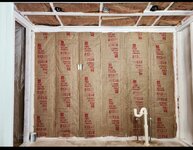
Looking for advise on insulating my detached garage. The space will be to store and work on my drag car and heated in the colder months. It's a standard framed building but for some reason wasn't exterior wrapped under the siding. I can feel air thru the joins but no sign of water. I was told that standard fiberglass insulation is a no go. I would either need to spray foam the joints or do a complete spray foam job.

Would going with rockwool and vaper barrier under the sheet rock be a bad idea?

I don't have the tools needed to remove and reinstall the siding even thou that solution makes the most sense.

Thanks
 
To avoid these ads, REGISTER NOW!

jack stand

Well-known member
Joined
Feb 29, 2012
Messages
3,336
Location
Lakes Region Maine
Most overhead garage doors leak terribly anyway so don't worry to much about not being wrapped.
Rock wool is dense enough to not have air movement in the stud bays like FG insulation.
 

finn

Well-known member
Joined
Mar 27, 2005
Messages
16,260
Location
The UP, God's country
My garage is 2x6 stud construction with steel siding. It’s not wrapped, has standard 6” fiberglass bats, sheet rock wall covering, and zero issues with moisture or condensation.

It heats up well, considering the size (32’x54’), three overhead doors, and five 5x5 ‘ windows, with either. a 75k btu overhead propane heater or a wood stove.

You’re not living in it, so don’t waste time fretting over it.
 

AC-WC

Well-known member
Joined
Jan 22, 2023
Messages
774
Location
NE, Indiana
I'm with Finn-If you're not living in it...It's better than not having any insulation. I'm still not finished insulating my walls but after getting the ceiling done and steel liner the heat really stays in the building much better. Start at the top and work your way down. Keep the interior light colored to reflect light. I inherited an 85k salamander heater and when it's 20 outside I still have to turn it off after an hour.
 

racecougar

Well-known member
Joined
Jan 26, 2021
Messages
5,106
Location
Missouri
My garage is 2x6 stud construction with steel siding. It’s not wrapped, has standard 6” fiberglass bats, sheet rock wall covering, and zero issues with moisture or condensation.

It heats up well, considering the size (32’x54’), three overhead doors, and five 5x5 ‘ windows, with either. a 75k btu overhead propane heater or a wood stove.

You’re not living in it, so don’t waste time fretting over it.
Similar story here. Panel frame style building with bookshelf/commercial girts, steel siding inside and out, no wrap, with 6" faced fiberglass in between. R-55 blown fiberglass in the attic. I heat and cool the 30'x60'x13' building easily/efficiently with a 24k mini-split in mid-MO.
 

cgrutt

Well-known member
Joined
Mar 4, 2016
Messages
8,271
Did some work on a old seasonal cabin lap siding directly over studs. You could literally see daylight between some of the boards. I spray foamed the joints with a can of sprayfoam and "wrapped" the stud cavities from the inside stapling wrap to sides of studs. By no means perfect but figured it's better than nothing. Insulated with fiberglass batt and drywalled. Came out very nice.

Eta some pics

Spray foamed gaps

Screenshot_20241220_100118_Gallery.jpg

Primed

Screenshot_20241220_100126_Gallery.jpg

"Wrapped" bays

Screenshot_20241220_100143_Gallery.jpg

Insulated

Screenshot_20241220_100151_Gallery.jpg

Drywall


Screenshot_20241220_100201_Gallery.jpg
 
Last edited:

Firstram

Well-known member
Joined
May 16, 2017
Messages
1,391
Looking for advise on insulating my detached garage. The space will be to store and work on my drag car and heated in the colder months. It's a standard framed building but for some reason wasn't exterior wrapped under the siding. I can feel air thru the joins but no sign of water. I was told that standard fiberglass insulation is a no go. I would either need to spray foam the joints or do a complete spray foam job.

Would going with rockwool and vaper barrier under the sheet rock be a bad idea?

I don't have the tools needed to remove and reinstall the siding even thou that solution makes the most sense.

Thanks
A vapor barrier on the interior should only used in the northern climates. Caulking and foaming the gaps will help and rock wool is the way to go for sure!
 
To avoid these ads, REGISTER NOW!

NUTTSGT

Super Moderator
Staff member
Joined
Sep 14, 2009
Messages
50,965
Location
Northern Central Ohio
First and foremost, adding a general location to your profile helps answer your question. What works for one location, may not be ample enough for the next location.


I'm curious who told you that fiberglass was a no-go ? By chance, spray foam salesman ?


How big is your structure ? Size will matter to the overall cost of the project and could be your deciding factor. IMHO, insulation is an investment, every time you heat or cool that structure, the insulation is giving you a ROI.
 

BombShelter

Well-known member
Joined
Nov 16, 2015
Messages
544
Location
State of Hockey
I've been watching the spray foam videos from the UK and wondering if we're not far off. Insurance over there won't insure homes with after the fact, spray foam insulation, becuase it can let the moisture in but it doesn't dissapate and ends up rotting the wood. Sometimes we wonder why they leave spaces in boards, maybe it's so the room can breath a little. Those old wood plank walls always seem to last decades.

Personally I'd use mineral wool, if you can feel air movement, there's also moisture coming in and fiberglass will get moldy. I don't know why pink fiberglass seems to get moldy much more than mineral wool, I think the fiberglass holds moisture while the mineral wool isn't as porous.
 

acer66

Well-known member
Joined
Dec 4, 2010
Messages
4,418
Location
Western North Carolina
I've been watching the spray foam videos from the UK and wondering if we're not far off. Insurance over there won't insure homes with after the fact, spray foam insulation, becuase it can let the moisture in but it doesn't dissapate and ends up rotting the wood. Sometimes we wonder why they leave spaces in boards, maybe it's so the room can breath a little. Those old wood plank walls always seem to last decades.

Personally I'd use mineral wool, if you can feel air movement, there's also moisture coming in and fiberglass will get moldy. I don't know why pink fiberglass seems to get moldy much more than mineral wool, I think the fiberglass holds moisture while the mineral wool isn't as porous.
The guy from the build show did a video about the UK and iirc its the wrong foam installed incorrectly causing the condensation/root issue.

I would also use mineral wool over fiberglass.
Not only does it deal with moisture better but rodents also do not like it.

I also like it was said before would spend my money on sealing the building envelope before putting any insulation in.

Good luck to the OP.
 

PWC Repair

Well-known member
Joined
Dec 27, 2012
Messages
3,181
Location
Arkansas
House wrap has not been out there forever, many homes have no wrap and they are still doing fine.
Yep.......like mine! Built in '58, I've been in it 27 years, we've gutted and redone it one room at a time. There WAS ZERO insulation in my walls, not even old newspapers! Siding is wood. Now there is kraft faced r13 fiberglass in the walls and R19 in the attic. I've never found any water or mildew issues save for sills around single pane glass that used to POUR condensation off them in the winter.
 

Hank11

Well-known member
Joined
Aug 19, 2019
Messages
1,152
Location
Tennessee
It might not be wrong to staple black tar paper up to the inside of the sheathing and the studs and then insulate with rock wool. Pretty easy too.
 

csp

Well-known member
Joined
Mar 23, 2010
Messages
5,719
Location
Franktown, CO
House wrap has not been out there forever, many homes have no wrap and they are still doing fine.
Yes but many of those older homes are so leaky that the air movement dries out any condensation or water that penetrates the outside. Dry wood isn't going to rot or mold. Heat loss from the inside also helps to dry it out. People often don't think about these things when they talk about how their older homes have made it *** many years without moisture problems or have managed without new, more efficient systems.

A garage is going to be leaky around the door so much that it likely wouldn't ever be a problem.
 
To avoid these ads, REGISTER NOW!
Top Bottom