To avoid these ads, REGISTER NOW!

Garage rafter vapor barrier??

innkeeper

Well-known member
Joined
Dec 28, 2011
Messages
45
Location
Ballston Lake NY
--------------------------------------------------------------------------------

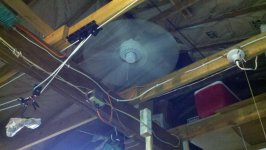
Well, insulated with R-21 left the soffets clear. no vapor barrier instaled, A TPI heater with 13,000 to 19,000 BTH the fan is 262 cfm with a built in thermistate. It is hung about 10 feet from the front of the garage door and 7 feet off the floor. Installed a 36" ceiling fan in winter mode on medium.
The question is do I need the vapor barrier? My buddy said no ,,, not sure myself, the temp in the garage is constant 60/63 with a roof vent!!

ANY TAKERS ??
 
To avoid these ads, REGISTER NOW!

Bull

Super Moderator
Joined
Dec 12, 2005
Messages
16,189
Location
MA
Did you use fiberglass batts? If so, were they faced or unfaced?
 

joe6749

Well-known member
Joined
Jan 1, 2011
Messages
48
Location
minnesota
Plastic is cheep put it up. It will keep moisture out of your insulation. Wet insulation will allow mold to grow.

Joe
 

kbs2244

Well-known member
Joined
Nov 11, 2006
Messages
14,065
In theory ….Yes.

Water vapor will always go from warm to cold.
And in a sealed room you should have vapor barrier to keep that vapor from entering the wall or ceiling, condescending halfway through, and making a general mess of things.

But you say you left the “soffits clear.”
Does that mean you have a cool air inlet at the edge of a room with a vaulted ceiling?

If so, and you give the room air to get to a high mounted exit vent then you are OK.
You will be “wasting” heat, but the water vapor will follow the air circulation and go to the high point and out the vent while the make up air comes in the soffits.
(You will have cool drafts down the wall is this case.)

But if you have an insulated ceiling below the soffit level, so that the cool air entering at the soffits is into a “cool” attic space, then the answer is..
“It depends.”
Mostly on how much moisture you are going to create in the “warm room.”

If you are going to washing cars, you need positive ventilation as well as a vapor barrier to keep the moisture out of the insulation.
If you are doing common wrenching, with a vented furnace, you might get by without it.
 
OP
I

innkeeper

Well-known member
Joined
Dec 28, 2011
Messages
45
Location
Ballston Lake NY
If I understand right, then if the facing in facing inward, the It should be fine. If you look in my profile I uploaded a picture.. just can't seem to get it to upload in the message yet..
 
OP
I

innkeeper

Well-known member
Joined
Dec 28, 2011
Messages
45
Location
Ballston Lake NY
Rafter insulation vapor barrier or not.

Does this help you see what I'am saying about the vapor barrier
 

Attachments

  • rafter.jpg
    rafter.jpg
    146.6 KB · Views: 108

K'ledgeBldr

Well-known member
Joined
Aug 22, 2011
Messages
1,925
Location
Johns Creek, GA
Re: Rafter insulation vapor barrier or not.

I see kraft-backed batt insulation between the rafters. The kraft paper is a form of vapor retarder not barrier. But, since it is open to the rest of the space and the kraftpaper isn't sealed to the rafters you don't have a vapor retarder at all. Nor are you getting the full R-value of the batt.
 
OP
I

innkeeper

Well-known member
Joined
Dec 28, 2011
Messages
45
Location
Ballston Lake NY
Re: Rafter insulation vapor barrier or not.

The paper is stapled to the rafter so should i tevek or plastic the interior? and thank you for the reply... Innkeeper
 

Bull

Super Moderator
Joined
Dec 12, 2005
Messages
16,189
Location
MA
If I understand right, then if the facing in facing inward, the It should be fine. If you look in my profile I uploaded a picture.. just can't seem to get it to upload in the message yet..

I took a look at your picture. I am using that same Johns Manville stuff from Lowes in R-30 for my barn. I read the package just the other day. It says that the paper is a vapor retarder. But, it says that for a continuous vapor retarder, the paper should be stapled to the face of each rafter bottom, and overlap. It looks like you attached the paper to the inside edges of the rafters.
 
To avoid these ads, REGISTER NOW!
OP
I

innkeeper

Well-known member
Joined
Dec 28, 2011
Messages
45
Location
Ballston Lake NY
I did have it to the face of the rafter and my friend said no but he is not a contractor.. but I thought that, was the right way, to staple it to the face of the rafter and the facing on the roll was part of the vapor barrier, Did you see the heater I installed??
 

Bull

Super Moderator
Joined
Dec 12, 2005
Messages
16,189
Location
MA
I did have it to the face of the rafter and my friend said no but he is not a contractor.. but I thought that, was the right way, to staple it to the face of the rafter and the facing on the roll was part of the vapor barrier, Did you see the heater I installed??

If you read the packaging for that insulation, it says that you can attach the paper either to the inside edges of the rafters, or to the face of the rafters in an overlap. The directions say that for an uninterrupted vapor barrier, attach the paper to the face of the rafters.

I'm not familiar with that type of heater. Is it just to warm you when you are under it, or will it do the whole space?
 

K'ledgeBldr

Well-known member
Joined
Aug 22, 2011
Messages
1,925
Location
Johns Creek, GA
Re: Rafter insulation vapor barrier or not.

Tyvek housewrap is not a vapor barrier. It is actually structured to allow vapor to pass through it. But, it will repel water- hence the reason why it's popular with today's builders.
The only true "Vapor Barrier" is a material’s ability to retard the diffusion of water vapor. Defined in terms of its permeability it's known as “perms.” This is a measure of the number of grains of water vapor passing through a square foot of material per hour at a known differential vapor pressure. Any material with a perm rating of less than 0.10 is considered a Class 1 vapor retarder.
 

GN4WHLN

Well-known member
Joined
May 8, 2009
Messages
2,074
Location
Alta Loma, CA
Re: Rafter insulation vapor barrier or not.

I would think ultimately it would need to be covered with something fire retardant. You may need to use a vapor barrier over it then a fire retardant surface over that. I have a similar idea for my garage but I have not come to a conclusion as to what to cover the whole thing with. One problem for me is access with hard sheets of anything. Any kind of drywall would be almost impossible. I noticed our garages seem similar in that you appear to have a low pitch roof and some overhead storage.

I also wonder if you might end up with moisture problems. Is your roof vented? Here they are not (in the garage) but in CA the climate is dry enough it doesn't seem to be a problem.
 
OP
I

innkeeper

Well-known member
Joined
Dec 28, 2011
Messages
45
Location
Ballston Lake NY
Re: Rafter insulation vapor barrier or not.

I would think ultimately it would need to be covered with something fire retardant. You may need to use a vapor barrier over it then a fire retardant surface over that. I have a similar idea for my garage but I have not come to a conclusion as to what to cover the whole thing with. One problem for me is access with hard sheets of anything. Any kind of drywall would be almost impossible. I noticed our garages seem similar in that you appear to have a low pitch roof and some overhead storage.

I also wonder if you might end up with moisture problems. Is your roof vented? Here they are not (in the garage) but in CA the climate is dry enough it doesn't seem to be a problem.

Yes it is vented, as another answer stated the stapling to the face of the rafter than to the inside will act as a barrier also. the heater is a TPI 13,000 to 19,000 btu about $248.00 to my door it is 240vt and is on lowest setting the garage is 60-63 constant and runs 5-10 an hour..
 

GN4WHLN

Well-known member
Joined
May 8, 2009
Messages
2,074
Location
Alta Loma, CA
Re: Rafter insulation vapor barrier or not.

OK, I just found the other thread on this. Are you going to finish the ceiling with something? If so, what have you come up with? I weld in the garage so I am concerned about catching the kraft paper on fire. Also, I thought, generally speaking, insulation could not be left uncovered in a garage space.
 
OP
I

innkeeper

Well-known member
Joined
Dec 28, 2011
Messages
45
Location
Ballston Lake NY
Re: Rafter insulation vapor barrier or not.

maybe I fraised it wrong, the facing is on the inside of the garage so you can see it. and stapling it the face of the rafter . rather than to the side of the rafter to create a barrier..
 
OP
I

innkeeper

Well-known member
Joined
Dec 28, 2011
Messages
45
Location
Ballston Lake NY
If you read the packaging for that insulation, it says that you can attach the paper either to the inside edges of the rafters, or to the face of the rafters in an overlap. The directions say that for an uninterrupted vapor barrier, attach the paper to the face of the rafters.

I'm not familiar with that type of heater. Is it just to warm you when you are under it, or will it do the whole space?

No not just under it, the WHOLE GARAGE is 60-65 the wall read 55-65 with a laser thermometer the floor reads around 50-55, the unit has only been instaled for about 2 1/2 weeks and it is around 20degs today and has been between 25 to 38 here just north of Albany New York..
 

Bull

Super Moderator
Joined
Dec 12, 2005
Messages
16,189
Location
MA
No not just under it, the WHOLE GARAGE is 60-65 the wall read 55-65 with a laser thermometer the floor reads around 50-55, the unit has only been instaled for about 2 1/2 weeks and it is around 20degs today and has been between 25 to 38 here just north of Albany New York..

Well, I am jealous. I still don't have heat in my barn.
 
OP
I

innkeeper

Well-known member
Joined
Dec 28, 2011
Messages
45
Location
Ballston Lake NY
If you go on line to the heater store and look under the brand name TPI I have the SKU: HF686TC | BTU /hr.: 19107 / 14330 btu | Fuel Type: Electric
Volts: 240 / 208 | Dimensions: 13-1/2"W x 17-1/2"H x 11-1/2"D | Color: Tan
Model HF686TC
Type Electric
Volts 240 / 208 V
Watts 5600 / 4200
BTUs 19107 / 14330
Phase 1
Amps 23.4 / 20.2
Temp Rise 75 F
Color Tan
Weight 20 lbs.
Dimension 13-1/2"W x 17-1/2"H x 11-1/2"D
Finned steel tubular heating element
Internal manual reset thermal cut-out
6' long cord with molded plug which can be removed at terminal block for hard wire instillations
Temperature control thermostat with 35 F to 85 F range
10' air throw - 262 CFM
Swivel base can be used as a wall, floor or ceiling mount

It works great..
 
Last edited:
To avoid these ads, REGISTER NOW!
Top Bottom