To avoid these ads, REGISTER NOW!

Garage Truss - Attic Storage Weight

Markfothebeast

Well-known member
Joined
Jul 29, 2016
Messages
419
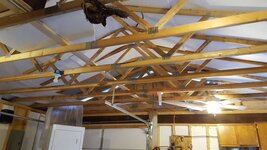
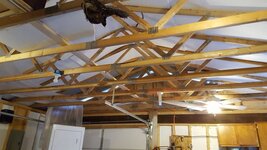
24' 2x4 Trusses from Menards. 62lbs per sq ft load rating. Garage is 20' x 22'. Steel roofing.

Can this handle storage? Bins of clothes and misc items. Probably a good 800 to 1200lbs or so.

If not, what can I do to increase the load capacity? c67b71d9f5015e747c5e100053800f1a.jpg1b31345419f3b0ed6b8b554a7b5be6c7.jpg

Sent from my SM-G920V using Tapatalk
 

Attachments

  • c67b71d9f5015e747c5e100053800f1a.jpg
    c67b71d9f5015e747c5e100053800f1a.jpg
    107 KB · Views: 3
  • 1b31345419f3b0ed6b8b554a7b5be6c7.jpg
    1b31345419f3b0ed6b8b554a7b5be6c7.jpg
    103.1 KB · Views: 27
To avoid these ads, REGISTER NOW!

nc416

Active member
Joined
Aug 9, 2016
Messages
28
I have the exact same truss design., my guy said if I wanted an attic I should have told him they would have beefed up my truss, that was after it was built

anyways...


I was thinking the best way would be to screw on a 8 foot 2x4's on each truss [so sandwich that middle section so it wont flex down with the weight]


then screw them in. I think the weak point would be that middle section where the 2 10foot or 12foot 2x4's meet with the steel plate, then put some 1/2" plywood ontop.
 
Last edited:

lakeroadster

Well-known member
Joined
Jan 19, 2015
Messages
5,166
Location
Central Colorado
Leave the trusses alone unless you are a truss designer...

If you want extra capacity add lumber independent of the trusses. Look at span tables (ceiling joists) based on the width of the building and what loading you are expecting.

http://www.southernpine.com/span-tables/joists-rafters/

Only use the type and grade of lumber the span table specifies.

And unless you are familiar with all of this... hire somebody that is knowledgeable.

Good luck, hope that helps.
 
Last edited:
OP
M

Markfothebeast

Well-known member
Joined
Jul 29, 2016
Messages
419
I have the exact same truss design., my guy said if I wanted an attic I should have told him they would have beefed up my truss, that was after it was built

anyways...


I was thinking the best way would be to screw on a 8 foot 2x4's on each truss [so sandwich that middle section so it wont flex down with the weight]


then screw them in. I think the weak point would be that middle section where the 2 10foot or 12foot 2x4's meet with the steel plate, then put some 1/2" plywood ontop.
I thought about that. We live in a strange and greedy world where it is "hire someone to do something". Complete ********. Anyone should have the ability to strengthen a garage or floor joists. It should not require a 19 month degree.
 

lakeroadster

Well-known member
Joined
Jan 19, 2015
Messages
5,166
Location
Central Colorado
I thought about that. We live in a strange and greedy world where it is "hire someone to do something". Complete ********. Anyone should have the ability to strengthen a garage or floor joists. It should not require a 19 month degree.

:lol_hitti

It's not ability, it is acquired knowledge. While the saying "what one man can do, another can do" is certainly true, there are no shortcuts in life.

Where the rubber meets the road is in designing for Environmental Loads – created by snow, wind, and earthquake forces. You may make your changes to the trusses, and they may work great... for a while.

And without adding your location to your profile... nobody with knowledge on this subject can really even help you.

A truss in the mojave desert vs. the upper peninsula of Michigan will in no way experience the same loading.
 

ssdave

Banned
Joined
Apr 11, 2015
Messages
2,913
Location
Eastern Oregon
You saved a bunch of money up front by buying trusses; they are engineered for the least cost with adequate strength. You can't simply modify them by adding a few boards and have them work correctly. The trusses you have are designed for carrying only the dead load of the truss materials and any sheetrock and lighting that would normally be installed on them. They are not designed to carry a storage load.

I commend you if you have the innate ability to know how to strengthen garage trusses without any engineering knowledge of the forces involved and how to correctly analyze them. That is an absolute amazing and unique ability that I have never heard of before! I'd capitalize on that by getting some degree that lets you put it to work; you would be in for a very lucrative career.
 

nc416

Active member
Joined
Aug 9, 2016
Messages
28
Watch "How to Strengthen Garage Ceiling for Storage – Home Remodeling" on YouTube
 

ssdave

Banned
Joined
Apr 11, 2015
Messages
2,913
Location
Eastern Oregon
Watch "How to Strengthen Garage Ceiling for Storage – Home Remodeling" on YouTube

What they are doing in this video is not modifying trusses. However, it can be done with trusses also. What they are doing is building a conventional joist floor. You can add floor joists alongside the trusses, if your span is short enough to span with floor joists. Just size them according to this table I'm including below, and you'll be good for 30 psf to be stored in your ceiling.

If your span across the garage exceeds the table value, you can't safely do it this way and will have to have the trusses re-designed and modified.
 

Attachments

  • spantable.jpg
    spantable.jpg
    21.4 KB · Views: 123

lakeroadster

Well-known member
Joined
Jan 19, 2015
Messages
5,166
Location
Central Colorado
What they are doing in this video is not modifying trusses. However, it can be done with trusses also. What they are doing is building a conventional joist floor. You can add floor joists alongside the trusses, if your span is short enough to span with floor joists. Just size them according to this table I'm including below, and you'll be good for 30 psf to be stored in your ceiling.

If your span across the garage exceeds the table value, you can't safely do it this way and will have to have the trusses re-designed and modified.
Watch "How to Strengthen Garage Ceiling for Storage – Home Remodeling" on YouTube

BUT... if done with trusses, the way the new lumber is implied to be implemented in the video, you are adding loads to the bottom chord of the truss (unless you are sistering lumber beside each lower chord.. and taller than the lower chord, to prevent the roof supporting truss from seeing new floor / ceiling loading).

And that is scary... just enough information to be very, very dangerous.

The weight of what you are storing... yeah, logic dictates it would be prudent to factor that in: feather pillows vs engine blocks.
 
Last edited:

ssdave

Banned
Joined
Apr 11, 2015
Messages
2,913
Location
Eastern Oregon
That's the problem with you tube video's and posts on forums like this. Somebody sees something (that may or may not be good practice) and applies it to their situation, which may or not be the same.

If the factors are different, it can easily become dangerous.

To clarify what I said above: You can add floor joists ALONGSIDE the existing trusses, if they don't exceed the span in the table, and make this work. I'm presuming any joist you add will be taller than the 2x4 bottom chord of the truss, so the loads will be applied to the joists, not the trusses.

If you add the joists to the bottom chord of the truss instead, or exceed the allowable span for the joist size you select, it can be dangerous.

As you said above, it's not ability, it's acquired knowledge. And, the internet is a great resource, but it doesn't substitute entirely for more formally learned knowledge.
 
To avoid these ads, REGISTER NOW!
OP
M

Markfothebeast

Well-known member
Joined
Jul 29, 2016
Messages
419
I watched that video multiple times. But I was thinking about the difference in weight if I would have opted for sheathing/tar paper/shingles. With the materials I would have used for a shingle roof it would have been 4.1LBS per SQ FT. However, my steel roofing is 1.2LBS per SQ FT.

I can't recall the roof pitch but if I assumed the roof was 528 sq ft, a shingled roof would weigh approximately 2,164.8 LBS vs the current steel roofing weighing in at 633.6 LBS. A difference of 1,531.2 LBS on the trusses.

But the trusses as mentioned appear to be designed simply to hold the weight load over the top rather than on the joists. I recently saw a small shed that had 2x6 joists that were about 12" apart. This is what I had in mind when I was thinking about attic storage. I am curious if it is at all possible to run 2x6 or 2x8 joists in between the trusses on to the load bearing walls? The storage plywood would run across the 2x6 rather than weigh down the truss joist 2x4s.

Sent from my SM-G920V using Tapatalk
 
Last edited:

ssdave

Banned
Joined
Apr 11, 2015
Messages
2,913
Location
Eastern Oregon
I am curious if it is at all possible to run 2x6 or 2x8 joists in between the trusses on to the load bearing walls? The storage plywood would run across the 2x6 rather than weigh down the truss joist 2x4s.

Sent from my SM-G920V using Tapatalk

Look at the span table I posted above. If you install a joist in accordance with that span table, it can support 30 lbs per square foot. If your span exceeds the length in that table, it won't work (at least with joists that size). You can't just add 2x6's or 2x8's and hope; the joist size and spacing has to be adequate, and the table indicates what is adequate. An engineer can calculate what load a 2x6 or 2x8 can hold for your span, if that's what you want to do. There may be some allowable load less than the 30 lbs that the table is designed for that can be supported with either longer spans or smaller boards.

The advantage of trusses is that they typically can safely span wider areas than non-truss designs. So, the typical garage is too wide to span with simple joists. So, the most economical answer is to have your trusses designed for an attic floor load. I did that in the garage I'm building now, and the cost over non-attic trusses was almost nothing. However, no good way to retrofit trusses that weren't designed for that loading.
 
OP
M

Markfothebeast

Well-known member
Joined
Jul 29, 2016
Messages
419
Here are the specs on load rating.

-Overall load rating of 62 pounds per square foot, distributed as 42-10-0-10
-42 lbs/square foot top chord live load (TCLL)
-10 lbs/square foot top chord dead load (TCDL)
-0 lbs/square foot bottom chord live load (BCLL)
-10 lbs/square foot bottom chord dead load (BCDL)

0 LBS live load on bottom chord tells me NO STORAGE is allowed on top of the joist. But it is also showing 10 LBS SQ FT dead load on bottom chord (drywall/lights/etc). These ratings are at 2' truss spacing. 10LBS SQ FT x 528 SQ FT = 5,280 LBS. That doesn't sound correct. But I'm not quite sure how SQ Footage is calculated on a truss or if it is referring to overall roof sq ft based on 2' truss spacing.


Sent from my SM-G920V using Tapatalk
 

ssdave

Banned
Joined
Apr 11, 2015
Messages
2,913
Location
Eastern Oregon
Here are the specs on load rating.

-Overall load rating of 62 pounds per square foot, distributed as 42-10-0-10
-42 lbs/square foot top chord live load (TCLL)
-10 lbs/square foot top chord dead load (TCDL)
-0 lbs/square foot bottom chord live load (BCLL)
-10 lbs/square foot bottom chord dead load (BCDL)

0 LBS live load on bottom chord tells me NO STORAGE is allowed on top of the joist. But it is also showing 10 LBS SQ FT dead load on bottom chord (drywall/lights/etc). These ratings are at 2' truss spacing. 10LBS SQ FT x 528 SQ FT = 5,280 LBS. That doesn't sound correct. But I'm not quite sure how SQ Footage is calculated on a truss or if it is referring to overall roof sq ft based on 2' truss spacing.


Sent from my SM-G920V using Tapatalk

The 10 psf can be applied to the bottom chord as storage load (minus some of that for the weight of the truss boards themselves) if no drywall, lights, etc is supported. The trick to this is that you can't multiply the whole area by the 10 and come up with 5000 lbs allowable. That 10 psf is DISTRIBUTED load, assumed evenly spread over the whole truss. The part in the middle counts for about 8 times as much load as the part towards the edge. Think of it this way: The load on the edge doesn't bend down the bottom chord nearly as much as the same load in the middle.

So, what it really means is that you can't load any part of the truss more than 10 psf. So, in the middle of the truss, if you put an 8 foot wide floor there, you could store 2x8x10 = 160 pounds on each truss, maximum. You'd need to reduce this by a bit, say 15 pounds, for the weight of the truss board itself, and about 40 to 50 pounds for the weight of the plywood floor sheet. If your garage door opener, lights, etc are also supported there, you'd reduce further for them. So, when it is all said and done, you might be able to support 80 to 100 lbs per truss in the middle 8 foot of the trusses.
 

forAK

Well-known member
Joined
Nov 11, 2015
Messages
380
Location
Peters Creek AK
Or if attic space is needed that bad, put a bearing wall down the middle of the garage. You could even put a steel beam to span the underside if the trusses and post it on the ends.
 
OP
M

Markfothebeast

Well-known member
Joined
Jul 29, 2016
Messages
419
I've had a heavy chest and a few hundred pounds of stuff up in the rafters since we put the garage up. Haven't had any sagging or signs of rafter or joist movement yet. And I plan to put more up there.

We also have another garage out in the woods that also has 2x4 trusses. It is a 20x30 that has been falling in for years and is now missing 3 trusses. The rafters were loaded to the brim before I gutted it out. It was holding at least 1,500lbs of junk dating back to the 1930's as well as rotted shingled decking and two large trees on top. It is amazing that it has held up till this day. The trusses are supported with 1x4s rather than the webbed type 2x4 design. I have a 6x6 with a 2x4 on top supporting the center, most likely why it is still standing. I'll be replacing it someday with a nice shop i hope.

Our ancestors have engineered buildings and structures that are thousands of years old and still standing. I doubt this newer garage will be there more than 40 years as well as many newer mass produced town homes built with manufactured materials like my Menards trusses held together with spiked plates.
 
Last edited:

Smoker

Well-known member
Joined
Sep 4, 2009
Messages
167
Location
San Antonio
I would find a structural engineer and hand him a couple hundred $ to run the calcs on what exact loading those trusses can handle. A truss supplier may be able to also run them for you.
 

Oceandweller

Well-known member
Joined
Jun 26, 2012
Messages
47
Location
Orange Beach
I have the same system and am going to plywood 1/4" 16$ at HD all of the edges around the outside 8 foot on the sides and 4 foot on the front and back and get thin 3/8 sheetrock and attach that to the ply. That way it gives me some storage around the outside for one rubber maid tote per section for things like clothes, Christmas, etc, and then I can store longer pieces of lumber, fishing rods, extra window screens, lighter/longer stuff in the middle. I think adding the plywood will help with the structure as a whole and just plan on using a lot of wood screws. It all depends on the weight of your roof, plywood, etc... its hard to say exactly without looking at it. I know my idea for my garage will work REALLY well when I am finally done with it. I plan on adding 6 cabinets that go all the way to the celing to help hold the load as well from sagging. 33 x 25 garage with hurricane straps. I agree with mark. I would also look at beefing up a couple of the trusses with added 2x4's.
 

bczygan

Well-known member
Joined
Nov 4, 2009
Messages
22,002
Location
DETROIT! Arsenal of Scrappers
To the OP.

You may do anything you want.

The difficulty though, is that you don't know what the result will be.

When you modify and install and redesign what is there, and then load it with what you want, there may seem to be no change, and it will seem to be adequate.

This may or may not be true.

The only advantage that engineering gives you, is that you will know exactly what the capabilities of the design are.

Bill
 

bczygan

Well-known member
Joined
Nov 4, 2009
Messages
22,002
Location
DETROIT! Arsenal of Scrappers
For the OP.

I have a solution for you.

Let's say you have 1200 pounds of stuff to store up there. And let's say some of it is bulky, so you want to put it in the middle where the height is greater.

So let us designate an area 8' wide by 12' long, or approx. 100SF. Spread the load across this area and you get 12 pounds per square foot of live load. The structure to hold this up will be another 7=10 pounds per square foot of dead load depending on whether you have a ceiling attached.

Using this joist calculator:
http://www.awc.org/codes-standards/calculators-software/spancalc

Set it to the following parameters:
Ceiling joist
L/240 (No finished ceiling attached to the bottom)
#2 Hem-Fir (Readily available lumber species and grade)
2x10's at 16" on center

This will span your 24'

Use 1/2" plywood for the decking material and use blocking between the joists where seams occur. Glue and screw the deck in place.

You could actually extend the decking all the way to the side walls for additional storage with the same capacity per square foot. It just wouldn't be as tall.

And you wouldn't have to stop at a 12' long space. Just add more 2x10 ceiling joists and decking to extend it. You could do the entire overhead area like this. But access becomes a problem, because it really isn't designed for walking on, and there isn't really space up there to do so anyway.

You could use 2x8's if the load was less per square foot by making the area larger and spreading the load out more.

Understand?

Btw, do you ever intend to have a ceiling in that space, or insulate it?

Bill
 
Last edited:
To avoid these ads, REGISTER NOW!
Top Bottom