To avoid these ads, REGISTER NOW!

Garage Ventilation

shiers69

Member
Joined
Aug 27, 2012
Messages
5
Location
Shakopee, MN
I would like to install some sort of ventilation in my garage for when I'm welding away on something or if I'm painting. My garage is 632 sq ft with 9 ft ceilings giving me a volume of 5688 cubic feet.

I was thinking about installing a few of the round ceiling mounted vent registers and piping them back to an attic mounted ventilator such as the Broan MP280 - but I think that even with 290CFM it's just too small to do a good job - 20 minutes to pull out all the air in the garage. Is there a better option?

I'm not particularly interested in the large shutter fans you install directly through the wall. My garage is where I work on my cars, it's not a chicken coop.

I'm in MN so a good winter seal is important to me as well.

Does anyone have any tips or advice on this? I feel like maybe I'm looking down the wrong path and haven't found anything in any searches on here yet. I'm probably just using the wrong keywords.
 
To avoid these ads, REGISTER NOW!

Steevo

Well-known member
Joined
Aug 18, 2009
Messages
8,738
Location
43.49600, -112.04300
The reason that welding booths/hoods and painting booths exist is because it is much easier to change the air in a small area than a large one. The bigger the area you wish to "refresh" regularly, the higher the air flow needed.
Your garage is about the size of a typical automotive paint booth.
To change the air in your 5688 Cu/ft space at a reasonable rate (every 5 minutes?) would require a fairly large and efficient exhaust fan. Think 2ft diameter and 1000CFM at a minimum.

Actually, I found this at Northern Tool:
http://www.northerntool.com/shop/tools/product_246493_246493

4966 CFM and only 20 in. diameter.
 
Last edited:

Falcon67

Well-known member
Joined
Jun 11, 2009
Messages
18,371
Location
Merkel, TX
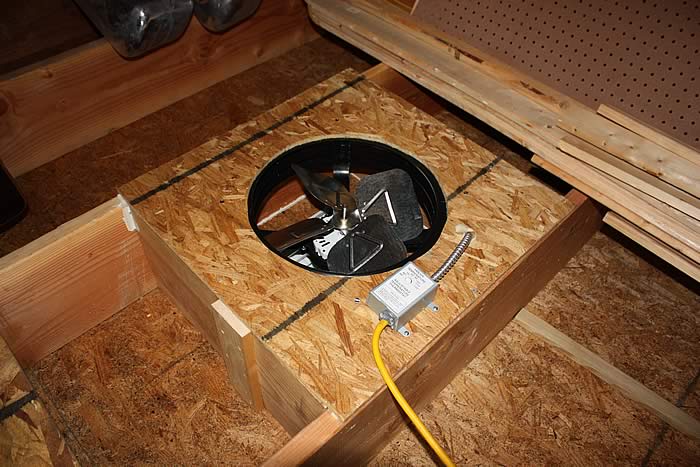
I have 5 each 9" diameter passive roof vents. I used a 1600 CFM vent fan in a slightly different way for forced ventilation.

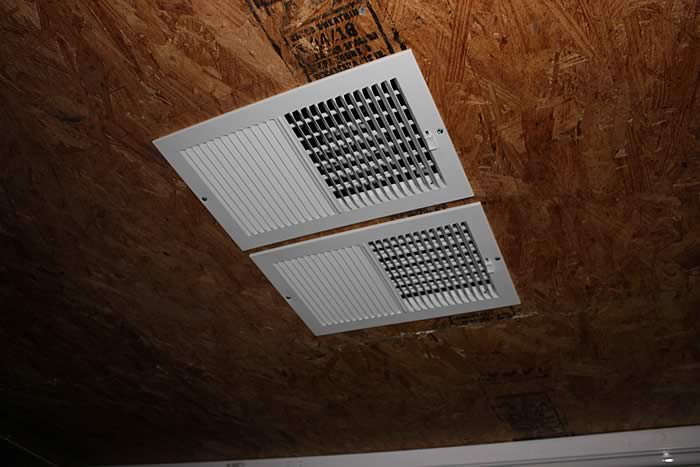
Inside30.jpg

Close the vents when not in use
Inside31.jpg


This is not a problem for me with an 8' ceiling - would be for you at 9'.
 

Alexbn921

Well-known member
Joined
Aug 22, 2013
Messages
579
Location
East Bay Nor Cal
Panasonic makes some super nice exhaust fans. The one in my garage is less them one scone and 290 cfm. It is hard to tell that it's running and it has a baffle system. I have it on a auto timer to come on every day from 12-8. Don't forget that air out needs air IN. Adding a side vent is a big help. That said, 500-1000 cfm is the minimum for welding. 290 works good at cleaning out the air over the day, but not for paint/welding....
 

toofart

Well-known member
Joined
Sep 27, 2013
Messages
280
Location
Qc
Subscribed. I'm in the same boat. In the summer I just open the doors, but when it's -20 it's a different story.

I was thinking of a used HRV -- some of them can move decent amounts of air, and you recover most of the heat.
 

pseudorealityx

Well-known member
Joined
Nov 10, 2009
Messages
999
Location
USA
What's the typical 'size' of what you're welding? Are we talking little tac welds here and there, or are you fabricating large scale stuff? You can get 'small' welding booths that only move a couple hundred CFM.

Once you're moving thousands of CFM within a standard size garage, you might as well just open the garage doors. HRV/ERV's could be effective, but they aren't meant to be used with hazardous materials/fumes, and ones large enough to handle thousands of CFM get pricey in a hurry.
 

arrowhead

Well-known member
Joined
Dec 11, 2008
Messages
681
Location
Stillwater, NY
I looks like your up north so just keep in mind a huge fan is going to cool off your garage real quick in the middle of winter. I have the same size garage and went with a very cheap and simple though the wall fan but built a hinged insulated cover for it.
 

toofart

Well-known member
Joined
Sep 27, 2013
Messages
280
Location
Qc
What's the typical 'size' of what you're welding?

I don't know about the OP, but I do mild fab, enough to fill a 32x33x12 shop with fumes fast. I have a home-made air filter that will clear the air from grinding dust quite effectively, but the fumes need to go.

Once you're moving thousands of CFM within a standard size garage, you might as well just open the garage doors. HRV/ERV's could be effective, but they aren't meant to be used with hazardous materials/fumes, and ones large enough to handle thousands of CFM get pricey in a hurry.

Indeed, after posting, I decided to look it up -- and even the biggest home HRV only moves less than 200 CFM and costs upwards of $1500.

I looks like your up north so just keep in mind a huge fan is going to cool off your garage real quick in the middle of winter. I have the same size garage and went with a very cheap and simple though the wall fan but built a hinged insulated cover for it.

In the end that's probably the best solution. I'll probably end up building a large hood over my welding table and use a 300-500 cfm fan to "scoop" up the fumes as I weld.
 

bullnerd

Well-known member
Joined
Sep 17, 2012
Messages
5,690
Location
Jersey
Heres the one I am thinking about using for my new 30x40 building. I will use the hood on the outside to hopefully keep some of the wind out and an insulated cover on the inside like mentioned.

There was a thread not long ago about pressureizing the shop rather than evacuating it, but I cant find it now. The guy sounded like he knew what he was talking about but I was confused. I would like to ask him some questions if anyone knows the thread please post it.

Theres a nice CFM calculator at the top of this page also.

http://www.industrialfansdirect.com/IND-FA-EF-GP/LFI-AX18-1V.html
 
To avoid these ads, REGISTER NOW!

pseudorealityx

Well-known member
Joined
Nov 10, 2009
Messages
999
Location
USA
If you do all of your work in one specific area, then a hood or draw through table is probably the best solution.

If you're all over the garage, like you're building a car frame, then you basically need general ventilation.

In either instance, understand that it's going to get cold [in the winter] in a hurry unless you want to use a bunch of money to provide heated make up air.
 

pseudorealityx

Well-known member
Joined
Nov 10, 2009
Messages
999
Location
USA
Heres the one I am thinking about using for my new 30x40 building. I will use the hood on the outside to hopefully keep some of the wind out and an insulated cover on the inside like mentioned.

There was a thread not long ago about pressureizing the shop rather than evacuating it, but I cant find it now. The guy sounded like he knew what he was talking about but I was confused. I would like to ask him some questions if anyone knows the thread please post it.

Theres a nice CFM calculator at the top of this page also.

http://www.industrialfansdirect.com/IND-FA-EF-GP/LFI-AX18-1V.html

The calculator may work, but avoid referencing the table below. Those values are sketchy at best.
 

toofart

Well-known member
Joined
Sep 27, 2013
Messages
280
Location
Qc
In either instance, understand that it's going to get cold [in the winter] in a hurry unless you want to use a bunch of money to provide heated make up air.

lol You think people who live in -30*C winter climates don't understand this?
 

bullnerd

Well-known member
Joined
Sep 17, 2012
Messages
5,690
Location
Jersey
"The calculator may work, but avoid referencing the table below. Those values are sketchy at best. "

Is there a more accurate way of calculating this? And whats sketchy about it?
 

pseudorealityx

Well-known member
Joined
Nov 10, 2009
Messages
999
Location
USA
"The calculator may work, but avoid referencing the table below. Those values are sketchy at best. "

Is there a more accurate way of calculating this? And whats sketchy about it?

Yes, there are more accurate ways of calculating the 'correct' amount of ventilation.

Almost all commercial and industrial applications have specific code requirements for ventilation air set by the IMC and ASHRAE. Places like gymnasiums, kitchens, laboratories, waiting rooms, cafeterias, etc all have specific codes and a lot of other variables that need to be worked into the HVAC calculations and design. It depends upon occupancy and square footage. An actual number of air changes is only rarely used except in some medical and industrial applications like clean rooms and whatnot. Ceiling height doesn't come into the equations, oddly enough.

All I'm saying is there's a lot of other factors in how you design something like a commercial kitchen or a laboratory than pulling a number of air changes off a table on some random manufacturer's wholesale website. It might be useful for a "does this make sense?" conversation, but it's not a final answer.
 

pseudorealityx

Well-known member
Joined
Nov 10, 2009
Messages
999
Location
USA
lol You think people who live in -30*C winter climates don't understand this?

A pretty frequent question that people miss on this forum and in real life is "where does the make-up air come from?"

I know it's a really basic idea for many guys here, but not to everyone.
 
To avoid these ads, REGISTER NOW!
Top Bottom