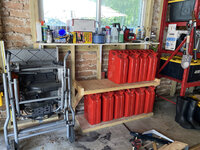
There's a lot of truth to this. Fuel is ruined by letting oxygen and water in (water is especially a problem with ethanol), and by letting volatile vapors out, and good cans are the best way to stop these problems before they happen. Stabilizer is a decent insurance policy for when they do occur, but its no substitute for proper storage.
Ok, BS here. I have a flammable liquid cabinet (actually two), and store things in it that are all in well sealed containers (mostly aerosols). You can ALWAYS smell it when I open the doors, and I don't have anything in there that "leaks". Vapors WILL find their way out. Put your "GOOD" full gas can into a well sealed container for a few days and tell me there's no odor when you break the seal. When I worked in a chemical lab, we had special explosion proof freezers to store the volatile stuff. Even they, as cold as they were, reeked when you opened them.
Also, it's not all about the quality of the cans (though that helps). It's also about the fuel.
Winter blend gasoline contains a significant amount of butane. Butane is a "waste gas" that refiners can dump into your tank that not only reduces your mileage (it has a lower energy content), but also increases the fuel vapor pressure to as high as 15 PSI (which does at least make for smoother running of cold engines). That WILL escape your gas cans in the summer in significant volumes! Seals on steel fuel containers are designed to vent above 2.5PSI (or else you can have a catastrophic failure). Seals on CARB compliant plastic fuel containers may hold up to 10 PSI, as the cans are designed to distort in shape, but even they may vent in the summer heat. And then, you've got all sorts of idiots advocating for modifying gas cans with vents to make them pour faster.
My advice to anyone storing gasoline would be to
buy it between June 1st and September 15th. And store it in metal cans. Plastic is semi-permeable, and some of the more volatile components of gasoline can escape directly through plastic (there are higher quality plastic cans on the market that are les vapor permeable, but their price rivals that of steel cans). Keep your cans out of direct sunlight, and make sure they're well sealed.
I don't actually park cars in my "two door - zero car" garage, but cars aren't a fire risk. Modern cars have a low fire risk because they have flame screens, pressurized tanks, and carbon vapor collection canisters that catch any vented vapors. Gas cans have none of this.
I do store my mower in my garage, but keep in mind that the amount of vapors released will be determined by the amount of fuel you're storing, and a three gallons between my mower and other small engines does not compare to 50 gallons of storage. Plus, as stated above, I only store low-RVP RFG. I also only store 93 octane gas, as the higher octane blends tend to have lower vapor pressures.
You can throw a plastic gas can full of fresh gas into a fire and it will remain intact too. That's just because the ullage is above the UEL. If they really didn't emit any fumes, would your wife be ok with storing one under her pillow? Yeah, I didn't think so.
Will you be safe storing that much fuel indoors? Probably. Here are some questions to consider.
Is this garage attached to your house?
Vapors will easily flow through cracks in the walls, so if there's a shared wall with your house, or worst case that leads to a basement...
Is there a low spot where vapors can collect inside, or if you dumped a bucket of water on the floor, would it just flow out the door (this is why we don't have floor drains in garages)?
Do you have anything like a gas water heater or other ignition sources near your floor?
How "leaky" is your structure? My garage is from 1920, and isn't anything like the airtight stuff built today.