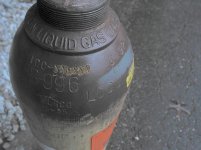
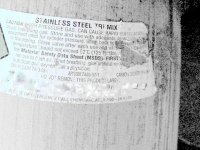
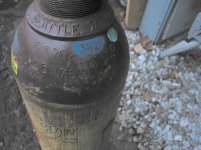
No way they removed it from service for being "only" 1800 psi. My guess is it failed either visual inspection or hydrostatic testing. There are no laws requiring different gasses to have specific pressure ratings of cylinders, they could have filled it with tri-mix, nitrogen, oxygen, helium, argon, or any other compressible gas. All they would have had to do is remove the labels showing what was in it, and replace the valve with the appropriate one for whatever gas was going to be put in it.
It depends on the gas distributor. For 31 years, I worked for a company that owned over 100 welding gas cylinders, and as the shop foreman, with the responsiblity of administering our welding supply contracts, I saw a lot of things happen with the various gas distributors we worked with during that time.
One company in particular--AIRCO (when they were still in the welding gas supply business)--went through a phase where they were refusing to service all high pressure COCs with less than a 2015 PSI service pressure rating. They even rejected one with a 3A2000 stamping (for the lack of 15 lbs). A different gas distributor we subsequently contracted with had no problem allowing us to reinstate that particular (oxygen) cylinder in service after it passed hydrotest. This was during the era when COCs were not necessarily exchanged, but instead were filled and returned to their owner. During that same time, AIRCO also refused to convert carbon dioxide cylinders to
any other type of gas service.
I'll agree with you that there are no "laws" requiring different gasses to have specific pressure ratings of cylinders, but that doesn't stop a company from having an internal policy for what they will accept, especially regarding COCs. I'm just saying it's not as "black and white" as you make it sound.

I'll further agree that there are a variety of other generally more common reasons for cylinders to be rejected for refill, or condemned and removed from service.
definitely 3/4" NGT......
have seen tanks marked chrome-moly now and then
Another common marking--especially on WWII vintage cylinders is "shatterproof." Although it's probably a lot less common nowadays than it was when I first started in the welding industry.
oldest tank? 1st test date 1909....5 columns of date stamps, an old Linde tank
1907 is the oldest I can remember seeing, and it was still in service at Y2K.