To avoid these ads, REGISTER NOW!

Gas furnace problem

rob1200

Well-known member
Joined
Jul 11, 2013
Messages
519
Location
California
My gas-fired furnace isn't working quite right, and I'm hoping you guys can help me get it sorted.


Symptom:
When the thermostat calls for heat, the furnace fires up and provides heat for about five minutes, then shuts down for exactly 60 seconds. It then repeats the heating/shutdown cycle until the set temperature is finally reached.


Details:
After firing up properly and heating for several minutes, the shutdown is accompanied by the control board LED flashing a 3-1 error: Pressure Switch Did Not Close Or Reopened. There are no other errors at any point in the cycle.

Monitoring the pressure switch with a multimeter, it starts at infinity ohms (open) as expected, then closes (0 ohms) as expected once the inducer motor starts. Minutes later, the pressure switch unexpectedly opens again and the burners shut off.

There are no blockages in the pressure switch tube.
The inducer motor seems to be working properly; there is no bearing noise.
I haven't checked the venting yet.

Is it likely that the pressure switch is out of spec? I don't have a manometer to measure the actual pressure. A new pressure switch is about $35.

Is checking the venting as simple as removing the sheetmetal screws in the vent pipe (at location "a" in the second photo), separating the pipe segments and seeing if large amounts of crud fall out? Do I need some kind of sealant when I put the aluminum pipe segments back together? I don't really want to get up on the roof to look at the top of the vent pipe.


Background:
Payne model number PG8JAA066110AAJA, single-stage furnace, 15 years old.
Fuel is propane: plenty of propane in the tank, and the adjacent propane-fired water heater is working properly.
Pressure switch is Honeywell HK06WC069 High Fire 27" Break, 47" Max Make.
Air filters are new.
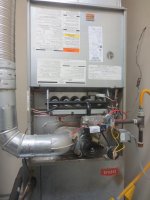
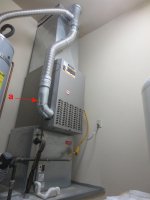
furnace1.jpg
furnace2.jpg
 
To avoid these ads, REGISTER NOW!

Dagny

Well-known member
Joined
Jul 25, 2014
Messages
2,984
Location
Northern Wi.
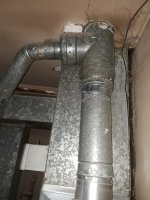
Is that the water heater teed into it most power vented furnaces don't allow that. Make sure chimney has no restrictions.
 

Ohmthis

Well-known member
Joined
Jan 20, 2013
Messages
3,009
Location
Outside of Louisville KY
Yes check and make sure there are no obstructions in the vent. Some gas simple as an insect nest can block it enough for it to fault out. Without a manometer to check the pressure, it’s a guess to whether or not the switch is bad. A simple manometer can be made with clear tubing and water, google it. It will show if there is a drop in pressure and you can go from there.
 

danski0224

Well-known member
Joined
Jan 29, 2005
Messages
13,376
Location
Near Naperville, IL
Water heaters are tied in with furnaces all the time.:headscrat

The tee should be in a wye configuration, not a bullhead tee like the picture.

The draft hood on the water heater is the silent problem in this type of installation.

If there is a blockage upstream of the tee/wye, then the induced draft furnace will vent out of the water heater opening, spilling flue gases into the living space.

Same happens with the water heater. Melted plastic rings around the pipe ******* is a sure sign of flue/vent problems.

It's funny to see people that put foil tape on flue piping but then you see the big open space between the water heater and the draft hood :)

Yes, the combined vent is technically allowed, but it shouldn't be.
 

spudley

Well-known member
Joined
Dec 27, 2016
Messages
702
Location
Northeast Wisconsin
The tee should be in a wye configuration, not a bullhead tee like the picture.

The draft hood on the water heater is the silent problem in this type of installation.

If there is a blockage upstream of the tee/wye, then the induced draft furnace will vent out of the water heater opening, spilling flue gases into the living space.

Same happens with the water heater. Melted plastic rings around the pipe ******* is a sure sign of flue/vent problems.

It's funny to see people that put foil tape on flue piping but then you see the big open space between the water heater and the draft hood :)

Yes, the combined vent is technically allowed, but it shouldn't be.

Now you have me thinking as I have exactly the venting set up as pictured. If the wye is needed, when would the bullhead tee ever be used? And if a blockage occurred, wouldn't gases still back up through the draft hood in a wye vented system?

Just looking for answers, not trying to argue.

I'm glad I have multiple CM detectors!:)

Anyway to the OP, my HVAC buddy claims most failures are dirty flame sensors, but sounds like yours is showing a different code.
 

danski0224

Well-known member
Joined
Jan 29, 2005
Messages
13,376
Location
Near Naperville, IL
Now you have me thinking as I have exactly the venting set up as pictured. If the wye is needed, when would the bullhead tee ever be used? And if a blockage occurred, wouldn't gases still back up through the draft hood in a wye vented system?

Just looking for answers, not trying to argue.

I'm glad I have multiple CM detectors!:)

The wye will naturally direct the natural draft flue gases up, unlike the bullhead tee. The bullhead tee might actually be prohibited as a common vent connection by the National Fuel Gas Code.

A bullhead tee can be used to install something like a barometric damper, a device that is a sore point in another thread :).

Yes, if there is a blockage above the wye, the common-vented induced draft furnace and water heater will still vent into the living space instead.

A barometric damper with a safety switch on the water heater, in place of the draft diverter, can provide a means to shut off the water heater burner if there is a venting problem. Still doesn't help the common vented furnace issue, but the water heater burner may trip off eventually, which is better than nothing.

This problem is why induced draft furnaces should not be common vented with natural draft water heaters, even though it is allowed by code.

Each appliance should have its own flue pipe and termination to the outdoors.
 

brewchief

Well-known member
Joined
Sep 20, 2008
Messages
2,370
Location
Michigan
The wye will naturally direct the natural draft flue gases up, unlike the bullhead tee. The bullhead tee might actually be prohibited as a common vent connection by the National Fuel Gas Code.

A bullhead tee can be used to install something like a barometric damper, a device that is a sore point in another thread :).

Yes, if there is a blockage above the wye, the common-vented induced draft furnace and water heater will still vent into the living space instead.

A barometric damper with a safety switch on the water heater, in place of the draft diverter, can provide a means to shut off the water heater burner if there is a venting problem. Still doesn't help the common vented furnace issue, but the water heater burner may trip off eventually, which is better than nothing.

This problem is why induced draft furnaces should not be common vented with natural draft water heaters, even though it is allowed by code.

Each appliance should have its own flue pipe and termination to the outdoors.
danski0224 have you taken classes through NCI? This sounds very familiar.

Sent from my SM-G965U using Tapatalk
 

cgrutt

Well-known member
Joined
Mar 4, 2016
Messages
8,203
Recently had similar issue with my water heater. It would fire up for a few minutes then stop and repeat cycle after another few minutes. It turned out to be a Robin was building a nest in vent pipe. Cleared twigs and heater immediately started working again. Not a plumber so not sure if furnace could have same issue.
 

Bruce Amacker

Well-known member
Joined
Nov 6, 2011
Messages
573
Location
Cleveland, Ohio
Power vent, right? I know less than nothing about furnaces, but we had one with a power vent that needed the motor oiled regularly. If you did not oil the motor bearings it would run slow and the pressure switch would not close.
 

theoldwizard1

Well-known member
Joined
Feb 22, 2011
Messages
43,126
Location
SE MI
I know less than nothing about furnaces, but we had one with a power vent ...

I know slightly more ! I think those are sometimes call a "draft inducer". They start before the burner comes on. If the controller does not "sense" the draft, the burner will not come on.
 

Jim greengo

Well-known member
Joined
Sep 3, 2018
Messages
7,415
Location
Behind my house
The tee should be in a wye configuration, not a bullhead tee like the picture.

The draft hood on the water heater is the silent problem in this type of installation.

If there is a blockage upstream of the tee/wye, then the induced draft furnace will vent out of the water heater opening, spilling flue gases into the living space.

Same happens with the water heater. Melted plastic rings around the pipe ******* is a sure sign of flue/vent problems.

It's funny to see people that put foil tape on flue piping but then you see the big open space between the water heater and the draft hood :)

Yes, the combined vent is technically allowed, but it shouldn't be.
If its blocked ahead of a wye it will do the same thing.
 

Jim greengo

Well-known member
Joined
Sep 3, 2018
Messages
7,415
Location
Behind my house
I guess it depends on where you're located,I'd be willing to bet I could walk down my block and all the houses will be vented just like this one in my house,completely legal around here.
 

Attachments

  • 20181202_122519.jpg
    20181202_122519.jpg
    92.2 KB · Views: 29

LS6 Tommy

Well-known member
Joined
Dec 27, 2013
Messages
26,162
Location
Northern NJ
I guess it depends on where you're located,I'd be willing to bet I could walk down my block and all the houses will be vented just like this one in my house,completely legal around here.

If the appliance is Category I, it's OK. You cannot have a positive pressure vented appliance (Category II, III, IV) share a duct with an atmospheric draft appliance. There is no requirement for a Wye.

When I said the setup was illegal, I didn't look at the pic closely. I thought it had single wall flex line, but looking at the photo in a larger image I can see it's flex B. I deleted that post.

Tommy
 
Last edited:

6768rogues

Banned
Joined
Nov 28, 2007
Messages
4,524
Location
Western NY
We can use a common vent for the water heater and furnace if they are both gravity vents. If one is a power vent, it has to have a dedicated vent. One power vent can backflow through the other appliance and cause the products of combustion to enter the dwelling. I recently saw one that was doing just that, the power vent furnace would start up and a match held by the hood of the gravity water heater would get blown out. We had no way to put in another vent, so we used the flue for the furnace and put in an electric water heater.
 
Last edited:

Showkey

"MEMBER EMERITUS"
Joined
Aug 9, 2014
Messages
8,638
Location
Wausau WI
We can use a common vent for the water heater and furnace if they are both gravity vents. If one is a power vent, it has to have a dedicated vent. One power vent can backflow through the other appliance and cause the products of combustion to enter the dwelling. I recently saw one that was doing just that, the power vent furnace would start up and a match held by the hood of the gravity water heater would get blown out. We had no way to put in another vent, so we used the flue for the furnace and put in an electric water heater.[/QUOT


Power vent heater with PVC exhaust would have solved the problem and avoid electric water heater high cost of operation.
 

6768rogues

Banned
Joined
Nov 28, 2007
Messages
4,524
Location
Western NY
We can use a common vent for the water heater and furnace if they are both gravity vents. If one is a power vent, it has to have a dedicated vent. One power vent can backflow through the other appliance and cause the products of combustion to enter the dwelling. I recently saw one that was doing just that, the power vent furnace would start up and a match held by the hood of the gravity water heater would get blown out. We had no way to put in another vent, so we used the flue for the furnace and put in an electric water heater.[/QUOT


Power vent heater with PVC exhaust would have solved the problem and avoid electric water heater high cost of operation.

Under other circumstances, I would agree.
It was a rental property that my son just bought, no where to run a PVC vent that would comply with distances from operable windows and doors, older water heater and the tenant pays the utilities. The tenant wanted hot water and it happened to coincide with a three year C of O inspection that the municipality requires for rentals, so we had an inspector breathing down our necks. Electric water heater fixed everything.
 
Last edited:

spudley

Well-known member
Joined
Dec 27, 2016
Messages
702
Location
Northeast Wisconsin
We can use a common vent for the water heater and furnace if they are both gravity vents. If one is a power vent, it has to have a dedicated vent. One power vent can backflow through the other appliance and cause the products of combustion to enter the dwelling. I recently saw one that was doing just that, the power vent furnace would start up and a match held by the hood of the gravity water heater would get blown out. We had no way to put in another vent, so we used the flue for the furnace and put in an electric water heater.
So let me get this straight...if I have a furnace that uses a draft inducer and a water heater that has a gravity vent, I can't or shouldn't vent both to a common B vent chimney?
I have 4" vents from both going to a 6" chimney.
My WH is nearing its end of life so I'm now considering a power vent replacement unit and leave the chimney dedicated to the furnace.
Learn something new every day here!
 
To avoid these ads, REGISTER NOW!

danski0224

Well-known member
Joined
Jan 29, 2005
Messages
13,376
Location
Near Naperville, IL
So let me get this straight...if I have a furnace that uses a draft inducer and a water heater that has a gravity vent, I can't or shouldn't vent both to a common B vent chimney?
I have 4" vents from both going to a 6" chimney.
My WH is nearing its end of life so I'm now considering a power vent replacement unit and leave the chimney dedicated to the furnace.
Learn something new every day here!

Power vent and natural draft shouldn't be in the same flue, even though it is allowed by code. This would be the best case installation.

When a heating appliance is removed from the flue, the flue must be re-evaluated to ensure that it is properly sized for what is left.

Yes, that means that sometimes a liner must be pulled through a B-vent, or if it is a straight shot, smaller pipe inside of the B vent.

The common term is "orphaned water heater".

If the water heater is left on the flue, it can be corrected with (wait for it....) a barometric damper. This controls the draft and increases the flue temperature. It also provides for a safety shutoff.

Those single pipe so-called high efficiency water heaters with PVC venting use a shitload of indoor air to dilute the flue gas to a temperature that can be vented with PVC pipe. The only tank style water heater that is truly high efficiency and 2 pipe is an AO Smith Vertex. The indoor air used to dilute the flue gas must be replaced with unconditioned/unfiltered air from outside :)

I'd leave the natural draft water heater, install a barometric damper, and install a 2 pipe PVC vent furnace.
 
OP
R

rob1200

Well-known member
Joined
Jul 11, 2013
Messages
519
Location
California
OP here...

The furnace does not have a power vent. It is a Category I furnace with an inducer fan.

According to this source:
http://www.ashireporter.org/HomeIns...ing-in-Common-of-Multiple-Gas-Appliances/2067
"The inducer fan applies a slight negative pressure on the heat exchanger to ensure that the products of combustion are evacuated upward. The fan, however, does not exert positive pressure into the flue pipe. The exhaust in the flue is gravity-vented. Therefore, its vent pressure is rated as “non-positive,” which is why it can be vented in common with a gravity-vented water heater."

That same source has two diagrams showing venting in common, one with a wye and this one with a tee:

CommonVent2Fixed.jpg

I'll agree with those who say separate vents would be better. But I'm certain my water heater and furnace installation met code when built in 2003. Nothing has been changed since the initial build and installation. This in the garage and I have CO detectors in the living space.


Back to the furnace problem (cycling on and off every few minutes):

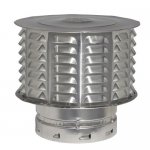
I've checked the vent pipe from the furnace. No crud or blockages at all. I ran a shop vac and a leaf blower into the vent pipe from below, but I couldn't verify visually that the pipe is clear all the way through the attic. I really don't want to get up on the steep roof to check from above, but the vent cap is the style in this image so I don't think nests/dead animals are likely:

6ECW.jpg


Next I'm going to look into rigging up a manometer with clear tubing and water (thanks Ohmthis for that suggestion). I may just go ahead and order a new pressure switch.
 

Jim greengo

Well-known member
Joined
Sep 3, 2018
Messages
7,415
Location
Behind my house
Codes change....

I work around mechanical equipment on old houses,and new houses on a pretty regular basis.
I've got 5 furnace installs with new equipment sitting on them already to be installed this week.
None of them have separate chimneys for gravity fed water heaters,and they all get inspected by the city and local gas co when I'm done.
So until I'm told otherwise by the city or gas company I will stick with doing it the same way we've always done them.:beer:
 

Jim greengo

Well-known member
Joined
Sep 3, 2018
Messages
7,415
Location
Behind my house
Power vent and natural draft shouldn't be in the same flue, even though it is allowed by code. This would be the best case installation.

When a heating appliance is removed from the flue, the flue must be re-evaluated to ensure that it is properly sized for what is left.

Yes, that means that sometimes a liner must be pulled through a B-vent, or if it is a straight shot, smaller pipe inside of the B vent.

The common term is "orphaned water heater".

If the water heater is left on the flue, it can be corrected with (wait for it....) a barometric damper. This controls the draft and increases the flue temperature. It also provides for a safety shutoff.

Those single pipe so-called high efficiency water heaters with PVC venting use a shitload of indoor air to dilute the flue gas to a temperature that can be vented with PVC pipe. The only tank style water heater that is truly high efficiency and 2 pipe is an AO Smith Vertex. The indoor air used to dilute the flue gas must be replaced with unconditioned/unfiltered air from outside :)

I'd leave the natural draft water heater, install a barometric damper, and install a 2 pipe PVC vent furnace.
The gas co thought dampers were a good idea on furnace flues to help save energy back in the 70s-80s.
Problem was they'd get stuck/rusted shut and destroyed a lot of furnaces/heat exchangers.
I'm sure more than one person died because of them.
 

brewchief

Well-known member
Joined
Sep 20, 2008
Messages
2,370
Location
Michigan
The metal squirrel cage wheel in the inducer motor can rust out and start losing blades(or just so rusty that the blades don't move air well).
I've seen furnaces with cracks in the heat exchanger that opened up enough when hot that the pressure switch would open up because of so much air able to come through the cracks, a 15 year old Carrier, Bryant or Payne having a cracked heat exchanger isn't exactly an uncommon thing.

Sent from my SM-G965U using Tapatalk
 
OP
R

rob1200

Well-known member
Joined
Jul 11, 2013
Messages
519
Location
California
The metal squirrel cage wheel in the inducer motor can rust out and start losing blades(or just so rusty that the blades don't move air well).
The squirrel cage wheel is undamaged and free of corrosion. I live in the mountains of California... it is very dry here. Obviously water is one of the combustion products when burning natural gas or propane, but in this climate the whole unit dries out quickly once the furnace is off. No sign of corrosion anywhere. I did oil the inducer motor bearings while I had the unit out.

I've seen furnaces with cracks in the heat exchanger that opened up enough when hot that the pressure switch would open up because of so much air able to come through the cracks, a 15 year old Carrier, Bryant or Payne having a cracked heat exchanger isn't exactly an uncommon thing.
That explanation would match the symptoms exactly. Unless it's an obvious crack in a visible place, it's going to take a professional to diagnose that.
 

mrobins297aaa

Well-known member
Joined
Sep 20, 2010
Messages
3,283
Location
south east michigan
The metal squirrel cage wheel in the inducer motor can rust out and start losing blades(or just so rusty that the blades don't move air well).
I've seen furnaces with cracks in the heat exchanger that opened up enough when hot that the pressure switch would open up because of so much air able to come through the cracks, a 15 year old Carrier, Bryant or Payne having a cracked heat exchanger isn't exactly an uncommon thing.

Sent from my SM-G965U using Tapatalk
If the new pressure switch doesn't solve your problem I'd be looking at this.
Carrier had a huge problem with there laminated steel heat exchangers and even lost a huge law suit over them. I not familiar with your exact model furnace but if it has that laminated heat exchanger that just maybe your problem.
 

mrobins297aaa

Well-known member
Joined
Sep 20, 2010
Messages
3,283
Location
south east michigan
also I would take a close look at the flame while the burner is on and check to see that it has a good draft, if the flame is lazy or rolling out, that would mean a obstruction or the draft inducer may be failing.
 
OP
R

rob1200

Well-known member
Joined
Jul 11, 2013
Messages
519
Location
California
My furnace isn't one of the models with laminated heat exchangers.

Here's a photo of the flames:
furnace3.jpg

Hard to get a good angle, and I don't really know what I'm looking for. The flames are about 10" long, absolutely horizontal, blue with just a bit of yellow right at far ends. I think they are the opposite of lazy... they are very forceful and not moving around at all.
 

danski0224

Well-known member
Joined
Jan 29, 2005
Messages
13,376
Location
Near Naperville, IL
The gas co thought dampers were a good idea on furnace flues to help save energy back in the 70s-80s.
Problem was they'd get stuck/rusted shut and destroyed a lot of furnaces/heat exchangers.
I'm sure more than one person died because of them.

I have seen these even now, on water heaters. I saved one, have it in the garage.

Obviously, the plumbers don't know about flue venting.

Worse, the schmucks called in to service/replace the furnace ignored the water heater right next to it- over the course of the next 20 to 30 years! Back to the poor service in the HVAC industry line again.
 

LS6 Tommy

Well-known member
Joined
Dec 27, 2013
Messages
26,162
Location
Northern NJ
So let me get this straight...if I have a furnace that uses a draft inducer and a water heater that has a gravity vent, I can't or shouldn't vent both to a common B vent chimney?
I have 4" vents from both going to a 6" chimney.
My WH is nearing its end of life so I'm now considering a power vent replacement unit and leave the chimney dedicated to the furnace.
Learn something new every day here!

You are fine. Category I appliances like your furnace and the water heater you are considering are not considered "power vent" or positive pressure vents. The inducer only assists draft though the burner. It does not create positive pressure in the stack.

Tommy
 
Last edited:

LS6 Tommy

Well-known member
Joined
Dec 27, 2013
Messages
26,162
Location
Northern NJ
OP here...

The furnace does not have a power vent. It is a Category I furnace with an inducer fan.

According to this source:
http://www.ashireporter.org/HomeIns...ing-in-Common-of-Multiple-Gas-Appliances/2067
"The inducer fan applies a slight negative pressure on the heat exchanger to ensure that the products of combustion are evacuated upward. The fan, however, does not exert positive pressure into the flue pipe. The exhaust in the flue is gravity-vented. Therefore, its vent pressure is rated as “non-positive,” which is why it can be vented in common with a gravity-vented water heater."

That same source has two diagrams showing venting in common, one with a wye and this one with a tee:

CommonVent2Fixed.jpg

I'll agree with those who say separate vents would be better. But I'm certain my water heater and furnace installation met code when built in 2003. Nothing has been changed since the initial build and installation. This in the garage and I have CO detectors in the living space.


Back to the furnace problem (cycling on and off every few minutes):

I've checked the vent pipe from the furnace. No crud or blockages at all. I ran a shop vac and a leaf blower into the vent pipe from below, but I couldn't verify visually that the pipe is clear all the way through the attic. I really don't want to get up on the steep roof to check from above, but the vent cap is the style in this image so I don't think nests/dead animals are likely:

6ECW.jpg


Next I'm going to look into rigging up a manometer with clear tubing and water (thanks Ohmthis for that suggestion). I may just go ahead and order a new pressure switch.

Your info on the difference between inducers and "power vents" is correct and was what I tried to point out in my earlier post. Other posts here are using the term "power vent" incorrectly.

My guess is still that you have a DP switch that is going bad.

Tommy
 
Last edited:

spudley

Well-known member
Joined
Dec 27, 2016
Messages
702
Location
Northeast Wisconsin
Other posts here are using the term "power vent" incorrectly.
That's kinda what I was thinking and where I was going when I said "draft inducer".
It's a lake cottage I go to occasionally in winter and turn both appliances up at the same time, so both are venting simultaneously.
I've been using this setup for over twenty years w/o issue with multiple CO detectors.
Thanks.
 

danski0224

Well-known member
Joined
Jan 29, 2005
Messages
13,376
Location
Near Naperville, IL
My furnace isn't one of the models with laminated heat exchangers.

Here's a photo of the flames:
furnace3.jpg

Hard to get a good angle, and I don't really know what I'm looking for. The flames are about 10" long, absolutely horizontal, blue with just a bit of yellow right at far ends. I think they are the opposite of lazy... they are very forceful and not moving around at all.

It is almost impossible to pass judgement on a heat exchanger (HX) from a furnace with inshot burners and a draft inducer by simply looking at the flames.

Until the HX is so bad that the blower pushes the flames out of it when the circulating fan comes on.

The only industry accepted way to test for a bad heat exchanger is AHRI Guideline X. It can be found with a web search. This eliminates all the jokers that condemn a furnace because they find a couple of HX crimp rings loose. This was developed by the AHRI and furnace manufacturers.

It is impossible to do a complete visual inspection without actually pulling the HX out of the furnace cabinet.

Pulling the blower motor and fan out helps, as long as it isn't a 90+ with a secondary HX in the way.

Outside of following the Guideline X procedure, which requires a combustion analyzer, doing just a combustion analysis can find a problem even when the flames look fine. I have seen it happen several times. CO goes through the roof, but visually the flames look fine.

A manometer in the flue checking the draft (yes, I realize that this is a draft induced furnace) can show if the draft reading goes down before the furnace shuts off giving the code. Or, if the draft reading stays steady at the flue and then the furnace shuts down.

Bad idea to just look at the flames.
 

danski0224

Well-known member
Joined
Jan 29, 2005
Messages
13,376
Location
Near Naperville, IL
I work around mechanical equipment on old houses,and new houses on a pretty regular basis.
I've got 5 furnace installs with new equipment sitting on them already to be installed this week.
None of them have separate chimneys for gravity fed water heaters,and they all get inspected by the city and local gas co when I'm done.
So until I'm told otherwise by the city or gas company I will stick with doing it the same way we've always done them.:beer:

Generally speaking, code changes do not require alterations to preexisting installations.

Requiring GFCI outlets in a kitchen, instead of just within 6 feet of the sink in the kitchen, is one exception. Home inspectors always call that one out now.

I have never installed a tee in a B vent riser for the furnace and water heater. It has always been a wye connected to the B vent.
 

Jim greengo

Well-known member
Joined
Sep 3, 2018
Messages
7,415
Location
Behind my house
Generally speaking, code changes do not require alterations to preexisting installations.

Requiring GFCI outlets in a kitchen, instead of just within 6 feet of the sink in the kitchen, is one exception. Home inspectors always call that one out now.

I have never installed a tee in a B vent riser for the furnace and water heater. It has always been a wye connected to the B vent.
I work all over the state and over into Iowa from time to time,I can count on 1 hand the amount of eyes I've seen on furnaces.
That includes brand new houses.
Like I said,I'm guessing it's a regional thing.:beer::beer::beer::beer:
 

Jim greengo

Well-known member
Joined
Sep 3, 2018
Messages
7,415
Location
Behind my house
Generally speaking, code changes do not require alterations to preexisting installations.

Requiring GFCI outlets in a kitchen, instead of just within 6 feet of the sink in the kitchen, is one exception. Home inspectors always call that one out now.

I have never installed a tee in a B vent riser for the furnace and water heater. It has always been a wye connected to the B vent.
Home inspectors dont have license in nebraska,all they can do is call out whatever stuck in their head on from the on line class they took.
Problem is most of them I come across have no clue about local electrical/plumbing or mechanical codes.
 
OP
R

rob1200

Well-known member
Joined
Jul 11, 2013
Messages
519
Location
California
Update:
A new OEM pressure switch solved the short cycling problem. My furnace is now working properly.

Thanks to everyone in this thread for your knowledge. :beer:
 
To avoid these ads, REGISTER NOW!
Top Bottom