To avoid these ads, REGISTER NOW!

Gas line pipe layout

bimmer1980

Well-known member
Joined
Feb 5, 2009
Messages
2,104
Location
York, PA
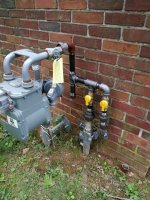
Just looking for some quick input on putting black pipe on the output of the meter to the under ground pipe to the dettached garage and into the house.

It is 1" from the meter. I will remove the T- fitting and drip leg. To be replaced with just an elbow.

I put the unions in there to make it easier to pipe together and then paint before install.

Let me know your thoughts...
 

Attachments

  • IMG_20180922_155906.jpg
    IMG_20180922_155906.jpg
    155.1 KB · Views: 116
  • IMG_20180922_155857.jpg
    IMG_20180922_155857.jpg
    149.1 KB · Views: 114
To avoid these ads, REGISTER NOW!
OP
B

bimmer1980

Well-known member
Joined
Feb 5, 2009
Messages
2,104
Location
York, PA
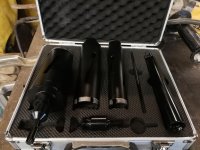
Once I have the pipe figured out, I will use my new core drills to put a hole in the wall.
 

Attachments

  • IMG_20180922_140620.jpg
    IMG_20180922_140620.jpg
    150.8 KB · Views: 74

HoosierBuddy

Well-known member
Joined
May 9, 2006
Messages
2,930
Location
Southern Indiana
I'm not sure if you are asking for advice or just someone to look at your pictures and see what isn't right.

If it's the later...the only thing I see is you don't have pipe sealant on your threads. Normally I'd assume you are aware that you have to use pipe sealant or it will leak at every joint...but as this is the internet, I won't.

Phil
 

nsula_country

Well-known member
Joined
May 23, 2013
Messages
1,534
Location
Northwestern Louisiana
I'm not sure if you are asking for advice or just someone to look at your pictures and see what isn't right.

If it's the later...the only thing I see is you don't have pipe sealant on your threads. Normally I'd assume you are aware that you have to use pipe sealant or it will leak at every joint...but as this is the internet, I won't.

Phil

Just using your quote Phil, not directing this at you.

I hope that is just a mock-up of how the fittings will layout. No pipe sealant and no wrench marks on fittings.

Are you asking if black pipe is acceptable?

Core drills look nice. Where did you purchase them?

CT
 
OP
B

bimmer1980

Well-known member
Joined
Feb 5, 2009
Messages
2,104
Location
York, PA
I'm not sure if you are asking for advice or just someone to look at your pictures and see what isn't right.

If it's the later...the only thing I see is you don't have pipe sealant on your threads. Normally I'd assume you are aware that you have to use pipe sealant or it will leak at every joint...but as this is the internet, I won't.

Phil

Per my first line, yes, I was looking for input. This is just a mock up. No pipe sealant yet. However, I do have it and it will be used.

Just trying to ensure I'm not making any major mistakes. I know the drop leg probably isn't necessary, but after further thought, it would be an easy place to add and outlet for a natural gas generator in the future.

I plan to build it all up, then paint and install.

I still have the pressure tester on the garage end, so it will get tested once it is all together.

I've heard that the unions can be a ****** to get them to seal....
 
To avoid these ads, REGISTER NOW!
OP
B

bimmer1980

Well-known member
Joined
Feb 5, 2009
Messages
2,104
Location
York, PA
I have the same core kit. Amazon is where I got mine. They work great.

Good to hear! I also got mine on Amazon. About $120.

Did you use a hammer drill or a regular drill to spin them? I could see where not using the hammer function might be better for the core drill part of it.... My demo saw has similar teeth....
 

metlmunchr

Well-known member
Joined
Sep 10, 2011
Messages
1,278
Those core drills appear to have the same sort of diamond impregnated segments as commercial core drills. Don't use a hammer drill with them.

Hammer drills are for carbide drills. Think of a carbide masonry drill as a rotating chisel. The drill motor just makes it go round and round while the hammering is what makes it cut its way thru the material. A diamond core drill uses the exposed bits of diamond to cut thru the material, and any hammering motion will only serve to fracture the diamonds and shorten the drill life.

One particularly useful function of a diamond core drill is its ability to cut thru embedded rebar or wire mesh while a carbide masonry drill will just stop if it hits any sort of steel.
 

HoosierBuddy

Well-known member
Joined
May 9, 2006
Messages
2,930
Location
Southern Indiana
Per my first line, yes, I was looking for input. This is just a mock up. No pipe sealant yet. However, I do have it and it will be used.

Just trying to ensure I'm not making any major mistakes. I know the drop leg probably isn't necessary, but after further thought, it would be an easy place to add and outlet for a natural gas generator in the future.

I plan to build it all up, then paint and install.

I still have the pressure tester on the garage end, so it will get tested once it is all together.

I've heard that the unions can be a ****** to get them to seal....

Yes. Agree on the unions. The key IMHO is having big enough arms or big enough wrenches.

Phil
 

SALIV8

Well-known member
Joined
Dec 11, 2008
Messages
2,114
Location
chicago and s/w michigan
Good to hear! I also got mine on Amazon. About $120.

Did you use a hammer drill or a regular drill to spin them? I could see where not using the hammer function might be better for the core drill part of it.... My demo saw has similar teeth....

Regular 18v milwaukee drill worked awesome through common brick without using hammer drill, on fast speed.

Face brick is another story. Hopefully you aren't going thru face brick.
 
To avoid these ads, REGISTER NOW!
Top Bottom