To avoid these ads, REGISTER NOW!

Gas water heater TP valve keeps leaking!

atnfromatl

Well-known member
Joined
Nov 4, 2013
Messages
66
Location
Atlanta, GA
Hey guys,

Didn't know where to post this question.

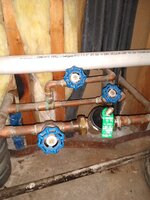
Water main has 150 psi coming into a residential house. It splits off into the front spigot, rear spigot and then to the house supply (each one has its own shutoff valve). Right after the house supply is a pressure reducer.

Measuring from the washing machine spigot. I am getting 52 psi.

The water heater is a NEW 40 gal, 38,000 BTU gas Rheem from Home Depot. It came with a TP valve. My friend and I just installed it.
There is a 3 year old 2 gallon Eastman expansion tank on the cold supply line.

The issue is that every morning there is a puddle of water from the TP valve (it is routed outside). And whoever turns on the hot water first in the morning will get a burst of high pressure for a couple of seconds. It doesn't do this with the cold water. These symptoms were present before the water heater install.

I have already tried removing the expansion tank and airing it to 52 psi to match the supply line pressure (Eastman instructions). This caused the TP valve to go off instantly.

I then deflated the expansion tank with it installed, water shut off, faucets running to relieve pressure. Then airing it to 52 psi. This did not solve my issues.

What is going on?
 
To avoid these ads, REGISTER NOW!

Jackfre

Well-known member
Joined
Dec 26, 2010
Messages
4,410
Location
N CA
Walker is correct. Your pressure reducing valve is not operating correctly. The bladder expansion tanks today are about a maintenance issue. Some last, some don’t. I wonder if you are getting surging pPressure on the hi pressure side that is causing the the PRV to malfunction.
 

nadogail

Well-known member
Joined
Jan 23, 2009
Messages
31,956
Location
Coronado, CA
Pressure regulator valves do not last forever; twenty years is a long time.

The Tempempture / Pressure reliefe valve on you water heater is doing its job, probably time to consider a new pressure regulator for your supply line.
Your Water Utility can give you some impartial guidance.
 

FMB4

Well-known member
Joined
Jan 19, 2017
Messages
2,926
I'm assuming that previous TP valve did not leak as you mention above. If so, I'd also consider replacing the latest TP valve in addition to following the advice in the post above. I say this because a new name brand replacement TP valve is cheaper than replacing the PRV and much cheaper than R&Ring the 'bladder tank'.
 
OP
A

atnfromatl

Well-known member
Joined
Nov 4, 2013
Messages
66
Location
Atlanta, GA
Thanks for the responses. I'll plan to replace the PRV in the next couple of days. Given its age, it's due for a replacement.

But can anyone explain why this wouldn't affect the cold water? Only the hot water is high pressure (momentarily) first thing in the mornings.
 

Walkers

Well-known member
Joined
May 17, 2021
Messages
3,912
Location
Cave Creek Az
Thanks for the responses. I'll plan to replace the PRV in the next couple of days. Given its age, it's due for a replacement.

But can anyone explain why this wouldn't affect the cold water? Only the hot water is high pressure (momentarily) first thing in the mornings.
Best guess here, but you likely have one of those thermal ****** things on the inlet of the water heater. They act like a check valve. Then the water sits there and expands due to the heating and stratification. There is also the momentum of the water passed the check valve. When you turn the water on the shut the valve the water keeps flowing into the heater for a second, but can’t back up out of it. Add up all those issues, plus the leaking by regulator and a too small expansion tank and it leads to exactly where you are at, and your TPR valve is doing exactly what it is designed to do.
 

FordTruckWench

Well-known member
Joined
Jan 8, 2015
Messages
539
Location
California
The issue is that every morning there is a puddle of water from the TP valve (it is routed outside). And whoever turns on the hot water first in the morning will get a burst of high pressure for a couple of seconds. It doesn't do this with the cold water. These symptoms were present before the water heater install.

I seem to remember a friend having a problem sort of like this: The water heater was turned up too hot.
 
To avoid these ads, REGISTER NOW!

PoorUB

Well-known member
Joined
Mar 29, 2021
Messages
11,632
Location
Fargo, ND
Is there a check valve on the cold water side entering the water heater? Some come with check valves to control migration of the hot water while there is no water flow. If there is a check valve it is preventing water from going back to the pressure tank.

I assume it didn't do it with the old heater and it started happening after the heater was changed out, so what changed?
 

FMB4

Well-known member
Joined
Jan 19, 2017
Messages
2,926
I assume it didn't do it with the old heater and it started happening after the heater was changed out, so what changed?
This is why I would start with the TP valve. And yes, 150 psi is very high in my book, but not unheard of in some parts of the US (I just learned this from the I-net).
 

FredWanaker

Well-known member
Joined
Mar 27, 2021
Messages
1,470
Location
NorCal
lots of prv have rebuild kits. Takes about 15 minutes. Also the folks who mention the check valve could be the correct answer. The reason you put a bladder in with a PRV is that the PRV blocks expanding water from going back into the main. When you heat water it expands. Bring cold water into the HW heater tank and it expands when heated. The bladder is supposed to take up this expansion. If the bladder is too small, defective, or something like a check valve blocks water in the tank from expanding back into the bladder, then it expands the water heater and also trips the TP. The high pressure releases every time you open the hot water.
 
OP
A

atnfromatl

Well-known member
Joined
Nov 4, 2013
Messages
66
Location
Atlanta, GA
Yes, 150 psi coming into the house. This is measured from the front & rear spigots.

Symptoms were there prior to the water heater install. TP valve is new and like others, I believe it is doing its job.

Water heater is set to Hot, second from lowest setting. ~128F at the faucet.

I just replaced the PRV today and will report back in a few days if my issues are solved. I will look into upgrading the expansion tank too.

Thank you!
 

FredWanaker

Well-known member
Joined
Mar 27, 2021
Messages
1,470
Location
NorCal
here, we have 95 - 105 psi at the main shutoff. Only the front outside faucet is at that pressure, everything else is reduced to 55 psi in the house by my PRV, which includes the rest of the outside faucets. The only other pressure regulators are on drip irrigation, and pressure/flow regulating faucets in the bathrooms. You indicate your rear outside faucet is at 150 PSI. Is it on a dedicated line, or is part of your house on the PRV and part not?
 
OP
A

atnfromatl

Well-known member
Joined
Nov 4, 2013
Messages
66
Location
Atlanta, GA
here, we have 95 - 105 psi at the main shutoff. Only the front outside faucet is at that pressure, everything else is reduced to 55 psi in the house by my PRV, which includes the rest of the outside faucets. The only other pressure regulators are on drip irrigation, and pressure/flow regulating faucets in the bathrooms. You indicate your rear outside faucet is at 150 PSI. Is it on a dedicated line, or is part of your house on the PRV and part not?

There is the main shutoff from the county out in the yard. Inside the house, its splits into separate lines, each with its own shutoff valve. 1 for the front spigot, 1 for the rear, and the third has the PRV directly after for the house supply lines.

It is nice to be able to shutoff the water to the outside spigots in the winter and allows for higher psi for washing cars, etc.
 

Attachments

  • IMG_20211103_174451045.jpg
    IMG_20211103_174451045.jpg
    325.6 KB · Views: 18

Milton Shaw

Well-known member
Joined
Feb 11, 2011
Messages
4,838
Our church had a pressure regulator(set at 50 psi) leaking the 210 psi line pressure into the plumbing. The PT valve would spit a little water out. The Sloan flush valves on toilets and urinals would not flush because of the high pressure. Once water was run at sink everything would flush. The 2" pressure regulator was rebuildable with new kit at a much better price than replacing it. If you can, find one a pressure gauge with a max and min needle to let you see what is happening in the future as it will probably happen again due to solids in water fouling the pressure valve..
 

rlitman

Well-known member
Joined
Oct 18, 2010
Messages
24,600
Location
Long Island
Best guess here, but you likely have one of those thermal ****** things on the inlet of the water heater. They act like a check valve. Then the water sits there and expands due to the heating and stratification...
This is the closest answer, but it still isn't all right.

The regulator IS a check valve. It will prevent reverse flow. What's happening is that the tank is filled cold at say 52 PSI, and as it heats, the hydraulic expansion raises the pressure, as the water has nowhere to go. That "burst of hot water" is the absolute proof of this.

Why does it have nowhere to go? Because the expansion tank is flooded (the bladder is leaking). Replace that expansion tank (or perhaps, get the next size up), and you'll be GTG. They're designed to last 5-10 years at best.
 

Walkers

Well-known member
Joined
May 17, 2021
Messages
3,912
Location
Cave Creek Az
This is the closest answer, but it still isn't all right.

The regulator IS a check valve. It will prevent reverse flow. What's happening is that the tank is filled cold at say 52 PSI, and as it heats, the hydraulic expansion raises the pressure, as the water has nowhere to go. That "burst of hot water" is the absolute proof of this.

Why does it have nowhere to go? Because the expansion tank is flooded (the bladder is leaking). Replace that expansion tank (or perhaps, get the next size up), and you'll be GTG. They're designed to last 5-10 years at best.
very likely the expansion tank bladder is shot, but he has had it down and changed pressure, so…? Also, the funny part is that the pressure shot is only on the hot side, so there is something else acting as a check valve on the hot side.
 

FredWanaker

Well-known member
Joined
Mar 27, 2021
Messages
1,470
Location
NorCal
from his description it has to be a hot side issue. If the hot water could get back to the bladder and cold side, the cold side would spit too. Something blocks the hot water. I did some quick research and some electric hot water tanks have a hot water check valve, so do systems that recirculate hot water so there is no wait for hot water.
 
OP
A

atnfromatl

Well-known member
Joined
Nov 4, 2013
Messages
66
Location
Atlanta, GA
Hey guys,

I just wanted to give everyone an update. I replaced the PRV about 4 days ago and my issues have been resolved. No more TP leaking or high pressure in the mornings.

Thank you to everyone who responded and shared their knowledge and experience. I greatly appreciate it!
 
To avoid these ads, REGISTER NOW!
Top Bottom