I hate to be the bearer of bad news but your gate guy is pretty much right.
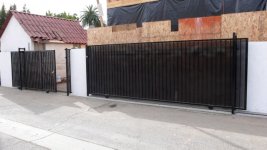
The operator connects to the gate with a length of chain that attaches to each end of the gate and uses a motor driven sprocket to pull the gate opened or closed. It isn't so much a matter of the operator having to be outside the wall as much as the operator has to be on the same side of the wall as the gates. If you could move the gates to the inside of the wall (which doesn't look feasible from your pics) then you could mount the operator inside as well.
One, not very good, option if you can't move the gates inside the wall would be to leave enough gap between the gate and wall to allow the chain room to run between the wall and gate. The bad news about that is twofold. You'd need somewhere around a 6" or more gap, and the operator would have to be mounted in the opening (travel lane) and the gate can't open past the operator, so you'd end up losing close to 3 feet of opening, maybe more depending on your operator.
From what I see in your pics his idea of mounting it on the wall is pretty much your second best solution. Which, as you already know, is not that good of a solution. Not only would it look out of place, if there's any movement of the operator from flexing of the wall or mounting system over time the operator is going to beat itself up and create maintenance and durability problems in the long run.The best fix would be to move the gates inside the wall and that would solve your operator location issues, but it looks like there's obstacles inside the wall that rule that out as well.
If I was installing your gates (which BTW is what I do for a living) in order of best to worst solution I would propose:
1) Move the gates to inside of the wall if there's room for them to slide. This would cure all your operator location issues.
2) Use a vertical pivot style operator. These swing the gate up vertically by pivoting at one end. The drawbacks with this are cost. They're not cheap, but any good operator system isn't cheap either, pivoting systems generally cost more. They also eat up quite a bit of space since they use either a counter weight or tension springs to lighten the load that the motor has to raise.
3) Swap over to a swing style gate instead of a slider. But this will create its own space issues.
4) Mount the operator on top of the wall, or on top of columns that raise it high enough to go over the wall. Make sure if you go this route that there's enough strength, however you mount it, for it to not flex.
At the risk of adding insult to injury if you live in an area where building code enforcement is strict, you could run in to issues with the gates creating a "pinch hazard" where they slide past the edge of the wall opening, if you keep your current set up.
As far as recommendations, once you pick your fix, ask yourself a few questions before you buy.
1) How many cycles (opening/closing) per day do you expect?
More cycles means a need for better quality, heavier duty systems.
2) Are power outages a regularly occurring issue?
If they are consider using a battery powered system. These run the operator off a battery that is kept charged by a transformer that's wired to AC power. So if power goes out you'll have so many cycles available before the battery goes dead.
3) Who needs access?
If you have frequent, and varied, visitors you'll want a keypad and intercom or keypad/telephony system that rings your (land line) phone.
If you need to let delivery or utility people in, but don't have a lot of other visitors you may be able to get by with just a keypad. Most keypads will give you x number of access codes so you can give each person their own code. The better ones allow you to program when (Day and time) those codes will allow access, so the UPS driver can't let themselves in at 4 AM and steal your stuff.
4) What about emergency services?
If there's more than one residence behind the gate some form of emergency access may be required by law. There's a couple of common ways to accomplish this, one way is a "SOS" or "siren operated sensor" that will open when an emergency vehicle uses the "yelp" setting on their siren. Another method is a "Knox Key" switch. This is similar to the emergency FD key switch in an elevator. The cheapest solution is a key box that houses a release key, or a release switch in a lock box for emergency personnel. You'll need to provide a key in advance to your FD/EMT/LEO.
As far as brands, some of the better ones are Chaimberlain, Elite, FAAC, and Universal Entry Systems. Viking has some good mid grade stuff with decent pricing. For the penny pinchers GTO Pro has some decent low cost systems.
As far as access/telephony/intercom systems Door King and Elite have some real good stuff. GTO pro, once again, is decent for the money.
Here's a link to one trade org that covers automated door and access control industry. I highly recommend looking through their Tech Bulletins, especially those about safety. Also look for info on UL325 guidelines for access control/gate installations.
http://www.dasma.com/default.asp
Sorry for being so long winded, but there's a lot to gate installs that most folks don't think about till it's too late, which it would seem is already the case with your gates. Operator systems aren't cheap and you could actually save money in the long run by planning first and spending more money the 1st time vs. adding or changing things later on. Just trying to help.
Feel free to PM or email me if you have any more questions.
Brian
[email protected]
www.appironworks.com

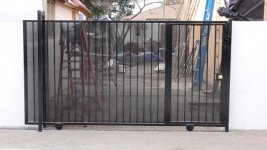

 The reason all roll gates are on the inside are many , vandalism,insurance liability( little johnys soccer ball rolls to the gate as it opens , he gets pinched and you get sued.) Our company just had a safety meeting about this issue. A lawyer in Fla was visiting daddy the judge, reached through the pedestrian rollgate to punch in the entrance code arm got stuck and she died. Daddy sued gate installer won 2mil, the opener co 200mil,garage door installer250k,all because it was improperly installed, theowner wanted it that way with no caution signs. If it was mine I would install the gate on the inside of wall or leave it off.my 2cts
