

You are using an out of date browser. It may not display this or other websites correctly.
You should upgrade or use an alternative browser.
You should upgrade or use an alternative browser.
Gate Post stiffener nonviagra
- Thread starter Suburbancharlie
- Start date
OP
Suburbancharlie
Well-known member
So I finally got a call back from the manufacturer....
Man that wasn't a pleasant conversation.
He provided no information, and simply continued to refer me to the website which has information that is not what I'm finding on my material.
I don't know if his wording has something to do with possibly mislabeled material or what?
File your claim with the dealer.
Look dude, I am simply asking you to provide me with the statistical information on your product.
Serious fence company, what is that? Wish I had started with one of those, I wouldn't be shedding tears on GJ
Man that wasn't a pleasant conversation.
He provided no information, and simply continued to refer me to the website which has information that is not what I'm finding on my material.
I don't know if his wording has something to do with possibly mislabeled material or what?
File your claim with the dealer.
Look dude, I am simply asking you to provide me with the statistical information on your product.
Serious fence company, what is that? Wish I had started with one of those, I wouldn't be shedding tears on GJ
OP
Suburbancharlie
Well-known member
Yes, orange is a gallon at around $300
Has more "strength", but designed for small space fills, and is all liquid
Red is closer to a yard for closer to $380
Is designed for a larger pour amount, has fine aggregate, and not as strong.
Has more "strength", but designed for small space fills, and is all liquid
Red is closer to a yard for closer to $380
Is designed for a larger pour amount, has fine aggregate, and not as strong.
OP
Suburbancharlie
Well-known member
And concrete is only a guarantee of a 5% strength increase according to my reading, as well as an irreversible action.
So I'm not understanding how repeating a post just above yours is productive?
So I'm not understanding how repeating a post just above yours is productive?
Well a lot of people have given you the same or similar solutions, but you've landed on looking for "statistics" from a fence company and $300/gallon epoxy grout. I'm not understanding that.And concrete is only a guarantee of a 5% strength increase according to my reading, as well as an irreversible action.
So I'm not understanding how repeating a post just above yours is productive?
Post some pics and maybe get some more advice.
OP
Suburbancharlie
Well-known member
Alright, what angle are you looking for?
Down a hollow tube?
Maybe the dirt around the the footing?
The label on the post?
Looking at a picture of the gate frame ain't gonna say much.
Sorry for sounding rude, but I've already said that I would prefer to have actual numbers before sealing my fate.
Yes, I'm looking for statistics because it's my understanding that the people who are capable of manipulating the appropriate formulas need those numbers.
I'm beyond guessing that it's good enough, as that's what got me here, some jerk guessing
Down a hollow tube?
Maybe the dirt around the the footing?
The label on the post?
Looking at a picture of the gate frame ain't gonna say much.
Sorry for sounding rude, but I've already said that I would prefer to have actual numbers before sealing my fate.
Yes, I'm looking for statistics because it's my understanding that the people who are capable of manipulating the appropriate formulas need those numbers.
I'm beyond guessing that it's good enough, as that's what got me here, some jerk guessing
billconner
Well-known member
I used to do i this - calculate bending and deflection of structural members, but it's been a long time since grad school. Also can't find data for fence posts and probably not standard. I'll look for 2 1/2" pipe or similar steel tube and see how much it would deflect under gate load. Need approx weight of gate, approx size, and how far off ground. Not positive I can find the right formula for an embedded beam. Don't wager on me coming through. Over 40+ years since last time, with slide rule. Pretty sure I packed textbook las move. 
You might look at some large steel posts with welded on flanges to bolt to all that concrete you have in the ground, slipped over the wimpy posts you have now, or just cut them off and get them out of the way. Like a pylon sign post for a billboard but smaller.
Sorry, but you are very much wrong about what you're saying. Filling hollow steel fence posts and many other hollow steel structural supports, as a means of increasing rigidity, is nothing new. You might try reading about it.And concrete is only a guarantee of a 5% strength increase according to my reading, as well as an irreversible action.
So I'm not understanding how repeating a post just above yours is productive?
OP
Suburbancharlie
Well-known member
Post was sold as Schedule 40, but I have my doubts.
Seems to have a wall thickness of 0.125
Section modulus of 0.6364
Yeild strength of 25,000 psi
Bending strength of 252 lbs
Bending moment 6' cantilever is 18,160 lbs in
That's the numbers that seems to match up with the dimensions I measured found on the manufacturer site?
As to the gate
78" wide
60" tall
Weight is 160 lbs
Hinges set at 19 & 61"
I'm unsure what other information you may need?
And thank you very much.
I've found a few formulas, but don't know exactly what they are for, or how to properly calculate the way the weight is applied to the top hinge, because of the length?
Of course the bottom hinge is helping to support, it's certainly got more of a push load than the top hinge's pull type load
Seems to have a wall thickness of 0.125
Section modulus of 0.6364
Yeild strength of 25,000 psi
Bending strength of 252 lbs
Bending moment 6' cantilever is 18,160 lbs in
That's the numbers that seems to match up with the dimensions I measured found on the manufacturer site?
As to the gate
78" wide
60" tall
Weight is 160 lbs
Hinges set at 19 & 61"
I'm unsure what other information you may need?
And thank you very much.
I've found a few formulas, but don't know exactly what they are for, or how to properly calculate the way the weight is applied to the top hinge, because of the length?
Of course the bottom hinge is helping to support, it's certainly got more of a push load than the top hinge's pull type load
OP
Suburbancharlie
Well-known member
@billconner
But here is a site with many different calculators.
This page is "cantilever beam load", and I plugged in my numbers, but I don't understand the results or the graphs.

 calcresource.com
But here is a site with many different calculators.
This page is "cantilever beam load", and I plugged in my numbers, but I don't understand the results or the graphs.
Cantilever Beam Calculator
Static analysis of a cantilever beam for point and distributed loads. Bending moments, shear, deflections, slopes.
calcresource.com
OP
Suburbancharlie
Well-known member
@FMB4
I've read plenty about CFM or something like that, the bollards in front of Walmart and ATM's, but it is simply not the same in narrow posts, it doesn't scale down accordingly from the traditional 8" to my narrow 3"
That's where I got my 5% number, which isn't really much gain.
I don't argue its the cheapest and easiest, but I can't find "proof" of a gain greater than even a sloppily fit chunk of steel?
Now that I've argued with the manufacturer, apparently I was looking at the wrong chart, and my post is much weaker than my original thoughts. Apparently I paid for schedule 40, but have Schedule 20.
Yes, I'd love to scrap it all and start over.
But my PowerBall ticket wasn't the winner last night.
I've read plenty about CFM or something like that, the bollards in front of Walmart and ATM's, but it is simply not the same in narrow posts, it doesn't scale down accordingly from the traditional 8" to my narrow 3"
That's where I got my 5% number, which isn't really much gain.
I don't argue its the cheapest and easiest, but I can't find "proof" of a gain greater than even a sloppily fit chunk of steel?
Now that I've argued with the manufacturer, apparently I was looking at the wrong chart, and my post is much weaker than my original thoughts. Apparently I paid for schedule 40, but have Schedule 20.
Yes, I'd love to scrap it all and start over.
But my PowerBall ticket wasn't the winner last night.
ez-duzit
Well-known member
Better to swallow that bitter pill now than to swallow the same pill after an expensive science experiment....if this was just one post, I would have simply scrapped it and chocked it up to failure, but 5,000 pounds and thousands of dollars is a bit too bitter pill to swallow...
Replace one post with the proper size and you'll see.
OP
Suburbancharlie
Well-known member
OK, well you've hung around this long, so here's a copy of the email I've prepared for an Engineer, when the time comes I know where to send it?
But it's got all the facts as I know it, and in one place.
Hi, thank you kindly for your time.
I'm not sure what you've been told, but I'm certainly in need of your knowledge and guidance. I've been installing a wooden shadowbox fence and am in uncharted territory.
For starters I just wanted you to know that this is entirely for me to proceed and not anything like a need for the city, or blueprinting, 99.7% of the fence is completed, and not an issue, it is simply that I do not feel comfortable with the amount of flex that I see in the terminal posts after I have hung the weight of swinging gates on these 3" round galvanized fence posts. I have never in all my years lived in the confines of a fence, so I designed mine with the utmost importance to access, and have gates everywhere.
I do not know if this is something you can help with, or even have an idea of what you might charge for the time on it?
So the posts.
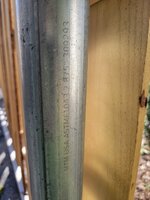
MTM USA ASTMF1403 2.875" 309293
That is the label on them. Apparently Galvanized Fence material is not required to meet the same qualifications as typical Steel Tube. I was not aware.
My supplier sold this as Schedule 40, made by Midwest Tube Mills. Well I have been unable to actually speak with someone willing to share information regarding the product labeling I have in the ground, they would only direct me to the website, and mention a recent acquisition? I don't know if this was code for they mislabeled products or what, but this is the accumulation of information to the best of my tremendous time researching a solution.
Please don't trust my numbers if you find any discrepancy.
As a layman, what I measured on my round post is
2⅞" OD. 2⅝" ID. ⅛" wall thickness, which more resembles what they call MT20, but MTM refuses to tell me which I have?
The spec sheets seem to provide the following for MT20
Weight per foot. 3.25 kg/m
Section modulus. 0.6364 Inches³
Yeild strength 25,ooo PSI 345MPA
Bending strength. 252 lbs
Bending moment 6' cantilever load. 18,160 lbs in
Now I don't really have a clue what any of that means, I simply went to a supplier, told them my plan, and brought home what they sold.
This link has an easier view of the information I've found available.
"Resources" https://midwesttubemills.com/en/resources
So the post hole
I bored a 10" hole, 5' deep in my hard pack grey clay soil, then proceeded to hand dig out to approximately 3' wide for a bell shape at the bottom.
I added a few inches of torpedo sand, then tamped a few inches of grade 9 gravel. To get a total top height for my 10' post, I used a patio block for a means to raise and level the post a smidgen more. Then, with a drum mixer, premixed around 18 bags of sakrete (60 lb bags) for a total of about 1,ooo of concrete to hold the post over the 4' that is below grade. The concrete is well cured by now, as this was done in July.
Then I began the process of putting together my gate frames. The frames are also made of similar galvanized post, in a 3 rail design, with 1⅞" (maybe? ) schedule 40, then skinned with lumber to match the shadowbox style wood privacy fence.
All total, the 78" wide, 5' tall steel frames, with lumber weights 160 pounds per my home scale.
Yes, I'll admit, my drivers license weight may not be correct.
The hinges used for 4 of the gates are Bulldog Hinges set at 61 & 19" above grade. Yes, I have this problem with 5 gates, most of which will not often be used, but I am wanting to prevent a problem before it occurs.
https://www.hooverfence.com/chain-link-bulldog-hinge
One slightly shorter gate uses different hinges to self close slowly, and uses through bolts.
Now these are all basically property line fence corner posts, set as close to the line as possible. I've heard everything from rip it out, use a strongback Deadman post, add a counterweight, to fill it with cement. None of which I like, or are truly feasible options.
I did this weekend get some 125 lb gate casters, that I will add, but I do not like knowing that the post may shear off at the ground? And the fill with cement idea I have read might only guarantee a 3-7% gain, and would obviously be an irreversible option.
"Everbilt 4 in. Gate Caster with Adjustable Spring Bracket and 125 lb. Load Rating" https://www.homedepot.com/p/Everbil...RCH=REC-_-rv_homepage_rr-_-NA-_-203661094-_-N
I've been trying to find a solution, and have found that due to the horrendous weld seam down the entire length of the galvanized post, the greatest size I can find is 2.5" round steel tube to fit inside. I'm now well aware that diameter is far more important than wall thickness, and I'll never be able to achieve the strength of what a properly sized 4" post could provide. I also am finding that due to COVID, there is an absolute shortage of the product, compounded with a 230% increase in price.
I know that it's not optimum, but am wondering if you can confirm or deny that a 10' piece of 2½"OD ⅛" wall steel tube slipped into the 10' piece of 2⅝ ID, maybe filled to the best of ability with a fine grain sand to reduce the size of the 1/16" perimeter voids, isn't going to help in some way?
The other concept I've come up with is to use the same inner tube, and fill the ID/OD void with an epoxy. In my quest for a solution, I've read about chocking compounds, for example ITW Chockfast. I've made contact with the company but have yet to hear back about my usage, this appears to be commonly used in marine and oil industry.
Or possibly this product all on its own?
"Chockfast - ITW Performance Polymers" https://itwperformancepolymers.com/products/chockfast/
I know there's no way to properly "fix" the bottom, but after sand (or epoxy) filling I can weld the top gap/seam for greater attachment? It's also from my recent research that I find round to be a stronger option, but certainly am open to any size, shape, dimension of an interior strengthening member.
I actually just got off the phone with a rep for ITW Chockfast, and he suggested to use the Red version, stating that a single pour would be allowed in my dimensions ( 3" ID x 10' ), and should not require any additional interior support, (his thought anyway) and is actually cheaper than the steel tubing, per post. Based on the composition, under $400 of Chockfast Red will fill 2 empty posts. I am just not sure if steel tube would provide for an extra boost of strength? If it does, I'd definitely consider using it for the fancy gate that would be used most often. And this product is readily available.
"Chockfast Red - ITW Performance Polymers" https://itwperformancepolymers.com/products/chockfast/grouting-compounds/chockfast-red/
The 2.5" 0.120 DOM round steel tubing I'm considering using weights 3.0848, per my web searches
Cross section 0.897
Moment of inertia. 0.637
Density lbs/in^3. 0.284
Yeild strength. 77,000 psi
Ultimate strength. 85,000 psi
With a calculated point load of 1,120 (my 7' gate X 150 lbs) this particular calculator gave me 65,944 PSI stress and a safety factor of 1.168 of just the 2.5" alone.
Now I know that isn't much, but in my mind it is in addition to the crummy post already installed.
The Chockfast Red
Compressive strength 15,250 psi
Compressive modulus of elasticity 2,000,000 psi
Flexible modulus of elasticity 2,000,000 psi
Flexible strength 4,025 psi
Tensile strength 1,890 psi
Izod impact strength 4.6 in lbs/inch
Immeasurable shrinkage
Again, this Chockfast information is the only information that I consider to be fact, as this is entirely provided by the manufacturer. Everything else is a result of my internet findings and the old saying is you get what you pay for.
I'm not sure what else might be of use, but please don't hesitate to ask. I apologize for this headache of an email and appreciate (more than I can put into words) any wisdom you can provide. Again, thank you for your time and consideration.
But it's got all the facts as I know it, and in one place.
Hi, thank you kindly for your time.
I'm not sure what you've been told, but I'm certainly in need of your knowledge and guidance. I've been installing a wooden shadowbox fence and am in uncharted territory.
For starters I just wanted you to know that this is entirely for me to proceed and not anything like a need for the city, or blueprinting, 99.7% of the fence is completed, and not an issue, it is simply that I do not feel comfortable with the amount of flex that I see in the terminal posts after I have hung the weight of swinging gates on these 3" round galvanized fence posts. I have never in all my years lived in the confines of a fence, so I designed mine with the utmost importance to access, and have gates everywhere.
I do not know if this is something you can help with, or even have an idea of what you might charge for the time on it?
So the posts.
MTM USA ASTMF1403 2.875" 309293
That is the label on them. Apparently Galvanized Fence material is not required to meet the same qualifications as typical Steel Tube. I was not aware.
My supplier sold this as Schedule 40, made by Midwest Tube Mills. Well I have been unable to actually speak with someone willing to share information regarding the product labeling I have in the ground, they would only direct me to the website, and mention a recent acquisition? I don't know if this was code for they mislabeled products or what, but this is the accumulation of information to the best of my tremendous time researching a solution.
Please don't trust my numbers if you find any discrepancy.
As a layman, what I measured on my round post is
2⅞" OD. 2⅝" ID. ⅛" wall thickness, which more resembles what they call MT20, but MTM refuses to tell me which I have?
The spec sheets seem to provide the following for MT20
Weight per foot. 3.25 kg/m
Section modulus. 0.6364 Inches³
Yeild strength 25,ooo PSI 345MPA
Bending strength. 252 lbs
Bending moment 6' cantilever load. 18,160 lbs in
Now I don't really have a clue what any of that means, I simply went to a supplier, told them my plan, and brought home what they sold.
This link has an easier view of the information I've found available.
"Resources" https://midwesttubemills.com/en/resources
So the post hole
I bored a 10" hole, 5' deep in my hard pack grey clay soil, then proceeded to hand dig out to approximately 3' wide for a bell shape at the bottom.
I added a few inches of torpedo sand, then tamped a few inches of grade 9 gravel. To get a total top height for my 10' post, I used a patio block for a means to raise and level the post a smidgen more. Then, with a drum mixer, premixed around 18 bags of sakrete (60 lb bags) for a total of about 1,ooo of concrete to hold the post over the 4' that is below grade. The concrete is well cured by now, as this was done in July.
Then I began the process of putting together my gate frames. The frames are also made of similar galvanized post, in a 3 rail design, with 1⅞" (maybe? ) schedule 40, then skinned with lumber to match the shadowbox style wood privacy fence.
All total, the 78" wide, 5' tall steel frames, with lumber weights 160 pounds per my home scale.
Yes, I'll admit, my drivers license weight may not be correct.
The hinges used for 4 of the gates are Bulldog Hinges set at 61 & 19" above grade. Yes, I have this problem with 5 gates, most of which will not often be used, but I am wanting to prevent a problem before it occurs.
https://www.hooverfence.com/chain-link-bulldog-hinge
One slightly shorter gate uses different hinges to self close slowly, and uses through bolts.
Now these are all basically property line fence corner posts, set as close to the line as possible. I've heard everything from rip it out, use a strongback Deadman post, add a counterweight, to fill it with cement. None of which I like, or are truly feasible options.
I did this weekend get some 125 lb gate casters, that I will add, but I do not like knowing that the post may shear off at the ground? And the fill with cement idea I have read might only guarantee a 3-7% gain, and would obviously be an irreversible option.
"Everbilt 4 in. Gate Caster with Adjustable Spring Bracket and 125 lb. Load Rating" https://www.homedepot.com/p/Everbil...RCH=REC-_-rv_homepage_rr-_-NA-_-203661094-_-N
I've been trying to find a solution, and have found that due to the horrendous weld seam down the entire length of the galvanized post, the greatest size I can find is 2.5" round steel tube to fit inside. I'm now well aware that diameter is far more important than wall thickness, and I'll never be able to achieve the strength of what a properly sized 4" post could provide. I also am finding that due to COVID, there is an absolute shortage of the product, compounded with a 230% increase in price.
I know that it's not optimum, but am wondering if you can confirm or deny that a 10' piece of 2½"OD ⅛" wall steel tube slipped into the 10' piece of 2⅝ ID, maybe filled to the best of ability with a fine grain sand to reduce the size of the 1/16" perimeter voids, isn't going to help in some way?
The other concept I've come up with is to use the same inner tube, and fill the ID/OD void with an epoxy. In my quest for a solution, I've read about chocking compounds, for example ITW Chockfast. I've made contact with the company but have yet to hear back about my usage, this appears to be commonly used in marine and oil industry.
Or possibly this product all on its own?
"Chockfast - ITW Performance Polymers" https://itwperformancepolymers.com/products/chockfast/
I know there's no way to properly "fix" the bottom, but after sand (or epoxy) filling I can weld the top gap/seam for greater attachment? It's also from my recent research that I find round to be a stronger option, but certainly am open to any size, shape, dimension of an interior strengthening member.
I actually just got off the phone with a rep for ITW Chockfast, and he suggested to use the Red version, stating that a single pour would be allowed in my dimensions ( 3" ID x 10' ), and should not require any additional interior support, (his thought anyway) and is actually cheaper than the steel tubing, per post. Based on the composition, under $400 of Chockfast Red will fill 2 empty posts. I am just not sure if steel tube would provide for an extra boost of strength? If it does, I'd definitely consider using it for the fancy gate that would be used most often. And this product is readily available.
"Chockfast Red - ITW Performance Polymers" https://itwperformancepolymers.com/products/chockfast/grouting-compounds/chockfast-red/
The 2.5" 0.120 DOM round steel tubing I'm considering using weights 3.0848, per my web searches
Cross section 0.897
Moment of inertia. 0.637
Density lbs/in^3. 0.284
Yeild strength. 77,000 psi
Ultimate strength. 85,000 psi
With a calculated point load of 1,120 (my 7' gate X 150 lbs) this particular calculator gave me 65,944 PSI stress and a safety factor of 1.168 of just the 2.5" alone.
Now I know that isn't much, but in my mind it is in addition to the crummy post already installed.
The Chockfast Red
Compressive strength 15,250 psi
Compressive modulus of elasticity 2,000,000 psi
Flexible modulus of elasticity 2,000,000 psi
Flexible strength 4,025 psi
Tensile strength 1,890 psi
Izod impact strength 4.6 in lbs/inch
Immeasurable shrinkage
Again, this Chockfast information is the only information that I consider to be fact, as this is entirely provided by the manufacturer. Everything else is a result of my internet findings and the old saying is you get what you pay for.
I'm not sure what else might be of use, but please don't hesitate to ask. I apologize for this headache of an email and appreciate (more than I can put into words) any wisdom you can provide. Again, thank you for your time and consideration.
billconner
Well-known member
that's good!
bassJAM
Well-known member
Well a lot of people have given you the same or similar solutions, but you've landed on looking for "statistics" from a fence company and $300/gallon epoxy grout. I'm not understanding that.
Post some pics and maybe get some more advice.
The problem with concrete is it's brittle and has little tensile strength (which is really what OP needs here), and as soon as someone slams the gate too hard, hangs off or tries to climb it, or hits the 1/8" thick galvanized post with a mower the concrete inside is going to crack and render everything inside useless. Concrete is great as a "stiffener" for static loads, not so great for dynamic loads.
bassJAM
Well-known member
So the posts.
MTM USA ASTMF1403 2.875" 309293
That is the label on them. Apparently Galvanized Fence material is not required to meet the same qualifications as typical Steel Tube. I was not aware.
My supplier sold this as Schedule 40, made by Midwest Tube Mills. Well I have been unable to actually speak with someone willing to share information regarding the product labeling I have in the ground, they would only direct me to the website, and mention a recent acquisition? I don't know if this was code for they mislabeled products or what, but this is the accumulation of information to the best of my tremendous time researching a solution.
Please don't trust my numbers if you find any discrepancy.
As a layman, what I measured on my round post is
2⅞" OD. 2⅝" ID. ⅛" wall thickness, which more resembles what they call MT20, but MTM refuses to tell me which I have?
The spec sheets seem to provide the following for MT20
Weight per foot. 3.25 kg/m
Section modulus. 0.6364 Inches³
Yeild strength 25,ooo PSI 345MPA
Bending strength. 252 lbs
Bending moment 6' cantilever load. 18,160 lbs in
Now I don't really have a clue what any of that means, I simply went to a supplier, told them my plan, and brought home what they sold.
This link has an easier view of the information I've found available.
"Resources" https://midwesttubemills.com/en/resources
I didn't catch earlier in the thread that this was a galvanized post. I take back a little of what I said about putting a second post inside now. Galvanized steel tends to be somewhat ductile, if you can hammer a round or even square steel beam inside that's not as ductile with a relatively thick wall, it should certainly add some stiffness to the post. It still needs to fit tight enough that you'll need a BFH to get it in, but I don't think a hydraulic press is necessary anymore!
Viper98912
Well-known member
That was somewhat difficult to read, a picture would have helped...
Nonetheless, I think I understand what you're doing, and the gate being perpendicular to the end of the run is really what the problem is.
Whenever I've done a gate (and it's only been a couple times, I'm no expert) I purposely put the gate with at least one other pole joined horizontally (be it 4', 6', etc away), as that other people will provide additional "sag" support as your vertical pull from the gate cantilever is now being supported by another fixed point. So the gate is not at the end of a perpendicular run, it's at least one section over.
Nonetheless, filling the pole will help, but not really provide much. The problem you have is that a majority of your sag is occurring between the top of the concrete base and the first hinge. That is where all your flex is. The gate itself is providing vertical support between the hinges.
If you try to weld a piece onto the existing pole (assuming you don't blow through it), it won't fix it, unless you significant overstress/overbend the pole on the opposite direction while you're welding another bracket on. Edit: scratch this, don't weld galvanized, unless you know what you're doing.
I have three recommendations:
1) Scrap the current setup and put in a larger pole (which is what I think you're trying to calculate; I'd have to get out an old mechanical engineering book to do so)
2) Put in another pole parallel and behind the current pole (in-line with the gate), and tie them horizontally together. But I don't know if you have the space to do so. An x-brace across the corners would really make it rigid as well.
3) Stop messing with everything and put a rolling wheel underneath the gate. Lots of gates are like this for this exact reason - too much weight/too much sag. This is probably your easiest solution, without having a picture for us to see
Nonetheless, I think I understand what you're doing, and the gate being perpendicular to the end of the run is really what the problem is.
Whenever I've done a gate (and it's only been a couple times, I'm no expert) I purposely put the gate with at least one other pole joined horizontally (be it 4', 6', etc away), as that other people will provide additional "sag" support as your vertical pull from the gate cantilever is now being supported by another fixed point. So the gate is not at the end of a perpendicular run, it's at least one section over.
Nonetheless, filling the pole will help, but not really provide much. The problem you have is that a majority of your sag is occurring between the top of the concrete base and the first hinge. That is where all your flex is. The gate itself is providing vertical support between the hinges.
If you try to weld a piece onto the existing pole (assuming you don't blow through it), it won't fix it, unless you significant overstress/overbend the pole on the opposite direction while you're welding another bracket on. Edit: scratch this, don't weld galvanized, unless you know what you're doing.
I have three recommendations:
1) Scrap the current setup and put in a larger pole (which is what I think you're trying to calculate; I'd have to get out an old mechanical engineering book to do so)
2) Put in another pole parallel and behind the current pole (in-line with the gate), and tie them horizontally together. But I don't know if you have the space to do so. An x-brace across the corners would really make it rigid as well.
3) Stop messing with everything and put a rolling wheel underneath the gate. Lots of gates are like this for this exact reason - too much weight/too much sag. This is probably your easiest solution, without having a picture for us to see
OP
Suburbancharlie
Well-known member
Thank you Bill.
BassJam, you were much better prepared to respond. When I kept hearing that "fill her with Crete and git er done", it was just so frustrating that I couldn't remember the verbiage of why, I just remembered that I knew it wasn't all many think it is, as far as durability.
Viper, yes, perpendicular. I have many words, and as you saw, can't figure out how to properly use them. But you got the idea, the end of a side run is the gate hinge post, so any countermeasures are not an option, as it would be on someone else's property.
And since the adding material inside is still cheaper, easier, and faster, if this was confirmed to be sufficient, I'd prefer to go that route.
I fully understand that cement is cheap, that's not the issue. It's the "twice the price" and 50' of garbage galvanized that's what are holding me back, along with the aches and pains of having to fill what will now be the 5x3' holes of loose soil. 1.3 cubic yards for a residential gate post sounds ridiculous even to me.
And all welding fumes aside, without burrowing into the cement and getting an attachment below grade, I'm unsure and exterior support would be enough?
And although I feel there's enough cement serving as the footer, I just don't see drilling and attaching a bolt on plate lasting, without compromising the top many inches of cement.
The top 10" sonotube is big, until that's all you have to work with. And I'd bet that is the diameter for the top foot or so.
I'd read bell, and that's what I did, a giant tapered/flared hole.
And for pictures, are they still through photo hub or whatever? I haven't had good luck with forum pictures in many years. And of course there's no way to properly get a picture of the footing, and a post is a post.
Unfortunately mines undersized...
BassJam, you were much better prepared to respond. When I kept hearing that "fill her with Crete and git er done", it was just so frustrating that I couldn't remember the verbiage of why, I just remembered that I knew it wasn't all many think it is, as far as durability.
Viper, yes, perpendicular. I have many words, and as you saw, can't figure out how to properly use them. But you got the idea, the end of a side run is the gate hinge post, so any countermeasures are not an option, as it would be on someone else's property.
And since the adding material inside is still cheaper, easier, and faster, if this was confirmed to be sufficient, I'd prefer to go that route.
I fully understand that cement is cheap, that's not the issue. It's the "twice the price" and 50' of garbage galvanized that's what are holding me back, along with the aches and pains of having to fill what will now be the 5x3' holes of loose soil. 1.3 cubic yards for a residential gate post sounds ridiculous even to me.
And all welding fumes aside, without burrowing into the cement and getting an attachment below grade, I'm unsure and exterior support would be enough?
And although I feel there's enough cement serving as the footer, I just don't see drilling and attaching a bolt on plate lasting, without compromising the top many inches of cement.
The top 10" sonotube is big, until that's all you have to work with. And I'd bet that is the diameter for the top foot or so.
I'd read bell, and that's what I did, a giant tapered/flared hole.
And for pictures, are they still through photo hub or whatever? I haven't had good luck with forum pictures in many years. And of course there's no way to properly get a picture of the footing, and a post is a post.
Unfortunately mines undersized...
ez-duzit
Well-known member
I am reminded of the saying: "Anything seems possible when you don't know what you're doing."..."fill her with Crete and git er done"...
OP
Suburbancharlie
Well-known member
@PCustoms
Sorry for lashing out. The city sent another love letter, while the other half is complaining that this is taking too long and more than expected, while I'd been on several phone calls with the post manufacturer and their grumpy old non listening codgers who kept reading from the same script. "Talk to the dealer" isn't moving forward, and they already "apologized" which we all know amounts to less than a hope, a wish, and a prayer.
So having heard fill it again just wasn't seen as helpful, and I was unnecessarily rude.
So sorry, and I'm being far more sincere than my Distributor was.
Sorry for lashing out. The city sent another love letter, while the other half is complaining that this is taking too long and more than expected, while I'd been on several phone calls with the post manufacturer and their grumpy old non listening codgers who kept reading from the same script. "Talk to the dealer" isn't moving forward, and they already "apologized" which we all know amounts to less than a hope, a wish, and a prayer.
So having heard fill it again just wasn't seen as helpful, and I was unnecessarily rude.
So sorry, and I'm being far more sincere than my Distributor was.
OP
Suburbancharlie
Well-known member
I'll be the first to admit I haven't got a clue.I am reminded of the saying: "Anything seems possible when you don't know what you're doing."
But I've done my due diligence and researched for countless hours to weed through most of what I read to determine what of the meat and potatoes was sensible and repeated.
Never in a million years would I have expected digging some holes, plumbing some posts, and pouring cement to become such a difficult task!
I'm at 360', alone, while babysitting (yes, my kid, I know that is called parenting), and multiple screw ups by the Distributor, whom now after the fact I'm finding absolutely screwed me upside-down and sideways (over double the price for everything, as compared to several other local and online stores for exact same components) shorting orders, selling and providing other parts not requested, wasting so much time (worse than me enen), and just plain incompetence, aside from this post epic fail.
I haven't a clue about what I'm doing, but feel comfortable saying I have enough knowledge to know when to listen.
How's it go, I know enough to be dangerous?
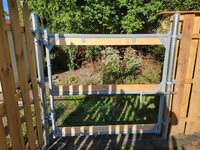
So here's a few pics, hopefully?
Attachments


OP
Suburbancharlie
Well-known member
I'll be the first to admit I haven't got a clue.I am reminded of the saying: "Anything seems possible when you don't know what you're doing."
But I've done my due diligence and researched for countless hours to weed through most of what I read to determine what of the meat and potatoes was sensible and repeated.
Never in a million years would I have expected digging some holes, plumbing some posts, and pouring cement to become such a difficult task!
I'm at 360', alone, while babysitting (yes, my kid, I know that is called parenting), and multiple screw ups by the Distributor, whom now after the fact I'm finding absolutely screwed me upside-down and sideways (over double the price for everything, as compared to several other local and online stores for exact same components) shorting orders, selling and providing other parts not requested, wasting so much time (worse than me enen), and just plain incompetence, aside from this post epic fail.
I haven't a clue about what I'm doing, but feel comfortable saying I have enough knowledge to know when to listen.
How's it go, I know enough to be dangerous?
So here's a few pics, hopefully?
OP
Suburbancharlie
Well-known member
And as far as my tube inside the post idea, yes I understand the 1/16th of an inch will compound over the 10', however, ⅝" is less flex than I'm currently seeing, and according to my super confused calculations, if I managed to use the right numbers, the 2.5" round steel tube should be capable of holding the gate, all on its own?
So there should only be a benefit from adding that, even if it's a sloppy seconds fit?
I dunno, I'll find out later, some tube is supposed to enter my state, and hopefully be available later today. I'm not missing the opportunity to grab some and try.
So there should only be a benefit from adding that, even if it's a sloppy seconds fit?
I dunno, I'll find out later, some tube is supposed to enter my state, and hopefully be available later today. I'm not missing the opportunity to grab some and try.
p00p
Well-known member
if it's feasible for you, you might consider putting a metal triangle (like a gusset) going from the top of the post down to the ground. Tie that in with a fence post sunk & concreted into the ground. Doing that for the gate hinge side should make it withstand a lot more load than the hinges could ever support.
OP
Suburbancharlie
Well-known member
But do you really think that it's safe with only a few inches of "extra" space?if it's feasible for you, you might consider putting a metal triangle (like a gusset) going from the top of the post down to the ground. Tie that in with a fence post sunk & concreted into the ground. Doing that for the gate hinge side should make it withstand a lot more load than the hinges could ever support.
At grade, and down a good foot, is only a 10" sonontube. In that 10" is the 3" essentially centered. Kinda only leaving me ~3" to work with.
Now I do like that triangle idea, to an oversized plate, that would allow me to through bolt a bit in the middle, on both sides of the gusset.
I'm just afraid to be too close to the post or the edge, and cause the cement to burst/ bust?
I'll definitely be having a good close look at the available space there.
Now how high up would you think is necessary?
The other issue is that there's wood fence (my wood fence) on the opposite of hinge side of the post, so obviously I can remove the lumber, but have limited gap wood to post, to get a significant hight of a decent sized plate.
p00p
Well-known member
about 4" inch from the top & sloping down to the ground to meet the newly inground post & ground lateral tube going back to the bottom of the gate post is how I would do it. You wouldn't need 3" tube, maybe 2" or close to it.
OP
Suburbancharlie
Well-known member
Well I feel like I'm in preschool and doing fingerpainting.
Sorry, I couldn't come up with a better method.
So green is lumber fence
Red is the problem posts
Blue is swing gates.
That's why I can't add an additional external support. Unfortunately the way I set everything up is to have the often used gate furthest from the house, so not to wake up the knuckleheads when I've gotta get in the shed in the middle of the night.
Sorry, I couldn't come up with a better method.
So green is lumber fence
Red is the problem posts
Blue is swing gates.
That's why I can't add an additional external support. Unfortunately the way I set everything up is to have the often used gate furthest from the house, so not to wake up the knuckleheads when I've gotta get in the shed in the middle of the night.
Attachments

nmk_61802
Well-known member
For the Gate you have pictured can you reverse it and hinge it off the other post pictured? It looks as if that post has a fence panel and most likely another post outside of the picture range....If you can hinge off that post, then install a tension wire from the top of the fence post to the bottom of the next post. Problem will be solved for less than $10
Unfortunately it is never ideal to have a single or corner post to hinge a gate off of.
Unfortunately it is never ideal to have a single or corner post to hinge a gate off of.
Last edited:
OP
Suburbancharlie
Well-known member
Darn, that high up.
I understand the principle, I'll just have to revisit the available space
I understand the principle, I'll just have to revisit the available space
OP
Suburbancharlie
Well-known member
Ah, the back corner.For the Gate you have pictured can you reverse it a hinge it off the other post pictured? It looks as if that post has a fence panel and most likely another post outside of the picture range....If you can hinge off that post, then install a tension wire from the top of the fence post to the bottom of the next post. Problem will be solved for less than $10
Unfortunately it is never ideal to have a single or corner post to hinge a gate off of.
Honestly that one would probably never be a problem, as I don't foresee it getting used.
Yes, I know what you mean, and I can still flip flop that one.
I hinged it that way so to open it, it's least likely to have **** piled in the way haha.
I wasn't going to have one back there, but absolute unimaginable crazy coincidence, as I was running a bobcat MT85 with the auger attachment, 8" bit with extensions to be 46", I was 2 holes away from my back corner hole to dig, so that's roughly 22' from the power pole.
I'm humming along slowly swinging dirt in the dark by flood flashlights, my kid on the swing behind me, flash bang boom ( All of the onomatopoeia words you can think of, (( ask your kids about "Batman words"))) there's a huge flash overhead, Roman Candle style, and again......
I happen to glance up, the power pole was dancing, sparks all over in the air, and the old time voltage lines are swinging opposite the new smart grid wire, bobcats down at the bottom few inches, Julie has given the all clear, WTF!?!?
Tackle the kid on the swing, forgetting the belt is held by chain, so I practically tear her in half, running for the hills!
Total darkness, backup generators running all around, bobcat still wide open out back.
"Hello, ComEd"
Turns out, a branch, a racoon, and the line, a block and a half away.....
I just so happened to be directly under the end of the cracked whip, and had the wonderful opportunity to get the total experience of the show.
They found the problem down the road, so they never stopped by old Charlie and I got to pay for an extra day with the machine. I called, "hey, that's great you got my power back on, but I've still got this machine in the hole lady. Somebody is coming here to speak with me!"
"Well sir, I don't have all the details blah blah blah"
I had nearly dropped a load in my pants living it, but 2 O'clock the next day when that big beautiful truck pulled up, I think the guy almost wet his pants with laughter as he tried explaining it to me.
So, with all that, I added an easement gate ;-)
But that's the only one that I could flip unfortunately.
But I do love that idea.
bassJAM
Well-known member
After seeing pictures I wanted to revisit my comment about reducing the weight of the gate. Here's what the gates look like on my fence, you basically have the same thing PLUS the weight of the steel frame. Get rid of the frame and you've taken a big chunk of weight off that post, maybe enough that it won't flex anymore.


OP
Suburbancharlie
Well-known member
Yeah, but with frequent repairs to keep square from what I hear.
Actually the frame isn't as much as the lumber, which shocked me.
Just the 13 pickets and three 2x4's was just under half my weight.
But I get what you're saying.
I'll have to mock one up and weight it.
Ugh, why do engineers not answer phones.
Oh yeah, cuz people like me ask stupid questions
Man, I look forward to denying after the fact help.
Wait, then I'd be out of a job
Actually the frame isn't as much as the lumber, which shocked me.
Just the 13 pickets and three 2x4's was just under half my weight.
But I get what you're saying.
I'll have to mock one up and weight it.
Ugh, why do engineers not answer phones.
Oh yeah, cuz people like me ask stupid questions
Man, I look forward to denying after the fact help.
Wait, then I'd be out of a job
FlaGman
Well-known member
Regarding the back corner gate (that can be flip-flopped to hinge the other side), why not experiment on the latch-side post with the rebar and concrete idea? It wouldn’t cost much to try, and it would still allow you to try a different $$ method with the other posts.
You could then measure any bend/deflection difference by putting a ratchet strap between the two posts.
You could then measure any bend/deflection difference by putting a ratchet strap between the two posts.
bassJAM
Well-known member
Ugh, why do engineers not answer phones.
Oh yeah, cuz people like me ask stupid questions
Mostly we just REALLY hate talking to people.
billconner
Well-known member
I feel like I could bend that post, if not just pushing then a little leverage. NFW I could do that with a 2 1/2" pipe - even schd 40, but go to schd 80 or 120. Just saying.
I finished chipping a lot of brush and trees I cleared to or my build, and am beat. I still want to look at my structures book and see if I can calculate deflection. I struggling because I was thinking the modulus of elasticity was in in3 (inches to the third) but it has been long.
I finished chipping a lot of brush and trees I cleared to or my build, and am beat. I still want to look at my structures book and see if I can calculate deflection. I struggling because I was thinking the modulus of elasticity was in in3 (inches to the third) but it has been long.
OP
Suburbancharlie
Well-known member
OhmageeMostly we just REALLY hate talking to people.
If that's not the truth!
I guess I've given up on the architect's guy and her 24-48 hours he was to be contacting me.
Called a big plumbing outfit and got a name for the guy she used for an Amazon building, he's not gotten back to me, even dropping the plumber's name with her permission....
Spoke with a Civil Engineer and he said he uses different types of similarly complicated formulas that would do me no good.
Today's steel supplier provided a name, but his wife informed me he passed.
Though I had another one, but "oh he's in California now, so that's not helpful"???
No ma'am, the math is still the same even if he's on Pluto, which isn't considered a planet anymore, please call him and ask.
I don't think she's going to call :-(
And I even forwarded the info to the Chockfast guy,but haven't heard back.
Are these guys all hermits? It's not even the playoffs yet.
And Bill, no worries. Get some fluids, maybe some Alleeve, and rest.
I'm not sure what the proper formulas are, but I'd imagine that they are displayed on the calculator pages. There's a ton of information there, it's just all hieroglyphics to me.
Let me know if you'd like the links reposted.
I don't know if I'm calculating it right, but I took the 78", called it 7'. Took the 160 pound gate.
7 X 160 = 1,120
When I did a point load on the 2.5", 1,120 had a safety factor of 1.168
Now I know there's still a bunch of chaulk dust on that line, but that's over the line on just the 2.5". Add in the bonus round of a smidgen of help from the galvanized and that should get me out of the red at least?
Am I wrong?
Viper98912
Well-known member
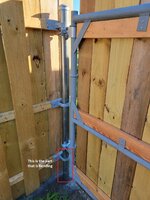
Thanks for the pictures. Question - is the metal post (on the other side) rubbing the gate when closed? If it's not, then you may want to consider re-doing the wood fence material where it's perpendicular/square to the final assembly of the mounted fence, not necessarily perpendicular/square to the metal gate frame itself.
From what I can see in your pictures, I don't see any real/great solutions to your issue. Your best bet is to offset the sag in the fence post as much as possible by compensating in the other direction. I find doing the items below much more reasonable than trying to rip out the post out of the ground and starting all over.
First, I would put an additional hinge as low as possible in the gate (inside of that little triangle). Doesn't necessarily need to be a full height hinge, so get your grinder with a cutting wheel out. Adding a hinge down here will help strengthen the part of the post that's bending (by using the gate itself)
Second, I would cut back the top hinge and re-drill the top holes to get it to pull back inward a bit. I don't know what's inside that hinge as we don't have that angle, but I'm assuming there's some gap in there to be able to take out. So basically, you want to tilt the door back in to offset the post.
If neither of those is good enough, I'd go back to the top of my suggestions and start taking off the wood fence material, and re-install it so it's slightly offset in the other direction, to offset the post sag.

From what I can see in your pictures, I don't see any real/great solutions to your issue. Your best bet is to offset the sag in the fence post as much as possible by compensating in the other direction. I find doing the items below much more reasonable than trying to rip out the post out of the ground and starting all over.
First, I would put an additional hinge as low as possible in the gate (inside of that little triangle). Doesn't necessarily need to be a full height hinge, so get your grinder with a cutting wheel out. Adding a hinge down here will help strengthen the part of the post that's bending (by using the gate itself)
Second, I would cut back the top hinge and re-drill the top holes to get it to pull back inward a bit. I don't know what's inside that hinge as we don't have that angle, but I'm assuming there's some gap in there to be able to take out. So basically, you want to tilt the door back in to offset the post.
If neither of those is good enough, I'd go back to the top of my suggestions and start taking off the wood fence material, and re-install it so it's slightly offset in the other direction, to offset the post sag.