To avoid these ads, REGISTER NOW!

Gauges

CHI_Tool&Die

Well-known member
Joined
Jul 20, 2021
Messages
1,386
Location
Chicago, IL
Guys, I’m looking for some quality thread pitch gauges for work but I’m not sure what to be looking for. I am a machinist so I would need metric and standard. The guys in the shop are no help because they will just go off of sight (the older guys) or literally cycle through all the screws and fittings (the apprentices). Would something like this work or do you have any other suggestions? Thanks for the help!
 
To avoid these ads, REGISTER NOW!

four.cycle

Well-known member
Joined
Oct 19, 2015
Messages
28,953
Location
Tacoma, Washington
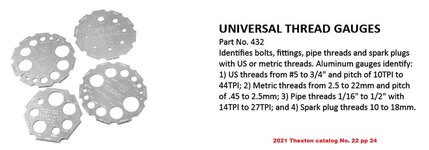
one of the coolest gizmos I've seen lately was this little gem from Thexton:
Thexton 432 thread pitch gauge set 2021 Thexton catalog No. 22 pp 24.jpg
They have limited retail distribution outlets, but that set is available online from a number of sellers. For WAY less money than $48.00.

YMMV
 

RTM

Well-known member
Joined
May 13, 2019
Messages
13,180
Location
SF Bay Area
I passed on several used pitch gauges for $10 each their weekend. The leafed gauge you linked to is much more versatile than the Thexton, especially if you work with oddball stuff, like you see on antiques and old tools.
 

GrantCee

Well-known member
Joined
Aug 23, 2010
Messages
808
Location
Willamette Valley, Oregon
Guys, I’m looking for some quality thread pitch gauges for work but I’m not sure what to be looking for. I am a machinist so I would need metric and standard. The guys in the shop are no help because they will just go off of sight (the older guys) or literally cycle through all the screws and fittings (the apprentices). Would something like this work or do you have any other suggestions? Thanks for the help!
That set isn't actually made by Mitutoyo; it's US made and usually found under the PEC Tools brand. The quality isn't terribly good, with many of the points rounded over or shortened. That makes it very hard to use, especially on the finer pitches.

I'm really surprised Mitutoyo is putting their name on it, to be honest, because it's not up to their standards.

The Starrett equivalent, though more expensive, is a much higher quality tool.
 

four.cycle

Well-known member
Joined
Oct 19, 2015
Messages
28,953
Location
Tacoma, Washington
^ re:
PEC / PEC Tools / Products Engineering Co., 2645 Maricopa St, Torrance, CA 90503 (originally Santa Monica) / https://pec.tools/ / precision measuring devices / est. 1960 /

per my phone conversation with PEC a week or so back, they are outsourcing a good portion of their product line now from China.... like feeler gauges.
wouldn't surprise me in the least if the thread gauge was also being outsourced.
 

four.cycle

Well-known member
Joined
Oct 19, 2015
Messages
28,953
Location
Tacoma, Washington
I bought an old Starrett on Ebay for about ten bucks. I just don't know where I put it. It's SAE only, but that's all I need 99% of the time.
 

GrantCee

Well-known member
Joined
Aug 23, 2010
Messages
808
Location
Willamette Valley, Oregon
per my phone conversation with PEC a week or so back, they are outsourcing a good portion of their product line now from China.... like feeler gauges.
wouldn't surprise me in the least if the thread gauge was also being outsourced.
That may actually be an improvement; my USA-made PEC is shamefully poor.
 

four.cycle

Well-known member
Joined
Oct 19, 2015
Messages
28,953
Location
Tacoma, Washington
I was calling to ask specifically about feeler gauges. I didn't ask them about other products, but the person I spoke with made it pretty clear that a good portion of their product line is now being outsourced.
 

BLUE72CAMARO

Well-known member
Joined
Jan 1, 2014
Messages
911
Location
IL
I have a set of starrett SAE and Metric thread pitch gauges and they are of good quality. The sets I have are 156m for metric and 474 for SAE
 

bwringer

Well-known member
Joined
Jan 1, 2013
Messages
10,293
Location
Indianapolis
What format works for you? What are you measuring most often? Parts, bolts, nuts, or what? There are lots of options, like those sets above that only measure pitch.


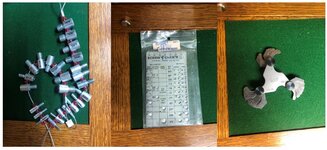
Or maybe a "thread checker" or thread detective would make more sense to your troop. It's basically a wire strung with little male/female examples of each thread size and pitch, and any primate can use it.
Pretty cheap, really.

A nice, even cheaper option, if it works in your most common situations, might be a bunch of these plastic thread L-gauges from Bolt Depot. $2 each when you buy bags of five, and very effective.
This is quick, easy, and what I reach for most often, honestly.


If you're running a lathe or similar machine, then you might need those pitch gauges like the ones you linked. As others have said, in really small sizes it pays off to scare up the highest quality set you can find.
 
OP
C

CHI_Tool&Die

Well-known member
Joined
Jul 20, 2021
Messages
1,386
Location
Chicago, IL
That set isn't actually made by Mitutoyo; it's US made and usually found under the PEC Tools brand. The quality isn't terribly good, with many of the points rounded over or shortened. That makes it very hard to use, especially on the finer pitches.

I'm really surprised Mitutoyo is putting their name on it, to be honest, because it's not up to their standards.

The Starrett equivalent, though more expensive, is a much higher quality tool.
Thank you for that heads up. I saw the Starret and the Mitutoyo and wasn't sure if the difference in quality was enough to justify the cost difference. Now I know.
What format works for you? What are you measuring most often? Parts, bolts, nuts, or what? There are lots of options, like those sets above that only measure pitch.


Or maybe a "thread checker" or thread detective would make more sense to your troop. It's basically a wire strung with little male/female examples of each thread size and pitch, and any primate can use it.
Pretty cheap, really.

A nice, even cheaper option, if it works in your most common situations, might be a bunch of these plastic thread L-gauges from Bolt Depot. $2 each when you buy bags of five, and very effective.
This is quick, easy, and what I reach for most often, honestly.


If you're running a lathe or similar machine, then you might need those pitch gauges like the ones you linked. As others have said, in really small sizes it pays off to scare up the highest quality set you can find.
I'm running mills with lots of fixtures that use socket head cap screws. Some stuff has very fine threading and others really coarse - metric and standard. I was looking for something to help me identify the sizes so I don't spend all day trying to find the right screws.
 

mogandave

Well-known member
Joined
Nov 4, 2021
Messages
3,052
Location
Bangkok
I have a number of nice pitch-gages, but for checking screws and nuts it pretty tough to beat one of these:

thread gage.jpg

This picture is from MSC, but I think I got mine from Enco a while back. Nuts screw on one end, screws screw in the other.
 
To avoid these ads, REGISTER NOW!

bwringer

Well-known member
Joined
Jan 1, 2013
Messages
10,293
Location
Indianapolis
It occurs to me that you might also put together something your own thread checker. Depends on your use case, variety of machines, etc. but... take samples of all the most common sizes of screws, paint the heads red or blue for SAE or metric, engrave or stamp the sizes, then get some swivel fittings (so you can rotate them), drill holes in the heads, and attach the lot to a cable, much like those thread checkers.

You could do the same with an assortment of nuts in the sizes you're likely to encounter.

In other words, if you have, say, ten or twelve sizes you need to distinguish, then making your own tool out of actual fasteners could make sense.

Or, you could do something like order up a couple of thread checkers, then remove the sizes you're not likely to encounter to make up one string that covers your machines.

Thread gauges like the type pictured in the first post require a bit of time and skill to use, especially in smaller sizes, and don't give you the diameter. And in the end you still have to double-check with an actual fastener thread.

There are also SAE and metric threads that are easy to mix up, so the only way to tell is to try. I once had no end of trouble arise from some old git in a hardware store who sold my buddy a 1/4-28 screw for a Suzuki motorcycle (M6-1.00). 5/16 and 8mm can be hard to tell apart sometimes.
 

dr_clyde

Well-known member
Joined
Jan 7, 2009
Messages
6,446
Location
Holland, MI
If this is your career, you should be able to justify some nice Starrett pitch gages.

These are best for checking a thread to identify it, but aren't good for much else. If you need to check threads you made to see if they're in tolerance, you need thread wires or a thread mic.
 

mogandave

Well-known member
Joined
Nov 4, 2021
Messages
3,052
Location
Bangkok
A traditional thread pitch gage is really not very good for checking screws and is almost useless for checking female threads. They are great when you want to check cut-threads on the end of shafts and whatnot. Of the three below, to check screws and nuts I only ever use the one on the left, but it only goes up to 1/2". I originally got them for the parts crib and assembly tables, but after I tried one I never went back to the Starrett for screws. I don't think I ever used the one in the middle.

Threads.JPG
 

goldtang

Well-known member
Joined
Feb 11, 2012
Messages
474
Location
Western Australia
MOORE & WRIGHT Screw Pitch Gauges are what I have been using for about 40 years have been more than happy with them . I have couple of sets of each American national , metric and whitworth.
 

BillK

Well-known member
Joined
Aug 24, 2006
Messages
9,324
Location
Beautiful Southern Maryland
I have two Starrett ones. One metric and one sae. They are probably over 30 years old. Personally I dont like the three sided ones. mostly due to the way they sit in my box.

To be honest with you 99% of the time if I am not sure of what size a screw or bolt is I grap my cheap digital caliper and measure the od. Then there is generally only two choices for pitch. But then agaain I am probably dealing with no more than 15 common automotive sizes and I can pretty much ID them by looking at them.
 

dutchgray

Well-known member
Joined
Sep 28, 2014
Messages
6,467
Location
Dorset. England.
MOORE & WRIGHT Screw Pitch Gauges are what I have been using for about 40 years have been more than happy with them . I have couple of sets of each American national , metric and whitworth.
Old Moore & Wright is what I have but they make much in the UK anymore, mostly far east production, don't know where the current thread gauges come from though.
 

goldtang

Well-known member
Joined
Feb 11, 2012
Messages
474
Location
Western Australia
Old Moore & Wright is what I have but they make much in the UK anymore, mostly far east production, don't know where the current thread gauges come from though.
I would not like to guess we’re some of the gear is made any more i did score a couple of my gauges off a retiring machinist when I was an apprentice the rest I bought new and when I no longer can use them I will pass them on
 

gearhead1

Well-known member
Joined
Oct 14, 2013
Messages
1,935
Location
NC
OP, I have the ones like you linked and they are perfectly fine. The reason they are designed that way is to fit in a blind tapped hole. That way they work on both external and internal threads.
 

gearhead1

Well-known member
Joined
Oct 14, 2013
Messages
1,935
Location
NC
I find I can accurately guess the SAE threads, so I use the gauges more for metric. I’ve also found it can be tricky when trying to determine thread pitch on smaller diameter fasteners. If I’m not familiar enough with the equipment or application, I measure the diameter first on small fasteners to try and figure out if it is SAE or metric. Then I attempt to measure the pitch.
 
Last edited:

Steve_P

Well-known member
Joined
Sep 15, 2010
Messages
5,185
I have an SPI metric thread leaf gauge set. Mine must be 20 years old, and it's excellent quality; no idea if they're as good today. For inch size, I have a generic one from Enco and it's also fine, although I almost never use it as I can generally judge by eye.
 

Steve_P

Well-known member
Joined
Sep 15, 2010
Messages
5,185
Something I just remembered as I went thru this a few months ago with a small metric screw, maybe M4 or M5. If you're not sure if its inch or metric, there are several metric and inch size screws that are close enough in diameter and pitch that they will thread into both inch and metric nuts or gauges. This is why you want to have the thread pitch gauges.
 
To avoid these ads, REGISTER NOW!
Top Bottom