To avoid these ads, REGISTER NOW!

Gauging heat loss from slab?

leeklm

Well-known member
Joined
Jul 15, 2011
Messages
72
Location
Minneapolis
This is my first winter with radiant heat, and am trying to determine what level of heat loss can be expected from the slab? My system seems to run efficiently and is not circulating very often, even with our recent -12 F cold snap. I have been keeping my slab temp at 60 degrees, which keeps the air temp at 55-60.

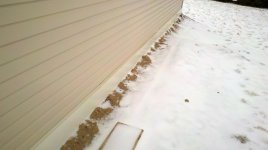
As seen in the pictures, we have not had much snow. The pics of the south & north side of the garage were taken about 3 days after the 1-2" snowfall. You can also see the roof drip line in the dirt to give you an ideal of the overhang, which of course minimizes how much snow piles up to begin with.

Any thoughts from guys with slab heat in the great white north? Does this look pretty typical?
 

Attachments

  • North side snow.jpg
    North side snow.jpg
    137.5 KB · Views: 35
  • south side.jpg
    south side.jpg
    142.8 KB · Views: 35
To avoid these ads, REGISTER NOW!

chickenhauler

Well-known member
Joined
May 31, 2011
Messages
473
Location
Pennsylvania
It does to me. I poured my house's slab inside of a stem wall that is insulated up to the surface and it will slowly melt snow out to a foot or so, eventually, if there's no new snowfall.
 

Gary S

Well-known member
Joined
Dec 27, 2008
Messages
2,972
Location
Bismarck, ND
Any time you heat the garage, you will lose some heat. Measuring the heat loss gets very difficult.If you think you are losing too much heat, try adding some insulation around the outside of the slab to contain it.

I don't heat my garage full time, so my slab becomes a source of heat to warm the garage from the ground heat rising up through it in winter. When the air temperature is -20 and the ground temperature a foot down is +30, the slab warms the building.
 

tdkkart

Well-known member
Joined
Jun 17, 2006
Messages
6,887
Location
Eastern Iowa
my slab becomes a source of heat to warm the garage from the ground heat rising up through it in winter. When the air temperature is -20 and the ground temperature a foot down is +30, the slab warms the building.


That would depend on which side of the "hot moves to cold" or "cold moves to hot" argument your on. Yes, I know, warm air rises, but cold air also sinks.......
 

Provincial

Well-known member
Joined
Sep 21, 2011
Messages
6,855
Location
Near Salem, OR
Temperatures tend to equalize, so the heat moves to the cold and vice versa. The only question is which is further from equalibrium, but the meeting point tends to be very near the temperature spread. Air holds less energy than ground/solids, but convection moves it around pretty fast. Solids move energy fast because of conduction, so an insulation barrier isolating a solid (like your slab) makes for a good return on investment.
 
OP
L

leeklm

Well-known member
Joined
Jul 15, 2011
Messages
72
Location
Minneapolis
I should note that there is 2" XPS (R10) foam under the slab and up the side of slab and 9" block (which the tin in the pictures is covering). I have read articles where some will dig down to bottom of slab, and out from the bldg 4ft, laying XPS foam flat in the trench. The idea is that the extra insulation will keep the frost away from the slab. I am not sure how much this will help, or if it is worth the extra cost & effort. I will need to make that decision before my landscaping project starts in the spring...
 
To avoid these ads, REGISTER NOW!

CARS

Well-known member
Joined
Jan 19, 2011
Messages
535
Location
New Ulm, MN
My slab had 2" foam under it and along the inside of the foundation wall. The foundation walls are poured about 2' higher than ground level.

The first winter I went though alot of LP and the snow melted a foot away from the foundation.

The next summer I dug down 2' and attached foam to the foundation wall. I don't get snow melt anymore around the building and cut my fuel bill down.

For ascetic reasons I stuccoed the foam to match the buildings white walls.
 
OP
L

leeklm

Well-known member
Joined
Jul 15, 2011
Messages
72
Location
Minneapolis
My slab had 2" foam under it and along the inside of the foundation wall. The foundation walls are poured about 2' higher than ground level.

The first winter I went though alot of LP and the snow melted a foot away from the foundation.

The next summer I dug down 2' and attached foam to the foundation wall. I don't get snow melt anymore around the building and cut my fuel bill down.

For ascetic reasons I stuccoed the foam to match the buildings white walls.

I have a floating slab, and no insulation directly under the "footing" of the slab. I may be getting some heat loss from under the slab perimeter. If so, it may make sense to lay the 4ft insulation down along the foundation as I mentioned above... I will see how it goes the rest of this winter, as so far, the NG use seems pretty minimal.
 

nehog

Well-known member
Joined
Jan 2, 2010
Messages
7,935
Location
Jaffrey, NH
I'm thinking of foam (as above, a floating slab with no insulation) around the perimeter. Probably will go down three or four feet (likely three since I'd be digging it by hand in sandy soil.) I might do a side per year and take measurements of the effect, that is I'll do the west side (30 ft) which I have good access to, and then monitor slab temperature next winter.
 

CARS

Well-known member
Joined
Jan 19, 2011
Messages
535
Location
New Ulm, MN
Probably will go down three or four feet (likely three since I'd be digging it by hand in sandy soil.)

Sheets are 4'x8'. When I said I went down 2' what I really meant was on average I dug 2'. Add the 2' above the ground on average and what I did was really just dig down enough to lay a sheet lengthwise under my steel siding to keep the wind from "shearing" the heat away from the foundation wall.

For some reason my floor doesn't have a barrier between the wall and slab. So even with that 5 1/2" connection heat goes from the slab and out the foundation wall. I think that even a 1/2" of foam pushed over the pinning that holds the slab to the wall would have done wonders to stop the heat from wicking out the building.
 

Motofixxer

Well-known member
Joined
Oct 10, 2009
Messages
681
Almost any insulation is better than no insulation. Think of your exposed skin in the winter, even putting a shirt sleeve over it makes a noticeable improvement.
 
To avoid these ads, REGISTER NOW!
Top Bottom