
To avoid these ads, REGISTER NOW!

GE triclad motor on a Saylor Beall compressor

jamurr65

Member
Joined
Oct 28, 2018
Messages
18
Location
central square ny
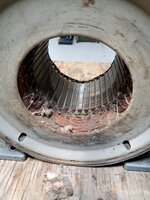
I dont think I have ever posted anything but sure have read alot on here, awesome forum with tons of information. Just wanted to share some info and some pictures on this motor. I know theres members here that have shown interest on these motors. The motor came on an old Saylor Beall compressor that I got for moving some woodworking equipment around for a friend. Love this old stuff. The reason for the teardown is every once an a while when the compressor kicked on the motor would hum while running. So I would turn it off and restart and it would be fine?? Holy **** is this heavy. Few things I found, the bearings felt and sounded like **** before tear down but didnt seem bad in my hands, ordered new anyway. Original capacitors, ordered new because that may have been the humming noise when it starts. One thing I found odd and I am no expert by any means, Both caps were of the same size 460-552 I thought one was for start and one was for run. Pretty dirty inside but not to bad,mouse nest and the remains of one. Some shewed up string and one bare wire up near one of the caps. I believe its from the 60s or 70s and the motor tag states for service station,dont know if that bad or good. Another thing I notice is that the contact start switch is different than most, which I had to repair when I first got it and before I turned on, Can you see the tiny screw in the switch arm? Not the usual
centrifugal switch like most. Well it is but different. One question I have is, has anyone ever bought anything from Carbon Brush .com? Would love to hear from anyone with any insight or tips tricks or any ideas on replacing the start contact switch. I know my repair isnt going to last forever. Thanks for reading guys and gals.
 

Attachments

  • 20231007_154218.jpg
    20231007_154218.jpg
    827 KB · Views: 33
  • 20231008_093230.jpg
    20231008_093230.jpg
    730 KB · Views: 28
  • 20231008_093241.jpg
    20231008_093241.jpg
    585.1 KB · Views: 29
  • 20231007_145820[1].jpg
    20231007_145820[1].jpg
    806.5 KB · Views: 35
  • 20231007_145358.jpg
    20231007_145358.jpg
    922.4 KB · Views: 34
To avoid these ads, REGISTER NOW!

winnievan

Well-known member
Joined
Nov 18, 2018
Messages
115
Location
OR
Cool post — just realized my Saylor Beall has one of these too. Didn’t realize they were such sought after motors.

I’ll put a magnetic starter on it stat — don’t want to toast it!!
 

marinusdees

Well-known member
Joined
Oct 30, 2012
Messages
1,325
Location
Edgewood, Washington
I dont think I have ever posted anything but sure have read alot on here, awesome forum with tons of information. Just wanted to share some info and some pictures on this motor. I know theres members here that have shown interest on these motors. The motor came on an old Saylor Beall compressor that I got for moving some woodworking equipment around for a friend. Love this old stuff. The reason for the teardown is every once an a while when the compressor kicked on the motor would hum while running. So I would turn it off and restart and it would be fine?? Holy **** is this heavy. Few things I found, the bearings felt and sounded like **** before tear down but didnt seem bad in my hands, ordered new anyway. Original capacitors, ordered new because that may have been the humming noise when it starts. One thing I found odd and I am no expert by any means, Both caps were of the same size 460-552 I thought one was for start and one was for run. Pretty dirty inside but not to bad,mouse nest and the remains of one. Some shewed up string and one bare wire up near one of the caps. I believe its from the 60s or 70s and the motor tag states for service station,dont know if that bad or good. Another thing I notice is that the contact start switch is different than most, which I had to repair when I first got it and before I turned on, Can you see the tiny screw in the switch arm? Not the usual
centrifugal switch like most. Well it is but different. One question I have is, has anyone ever bought anything from Carbon Brush .com? Would love to hear from anyone with any insight or tips tricks or any ideas on replacing the start contact switch. I know my repair isnt going to last forever. Thanks for reading guys and gals.
GE quit making those motors because they were bulletproof, couldn't sell replacements. Replace those microswitches, atypical starting switches, atypical centrifugal mechanism. Likely double row ball bearing on shaft end, single row on the other end. Just because it's me, I would rplace both bearings. If you don't know, there is a number on each bearing, peculiar to that bearing only. Any bearing house, or Amazon, or ebay will have these bearings. I wouldn't obsess about made in USA bearings, my motor shop owning buddy uses Korean made. If you are really ****, take the stator to a motor shop (assuming you can find one) and have it dipped and baked. Personally, if it looked OK, I wouldn't. If I left anything out, PM me. This motor will be running when you are not.
 
To avoid these ads, REGISTER NOW!

Beerhippie

Well-known member
Joined
Oct 13, 2023
Messages
9,801
Location
Far NE Oregon
While you're at it, check the unloader valve on the compressor. It' like a compression release for starting the compressor, and can cause the same symptom you describe. Our old DeVibliss would do the same thing--and pop the breaker--until I rebuilt the unloader.
 

Packard V8

Well-known member
Joined
Mar 16, 2009
Messages
7,380
Location
Spokane, WA
"New Tri-Clad Motor Introduced" (Chem. Eng. News, 1940, 18 (23), p 1102.):
"CHANGING requirements of industry have resulted in introduction by the General Electric Co., Schenectady, N. Y., of an entire line of completely new polyphase induction motors in integral horsepower sizes. Known as the Tri-Clad motor and representing one of the most extensive product changes in the company's history, this general purpose motor has called for new methods in manufacturing and introduces many protective features.
In all ratings the new motor presents modern streamlined appearance, more complete protection through use of a cast-iron frame, major advances in insulation of current-carrying parts, and improved bearing design and lubricating arrangements. It incorporates the cast-aluminum rotor and a pressure-relief system of greasing for ball-bearing motors.
A cast-iron frame of the box type is used instead of the conventional open frame. End shields, designed to match the frame, are enclosed above the center line. This combination minimizes contact of vital motor parts with foreign material such as lubricants, coolants, other ... "
jack vines
 
To avoid these ads, REGISTER NOW!
Top Bottom