To avoid these ads, REGISTER NOW!

General Aviation Tools?

gagreen

Well-known member
Joined
Mar 22, 2013
Messages
779
Location
Colorado
I'm desperately trying to get into a smaller GA shop after I finish my A&P. I've interviewed with a few shops already, and these places are small. So to keep away from being that unprepared new guy what tools would you suggest? Outside of the typical standard hand tools?
Magneto timing light?
Ignition lead tester?
Cylinder head wrenches?
Air Drill and rivit gun (I am getting these suggestions on brands or deals?)

Anything else you use on a fairly regular basis please let me know.

I am intentionally going for the small fbo's with a focus on getting into a place fixing agricultural aircraft. Thanks for the help.
 
To avoid these ads, REGISTER NOW!

Provincial

Well-known member
Joined
Sep 21, 2011
Messages
6,855
Location
Near Salem, OR
All the items you listed, plus a differential cylinder pressure tester, accurate tire pressure gauge that reads down to 20 psi, good duckbill pliers in addition to the safety wire twisters because twisters don't get the job done in some areas, spark plug gapper and gauge, and a stiff piece of wire about 1/8" diameter and about 3" long to slip through the center hole of turnbuckle barrels to adjust them.

I would also suggest several pair of pliers. Needle-nose, bent needle-nose, short needle-nose, duckbill with and without teeth, an assortment of vise grips, and an assortment of Channellock (groove-joint) pliers.

Crowfoot wrenches come in handy, but get good quality ones, as cheap ones will slip and ruin the fitting.

A good 37* flaring tool comes in handy, but you can probably wait on that.

A good LED trouble light, preferably cordless, will be worth it's weight in gold!

A mobile bag or box for when you need to take tools out to the flight line. Get in the habit of putting the same tools in the same place in the box/bag each time. When you finish the job, take inventory of your tools before closing the box/bag. You will be surprised how often you discover a tool left behind!
 

A_Pmech

Well-known member
Joined
May 8, 2007
Messages
8,002
Location
IL
Gear wrenches and u-joint sockets will save your *** on a daily basis. A good selection of inspection mirrors, a battery operated drill with clutch for removing and installing inspection panels and a couple Streamlight or Surefire LED flashlights should also be added to your kit.

Don't go buying cylinder wrenches, compression testers, timing lights, etc. until you see what your prospective employer has. Even small FBO's will usually provide all that. It really doesn't take an enormous box of tools to work on general aviation aircraft. I used to work out of a large air force tool bag and it was usually sufficient at remote locations.
 

CWP1616L

Banned
Joined
Aug 31, 2012
Messages
3,297
Location
USA
You're gonna need this tool here. It's a speed handle with a big plastic knob. The big plastic knob enables you to put a lot of pressure on the screw head. You're gonna need that for stubborn painted screws on access panels. If you try to use a cordless tool on everything, you'll be stripping a lot of screw heads. The speed handle enables you to break the screw head loose slowly without stripping it.

SNAP-ON

SNAP-ON
 
Last edited:

bhalv

Well-known member
Joined
Oct 27, 2011
Messages
346
Location
Boise Idaho
You're gonna need this tool here. It's a speed handle with a big plastic knob. The big plastic knob enables you to put a lot of pressure on the screw head. You gonna need that for stubborn painted screws on access panels. If you try to use a cordless tool on everything, you'll be stripping a lot of screw heads. The speed handle enables you to break the screw head loose slowly without stripping it.

SNAP-ON

SNAP-ON

One of these just saved my bacon 2 days ago removing a stripped out screw in an inspection panel. I would also strongly suggest a set of angle head wrenches, a cotter pin puller, and a #2 phillips long shaft screwdriver. oh, don't forget a set of picks/scribes.
 
Last edited:

Charles (in GA)

Well-known member
Joined
Jan 11, 2006
Messages
12,489
Location
50 mi south of Atlanta
A 7/8" Craftsman ½" drive full depth broach DEEP 12 point socket for removing spark plugs.

A 9/16" DEEP 12 point Craftsman, full depth broach, socket for removing Continental Motors fuel injection nozzles.

A 3/4 and a 7/8 12 point crowsfoot, the line wrench type, for loosening bottom spark plug leads in difficult to reach places between exhaust stacks.

A set of ¼ drive SNAP-ON 12 point flex sockets, and a set of locking extensions. Buy an extra 7/16" socket and be prepared to grind it real thin, to fit over the brass exhaust stack nuts on large Continentals.

A spark plug gapping tool and wire gauge set, keep your own, as people will damage, bend and totally screw up the shop's tools. These belong in your toolbox, not the shop tools.

Rivet gun, GA sheet metal is THIN, a 2X or at the most a 3X is all you will need, plus a good set of bucking bars (the ten bar set is a good place to start)

For an air drill, get a 2500-2800 RPM palm drill with a ¼" chuck, not one of those huge automotive air drills. Dotco makes a great one with a very smooth teasing trigger. I think the Sioux palm drills are OK too. IR makes (or did) a very nice one model 3AL1. Looks like the last one on Ebay was in Feb and sold for $250.

If you don't know about them, go to www.yardstore.com and look at what they have.

Do not skimp on safety wire pliers, the cheap chinese ones will get to where they won't hold or stay locked. Get Milbars, a set of 6" and you will need a larger 9" for .041 wire for safetying props. A good mechanic needs the safety wire pliers to allow him to work faster. You most certainly can do the safety wire twisting with your fingers and duck bills, but the customer is paying to get it done, not for you to mess around with slowly twisting wire by hand. Some tight places you just about cannot get your hands to twist it anyhow.

A set of angle wrenches will be a lifetime investment. Snap On has the more desirable angles to the head than most other brands.

Ratcheting magnetic tip screwdriver also, and a tube of clover valve lapping compound to smear on the tip to make it bite tighter when you have a difficult screw.

Charles
 
Last edited:

jmm

Well-known member
Joined
Aug 20, 2012
Messages
1,349
Location
NC
Not an aviation guy, but a close friend of mine works on small aircraft for a living. I've seen his box before, and there's lots of testers and whatnot that I'm not familiar with, but what strikes me are the number of t-handled tools he has. A few I remember right off were 1/4 and 3/8 drive sliding T-bars in a few different lengths and a couple modified for specific jobs. Pretty much all sizes through 9/16 in flexible t-handles. Complete sets of as torx, allen, and a few odd drives I'm not familiar with. He's built a locking hutch with them all organized on racks (FOD precaution, I reckon) -- very sharp.
 
OP
G

gagreen

Well-known member
Joined
Mar 22, 2013
Messages
779
Location
Colorado
thanks for all the replies. I was avionics in the air force on 16's and 117's so I started out buying tools to basically mimmic the tool box I used in the air force. I was wondering about th angle head wrenches, never used them in the military but that's why I'm asking here.

I invested in milbar's got a 6" pair with reversing and cushioned throat. I still need to get my 9" sw pliers. I've got a few pairs of needle nose, some duckbills, a few pairs of vise grips of different styles, side cuts, a pair of knipex side cuts (smaller for getting at that safetywire that is impossibly close or tight) and a pair of linesman's.

I never used a drill/driver in the military so i have a set of craftsman speed handles. I found an old craftsman 1/2 drive speed handle that is going to be my stuck screw go to it has a similar end to the snap ons linked and it was free lol.

I have never seen locking extensions before, but I will have a set the sk's seem reasonably priced so why not. I have the universal joint extensions that will have to work till i start making enough money to jump on a snap on set.

I need schooled on air tools. The sheetmetal course at school was my favorite class, but school rarely teaches you about the ins and outs of the tools you are using. I have been lurking yardstore.com for a few weeks but not knowing a whole lot about air tools I haven't pulled the trigger on a drill or a rivet gun. Thanks for the heads on up on them.
 

Airframer

Well-known member
Joined
Feb 10, 2013
Messages
195
Everything mentioned above. I will stress the speed handle, valve lapping compound, and lots and lots of apex bits.

Do not cheap out on line wrenches - the inexpensive ones will just piss you off.

If you get a rivet gun, pick up a lester-tool as well (screw knocker) if not provided in the tool room.

Most of the specialty stuff will come in time. You'll know when you need it (e.g. you just spent an hour trying to remove or install something and an old timer hands you a bent up, welded up wrench which would have allowed you to do the job in 20 minutes). When you start acquiring the odd stuff, start with what is not available in the tool room first.
 

Airframer

Well-known member
Joined
Feb 10, 2013
Messages
195
Whoops! Took too long writing that last one!

About the angle head wrenches - you will need them when none of your regular stuff can access that nut.
 

Charles (in GA)

Well-known member
Joined
Jan 11, 2006
Messages
12,489
Location
50 mi south of Atlanta
If you get a rivet gun, pick up a lester-tool as well (screw knocker) if not provided in the tool room.

For heavy aircraft I would say yes, but for small GA aircraft, you could easily destroy the aircraft with one bump from a screw knocker. That is why I suggest the valve lapping compound. Most Cessnas are sheet metal screws so they won't be stuck anyhow.

Just my experience from working the spectrum from light singles up thru corporate and finally airlines for the past 24+ years.

Charles
 
To avoid these ads, REGISTER NOW!

Airframer

Well-known member
Joined
Feb 10, 2013
Messages
195
For heavy aircraft I would say yes, but for small GA aircraft, you could easily destroy the aircraft with one bump from a screw knocker. That is why I suggest the valve lapping compound. Most Cessnas are sheet metal screws so they won't be stuck anyhow.

Just my experience from working the spectrum from light singles up thru corporate and finally airlines for the past 24+ years.

Charles

Hmm. Never had an issue being careful, but the smallest thing I've touched is a Twin Otter. My apologies if I've answered out of my depth.
 

Charles (in GA)

Well-known member
Joined
Jan 11, 2006
Messages
12,489
Location
50 mi south of Atlanta
Hmm. Never had an issue being careful, but the smallest thing I've touched is a Twin Otter. My apologies if I've answered out of my depth.

I have some time on a Twin Otter. ASA (now merged into Express Jet and owned by Sky West) first began operations with one DHC6-200 operating 6 times a day between Atlanta and Columbus, GA. I worked in a small GA shop in CSG and every other Monday evening they would cancel the last flight of the day, and the first flight on Tues morning, and we would spend the night pulling a 100 hr on the aircraft, doing flap/aileron rods end inspections for splitting, and all of the other engine and airframe items, etc. It was a good experience.

The skin and structure on most singles and light twins is just too light for a screw knocker, scares me to see someone with one around a GA aircraft.

There is a device that screws into an adjacent nutplate and has a sliding apex bit holder and square drive and a handle to allow you to bear down, giving you a lot of down force, to break the screw loose, it all folds up real compact, but very expensive. Don't recall where I finally found someone selling them. Would be good for line mx where you don't have any air. An ex Nat Guard guy at work had one.

Charles
 
OP
G

gagreen

Well-known member
Joined
Mar 22, 2013
Messages
779
Location
Colorado
I have some time on a Twin Otter. ASA (now merged into Express Jet and owned by Sky West) first began operations with one DHC6-200 operating 6 times a day between Atlanta and Columbus, GA. I worked in a small GA shop in CSG and every other Monday evening they would cancel the last flight of the day, and the first flight on Tues morning, and we would spend the night pulling a 100 hr on the aircraft, doing flap/aileron rods end inspections for splitting, and all of the other engine and airframe items, etc. It was a good experience.

The skin and structure on most singles and light twins is just too light for a screw knocker, scares me to see someone with one around a GA aircraft.

There is a device that screws into an adjacent nutplate and has a sliding apex bit holder and square drive and a handle to allow you to bear down, giving you a lot of down force, to break the screw loose, it all folds up real compact, but very expensive. Don't recall where I finally found someone selling them. Would be good for line mx where you don't have any air. An ex Nat Guard guy at work had one.

Charles

They go by johnson bar or the manufacturer named the tool el brutus. Loved having that as a go to, it was a daily go to on the f-117. Pretty pricey I'm watching for used ones to pop up.

Pretty sure brown aviation sells them new.**
 

Airframer

Well-known member
Joined
Feb 10, 2013
Messages
195

Provincial

Well-known member
Joined
Sep 21, 2011
Messages
6,855
Location
Near Salem, OR
A 7/8" Craftsman ½" drive full depth broach DEEP 12 point socket for removing spark plugs.
Charles

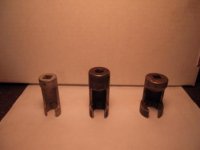
I found that the full broach would damage the upper (where the lead attaches) threads on large barrel spark plugs. These threads are nearly as big as the hex flats and if you allow the socket to tip a little the sharp edge of the 12 point contacts the threads and smears them over. One way to deal with this is to put a sleeve of thin aluminum sheet metal in the upper end of the broaching to protect the threads. I later found a New Britain 6 point deep socket with a short broach and smooth bore big enough to clear the upper end of the large thread plugs.

I made a couple of special wrenches for the spark plug leads. In the photos the left hand wrench is the original Pratt & Whitney wrench I used as a pattern. It was 5/8" hex for a long-obsolete size connection. The center one is 3/4" hex for the "standard" leads in current use. I made it from a SnapOn impact socket using a small cut-off wheel and some grinding. The right hand wrench is 7/8" hex for "All-Weather" leads and is also made from a Snap-On impact socket. I had to cut this one down in length and replace the original 1/2" drive with a 3/8" square. These are great for those hard to reach plugs!
 

Attachments

  • DSCN1390.JPG
    DSCN1390.JPG
    11.8 KB · Views: 35
  • DSCN1391.JPG
    DSCN1391.JPG
    11.9 KB · Views: 28

Mooniac

Well-known member
Joined
Jan 23, 2013
Messages
113
Location
Wichita, KS
I'm an owner that does a lot of my own (supervised) maintenance and can say there is a lot of great advice above.

If you do care to own your own mag timing system, I cannot recommend this one highly enough:
http://www.ritesystem.net/

I've found deep offset box wrenches handy. Every now and then I troll the local pawn shops (tons in this town) and look for quality 3/8 and 7/16 wrenches to acquire for spares and modifications. Sometimes I need very thin wall wrenches and cut/grind these as needed.

My plane has a ton of inspection panels and belly panels with hundreds and hundreds of machine screws that need to be removed for annuals, and my now favorite method is this beauty from Snap On:
http://buy1.snapon.com/catalog/item.asp?item_ID=646593&group_ID=682669
I got it at an Oshkosh show special for ~$110 and it is worth every penny. Adjustable clutch, great battery life and ergonomics. It must be used with a good quality bit, though, like the SO versions with the ridges that really grip the screw heads. I'm also a big fan of the old plastic-handle SO ratcheting screwdrivers... I have a regular and stubby one and they're wonderful.

I recently got a set of 1/4" drive SK swivel sockets and they've been very handy as well. Snap On angle wrenches are on my wish list next.

Long needle nose pliers and hemostats prove to be handy many times.

I like Provincial's modified sockets for working on spark plugs, and I believe I'm going to copy his work! Conventional wrenches and sockets work OK for me, but there is limited swing room in between my exhaust and induction tubes...those sockets would speed up that work considerably.
 

Charles (in GA)

Well-known member
Joined
Jan 11, 2006
Messages
12,489
Location
50 mi south of Atlanta
Yeah, I worked on CODs in the Navy and got a lot of use out of the Johnson Bar- didn't realize they were that expensive. Figured on about $150-200:

http://www.browntool.com/Default.aspx?tabid=255&ProductID=1719&List=1&SortField=ProductName,ProductNumber

Now, we do mostly line maintenance on 737's to support a paint shop. R&R flight controls, etc. Get some oddball things like the Otters, CL-215, Saabs, etc sprinkled in now and then.

Thanks for the link!!!!!!!! I never could find anything about them with web searches. That was back when my co-worker had his. I later forgot the El Brutus name and could not search again. My co-worker went on to become a full time FE on the J-Stars so he wasn't around to ask.

Seriously considering spending the money to get one. Funny, but in the description it says "Choose from two different models" but only lists one and doesn't explain what the other might be.

Whats slick is how it folds up to take up so little space, and how smoothly everything slides and pivots.

I found that the full broach would damage the upper (where the lead attaches) threads on large barrel spark plugs. These threads are nearly as big as the hex flats and if you allow the socket to tip a little the sharp edge of the 12 point contacts the threads and smears them over. One way to deal with this is to put a sleeve of thin aluminum sheet metal in the upper end of the broaching to protect the threads. I later found a New Britain 6 point deep socket with a short broach and smooth bore big enough to clear the upper end of the large thread plugs.

About the spark plug sockets, you can still find the genuine WWII surplus Plomb aircraft spark plug sockets also. They work great on the standard plugs (with 3/4 lead nuts) and they have a fiber insert to center them and protect the threads and a square external on the base for turning with a open end in tight spaces. Of course they don't work on the weatherproof plugs.

A REALLY big hammer with a short handle, you probably won't use it, but it will keep pilots from asking stupid questions.

That reminds me, the OP will want a decent brass hammer also. Absolute necessity for an aviation mechanic.

Charles
 
Last edited:
OP
G

gagreen

Well-known member
Joined
Mar 22, 2013
Messages
779
Location
Colorado
Seriously considering spending the money to get one. Funny, but in the description it says "Choose from two different models" but only lists one and doesn't explain what the other might be.

Whats slick is how it folds up to take up so little space, and how smoothly everything slides and pivots.

Charles

3/8 and 1/4 drive options. I used both but generally went for the 1/4, easier to use by yourself
 

Guam_Guy

Well-known member
Joined
Jun 11, 2011
Messages
75
The "El Brutus" has come in handy when removing tip cap screws on main rotor blades. The difference between the two models are the different drive options and tool length. I have both and they are worth every penny. Works like a charm with hi-torq bits.
 
To avoid these ads, REGISTER NOW!
Top Bottom