To avoid these ads, REGISTER NOW!

Generator connection for dual panels

mike93lx

ALLIANCE MEMBER
Joined
Dec 9, 2013
Messages
37,487
Location
Richmond, VA
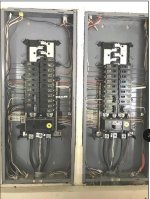
My new house in VA has dual 200a panels (homeline, from 2003). I need to look at the layouts to see if I can get by with just one panel lit up, but in case I need both, what are my options?

It will just be a portable generator with a 30a inlet. I was thinking dual interlocks and somehow connect both to the inlet, but that feels like it won't be compliant for some reason.

Besides moving stuff around, what are my options?
 
To avoid these ads, REGISTER NOW!

u2slow

Well-known member
Joined
Nov 20, 2011
Messages
3,585
Location
BC
The illustrate one of the problems with dual main panels like that. Normally you group what you want backed up into one.

I suppose you could do an interlocked 15A breaker in each panel. A 30A in each could overload the gen. I do not know the NEC particulars.
 
OP
M

mike93lx

ALLIANCE MEMBER
Joined
Dec 9, 2013
Messages
37,487
Location
Richmond, VA
They have their own feeds, from a single meter.
 

Attachments

  • Screenshot_20210517-181410_Acrobat for Samsung.jpg
    Screenshot_20210517-181410_Acrobat for Samsung.jpg
    107.5 KB · Views: 52
OP
M

mike93lx

ALLIANCE MEMBER
Joined
Dec 9, 2013
Messages
37,487
Location
Richmond, VA
What about running the inlet into a small sub as a feed with a 30a breaker, then two 30a breakers feeding to the interconnects? That would allow each panel to pull up to 30a,but not exceed 30a in total

$20 for a 6 space homeline panel, $11 each for three breakers, $50 each for two interlocks

Hoping I can get away with one panel, but just planning for the worst
 
Last edited:

theoldwizard1

Well-known member
Joined
Feb 22, 2011
Messages
43,135
Location
SE MI
My new house in VA has dual 200a panels (homeline, from 2003). I need to look at the layouts to see if I can get by with just one panel lit up, but in case I need both, what are my options?

It will just be a portable generator with a 30a inlet. I was thinking dual interlocks and somehow connect both to the inlet, but that feels like it won't be compliant for some reason.

Dual interlocks are fine. The problem is you probably can't buy a generator with dual 30A outlets !
 

PCustoms

Well-known member
Joined
Jul 23, 2011
Messages
22,625
Location
VT
Just thinking out loud here:

If you have a interlock breaker in each panel, can you feed the left breaker from the right breaker, which is also tied into the 30A inlet? Homeline breakers allow for 2 wires....

Otherwise are these fed from a dual lug at the meter?
 
OP
M

mike93lx

ALLIANCE MEMBER
Joined
Dec 9, 2013
Messages
37,487
Location
Richmond, VA
Just thinking out loud here:

If you have a interlock breaker in each panel, can you feed the left breaker from the right breaker, which is also tied into the 30A inlet? Homeline breakers allow for 2 wires....

Otherwise are these fed from a dual lug at the meter?

I would assume it is a dual lug meter and 320a service

Is it kosher to feed from one panel to another? If so, that is a way simpler way, but theoretically, the wire to the inlet could get overloaded, so I imagine it isn't ok
 

zeke67

Well-known member
Joined
Jun 11, 2010
Messages
272
Location
Houston
Post #5. Post # 7 as an alternate, but it would allow energizing the second panel from the first one if you weren't on gen. Might be considered a second set of feeders to the second panel when not in gen mode.
 

jrkrace

Well-known member
Joined
Aug 12, 2016
Messages
45
Location
Connecticut
I used to use a manual transfer switch wired up to the circuits I wanted energized. I used two automatic transfer switches when I moved up to a 22kw generator. I have the same setup as you with the two 200’s...
 
To avoid these ads, REGISTER NOW!
OP
M

mike93lx

ALLIANCE MEMBER
Joined
Dec 9, 2013
Messages
37,487
Location
Richmond, VA
I used to use a manual transfer switch wired up to the circuits I wanted energized. I used two automatic transfer switches when I moved up to a 22kw generator. I have the same setup as you with the two 200’s...

I have no interest in setup up a separate generator panel. I want everything (or almost everything) to be able to be powered up. This is what I've had in my last two houses, but they were much smaller and simpler.

On the flip side, I have no need for a whole home setup. The area very rarely loses power, so it would be a lot of money ******* to never be used. For now, my 5.5kw generator will be plenty to do what I want, which is lighting, outlets, fridges. A/c would be awesome, but to run one of my 2.5 ton units, I'd need something like 10kw alone.

Ultimately, I can probably get by with an interlock in one of tbe panels and just plan around it. I was just hoping there might be something relatively simple that I could do to get both
 

dcg9381

Well-known member
Joined
Jun 20, 2018
Messages
11,711
Location
Austin, TX
Any reason you cannot connect both panels to the single inlet?

That's interesting. Lets say we are feeding both panels off a single generator inlet and have two interlocks on both mains.. I guess that work work. (and be legal)
 

dcg9381

Well-known member
Joined
Jun 20, 2018
Messages
11,711
Location
Austin, TX
For now, my 5.5kw generator will be plenty to do what I want, which is lighting, outlets, fridges. A/c would be awesome, but to run one of my 2.5 ton units, I'd need something like 10kw alone.

I installed a 20KW generator with two big load sheds. The ATS included a power monitoring system by Generac (which is still very alpha). We stay well under 5KW running a 3.5T HVAC. I don't know what inrush is - or if soft starts would be needed, but via power monitoring, our home doesn't really use that much power.. Note: We don't have tanked water heaters. We could run this home on continuous use with a 7,500 watt generator as long as we kept it to one HVAC system.

What I can't see is how much power is being pulled on each "side" of the panel.

The other thing I've found with portable generators is that those in the 5000-6500 watt size - they can be limited by their breaker on the 240V side, which is often 20A... If your panel has the stuff you "need" largely on one side - it would be easy to over load the gen.
 
OP
M

mike93lx

ALLIANCE MEMBER
Joined
Dec 9, 2013
Messages
37,487
Location
Richmond, VA
I installed a 20KW generator with two big load sheds. The ATS included a power monitoring system by Generac (which is still very alpha). We stay well under 5KW running a 3.5T HVAC. I don't know what inrush is - or if soft starts would be needed, but via power monitoring, our home doesn't really use that much power.. Note: We don't have tanked water heaters. We could run this home on continuous use with a 7,500 watt generator as long as we kept it to one HVAC system.

What I can't see is how much power is being pulled on each "side" of the panel.

The other thing I've found with portable generators is that those in the 5000-6500 watt size - they can be limited by their breaker on the 240V side, which is often 20A... If your panel has the stuff you "need" largely on one side - it would be easy to over load the gen.

The panel at my current house as meters for each leg, which is nice to make sure things are relatively balanced. I'll have something silimar in the next house as well.

I would love to be able to run one of the a/c's, but it's not important enough to justify a generator upgrade. Ultimately, I know my current generator will keep my heat on, my food cold and my lights on
 
OP
M

mike93lx

ALLIANCE MEMBER
Joined
Dec 9, 2013
Messages
37,487
Location
Richmond, VA
That's interesting. Lets say we are feeding both panels off a single generator inlet and have two interlocks on both mains.. I guess that work work. (and be legal)

If you use a 30a breaker in each panel, the wire to the generator and the inlet could get overloaded. That's why I was thinking of running it through a 30a disconnect before the generator hookup
 

dcg9381

Well-known member
Joined
Jun 20, 2018
Messages
11,711
Location
Austin, TX
If you use a 30a breaker in each panel, the wire to the generator and the inlet could get overloaded. That's why I was thinking of running it through a 30a disconnect before the generator hookup

Absolutely true.. The generator should have it's own overload protection though, so I'm not sure this is necessary. Going into a 30, then splitting it works too.
 

slow

Well-known member
Joined
Feb 26, 2006
Messages
2,596
Location
near Orlando
If overloading the generator inlet is a concern, then put 2 30 amp breakers in the left (or right) panel, 1 on a generator interlock, and then the second to feed a generator interlock in the other panel. That keeps the 30 amp overcurrent protection on the generator inlet and then allows the second panel to be fed from the first (and since it is on a generator interlock, it should not count as multiple feeds into a panel correct? )
 

gkw4815

Member
Joined
Feb 19, 2021
Messages
11
Location
Houston, TX
This is timely - I'm in the exact same situation with the house we just purchased, except that we have dual 150 amp GE panels.

Originally I was planning to designate one of the panels as the "critical circuits panel" and only have an interlock/inlet connection on this panel. However, going with this option will require me to exchange about 10 breakers total between the two panels (since the circuits that I want to back up are spread between both). This would be a bit tricky because both panels are flush-mounted with a stud between them.

I'm liking the ideas discussed in this thread:

1) Split the hot, ground, and neutrals from the inlet and connect to both panels with interlocked breakers.
2) Connect the inlet to one panel directly, and then use a second 30 amp breaker in that panel to feed an interlocked breaker in the second panel.

As I understand, both options should be perfectly safe as far as preventing backfeeding, but Option 2 provides additional protection from overloading the generator (since you aren't only relying on the generator's built in breaker)?

Do both of these options assume/require that the neutrals are bonded between the two panels, within the panels (as opposed to within the meter box)? Is this where the bonding is typically done?

(incidentally - we have an electrician at our house for some unrelated work later this week, I'll ask him all of these questions as well)
 
To avoid these ads, REGISTER NOW!
Top Bottom