To avoid these ads, REGISTER NOW!

generator exhaust. exhaust stack?

1950coronet600hp

Well-known member
Joined
Aug 14, 2010
Messages
81
so I have to have my generator right next to my shop. was thinking the best way to keep fumes from entering (and they do) is an exhaust stack, say about 13' in the air (about 3' above the roof) would that be enough to dissipate fumes? or is there some other way to do this? thanks folks!
 
To avoid these ads, REGISTER NOW!

The Cobbler

Super Moderator
Staff member
Joined
Oct 24, 2013
Messages
25,933
Location
Niagara Region, Ontario, Canada
one of the apartment buildings I work in has a b/u generator outside in an enclosure behind the building. it runs on diesel and has a stack that goes to the roof(15 stories) so the smell doesn't interfere with the apartments . it has about a 6" pipe .
 

matt_i

Well-known member
Joined
Mar 14, 2008
Messages
10,730
Location
SE Michigan
I think that would be just fine. You want to make sure to bug-proof the pipe as well as give it a rain cap. And have to come up with a flex tube to connect the genset to the stack.
 

Jess

Well-known member
Joined
Oct 22, 2006
Messages
430
Location
Vancouver Island, BC Canada
If its a portable, be sure that the pipe is sufficient diameter to not create back pressure and end up with burned exhaust valves. If its a stationary unit, the manufacturer should have information on sizing the pipe. The previous suggestion of a rain cap is a good one, as water in the exhaust pipe will end up causing you a lot of issues. You can get flex exhaust sections in the correct size to deal with the vibration. I have a 5KW Onan with about 10 ft of vertical exhaust but we just turned the top foot down at a 45 to keep the rain out.
 

Firebrick43

Well-known member
Joined
May 12, 2015
Messages
14,132
Location
West central Indiana
so I have to have my generator right next to my shop. was thinking the best way to keep fumes from entering (and they do) is an exhaust stack, say about 13' in the air (about 3' above the roof) would that be enough to dissipate fumes? or is there some other way to do this? thanks folks!

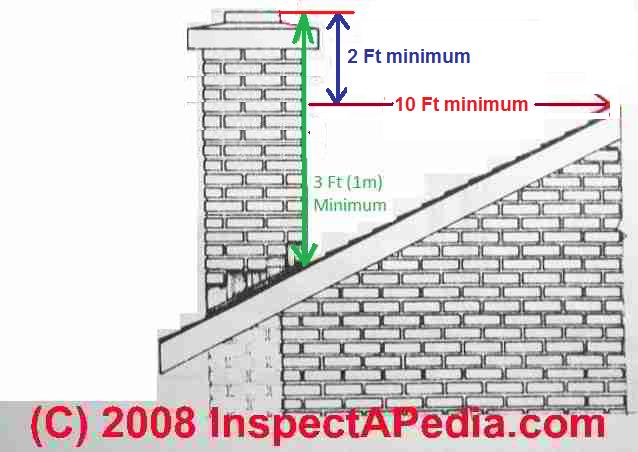
Everyone has given good advice so far. My 2 cents is 3 feet might be enough or not. The golden rule is that in a horizontal plane from the top point of the chimney it is 10' away from the roof in that plane.

Steep pitched roofs therefore will require taller chimneys vs low pitch roofs
 

Kaizen

Well-known member
Joined
Jan 9, 2015
Messages
6,948
Location
New England
curious how you are going to attach this to your generator? I have a portable but its pretty big and it has some good vibration at the exhaust when running
 
To avoid these ads, REGISTER NOW!
OP
1

1950coronet600hp

Well-known member
Joined
Aug 14, 2010
Messages
81
The golden rule is that in a horizontal plane from the top point of the chimney it is 10' away from the roof in that plane.

Steep pitched roofs therefore will require taller chimneys vs low pitch roofs

I just want to make sure I understand this, the outlet should be 10' from the tallest point of the roof? that right?

My Genny is a 4000w allpower with a 1/2" exhaust outlet. the plan was to take 3/4 electrical conduit and slip it over the outlet and clamp / weld / braze it on. I could also use some high temp silicone hose intended to repair AIR injection pipes at catalytic converters to bridge the gap between the muffler and exhaust stack. that would take care of both vibration, and attaching. then I could use 1/2" conduit. as far as the rain cap goes, the smallest ive seen is 1.5" do they make rain caps for itty bitty pipes? my plan to combat rain was to bend the end like a sink drain trap, with a drain hole at the bottom of the "trap"
 

rlitman

Well-known member
Joined
Oct 18, 2010
Messages
24,632
Location
Long Island
Everyone has given good advice so far. My 2 cents is 3 feet might be enough or not. The golden rule is that in a horizontal plane from the top point of the chimney it is 10' away from the roof in that plane.

Steep pitched roofs therefore will require taller chimneys vs low pitch roofs

I believe you are referring to this:
Chimney_Clearance_Spec020-DFs.jpg


That's a recommendation for a natural draft MASONRY chimney. Perfectly good advice for someone venting an indoor fireplace, not necessarily appropriate for someone venting an outdoor generator that technically does not require a chimney at all.

curious how you are going to attach this to your generator? I have a portable but its pretty big and it has some good vibration at the exhaust when running

You cannot. What you need to do, is attach the stack to your structure in a way that keeps the heat of the stack from damaging the structure. Then you run a flexible exhaust from the muffler of the generator into the bottom of the stack.

heres what they use on rvs parked in tight quarters

https://www.amazon.com/dp/B000BUU5XG/?tag=atomicindus08-20

Interesting. The storm before hurricane Sandy, I made something like that for my generator. I used a heavy gauge brass drain elbow to turn the exhaust from the muffler into the stack. I built the stack out of 4" galvanized vent. It is terminated on the top with a rain cap (a critical part of that kit that is missing). Mine differs from this in one big way though:
B000BUU5XG.03.lg.jpg


In the "Genturi", the exhaust is directed at the bottom of the stack with a gap. In mine, the smaller exhaust tube is led into the bottom of the stack, with the inner tube inserted about 16". I made three vertical cuts into the inner tube, which I bent outwards to form spacers( they look like rocket fins) that keep the tube centered. I also perforated the inner tube, starting about 4" past where it enters the stack, and then loosely filled the space between the two tubes with stainless steel pot scrubbers. This overlapping area acts like a straight-through glass-pack muffler, with the bottom of the stack still open to **** air in.
 

jlckmj

Well-known member
Joined
Dec 7, 2009
Messages
732
Location
SE Wiscosin
I used a section of 4inch rain gutter on my RV to get the stink (and the noise) up in the air.

Jim
 

Firebrick43

Well-known member
Joined
May 12, 2015
Messages
14,132
Location
West central Indiana
I believe you are referring to this:
Chimney_Clearance_Spec020-DFs.jpg


That's a recommendation for a natural draft MASONRY chimney. Perfectly good advice for someone venting an indoor fireplace, not necessarily appropriate for someone venting an outdoor generator that technically does not require a chimney at all.


You cannot. What you need to do, is attach the stack to your structure in a way that keeps the heat of the stack from damaging the structure. Then you run a flexible exhaust from the muffler of the generator into the bottom of the stack.


Interesting. The storm before hurricane Sandy, I made something like that for my generator. I used a heavy gauge brass drain elbow to turn the exhaust from the muffler into the stack. I built the stack out of 4" galvanized vent. It is terminated on the top with a rain cap (a critical part of that kit that is missing). Mine differs from this in one big way though:
B000BUU5XG.03.lg.jpg


In the "Genturi", the exhaust is directed at the bottom of the stack with a gap. In mine, the smaller exhaust tube is led into the bottom of the stack, with the inner tube inserted about 16". I made three vertical cuts into the inner tube, which I bent outwards to form spacers( they look like rocket fins) that keep the tube centered. I also perforated the inner tube, starting about 4" past where it enters the stack, and then loosely filled the space between the two tubes with stainless steel pot scrubbers. This overlapping area acts like a straight-through glass-pack muffler, with the bottom of the stack still open to **** air in.

It's recommendation for metal chimney as well a masonry, fire place, stove, or furnace. Ironically the second picture is a natural draft chimney. Is it as critical as a wood burning stove, no, but if not taken up to that level then down drafts can cause issues with fumes being forced back down which is what the op is trying to avoid. Really depends on the roof line, surrounding trees, and prevailing winds.
 

rlitman

Well-known member
Joined
Oct 18, 2010
Messages
24,632
Location
Long Island
It's recommendation for metal chimney as well a masonry, fire place, stove, or furnace. Ironically the second picture is a natural draft chimney. Is it as critical as a wood burning stove, no, but if not taken up to that level then down drafts can cause issues with fumes being forced back down which is what the op is trying to avoid. Really depends on the roof line, surrounding trees, and prevailing winds.

In a natural draft chimney, the chimney is venting combustion taking place indoors to the outside. The reason that the guidelines exist is to prevent the chimney from reversing flow, which would prevent exhaust from escaping.

But in the case of a generator, the combustion is already taking place outside. Should the chimney reverse flow, the exhaust would still be outside, and would be no worse than what you already have exiting the muffler, which is already acceptable! Additionally, with indoor combustion, reversing the flow of the chimney leads to oxygen deprivation of the appliance, which increases CO production. But with the generator outside, reversing the stack flow will not cause it to run rich. Pool heaters and other outdoor appliances do not require a chimney of any sorts.

Similarly important, is the fact that this is NOT a natural draft chimney. It is an INDUCED flow chimney. The chimney guidelines for natural flow chimneys do not apply to induced flow designs. Induced flow vents require following the manufacturer's guidelines, and so your recommendations are moot.

Now if we were talking about running the generator indoors while venting the exhaust outdoors, then we'd have to be much more careful. Using such a chimney on a generator running indoors would be highly dangerous without some sort of safety interlocking system (the same sort of thing that is required of any induced vent appliance).
 

TractorJeff

Well-known member
Joined
Dec 8, 2013
Messages
3,309
Location
Elkhorn, WI
Just remember what is a by product of combustion. A condensate drain will need to be configured into this.
1/2 inch pipe will not work for the exhaust, it needs to be larger.
 

RWorth

Well-known member
Joined
Aug 29, 2016
Messages
592
Location
Cape Cod , Mass.
my father burried a 55 gallon drum with removable lid next to the compressor, filled it with 6" diameter rocks, then dug a shallow trench 20 feet away from the shed and burried a 3" schedule 40 pvc. It was totally silent, and got rid of the fumes.
 
To avoid these ads, REGISTER NOW!
Top Bottom