To avoid these ads, REGISTER NOW!

Generator Exhaust

Lucid Moments

Well-known member
Joined
Aug 9, 2015
Messages
1,775
Location
Gainesville, Ga
So I am in the process of building a new house and shop. A little out in the country so I want a generator for backup, but am not willing to pay for a whole house unit. My plan is to keep a portable generator in the shop, but it would be nice to not have to haul it outside in bad weather. I could just keep one or more of the shop doors open for ventilation, but is there any reason why I can't make some semi-permanent way to vent the exhaust to the outside?
 
To avoid these ads, REGISTER NOW!

3rdgendslmech

Well-known member
Joined
Mar 12, 2017
Messages
499
Location
Maryland
If you've got a furnace in the shop you could get fancy with some flex pipe and tie it into the furnace vent. Or buy one of those exhaust vent kits that gas station garages put on their doors
 

jtetterton

Member
Joined
Oct 10, 2017
Messages
8
It’s really not a good idea to run the generator in the garage. Especially if it’s attached to the house or being used as a workspace.

I did a whole house generator on my own for about $2500. That included the 13kw generator, conduit and cabling, generator base, auto transfer switch. Shop around on Craigslist for a good deal on a used one. Mine is 4 years old and barely used. I installed it completely by myself except for the gas plumbing, and I’m not an electrician. Pulled all proper permits and had all required inspections done.

Since you’re building now is the time to save the money on getting the generator wired up. If you’re dead set on a portable then get a 50 amp receptacle wired up right outside your garage door and a transfer switch near the panel. Then all you need to do is wheel it right outside and plug it in.


Sent from my iPhone using Tapatalk
 
OP
L

Lucid Moments

Well-known member
Joined
Aug 9, 2015
Messages
1,775
Location
Gainesville, Ga
I like the portable generator because I want to be able to take it with me if I want to. If I go with fixed, whole house generator then I have to have two.

The shop will be a completely separate building from the house. Connected by a breezeway, and some plumbing and wiring only.
 

jtetterton

Member
Joined
Oct 10, 2017
Messages
8
I keep a small 3kw handy for on the go. But I love the convenience of the auto transfer switch on my 13kw propane generator. 2600 square feet and it’ll run the ac in the peak of summer with no problem. Also runs the well pump. Our oven, furnace and water heater are also propane powered so no load from those.

085d83023c3b43dad2a90d6b0a34008d.jpg


Sent from my iPhone using Tapatalk
 

LS6 Tommy

Well-known member
Joined
Dec 27, 2013
Messages
26,162
Location
Northern NJ
I keep mine in my shed. I have a gable vent attic fan in there that gets plugged in when the generator is started. Works great.

Tommy
 

Showkey

"MEMBER EMERITUS"
Joined
Aug 9, 2014
Messages
8,638
Location
Wausau WI
Running in garage or enclosure...........Have seen end poorly at least a half dozens times........people under estimate how hot the exhaust gets over a long runtime and how much CO generators produce. They run rich compared to other small engines so they don’t surge or gallop.
 

rlitman

Well-known member
Joined
Oct 18, 2010
Messages
24,579
Location
Long Island
A simple 3" or 4" water heater double wall exhaust pipe and thimble at the wall level where you can just wheel the generator over by it so the exhaust is within an inch or two of the pipe.

It will venturi right out the pipe.

Just make sure the generator can't vibrate away from it.

Don't do this. You're sure to flood the space with CO.

Internal combustion engine operating in an enclosed space with a rigged exhaust setup?

What possibly could go wrong?

Exactly.

I have my generator outside, but protected from the weather by an awning that leans against my garage and a fence on three sides. I vent the exhaust vertically through a 4" single wall exhaust pipe that runs through a thimble in the awning. But the trick is to get the exhaust into that pipe without ANY leakage. In my case, I use a heavy wall 1-1/2"x12" brass drain elbow that fits onto the muffler end, to turn the exhaust directly into the stack.

The important details here are that the pipe directly connected to the muffler is short (to limit back pressure), and sticks significantly INTO the vent stack. From there, the injected exhaust ***** in air as a venturi, which cools the vent stack as well. I loosely packed the open space at the bottom of the vent stack with stainless pot scrubbers both to keep the pipe centered, and to reduce noise.
 
OP
L

Lucid Moments

Well-known member
Joined
Aug 9, 2015
Messages
1,775
Location
Gainesville, Ga
I vent the exhaust vertically through a 4" single wall exhaust pipe that runs through a thimble in the awning. But the trick is to get the exhaust into that pipe without ANY leakage. In my case, I use a heavy wall 1-1/2"x12" brass drain elbow that fits onto the muffler end, to turn the exhaust directly into the stack.

The important details here are that the pipe directly connected to the muffler is short (to limit back pressure), and sticks significantly INTO the vent stack. From there, the injected exhaust ***** in air as a venturi, which cools the vent stack as well. I loosely packed the open space at the bottom of the vent stack with stainless pot scrubbers both to keep the pipe centered, and to reduce noise.

This is basically what I had in mind, just inside.
 

meboatermike

Well-known member
Joined
Dec 28, 2014
Messages
104
Location
Southern Maine
I made a small enclosure that the generator is housed in -- the front wall is hinged at the top and gets propped open about 3/4 open for lots of ventilation -- likewise one sidewall is hinged on the side and can open for venting and the top can be propped up a little as the roof in hinged. It is close to the back of the garage but not attached (about 8-10 ft) and the exhaust is headed away from the buildings. Doesn't cost that much to make it and has had a fair amount of use here in many weather conditions.
 

moparfreak

Well-known member
Joined
Jan 24, 2005
Messages
853
Location
Milwaukee, WI
Most setups to be able to run an IC engine of any type (small engine, bike, car) for any decent amount of time pull a vacuum on the exhaust to help **** it through. When the exhaust gasses expand out the muffler there is a drastic loss in velocity, so it's very easy for it then to simply escape out anywhere and reflect off things rather than flow nicely down a pipe you have set next to it.

Personally I think it's a bad idea and I would never do it, but IF you wanted to at least evaluate the theory of will it or won't it work, you could fab up something along the lines of what you're thinking and invest in a quality CO detector and run it with the meter in several spots in your shop and see how the levels respond. At least a place to start, so that you don't blindly walk into an absurdly unsafe condition.
 

HoosierMark

Well-known member
Joined
Jan 31, 2013
Messages
1,438
Location
Southeast IN
I did the same setup when I built my new house. I have two electric panels. One is the main one and one has all the essential breakers for a power outage. I have a manual breaker to cut the main power off and it then becomes the feed breaker from the generator. I simply wheel my generator outside of my garage, fire it up and run the 220 power line into the garage and plug it into the dedicated wall plug. very similar to an RV setup only instead of powering a camper it powers part of my house. My electrical guys set it up so it would be very simple to use. My buddy has a similar setup for a cabin with a remote start from inside.
Think about remote switches from RVs. Set the generator up on a simple enclosure outside and store it there. Have it all ready to start and it will only be a little work to unplug if you want to take it somewhere.
 

bad_idea

Well-known member
Joined
Jun 11, 2011
Messages
4,330
Location
Pasquotank, NC
I'd build a lean to on the back of the garage. Build it large enough to house the air compressor too. Sheath the bottom foot of each side with lattice (or similar) and be sure there is plenty of open vent space at the roof edge. Make sure it is 100% sealed away from the garage.
 

TractorJeff

Well-known member
Joined
Dec 8, 2013
Messages
3,309
Location
Elkhorn, WI
A separate building or an enclosure, no difference!
Run a piece of flex between the unit and the pipe out through the wall.
As long it is a solid connection, no gasses will come back into the building.
As stated by others, going to a larger pipe will cause velocity loss.
You will need ambient air exchange to keep the unit cool so there should be no CO build up in the building.
 

zak77

Well-known member
Joined
Sep 18, 2014
Messages
1,351
Location
Monson, MA
I'd say as long as you have good ventilation and you're not spending much time out there, you should be fine. Just use common sense. I'd assume your shop has a garage door or 2? Open the door(s) all the way and any other doors to get as much cross ventilation going as possible. Then i'd get a box fan and put it in a doorway blowing out or in, depending on wind direction, on high to get as much exhaust out as possible. And bottom line, stay out of that space unless absolutely necessary!!!! Of course i'm not addressing basic safety things such as keep flammable things far away etc.
 

rlitman

Well-known member
Joined
Oct 18, 2010
Messages
24,579
Location
Long Island
This is basically what I had in mind, just inside.


But that’s the most important part. Outside, it is fail-safe. Inside, it is not.

Mufflers and exhaust manifolds can leak. If you had some way to have a CO detector that automatically shut the unit off, then maybe, but the lean-to suggestions above are much better ideas.
 

WaterBoyz

Well-known member
Joined
Nov 16, 2015
Messages
368
Location
Northern VA
I keep a small 3kw handy for on the go. But I love the convenience of the auto transfer switch on my 13kw propane generator. 2600 square feet and it’ll run the ac in the peak of summer with no problem. Also runs the well pump. Our oven, furnace and water heater are also propane powered so no load from those.

085d83023c3b43dad2a90d6b0a34008d.jpg


Sent from my iPhone using Tapatalk

What brand did you get?
Self-install?
 

WaterBoyz

Well-known member
Joined
Nov 16, 2015
Messages
368
Location
Northern VA
Lots of youtube videos of people using the store-bought plastic sheds. Some went the extra mile for exhaust and temperature and noise reductions.
 
To avoid these ads, REGISTER NOW!

moparfreak

Well-known member
Joined
Jan 24, 2005
Messages
853
Location
Milwaukee, WI
But that’s the most important part. Outside, it is fail-safe. Inside, it is not.

Mufflers and exhaust manifolds can leak. If you had some way to have a CO detector that automatically shut the unit off, then maybe, but the lean-to suggestions above are much better ideas.

Briggs just launched this exact thing. Not sure if the OP already has his gen or is going to buy a new one, but maybe an option would be to get one that has this fit up to it. It's not really retrofittable to old gens as an add-on device. This was being done in response to folks bringing gens into their living rooms, passing out or worse...and then blaming the company....:headscrat

https://www.briggsandstratton.com/na/en_us/innovations/portable-generators/co-guard.html
 

Bretny

Well-known member
Joined
Jul 31, 2017
Messages
3,918
Location
Dutchess county NY
I would put it in one of those small sun cast/rubbermaid sheds or just buildna small 4x4ft shed on a pallet.

Getting everything plumbed through your shop wall and have it taking up space would be a pain
 

kelpaso1

MEMBER EMERITUS
Joined
Sep 28, 2009
Messages
3,962
Location
New Brunswick
Geez, the safety nazis....... How many thousands of automotive shops in the country run cars inside with a hose connected to the tailpipe and the end stuck through a hole in the door? Common sense needed.
 

rlitman

Well-known member
Joined
Oct 18, 2010
Messages
24,579
Location
Long Island
Geez, the safety nazis....... How many thousands of automotive shops in the country run cars inside with a hose connected to the tailpipe and the end stuck through a hole in the door? Common sense needed.

They don't. The hose is supposed to be connected to a blower that ***** the exhaust out. The blower pulls a lot of extra air, keeping the rubber hose below the temperature that it would melt, but it also guarantees that no exhaust stays behind. Automotive shops are also generally not well sealed.
 

Falcon67

Well-known member
Joined
Jun 11, 2009
Messages
18,371
Location
Merkel, TX
Get a decent portable genny - don't go too cheap. If you need quiet, then Honda. If not then Champion makes good units, just loud. Pour a pad WELL AWAY from any shop openings and run a conduit/cable out there with the appropriate weather covered connection (230V 50A RV, etc). When you need backup, put the genny out there, hook it up, set your transfer switch and light it up. If you are concerned about weather, then build some light weight open roof/cover that it can sit under.

Edit - I use cords here if necessary and only 50' so the genny can be at least 20+ feet from the house. Or shop. Don't screw with CO, it's insidious.
 
OP
L

Lucid Moments

Well-known member
Joined
Aug 9, 2015
Messages
1,775
Location
Gainesville, Ga
Briggs just launched this exact thing. Not sure if the OP already has his gen or is going to buy a new one, but maybe an option would be to get one that has this fit up to it. It's not really retrofittable to old gens as an add-on device. This was being done in response to folks bringing gens into their living rooms, passing out or worse...and then blaming the company....:headscrat

https://www.briggsandstratton.com/na/en_us/innovations/portable-generators/co-guard.html

I will have to buy a new generator for what I want. I actually have a 3kw gen but I will need more than that. I will look into that and see just because it isn't a bad idea.

Of course I can just do what I suggested in my original post and leave it inside, but roll up a couple of the shop doors (It will have 3 roll up doors) and I suspect those will ventilate the shop well enough. Or just take the darn thing outside like everyone is suggesting. It isn't that hard I was just seeing if other options were practical.
 
OP
L

Lucid Moments

Well-known member
Joined
Aug 9, 2015
Messages
1,775
Location
Gainesville, Ga
They don't. The hose is supposed to be connected to a blower that ***** the exhaust out. The blower pulls a lot of extra air, keeping the rubber hose below the temperature that it would melt, but it also guarantees that no exhaust stays behind. Automotive shops are also generally not well sealed.

I have actually seen one like that, but it was in their chassis dyno room. Most I have seen are just like kelpaso1 said. Hose is formulated of high temp stuff so it doesn't melt.
 
Last edited:
OP
L

Lucid Moments

Well-known member
Joined
Aug 9, 2015
Messages
1,775
Location
Gainesville, Ga
Get a decent portable genny - don't go too cheap. If you need quiet, then Honda. If not then Champion makes good units, just loud. Pour a pad WELL AWAY from any shop openings and run a conduit/cable out there with the appropriate weather covered connection (230V 50A RV, etc). When you need backup, put the genny out there, hook it up, set your transfer switch and light it up. If you are concerned about weather, then build some light weight open roof/cover that it can sit under.

Edit - I use cords here if necessary and only 50' so the genny can be at least 20+ feet from the house. Or shop. Don't screw with CO, it's insidious.

I may take it outside to run when I need it, but I definitely will not store it outside. I know myself and out of sight is out of mind. If it gets stored outside I won't think about it and the next time I need it it won't run. If I store it in the shop I will have to look at it and I will check it every once in a while just because I saw it and thought about it.
 

theoldwizard1

Well-known member
Joined
Feb 22, 2011
Messages
43,076
Location
SE MI
Biggest problem with any portable generator running inside of a small "shed" is heat. You might need a fan to keep it cool.

Mufflers really will not cut the noise down a lot. Use foil faced insulation. For the side with the exhaust mount a large steel plate spaced off of the insulation by about 2"-4" and at least 6" away from the exhaust.
 

sixty4

Well-known member
Joined
Dec 1, 2007
Messages
1,424
Location
CT
Would make up air be needed? Would you then not need to pull in air from the outside? If this is the case I see no benefit.
 

Bruce Amacker

Well-known member
Joined
Nov 6, 2011
Messages
573
Location
Cleveland, Ohio
Geez, the safety nazis....... How many thousands of automotive shops in the country run cars inside with a hose connected to the tailpipe and the end stuck through a hole in the door? Common sense needed.

Modern cars don't make CO like old cars and generators do. I'm thinking a small portable generator makes a hundred times the CO a newer car does idling. Maybe thousands.

And, if you're running a portable gen as a backup you're probably sleeping in the house too, a deadly combination. Don't do it.
 

joe_padavano

Well-known member
Joined
Feb 26, 2011
Messages
1,788
Location
Northern VA
They don't. The hose is supposed to be connected to a blower that ***** the exhaust out. The blower pulls a lot of extra air, keeping the rubber hose below the temperature that it would melt, but it also guarantees that no exhaust stays behind. Automotive shops are also generally not well sealed.

Sorry, but BS. Yeah, new shops may have a central powered vent system, but thousands of small shops simply have a thimble in the door that the tube from the tail pipe connects to. I do agree with the post above, however, about exhaust velocity. A car engine produces a much larger volume of gas that doesn't cool or slow as much over the pipe as would that from a small engine. Of course, once again, common sense rules. Use a small diameter pipe connected to the generator exhaust and keep it as short as possible. Also keep in mind that you need inlet air into the shop as well as exhaust air.
 

joe_padavano

Well-known member
Joined
Feb 26, 2011
Messages
1,788
Location
Northern VA
Modern cars don't make CO like old cars and generators do.

And yet, those powered vent systems in new shops didn't exist in the 1960s when there were no emissions controls on cars and shops just used the hose through the opening in the door.

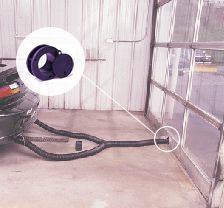
I'll also point out that garage heaters make CO and no one says that you need a powered exhaust vent on one of those.


doorport_example_sm.jpg
 

LS6 Tommy

Well-known member
Joined
Dec 27, 2013
Messages
26,162
Location
Northern NJ
They don't. The hose is supposed to be connected to a blower that ***** the exhaust out. The blower pulls a lot of extra air, keeping the rubber hose below the temperature that it would melt, but it also guarantees that no exhaust stays behind. Automotive shops are also generally not well sealed.

Exhaust extraction systems are usually only in large multiple bay shops. Every gas station I ever saw had just the hose through the roll up door port. The hoses are rated for around 400°F +.

In any event, exhaust at the outlet of a car tailpipe is nowhere near as hot as the muffler outlet on a small engine.

Tommy
 

rlitman

Well-known member
Joined
Oct 18, 2010
Messages
24,579
Location
Long Island
And yet, those powered vent systems in new shops didn't exist in the 1960s when there were no emissions controls on cars and shops just used the hose through the opening in the door.

I'll also point out that garage heaters make CO and no one says that you need a powered exhaust vent on one of those.


doorport_example_sm.jpg

First, plenty of people in the 60's died or just suffered long term CO poisoning. That's not a valid excuse for bad practices today. Seatbelts were also not worn that much.

Second, garage heaters make very little CO, so long as the environment is not oxygen deprived (and they have ODS to shutdown in this condition). This is VASTLY different from small generators, which make a lot of CO whenever they are running.

Exhaust extraction systems are usually only in large multiple bay shops. Every gas station I ever saw had just the hose through the roll up door port. The hoses are rated for around 400°F +.

In any event, exhaust at the outlet of a car tailpipe is nowhere near as hot as the muffler outlet on a small engine.

Tommy

I don't know any commercial single bay shops around here. All of the automotive shops in my area have powered exhaust extraction, usually using a blower on a cart connected to the hose (of course, not all of them use it). Perhaps it's required by code here, I don't know.

Yes, a car exhaust's tailpipe temperature is far lower than an air cooled small engine's muffler. Regardless, rubber hoses are NOT safe at 400F. No way. Rubber ignites between 260F and 316F. Silicone can withstand higher temperatures, but I've never seen that used for an exhaust hose. Of course, the exhaust temperature does not necessarily equal the hose temperature, but my point is that blowing car exhaust through a rubber hose will cause it to smoke and char. I suppose that nobody is looking for black char inside their black exhaust hoses, but you can bet it's there, and it isn't healthy.
 

LS6 Tommy

Well-known member
Joined
Dec 27, 2013
Messages
26,162
Location
Northern NJ
First, plenty of people in the 60's died or just suffered long term CO poisoning. That's not a valid excuse for bad practices today. Seatbelts were also not worn that much.

Second, garage heaters make very little CO, so long as the environment is not oxygen deprived (and they have ODS to shutdown in this condition). This is VASTLY different from small generators, which make a lot of CO whenever they are running.


I don't know any commercial single bay shops around here. All of the automotive shops in my area have powered exhaust extraction, usually using a blower on a cart connected to the hose (of course, not all of them use it). Perhaps it's required by code here, I don't know.

Regardless, rubber hoses are NOT safe at 400F. No way. Rubber ignites between 260F and 316F.


Extraction systems may very well be code now in some areas, but not n NJ. At least not in gas stations.
Exhaust hoses are designed specifically for the application, and the ones I purchased for the gas stations back in the 80's were rated at 400°F. A quick websearch just displayed a few brands of exhaust hoses rated between 375°F-600°F .

I definitely would not recommending just getting any rubber hose that fits the tailpipe. :thumbup:


Tommy
 

junkyardwarrior

Well-known member
Joined
Nov 17, 2014
Messages
174
Running in garage or enclosure...........Have seen end poorly at least a half dozens times........people under estimate how hot the exhaust gets over a long runtime and how much CO generators produce. They run rich compared to other small engines so they don’t surge or gallop.

Occasion one: portable gen set up to run on an auto transfer switch, power goes out, gen comes online. Easy. Gen was in the garage, along with the car, normal garage stuff, and water heater. Power went out, gen came on, ran for several hours, overheated one of the car's tires, caught fire, burned the garage and part of the house.

Occasion two. Similar setup, in garage. Power goes out, gen comes online. Overhead door down. Fills house with CO, 2 occupants die during their sleep. This was a high dollar Honda that doesn't make a lot of noise. The 2 occupants never knew what was going on.

CO is heavier than air and tends to hang around the floor. Grab a CO meter and go start the car in the shop, just for a few seconds, and then turn it off. Watch the CO meter change from arms length high, to the floor-it'll be higher at the floors. CO is not the only compound from IC engines...theres CO2, and a TON of other gases-most are nonflammable, which if you have a water heater in the garage, I've seen the pilot light go out because there was no oxygen to sustain combustion. Even had a call once from someone said that if they run their gen for a bit, then start the car, the car will run but poorly. Inside the garage nonetheless. Hmm...must have been a "college graduate".

If you have a portable genset, keep it inside when not in use, but when you need to use it, park it outside. Away from the house. That's why it's portable. If you don't like the portable thing and it's downfalls, you're going to have to invest in a whole-home genset that is fixed. That is the only safe way to do it.

Latest one...guy had a 5500w JD genset that he kept in the truck bed for his primitive camping excursions. Guy was out in an area where daylight had to be pumped into (camping), woke up in the morning for coffee and breakfast, fired up the generator-that noisy thing-and had his breakfast. Started to rain. So he throws a tarp over the truck bed, seals it up pretty good with rubber straps to "keep the rain off of the generator since electricity and water don't mix well", proceeds to burn the truck to the ground along with the camper. Plastic bedliner and hot exhaust started the whole process. His family called me at work asking if I'd heard from him...nope...I was headed that direction after work, so I stopped in, found the burned truck & camper, no sign of him or even any body parts...found him up the road walking toward town. Thankfully he's ok but I think he learned a lesson.

These things are dangerous...extremely...and people tend to downplay what they can and WILL do. Don't play around. If you have a HINT of a doubt, just quit while you're still alive, even if that means spending a little more on a fixed whole-home genset that is specifically designed for what you're wanting to do. I don't particularly care to pick up dead bodies, especially knowing that they KNEW what they were doing was fixin' to kill 'em.

At the least, you can build a small "pole-barn" to house the portable genset permanentaly, but don't enclose it..leave the sides open so cooling air can get INTO the engine and hot air can escape...

On and by the way I have been a victim of CO poisoning. Age 9, don't remember what happened prior to the accident, but I was behind a boat in a raft, boat running stationary. My mom tells how she found me, basically slumped over the side of the raft almost in the water. Nonresponsive. Her and dad nabbed me up, took me to hospital, basically dead. Obviously revived, but not fully...to this day, have lost some vision, some brain function mostly affecting the left side (eye, ear, smell, some feeling lost in left extremities). THAT is what CO and other exhaust gases can do....by the way I'm told that I was in the hospital for 4 weeks being monitored & tested. They say I'm quite lucky....THANKFULLY I don't remember a thing of it.
 
Last edited:

jtetterton

Member
Joined
Oct 10, 2017
Messages
8
Occasion one: portable gen set up to run on an auto transfer switch, power goes out, gen comes online. Easy. Gen was in the garage, along with the car, normal garage stuff, and water heater. Power went out, gen came on, ran for several hours, overheated one of the car's tires, caught fire, burned the garage and part of the house.

Occasion two. Similar setup, in garage. Power goes out, gen comes online. Overhead door down. Fills house with CO, 2 occupants die during their sleep. This was a high dollar Honda that doesn't make a lot of noise. The 2 occupants never knew what was going on.

CO is heavier than air and tends to hang around the floor. Grab a CO meter and go start the car in the shop, just for a few seconds, and then turn it off. Watch the CO meter change from arms length high, to the floor-it'll be higher at the floors. CO is not the only compound from IC engines...theres CO2, and a TON of other gases-most are nonflammable, which if you have a water heater in the garage, I've seen the pilot light go out because there was no oxygen to sustain combustion. Even had a call once from someone said that if they run their gen for a bit, then start the car, the car will run but poorly. Inside the garage nonetheless. Hmm...must have been a "college graduate".

If you have a portable genset, keep it inside when not in use, but when you need to use it, park it outside. Away from the house. That's why it's portable. If you don't like the portable thing and it's downfalls, you're going to have to invest in a whole-home genset that is fixed. That is the only safe way to do it.

Latest one...guy had a 5500w JD genset that he kept in the truck bed for his primitive camping excursions. Guy was out in an area where daylight had to be pumped into (camping), woke up in the morning for coffee and breakfast, fired up the generator-that noisy thing-and had his breakfast. Started to rain. So he throws a tarp over the truck bed, seals it up pretty good with rubber straps to "keep the rain off of the generator since electricity and water don't mix well", proceeds to burn the truck to the ground along with the camper. Plastic bedliner and hot exhaust started the whole process. His family called me at work asking if I'd heard from him...nope...I was headed that direction after work, so I stopped in, found the burned truck & camper, no sign of him or even any body parts...found him up the road walking toward town. Thankfully he's ok but I think he learned a lesson.

These things are dangerous...extremely...and people tend to downplay what they can and WILL do. Don't play around. If you have a HINT of a doubt, just quit while you're still alive, even if that means spending a little more on a fixed whole-home genset that is specifically designed for what you're wanting to do. I don't particularly care to pick up dead bodies, especially knowing that they KNEW what they were doing was fixin' to kill 'em.

At the least, you can build a small "pole-barn" to house the portable genset permanentaly, but don't enclose it..leave the sides open so cooling air can get INTO the engine and hot air can escape...

On and by the way I have been a victim of CO poisoning. Age 9, don't remember what happened prior to the accident, but I was behind a boat in a raft, boat running stationary. My mom tells how she found me, basically slumped over the side of the raft almost in the water. Nonresponsive. Her and dad nabbed me up, took me to hospital, basically dead. Obviously revived, but not fully...to this day, have lost some vision, some brain function mostly affecting the left side (eye, ear, smell, some feeling lost in left extremities). THAT is what CO and other exhaust gases can do....by the way I'm told that I was in the hospital for 4 weeks being monitored & tested. They say I'm quite lucky....THANKFULLY I don't remember a thing of it.


OP read this post over and over. The guy who called us “safety nazis” should also read this over and over. Listen to people with experience and expertise. It’s not safe. Period. End of story.

Wire up an inlet and wheel the generator outside.


Sent from my iPhone using Tapatalk
 
Last edited:

DGersic

Well-known member
Joined
Mar 12, 2017
Messages
6,264
Location
DeKalb, IL
I will have to buy a new generator for what I want. I actually have a 3kw gen but I will need more than that. I will look into that and see just because it isn't a bad idea.


Of course I can just do what I suggested in my original post and leave it inside, but roll up a couple of the shop doors (It will have 3 roll up doors) and I suspect those will ventilate the shop well enough. Or just take the darn thing outside like everyone is suggesting. It isn't that hard I was just seeing if other options were practical.


Don’t screw around with CO. Two guys I went to HS with died from CO from forklifts in a warehouse with all of the doors open. Run it outside, or get a CO detector.


Sent from my iPad using The Garage Journal mobile app
 
To avoid these ads, REGISTER NOW!
Top Bottom