To avoid these ads, REGISTER NOW!

Generator - Gas or Diesel

AngryBeaver

Well-known member
Joined
Jul 12, 2017
Messages
1,705
Location
Lake Milton Ohio
The diesel fuel I have stored I use this https://www.amazon.com/gp/product/B001JT5MGI/?tag=atomicindus08-20
So far, I have not had any issues and it is supposed to keep it from gelling in the winter. The thing about algae, this and another previous post is the first I hear about it. How long can diesel be stored with zero additives before it can have issues?

I suspect the algae problem would be if water get in? I have 2 drums, about 100 gal currently in drums where one hole/spout has a sealed cap and the other is a vented cap like this
https://www.yankeecontainers.com/c/vent-plug-in-drum-plug/

Any tank stored outside will have condensation. Plastic or metal, empty or full. plastic is better, the fuller you can get it, the better. that condensation is water. the water in diesel is what causes the legionous bacteria to grow. the more water, the more bacteria.

Would you know if most diesel engines do fine on home heating fuel or not?

Here diesel fuel at the pump has about 30-40% in "the government calls it road and save the environment tax" but really is "we need money" tax. So home heating fuel is vey cheap....even delivered compared to diesel at the pump. AGR diesel does not have the road taxes but I believe you need to have some kind of "I am a farmer" permit it to buy it.

Since 2014 here in the states, On road fuel, offload fuel (commonly called #2 diesel), And home heating oil are all identical. not sure how canada is though... In 2006, LSD (low sulfur diesel) had 500 PPM sulfur content in it and ULSD (ultra low sulfur) had 15ppm and became the standard for on road (#1 fuel) The higher sulfur would actually produce more power, better lubricity and more harmful emissions. The offroad fuel was still available until 2014 when all on road and off-road fuel became USLD at 15ppm. Since them Its all the same minus color for taxation purposes.. I run my three kubota powered pieces of equipment, My home heating furnace, my garage oil furnace and my MQ whisper watt 7000 generator on "off road fuel" Its dyed red to prevent people from running that in on road vehicles. the home heating oil here in the states is the exact same fuel as on road fuel with the exception of more kerosene added as a freeze protection/antigel in the winter months. You could 100% run home heating oil in your equipment if you uses a quality additive to put that lubricity back into the fuel to protect the injection pump. I myself, use power serives. some guys like hot shots, and some prefer howes. you can do your own research on that.

This is where I get mixed responses. Many tell me they run tractors and other equipment on home heating fuel. Less, but some others feel it is not a good idea.

I'll ask the home heating supplier I used as well as my Kubota dealer...see what they say.

no one is going to tell you to run it, because of the added kerosene in it for freeze protection in winter months, which strips quality lubricants out of the fuel. The dealer won't approve it because of a possible warranty claim, even though the tractor is well out of warranty period.. and then there's the whole legal issue of the home fuel oil people saying sure, run it......

Good to know...I had to look up what a DEF tank is and no, I do not have one. I do not think it has a catalytic converter. I have seen where they stick the cat conv on ne models, so pretty sure I do not have one. But I can check to be sure with my dealer.

DEF is deisel exahust fluid and only used in conjunction with a DPF (diesel particulate filter) All diesel engines under 29 hp are not required to meet those emissions requirements, YET. no sub 30 hp Kubota tractor is equipped with a DEF tank or DPF. the larger MX series do....

Now that I'm done quoting 4 pages worth of replies, now I can offer my 2 cents.

Generator Tech here for 17 years. I live out in the sticks and loose power once or twice a year for a couple days.

I had a gasoline screamer for the first few years I lived here. I'm SOOOOOOO glad i never have to hear that screaming noise box ever again.

Everything I own, except my race car and weed whacker are diesel powered. Everything. No more bad fuel, no more gummed up carbs to clean every time i want to start something that has been sitting....

My kubota tractor, My kubota lawn mower, My old skid steer that i repowered with a Kubota. I bought a MQ whisperwatt 7000 from a guy that i assumed worked oil and gas. he had 5 of them for sale, all missing the internal fuel tanks. They were on skids with 250 gallon tanks to run non stop for months or years at a time. They are commercial units. I bought the last two he had. ordered the tank for the one and sold it for 2K with 2500hours on it. it paid for mine and i made a cart for mine with a 25 gallon tank and electric pump. The MQ uses a 2 cylinder D482 Kubota engine. now, unlike larger gas engines, this one is rated for continuous use at 7Kw. Most gasoline gens that are rated at 10K are only rated for starting or "surge" at 10kw and most will be in the 7500 continous range. It is very fuel efficient. i could use it for 8 hours running my welders on a couple gallons of fuel. It will run my well pump, freezers and my furnace. I recently sold it for 4x what I paid for it only because I ran across a Kubota Low boy (11K, 10K continous). It uses a kubota D722 3 cylinder engine that just happens to be in my lawn mower and i have a spare 722. I've changed all the filters on the tractor, skid steer, lawn mower and generator so everything uses the same filters.

Get rid of the 55 gallon barrels. They rust and condensate badly because they are so thin. Either get a 50 gallon cube tank, or a 100, depending on what your tractor can move. Then invest into a quality pump with 10 micron filter setup. At that point, you won't have to worry about fuel contamination on the gen or tractor because the primary fuel filter is 30 micron on most of these small engines.
 
To avoid these ads, REGISTER NOW!

WittHay

Well-known member
Joined
Jan 6, 2016
Messages
2,157
Location
Surrey, BC Canada
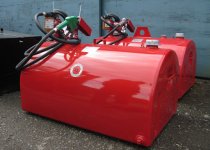
To expand on Angry Beavers last point. Most guys around here transport diesel in what we call a Tidy Tank. Local company that has been manufacturing tanks for decades.

Available in 20 gallon and up sizes. Some people just leave them on a small trailer , if you dont want to remove them from a pickup or lift them off with loaders. Electric pumps, filters and meters are options
 

Attachments

  • Tidy 1.jpg
    Tidy 1.jpg
    20.2 KB · Views: 17
  • Tidy 2.jpg
    Tidy 2.jpg
    61.8 KB · Views: 15
  • Tidy 3.jpg
    Tidy 3.jpg
    74.8 KB · Views: 15

Farmall450

Well-known member
Joined
Dec 23, 2011
Messages
13,367
Location
Marengo, Illinois
I'd go with the Honda Diesel. You're getting the objectively "best" unit for the money you are looking to spend. Diesel storage isn't hard, and it's a heck of a lot better than gas.
 
OP
F

FMC1959

Well-known member
Joined
Feb 9, 2014
Messages
2,319
Location
Montreal, Canada / Upstate NY
Any tank stored outside will have condensation...

Generator Tech here for 17 years. I live out in the sticks and loose power once or twice a year for a couple days.

... It will run my well pump, freezers and my furnace. I recently sold it for 4x what I paid for it only because I ran across a Kubota Low boy (11K, 10K continous). It uses a kubota D722 3 cylinder engine that just happens to be in my lawn mower and i have a spare 722. I've changed all the filters on the tractor, skid steer, lawn mower and generator so everything uses the same filters.

Get rid of the 55 gallon barrels. They rust and condensate badly because they are so thin. Either get a 50 gallon cube tank, or a 100, depending on what your tractor can move. Then invest into a quality pump with 10 micron filter setup. At that point, you won't have to worry about fuel contamination on the gen or tractor because the primary fuel filter is 30 micron on most of these small engines.

AngryB, thanks for all of the advice.

Like I mentioned earlier, I already have the drums (plastic) so for now I will use them till I can get something better....speaking of which.

I can get tanks like these for less than $30 a tank, used. New on websites, some of these say not for pressurized use, water only. Others say they take petroleum products. The ones I can get, no idea what they are listed for.

With a vented cap and covered where water does not get in through the vented cap, these can work for diesel?
https://www.tank-depot.com/product.aspx?id=3268

Also, are you familiar with this Yamaha?
https://www.yamaha-motor.ca/en/power-equipment/generator/diesel/edl11000sde/EDL11000SDE

WittHay mentioned what I also suspect. They look like they came of the same assembly line as Kubota Lowboys but badged as Yamaha. I would like some like your 11Kw Kowboy, but here in my area, almost nobody sells them. The Yamaha's a bit easier to find and the odd dealer I've seen has 2019's they are trying to get rid of with a bit of price reduction.
 
Last edited:
OP
F

FMC1959

Well-known member
Joined
Feb 9, 2014
Messages
2,319
Location
Montreal, Canada / Upstate NY
To expand on Angry Beavers last point. Most guys around here transport diesel in what we call a Tidy Tank. Local company that has been manufacturing tanks for decades.

Available in 20 gallon and up sizes. Some people just leave them on a small trailer , if you dont want to remove them from a pickup or lift them off with loaders. Electric pumps, filters and meters are options

Thanks, I will check them out
 
OP
F

FMC1959

Well-known member
Joined
Feb 9, 2014
Messages
2,319
Location
Montreal, Canada / Upstate NY
I'd go with the Honda Diesel. You're getting the objectively "best" unit for the money you are looking to spend. Diesel storage isn't hard, and it's a heck of a lot better than gas.

My feeling also...If the Yamaha diesel is truly running a Kubota Diesel, then I might spend the extra for that.

Then, I have to see about how viable LP would be for me, otherwise I think diesel would be best for me

Thanks
 

Aefriot

Member
Joined
Aug 22, 2019
Messages
10
Location
Potsdam, New York
As for the ****** bloke that stated that small diesels were good for 20,000-30,000 hours, I about fell out of my chair laughing so hard. I think someone put something in his crumpets.

My apologies. I did not mean to say that all small diesels lasted that many hours. Trying to type fast so I could get back to work outside, I abbreviated what I was thinking.

I should have stipulated that I have been told by those who use them, the MEP-002 can last a very long time...25-30,000 hours without a rebuild. My generator is a liquid cooled twin cylinder Onan brushless generator 5 kW (underrated) model MEP-802a TQG (Tactical Quite Generator). I obtained my generator with 2 hours on it and with high hopes and a good lineage, will last the rest of my life for as much as I use it. It operates at 1800 RPM, not the high rpm units, I will not own one of those. Brushless all the way for clean power. I only use a brushed generator for devices that don't matter much, still it's an 1800 rpm Onan 6.5 kW.

I make my own crumpets (English Muffins), thank you. Sorry I wasn't more specific in my post.
 
Last edited:
OP
F

FMC1959

Well-known member
Joined
Feb 9, 2014
Messages
2,319
Location
Montreal, Canada / Upstate NY
My apologies. I did not mean to say that all small diesels lasted that many hours. Trying to type fast so I could get back to work outside, I abbreviated what I was thinking.

I should have stipulated that I have been told by those who use them, the MEP-002 can last a very long time...25-30,000 hours without a rebuild. My generator is a liquid cooled twin cylinder Onan brushless generator 5 kW (underrated) model MEP-802a TQG (Tactical Quite Generator). I obtained my generator with 2 hours on it and with high hopes and a good lineage, will last the rest of my life for as much as I use it. It operates at 1800 RPM, not the high rpm units, I will not own one of those. Brushless all the way for clean power. I only use a brushed generator for devices that don't matter much, still it's an 1800 rpm Onan 6.5 kW.

I make my own crumpets (English Muffins), thank you. Sorry I wasn't more specific in my post.

No worries, at least from me.

I have a basic knowledge of many things but only be asking and getting many of these responses, is it possible to learn more.
 
OP
F

FMC1959

Well-known member
Joined
Feb 9, 2014
Messages
2,319
Location
Montreal, Canada / Upstate NY
Firebrick43 or anyone that knows, when it is mentioned that diesels or only cost effective when they are loaded at 50% or more.

How exactly should this be interpreted, when it is used, having it work hard is important, even if used only a couple of times a month?

I just had another power failure today, this time 8 hours. I figure in the short time I have been at his home (rural area) I get at least 2 outages a month, if not more, and it is never 15 minutes. At the very least, it is 3 hours and from people who have been living here for 10+ years say in the winter it will longer. I can expect at least 2-3 days /year where it will be over 24 hours. Of course, like anywhere, there can be those times when a week or more outage can happen, but this is the rare circumstance

If I got a diesel, it would not be used often (like daily), but when it is used, definitely under load as it would be running close to its limit most often.

Or if this is not clear...I use it every month, at least 24 hours a month (obviously not a lot), but it would be working hard when used 70 to 80% load, not just idling most of that time.

Would this be an ideal situation for a diesel or it must be used daily?
 
OP
F

FMC1959

Well-known member
Joined
Feb 9, 2014
Messages
2,319
Location
Montreal, Canada / Upstate NY
Also wanted to add, some people stating that they gens are used so infrequent that when you need them they won't start.

Many of these systems have built in programable startups that can be set for once a week, or twice a month it starts a runs for 15 minutes or you can have it run 30 to 60 minutes...you can pretty much set it as you see fit.
 

ihateminimumwage

Well-known member
Joined
Jan 26, 2012
Messages
3,960
Diesels need to run with a load, or else they "wet stack" and build up enough unburnt fuel and soot in the exhaust that they won't run. I've load banked some under loaded standby gens that blew out some pretty big flaming chunks, which makes you a little nervous when there's a field of dry grass on the other side of the fence.

Standby equipment comes with programmable exercise cycles to make sure everything is operating properly. Rental and portable units (Like the Kubota Lowboy or MQ Whisperwatt) don't have that function built in, but most of the more recently built units will have 2 wire start terminals, which can either be controlled with a transfer switch, or just hooked to a standard light switch for manual operation.
 
OP
F

FMC1959

Well-known member
Joined
Feb 9, 2014
Messages
2,319
Location
Montreal, Canada / Upstate NY
Diesels need to run with a load, or else they "wet stack" and build up enough unburnt fuel and soot in the exhaust that they won't run. I've load banked some under loaded standby gens that blew out some pretty big flaming chunks, which makes you a little nervous when there's a field of dry grass on the other side of the fence.

Standby equipment comes with programmable exercise cycles to make sure everything is operating properly. Rental and portable units (Like the Kubota Lowboy or MQ Whisperwatt) don't have that function built in, but most of the more recently built units will have 2 wire start terminals, which can either be controlled with a transfer switch, or just hooked to a standard light switch for manual operation.

The running on a load part I am more and more understanding that. What I am trying to figure out if it runs infrequently, 2-3 times per month, but make sure it is running with a good load like 70-80% load, is that OK?

Even if it doesn't have the programable features, I am pretty **** with my tools and could easily start it every 2 weeks. But it is looking that I will be running it 2 or more times a month just out of necessity.
 

ihateminimumwage

Well-known member
Joined
Jan 26, 2012
Messages
3,960
The running on a load part I am more and more understanding that. What I am trying to figure out if it runs infrequently, 2-3 times per month, but make sure it is running with a good load like 70-80% load, is that OK?.

That will be fine. It's good to exercise them (even at no load) rather than take the chance of it not working when you need it. The wet stacking issue is more along the lines of people that have a trailer mount 50kW tucked into a corner of their property just running a skilsaw day in and out.
 
To avoid these ads, REGISTER NOW!

Firebrick43

Well-known member
Joined
May 12, 2015
Messages
14,088
Location
West central Indiana
Along with issue of wet stacking and fuel dilution of the oil, diesels efficentcy does not overcome purchase cost and operating cost unless you actually put a load on them consistently.

IE many toot their horns about their diesels high mpg on a truck or low gph usage of a tractor(or generator)

Most diesel engine will have better fuel economy at all rpms but a gasoline engine gets particulary bad as constant heavy loads increase. A diesel truck makes financial sense only if pulling a large trailer a majority of the time. Same with a tractor, plowing or tillage makes sense but doing chores as most property owners doesn't. Now I understand most like diesels torque when they really like long stroke engines with turbos as an equal displacement NA diesel has much less power than an equivent displacement gasser.

I am not knocking people's choice of a diesel because they like them, pointing out that many confuse hourly fuel cost with hourly operating cost and for many the gas or lp will be much lower.

If you are only putting 10 hours a month, 120 a year, a gas engine sold last 15 years or so, more if LP.
 
Last edited:
OP
F

FMC1959

Well-known member
Joined
Feb 9, 2014
Messages
2,319
Location
Montreal, Canada / Upstate NY
Along with issue of wet stacking and fuel dilution of the oil, diesels efficentcy does not overcome purchase cost and operating cost unless you actually put a load on them consistently.

IE many toot their horns about their diesels high mpg on a truck or low gph usage of a tractor(or generator)

Most diesel engine will have better fuel economy at all rpms but a gasoline engine gets particulary bad as constant heavy loads increase. A diesel truck makes financial sense only if pulling a large trailer a majority of the time. Same with a tractor, plowing or tillage makes sense but doing chores as most property owners doesn't. Now I understand most like diesels torque when they really like long stroke engines with turbos as an equal displacement NA diesel has much less power than an equivent displacement gasser.

I am not knocking people's choice of a diesel because they like them, pointing out that many confuse hourly fuel cost with hourly operating cost and for many the gas or lp will be much lower.

If you are only putting 10 hours a month, 120 a year, a gas engine sold last 15 years or so, more if LP.

I understand your points and I am not liking diesel because I think it is cheaper, more that the overall package for me is easier.

I called a propane company today and need to contact a couple of others. This one said they would rent me 420lb (122 gallon) tank for $120 per year and would need at least 2. The delivered price is $2.22USD/gallon.

I need to check more on propane and do some calculations to see how cost efficient it is + LP gen versus diesel and then see. Thanks
 
Last edited:
OP
F

FMC1959

Well-known member
Joined
Feb 9, 2014
Messages
2,319
Location
Montreal, Canada / Upstate NY
Anyone know much about these Westinghouse generators popping up at all the big box stores and online? I know they are gasoline, but they have a unit that peaks at 15Kw (12Kw contuous) which isn't bad. Places that have ratings, usually they do pretty good. Their engines are Westinghouse? I am going to guess the whole genset is made in China (including engine) and they slap the Westinghouse name on it.

Any good or bad experiences to speak of?
 
Last edited:
OP
F

FMC1959

Well-known member
Joined
Feb 9, 2014
Messages
2,319
Location
Montreal, Canada / Upstate NY
I have a 500 gallon tank I bought for $56 dollar (after sales tax) from a large company that used to use it for fire fighting training. It is old, 1950's vintage but solid with the valves and regulator either replaced or rebuilt. In the US, these tanks (500 & 1000, not sure on the 120 gallon) do not need to be tested/certified every 10 years like your 20 & 100 pounders.

Here is a before and after pictures of my tank, purchased in 2008. Sorry the painted tank picture isn't a close up. Behind it is my 12kW generator (it is a Gillette brand, a company who no longer makes home units :sad:)

bob15, just wanted to mention that I have been looking at used propane tanks, at $56 you did incredibly well. Here there are not many listed, and the ones that are go from $500 and up and all of them stated, need to be re-certified. So if you do not need to do it where you live, not sure if I should say lucky you, or maybe re-certifying is a pain and expense, but better to be safe than sorry.

New tanks go for - 500gl so far $2500cdn best price & 1000gl $4200cdn. Not cheap, but still more looking around to do.
 

bob15

Well-known member
Joined
Dec 8, 2011
Messages
6,863
Location
Northeasten, CT
bob15, just wanted to mention that I have been looking at used propane tanks, at $56 you did incredibly well. Here there are not many listed, and the ones that are go from $500 and up and all of them stated, need to be re-certified. So if you do not need to do it where you live, not sure if I should say lucky you, or maybe re-certifying is a pain and expense, but better to be safe than sorry.

New tanks go for - 500gl so far $2500cdn best price & 1000gl $4200cdn. Not cheap, but still more looking around to do.

Not sure if you read this or not: https://propane.ca/safety-regulation/
 
OP
F

FMC1959

Well-known member
Joined
Feb 9, 2014
Messages
2,319
Location
Montreal, Canada / Upstate NY
Not sure if you read this or not: https://propane.ca/safety-regulation/

Thanks for the link...this is the Feds, they regulate transport of propane tanks more than the tanks themselves. The tanks themselves falls to each province, from what I can tell in Quebec, and most other provinces I saw references to, they all require recertification every 10 years.

I need to call the office that handles this (that's at least 2 hours of my life lost) and ask for the particulars because on line is actual laws that have all the legal lingo which can be a pain to understand, then in Quebec, most often the page are in French, making it even harder to understand.

I saw a place online that does certification and had prices. 420lb (~80gal) tank is $150 to recertify, didn't have a price for 500 & 1000 gal tanks. I also saw some laws talking about tanks underground, so it would seem to be doable, but there were so many particulars about the tanks, the lines, what kind of welds and all....best to talk with someone at the office about it.
 

Fatboy148

Well-known member
Joined
Feb 15, 2017
Messages
999
I bought 2 used propane tanks to store hot water in a water heating system. They were built in 1957 and heading to the scrap yard. I had to sign a document that I would not use them for storing propane before the propane company would sell them to me. I needed to make some alterations to the tank for my particular application, seal up some holes and add new for my 1 1/4" threaded adapters. The ends of these 500 gallon tanks had to be almost 3/8" thick. The straight walls were thinner but not a lot. This may be a reason recertification is not need on 500 and 1000 gallon tanks (at least here in the US).
 
OP
F

FMC1959

Well-known member
Joined
Feb 9, 2014
Messages
2,319
Location
Montreal, Canada / Upstate NY
I bought 2 used propane tanks to store hot water in a water heating system. They were built in 1957 and heading to the scrap yard. I had to sign a document that I would not use them for storing propane before the propane company would sell them to me. I needed to make some alterations to the tank for my particular application, seal up some holes and add new for my 1 1/4" threaded adapters. The ends of these 500 gallon tanks had to be almost 3/8" thick. The straight walls were thinner but not a lot. This may be a reason recertification is not need on 500 and 1000 gallon tanks (at least here in the US).

I heard from someone in Alberta, there recertification is once in 25 years. And there may be provinces that it is like yourself in the US, where no recertification is required, but I need to concern myself where I live which is in Quebec, and it is every 10 years.

It is maybe $200 to $300 to have it recertified, every 10 years, not the end of the world, but finding a decent tank is easily over $1500. Anything that is less is not certified and the response I get on $500 tanks is that they are not re-certifiable, often have holes and are being sold for other purposes than propane.
 
To avoid these ads, REGISTER NOW!
Top Bottom