To avoid these ads, REGISTER NOW!

Generator Interlocks and Inlets

Charles (in GA)

Well-known member
Joined
Jan 11, 2006
Messages
12,489
Location
50 mi south of Atlanta
About a year ago, a co-worker asked if I knew anyone who might want to buy a generator. As I'd had it in the back of my mind for a while, I told him I might be interested. Turns out the generator was a Northern Tools NorthStar 10 hp Yanmar diesel powered 6500 watt unit. He had acquired it from someone who was getting divorced and needed to liquidate some stuff and my co-worker is somewhat of a wheeler dealer. The generator, from the date stamps on the motor and fuel hoses and other items, appeared to have been made in 2003 or 2004 and was still wrapped in plastic, never having had fuel or oil in it. His wife was after him to get it out of the garage, and since he had a generator he had been using, he was willing to sell it.

I went to his house and loaded it up, and then set out to install a generator interlock on my Square D circuit breaker panel and an inlet connection under the back porch.

After doing some searching and looking on Ebay, and searching some Square D documents I found they made a couple of different interlocks for various model panels. I ended up with the QOCGK2C interlock for my 200 amp main breaker panel. I think I paid $52 or somewhere thereabouts with shipping. So after a trip to Home Depot to get a 30 amp breaker, I opened the panel and had to move a few breakers to free up the two spaces on the upper right side, and drilled the front and installed the interlock and breaker. Then I set about mounting a Reliance generator inlet box with a L14-30 connector in it, under my screened in redneck back porch. Supposedly the degree of redneck that the porch is, is determined by how many dogs would be killed when it collapsed :evil: In any case, I mounted the box, ran some 3/4 PVC conduit along one of the floor joist of the porch, and stopped... for the winter. Recently I got around to drilling the foundation block to run the conduit into my crawlspace. I used the largest masonry bit I had for my drill, then the largest star drill I had and opened it up by hand drilling with the star bit and masonry hammer. Finally a trip to the local hardware to get a larger star drill and finished the job. My hammer hand hurt for days after that!!!

I am at the point now that I need to run the NM 10/3 w/grd and hook it up and I'll be finished.

Charles
 

Attachments

  • Northstar 10hp Yanmar diesel generator.jpg
    Northstar 10hp Yanmar diesel generator.jpg
    130.6 KB · Views: 404
  • Square D generator interlock normal mode.jpg
    Square D generator interlock normal mode.jpg
    127.4 KB · Views: 591
  • Square D generator interlock generator mode.jpg
    Square D generator interlock generator mode.jpg
    100.7 KB · Views: 159
  • Reliant generator inlet mounted under back porch.jpg
    Reliant generator inlet mounted under back porch.jpg
    125.1 KB · Views: 437
Last edited:
To avoid these ads, REGISTER NOW!
OP
C

Charles (in GA)

Well-known member
Joined
Jan 11, 2006
Messages
12,489
Location
50 mi south of Atlanta
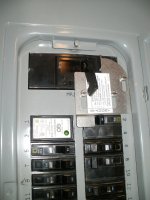
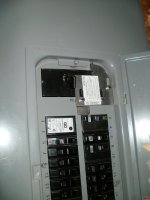
Well, this got me to thinking that I need to improve the generator inlet setup our HOA has on one of its water wells. When the well was installed in 1994, one of the neighbors cobbed up a generator cord to connect the 10,000 watt Dayton generator to the well house panel. The well house has a meter/main combo panel outside made by Cutler-Hammer, and a 16 space main lug panel inside made by General Switch. General Switch is out of business, and I don't know if they ever made breakers at all. The panel accepts common stab breakers such as Siemens, GE, Murray, Homeline, and a few others, legal or not, its a well house, and if it works...........

The existing generator connection installation consisted of a 10/4 cord with the L14-30 plug on the generator end, and of all things, a L14-20 plug on the other end..... A SUICIDE CORD that plugged into a receptacle that was jammed into a tiny metal handy box under the panel, unsupported except by the conduit connection. wires ran from this to the generator breaker in the panel, and also to a weatherproof box outside with another recpetacle (which has never been used). Thus this huge L14-20 receptacle and a total of 8 wires, including the grounds, in this tiny 18 cu in box.

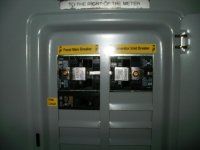
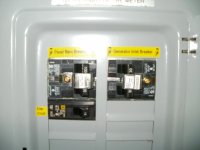
I ended up installing a Siemens 100 amp double pole breaker in the panel and a new 30 amp Siemens Double pole breaker opposite it, and routed the wires that went to the lugs, to the breaker instead. I then installed a Siemens ECSBPK01 interlock kit on these breakers. I bought this from Amazon and got a decent price on it, and then went shopping for something cheaper than the $50 Reliance generator inlet. Since this would be inside, it didn't need to be weatherproof. I found some L14-30 inlet plugs at Fruitridge tools, just the inlet, no box or other parts, and got 3 of them for about $18 each. Many listings on Ebay and elsewhere were $30 and up. Pictures tell the story better, but I mounted a 4x4 metal box with a wall stud mounting bracket and an offset connector to the panel, and used a metal face for a 50 amp receptacle that I opened up slightly to accept the inlet plug. The prongs will never be hot, as the interlock prevents this. Only if a generator cord is plugged onto it and powered by the genny will it be hot, and then not exposed. I did fab up a cap that fits into the inlet connector to protect it from spiders and mud daubers, it is dangling out of sight by the wire on the corner of the 4x4 box.

Gotta test it out yet. We normally open the double doors of the well house, and turn the genny so the exhaust faces out, and leave it inside the well house, thus it can stay out of the weather. This genny has an idle circuit on it that allows it to idle except when a load is placed on it, when it throttles up to proper speed to generate the 60Hz and 120/240v.

Charles
 

Attachments

  • General Switch panel interlock in generator mode.jpg
    General Switch panel interlock in generator mode.jpg
    84.5 KB · Views: 112
  • General Switch panel interlock in normal mode.jpg
    General Switch panel interlock in normal mode.jpg
    78.8 KB · Views: 766
  • General Switch panel and generator inlet.jpg
    General Switch panel and generator inlet.jpg
    116.2 KB · Views: 135
  • Generator inlet in 4 inch box below panel.jpg
    Generator inlet in 4 inch box below panel.jpg
    122.2 KB · Views: 112
Last edited:
OP
C

Charles (in GA)

Well-known member
Joined
Jan 11, 2006
Messages
12,489
Location
50 mi south of Atlanta
Our water system consist of three wells. Having 15 or fewer taps means we are not a regulated water system under Federal or State regulations, so we have three separated systems. Two of the wells are supplied by Georgia Power and one is supplied by an electric co-op as the lines meet at our subdivision.

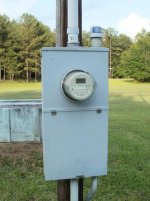
After installing the new interlock and inlet on the well house, I decided to install an inlet and interlock on the EMC powered well. It is an open well head and 1500 gal tank, and a GE meter/main combo panel mounted on a pole next to the well. The GE panel has places for four full size 1" breakers or 8 of the ½" wide breakers.

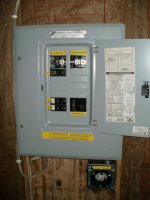
The interlock requires a standard GE double pole breaker in the two right hand spots, leaving room only for two other breakers or four of the thin ones. I installed a thin double pole for the well pump, and relocated the existing two thin single pole 20 amp breakers to either side of the DP pump breaker. Again, the pics tell the story.

The only quirk is that, to slide the interlock to the left for generator operation, the breaker to its immediate left must be tripped off. I put the GFCI receptacle breaker in this position. The receptacle is mounted on the backside of the panel in a weatherproof Bell box and is merely for maintenance purposes and if a generator is running, then it will have outlets that can be used if needed, so it is a non issue.

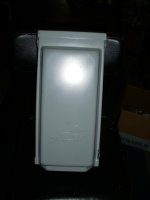
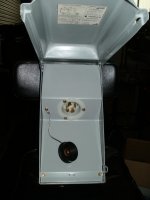
I haven't yet installed the inlet connector, but did acquire a Midwest brand (GE) metal inlet box with a L14-30 inlet plug and it is a NEMA 3R box that can have the cord connected and run out the bottom and still remain raintite. I'll post pics when I get it mounted. I picked up the Midwest inlet box from an Ebay seller. It was listed with a BIN of $80 but with a make offer, so I offered $60 (shipped) and they accepted. It is a huge box, but I wanted the raintite WHEN IN USE capability, which the Reliance is not.

I installed a GE branded THQLLX4 interlock kit designed for this panel. It cost $42 from an Ebay seller, and works perfectly.

I will post pics of the inlet box when it is installed.

Charles
 

Attachments

  • GE meter main combo outside view.jpg
    GE meter main combo outside view.jpg
    139 KB · Views: 156
  • GE meter main interlock in normal mode.jpg
    GE meter main interlock in normal mode.jpg
    78.9 KB · Views: 197
  • GE meter main interlock in generator mode.jpg
    GE meter main interlock in generator mode.jpg
    79 KB · Views: 442
  • Midwest generator inlet box.jpg
    Midwest generator inlet box.jpg
    61.9 KB · Views: 374
  • Midwest generator inlet box open.jpg
    Midwest generator inlet box open.jpg
    87.6 KB · Views: 374
Last edited:

edcantu9

Well-known member
Joined
Mar 2, 2013
Messages
607
Location
Southeastern Iowa
I am not an electrician, but recently acquired a 4000w generator. Is it possible for a DIY guy to do this? I do have experience wiring new outlet and change outlets. Just looking for other members views. It sounds like I could do enough research and do it, but it there more to it that it is not as simple as it sounds?
 

wyliesdiesels

Well-known member
Joined
Aug 14, 2012
Messages
19,983
Location
Modesto, CA
Nice setup charles!

....The interlock requires a standard GE double pole breaker in the two right hand spots, leaving room only for two other breakers or four of the thin ones. I installed a thin double pole for the well pump, and relocated the existing two thin single pole 20 amp breakers to either side of the DP pump breaker. Again, the pics tell the story........

Charles

Charles did u use 2 of the single pole GE thin breakers for the pump breaker? To me thats what it looks like. If so, then that doesnt work because a 240v circuit must be fed by a common trip breaker...

I am not an electrician, but recently acquired a 4000w generator. Is it possible for a DIY guy to do this? I do have experience wiring new outlet and change outlets. Just looking for other members views. It sounds like I could do enough research and do it, but it there more to it that it is not as simple as it sounds?

Yes it is TOTALLY DIY.

If u have any questions, just start a new thread and ask away! Be sure to post pics!
 
Last edited:

rockwithjason

Well-known member
Joined
Jan 8, 2006
Messages
2,633
Location
Las Vegas
I am not an electrician, but recently acquired a 4000w generator. Is it possible for a DIY guy to do this? I do have experience wiring new outlet and change outlets. Just looking for other members views. It sounds like I could do enough research and do it, but it there more to it that it is not as simple as it sounds?


if you have any kind of electrical dyi experience it's within your reach. there are some quirks that you have to watch out for tho, this is where homework is key. this is not one of the areas to cheap out on.
 
OP
C

Charles (in GA)

Well-known member
Joined
Jan 11, 2006
Messages
12,489
Location
50 mi south of Atlanta
Nice setup charles!

Charles did u use 2 of the single pole GE thin breakers for the pump breaker? To me thats what it looks like. If so, then that doesnt work because a 240v circuit must be fed by a common trip breaker...

The double pole breaker is a GE THQP240 which is a listed double pole breaker designed to clip on the special clips on a GE stab that accept those 1/2 inch modules. It straddles two stabs, clipping to each one.

To clarify a little more, it is esentially two of the thin line breakers riveted together with a handle tie. It is manufactured by GE and UL listed as a double pole common trip breaker. Whether is has a internal common trip or not, I do not know, I suspect it is certified with the handle as the common trip, and if UL is happy that this alone can trip both halves of the breaker, due to internal design, then I'm fine with it). It is designed so it cannot inadvertently be installed on one stab alone (as other brands of tandems do), but must be installed straddling two stabs. GE does not make thinline tandems like other manufacturers do, they only make ½ wide individual thinline single pole breakers, and these one inch wide (total width) thinline double pole breakers.

Go to page 1-5 of THIS CATALOG for their listings.

Charles
 
Last edited:
To avoid these ads, REGISTER NOW!

madosta

Well-known member
Joined
Sep 4, 2012
Messages
807
Location
Michigan
Clearly that generator is not to code. Please ship it to me for inspection. Thank you.
 
OP
C

Charles (in GA)

Well-known member
Joined
Jan 11, 2006
Messages
12,489
Location
50 mi south of Atlanta
I am not an electrician, but recently acquired a 4000w generator. Is it possible for a DIY guy to do this? I do have experience wiring new outlet and change outlets. Just looking for other members views. It sounds like I could do enough research and do it, but it there more to it that it is not as simple as it sounds?

To me, workmanship counts for alot, so if you do neat work, you probably are patient enough to do this. Its not difficult, but you need to carefully research which panel and main breaker you have, and what interlock you need. The interlocks come with a drill pattern, the Square D one was a piece of metal with the holes in it and dimples on it for properly locating it. Accurate drilling of the panel front (removed or course) is essential to a good functioning installation. The Square D pattern forces you to not get stupid and drill from the front.......... it only fits from the back side so you drill from the back. The remainder is engineering proper mounting for the inlet connector and routing of the wire to the panel.

Your main panel must have a main breaker installed in it for these interlocks to work. If your only main breaker is outside, then you will need to obtain a main breaker kit for the panel and install it first.

Electricity is not forgiving so you have to be careful and know what is going on. On my house install, the romex clamp I installed in the panel had a sharp burr inside of it, that I did not spot. It cut thru the Romex jacket and a hot wire. I went to test the wiring job by leaving the panel front off, thus defeating the interlock, and energizing the inlet connector from the panel to check the wiring with a meter. When I closed the breaker I got a flash and boom from the short to ground and the breaker blew:shocking:. Was glad to have found it when I did, and not when I needed the genny powering the house. I ended up splicing the Romex in a junction box under the house, using tiny split bolts and lots of 3M tape.:eyecrazy:

Charles
 

bgeery

Active member
Joined
Jul 2, 2013
Messages
43
Location
Yucca Valley, CA
Is ground tied to neutral in that generator? In that case, you need to disconnect the bonding wire so they float separately. Ground and neutral should only be bonded one place.
 

Highbeam

Well-known member
Joined
Feb 15, 2011
Messages
2,292
Location
Mt Rainier foothills, WA
Is ground tied to neutral in that generator? In that case, you need to disconnect the bonding wire so they float separately. Ground and neutral should only be bonded one place.

Uh oh, this is the never ending problem with portables. Nobody knows and it doesn't matter if your genset has a floating neutral. Leave the genset wiring OEM.
 

pattenp

Well-known member
Joined
Jun 4, 2008
Messages
10,175
Location
Virginia - USA
Uh oh, this is the never ending problem with portables. Nobody knows and it doesn't matter if your genset has a floating neutral. Leave the genset wiring OEM.

If gen is solely used to power the house wiring the neutral should be floating at the gen. If the gen is used strictly as a portable then the neutral is to be bonded at the gen. So it does matter.
 

bgeery

Active member
Joined
Jul 2, 2013
Messages
43
Location
Yucca Valley, CA
Ah, yes, it does matter if neutral and ground are bonded at the generator! Or do you think the NEC requirement is just a suggestion? It's an easy thing to test for and correct.

If you don't want to break the ground/neutral connection in a bonded generator, then an interlock is not a NEC compliant solution. You need the (more expensive) solution of a transfer switch that switches all the wires, not just the hots (as an interlock does).

A simple trick is to break the generator bond (if bonded), then buy a plug and bond the neutral and ground together inside it. When using portable, plug in your new bonding plug to one of the generator sockets to tie together ground and neutral. When using on the house, remove the bonding plug from the generator socket to float neutral and ground.
 
To avoid these ads, REGISTER NOW!
Top Bottom