To avoid these ads, REGISTER NOW!

Generic rust removal solution

marksd1

Member
Joined
Jul 7, 2010
Messages
20
Hello-
I thought I would share a few results of some experiments. After searching the web, it appears that Evapo-Rust and similar products are actually chelation agents. These are compounds that bind tightly to oxidized iron and pull it into solution. I could go into detail, but this is posted elsewhere. In any event, one of the best chelation agents out there (rumored to be the active ingredient in E-R) is ethylenediaminetetraacetate or EDTA. One can purchase this pure in bulk (for example from sigma aldrich). Get EDTA, not its disodium salt. It is around $110 per kilogram. I made up about a 5% solution, and adjusted the pH to 9.0 with sodium hydroxide pellets (dangerous, know how to handle). Even extremely rusted wrenches were remarkably cleaned with this very cheap solution. After about a day in the solution with an occasional mild scrub with a scrub pad to remove bulk rust, they were essentially rust free, and ready for passivating (some kind of treatment to prevent flash rust of pure iron crystals that form on the surface of the tool during this process). One can use WD40, or microcrystalline wax. It is probably not superior to electrolysis, but is really easy. The solution is relatively non-toxic. About 80 million kilograms of EDTA are synthesized annually. Some people even take minute quantities as a (probably quack) cure-all. That being said, it does break down into some compounds with some pollution potential. Another compound with potent chelation properties is EDDS (ethylenediamine NN Disuccinic acid). This compound is much easier on the environment, but is also much more expensive ($400 for one liter of a 35% solution), and I have not yet tried this on a rusty wrench.

Hope this is helpful.
Dan
 
To avoid these ads, REGISTER NOW!

Abbott

Well-known member
Joined
Apr 29, 2009
Messages
1,684
Location
U.S.A.
I soak rusty stuff for a few days in vinegar. It's cheap, easy and does an outstanding job of removing rust. Then rinse with plenty of clean water and a light wipe down with oil on the metal tool or part. Vinegar soaking will get all of the rust.
 

Bull

Super Moderator
Joined
Dec 12, 2005
Messages
16,189
Location
MA
I got scared at the word "dangerous."

I also have been using vinegar, and appreciate its relative safety.

It does stink once the batch gets rusty and dirty, though.
 
Last edited:

Bolster

Well-known member
Joined
Jul 8, 2008
Messages
4,056
Location
Mexifornia
Hello-
I thought I would share a few results of some experiments. ...

Wow, this is really interesting information, despite the fact that it is about three PhDs over my head!! Thanks for posting it. Is it possible to do pH adjustment with commonly available solutions available for fish tanks, advertised as expressly for the purpose of adjusting pH up and down? Why do we need to adjust the pH in the first place?

Another question...not knowing anything about chelation...about how long would you expect a batch to last, if you used it say once a week or so? Does the solution "chelate out" after awhile? Nothing left to bind oxidized iron?
 
Last edited:
OP
M

marksd1

Member
Joined
Jul 7, 2010
Messages
20
Yes, eventually the chelation will saturate. However, this will be at least on a gram per gram basis. That is, a solution with 5 grams of EDTA will chelate at least five grams of rust. It is not an exact count, the EDTA actually chelates more than that, but it is close enough. Sodium hydroxide is the most simple base out there (makes a solution have a higher pH, more alkaline). It is just NaOH. Technically any other base will work (including those for fish tanks) or even sodium bicarbonate (baking soda). Keeping the solution alkaline will prevent acid etching, and also drives the process of chelation. The advantage to chelation vs. acid is that you cannot etch iron this way, and it allows for very little "flash rust" problem. It is also much faster. There is really nothing dangerous here, it is just that pure sodium hydroxide is extremely basic, and will burn you just as fast as a strong acid. Just use rubber gloves, and you are fine. There really are no harmful fumes from this process either.
 

DavidB

Well-known member
Joined
Feb 6, 2010
Messages
734
Location
Navarre, FL
Greats posts! Thanks for posting this. Its interesting to hear what makes E-R work so well. Welcome to the board.
 

Bolster

Well-known member
Joined
Jul 8, 2008
Messages
4,056
Location
Mexifornia
Yes, eventually the chelation will saturate. ....

Aha! I only have an intuitive grasp of this (college chemistry was half a lifetime ago), but I've always been anti-vinegar (or name your acid) because it seemed to me it made the surface of the treated item, rougher than EOR treatments. And I've read rumors that acid treatments would then re-rust rapidly. I read somewhere you could "ruin" a tool with the wrong rust removal technique, because it would then forever re-rust very easily. Are you saying that the chelation method avoids these issues?

You've also neatly explained why EOR lasts for so long. It would take awhile to encounter sufficient iron oxide.

And you're also confirming why a treatment of WD40 after chelation works so well. I had stumbled across this sequence some time ago and noticed it was just better if I'd WD40 after EOR.

I don't mean to sound like an excited school girl here, but this really is blowing my dress up.

Glad you've joined the board! We could use a chemist!!

PS: Do you have any explanation for why using a brass brush with EOR seems to "brass plate" tools with an odd yellowish hue? I've gotten some very odd results with a brass brush...
 
Last edited:

Bolster

Well-known member
Joined
Jul 8, 2008
Messages
4,056
Location
Mexifornia
Interesting stuff.
Kind of scary that you can just buy it and eat it.
http://www.amazon.com/dp/B000BLEGQC/?tag=atomicindus08-20

I don't know anything about alternative medicine, but I have heard medical experts describe human aging as a sort of "rusting" or oxidation that occurs to the body. That's why antioxidants are all the rage. I suppose it's inevitable somebody takes it a step farther and sells a chelation agent as a powerful antioxidant...EvapORust for your body...

Oh look! "Chelation Therapy"!!!

Mebbe I'll be washing down my gopher with EOR!! (Not!)
 
Last edited:
OP
M

marksd1

Member
Joined
Jul 7, 2010
Messages
20
EOR is not buffered, so I suspect the pH might drift a bit depending on storage, use, etc. I measured the pH of a fresh batch at 7.1
Dan
 

Bruce Lancaster

Well-known member
Joined
Apr 3, 2006
Messages
1,642
Ph of 9...I have no practical knowlege of the stength range between "neutral" and "dissolve a bulldozer". At 9, can the scrubbing be done bare-handed without skin trouble, and also is that safe in areas other than alkalinity? Hate rubber gloves, but also hate watching my skin flake off...
Vinegar and other acids I have found and tried other than phosphoric leave a nasty surface texture and a very aggressive desire to rust again. Phosphoric is much better and safer for the metal, IMHO, but the solutions it comes in seem to be expensive.
 

smitmw

New member
Joined
Mar 26, 2013
Messages
1
Question for marksd1 about the ethylenediaminetetraacetate or EDTA you referenced above. I would like to make sure I understand you correctly. Were you actually referring to Ethylenediaminetetraacetic acid, widely abbreviated as EDTA? Ethylenediaminetetraacetate is the conjugate base of Ethylenediaminetetraacetic acid. Based on your addition of the sodium hydroxide pellets to the 5% solution to make it more basic, I assume you meant the -acetic acid form. Is that correct?
 

1950mercury

Well-known member
Joined
Mar 26, 2013
Messages
2,246
Location
metro detroit
I use citric acid it seems to work exactly like evaporust..its cheap and safe...turns the metal black that wipes off just like evaporust....tried vinager and that is a pain.....also use citric acid in a ultrasonic cleaner to clean range brass
 

AR1911

Active member
Joined
Jun 30, 2011
Messages
26
Great discussion, and timely. I use Evaporust by the gallon. I went to the warehouse to pick up a 5-gallon jug for the mill I'm working on, and they are out and won't re-order.
So I'm looking at an alternative.

I searched on EDTA but everything seems to be pills or have a sodium component in the name. Can you provide a link to the right stuff?

Citric acid is also of interest. Where does one buy that in quantity?
 

4xdog

Well-known member
Joined
Aug 18, 2012
Messages
5,595
Location
Santa Fe, NM
I don't get the explanation of the underlying chemistry, I gotta say.

Why would chelation remove the rust? Why use EDTA -- acid, not the acetate or salt form (as noted above) -- and then convert it to the sodium salt form by adding NaOH separately? This has a bit of mumbo-jumbo chemistry to it. Don't believe everything one reads on a website.

Evapo-Rust turns black and has a vaguely sulfurous smell as it works. I've always assumed it was a gentle reducing agent of some sort, possibly based on sulfite or bisulfite chemistry, and the mode of action was simple redox. This is the same reason sulfited molasses is recommended for another type of homebrew rust treatment. The black color is often associated with sulfur chemistry.

One of the first rules a freshman chemistry student learns is the nemonic LEO roars GER. Loss Of Electrons = oxidation, Gain Of Electrons = reduction. Rusting, oxidation, is thus a loss of electrons from the iron. Electrolysis gives them back, reducing the iron oxide to the metal. Chemical reducing agents do the same, supplying the electrons from chemicals rather than a wall outlet.

Maybe a chelating agent is part of the formulation to stabilize the system as it works. I could imagine something like that. To the op -- feel free to go into detail or cite other websites about this chelation mechanism if there's something important we need to know.
 
Last edited:
To avoid these ads, REGISTER NOW!

rick carpenter

Well-known member
Joined
Jan 20, 2011
Messages
3,765
Location
Huntsville, East Texas
Is this grocery store molasses, or the dry molasses from a garden store?

My initial batch was from a grocery store. It's all used up now so I'm going to try other sources to see how they compare. Works well, not toxic, safe to dispose, but slow. Oh well, I'm getting slower these days myself...
 

White 99

Well-known member
Joined
Jul 5, 2009
Messages
285
Location
Northern CA
I got some liquid molasses from a feed store. I am not sure but it might be for horses. Should be able to find more info here with a search. I left mine outside because of the smell so it worked very slow because of the cold.
 

Robert Hall

Well-known member
Joined
Jan 17, 2011
Messages
414
Location
Utah
Having a rather large darkroom I have most of these chemicals as stock. A good source for EDTA is ebay.

I use EDTA and sodium bicarbonate as a catalyst for rust removal. It can be sped up as well by using electrolysis along with the chemicals.

I tend to buy old tools, photograph them, then clean up the tools and use them. Kind of like what Edward Weston did with his pepper #29. :)

I have used many chemicals for many years. Dangerous is a word I don't like to use as it usually means ill educated on handling.

Every chemical has an MSDS which talks about the chemical and what is needed for safe handling of such. At that point it would be respect and not fear in dealing with any chemical.

EDTA is quite safe to handle and washing soda, or sodium carbonate is quite safe as well.

Always read the MSDS before handling chemicals.
 

dkmc

Well-known member
Joined
Jan 20, 2008
Messages
948
Location
NYS--Upstate in the corn fields
Digging up this old thread.....maybe there's other threads that covered this??

Can any of the resident chemists on here (Marksd1) put the mix ratio
of the EDTA into terms a redneck like me can relate to? ie Ounces, quarts,
gallons, etc? Like how much EDTA to make a gallon of rust-be-gone 'shine?
:dunno:

thanks!
 

WhoWhatNow

Well-known member
Joined
Feb 22, 2011
Messages
1,884
Location
Collegeville, PA
1g = 1ml
So 5% = 50mg/ml
1 gal = 3785ml
1oz = 28300mg
So ~0.667oz/gallon of water

That's half way into my second beer and I hate math so double check my calculations.
 

Corndoggeh

Well-known member
Joined
Apr 2, 2016
Messages
1,198
While EDTA can be partially effective for rust removal, it is only one part of a two part solution that would give you "most bang for your buck" and is also more difficult to dispose of versus phosphoric acid. I prefer to use a solution of only phosphoric acid that is also the main component of 90% of over the counter rust removers that you'll find in stores. Phosphoric acid is also more readily available than EDTA since it can be found at home improvement stores and homedepot has a SDS sheet for it on the product page.

I purchase concrete etching at home depot (http://www.homedepot.com/p/Klean-Strip-1-gal-Phosphoric-Prep-and-Etch-GKPA30220/100406369) that is 55% phosphoric acid ONLY and dilute it to approximately 5 - 15% concentration depending on what I am working on. Letting it sit for a few hours in a container will convert the rust into Iron(III)phosphate which creates a light black layer around the iron that is paintable after any loose parts are brushed off and is safe (after neutralization of the acid on it) to use for items such as grill grates. The iron phosphate is also a source of natural phosphorous in our diets. The only side effects to this process is the smell that emits smelling like sulfur (rotten egg). After I'm done with the acid I neutralize it with baking soda and it is then safe to dispose of.

The most important difference between muriatic acid (Hydrochloric acid) and phosphoric acid is that the muriatic will continue to attack the voids and holes in the iron even after someone believes they've completely neutralized it due to the properties of the acid versus phosphoric acid will not readily react with bare iron under normal conditions.

Now overall, products such as evaporust most likely utilize both EDTA and phosphoric acid to remove the rust, keep the metal ions in solution, and create a semi-protectant layer that will not flash rust. The biggest concern I would have using EDTA is how it should be properly disposed of after using it versus phosphoric acid which can be neutralized and washed away down a drain.

I know this is pretty old but its important to keep things simple, using strictly EDTA for rust removal can work but due to its difficulty in breaking down poses an environmental risk. WWN, your math is incorrect.

% conc = 100 x mass of solute/mass of solution.
We need 5% concentration.
mass of 1 gal water = 3785g
5/100 x 3785 = 189.25 g
1 gram is .03527 oz
so.... 189.25g x .03527 oz = 6.6755 oz

Now for our pricing its 13.75 per LB which is 16 oz
6.6755oz x ($13.75/16oz) = $5.74 per gallon at 5% concentration.

So 1 LB of EDTA will make approximately 2.396 gallons. Getting the near equivalent concentration of phosphoric acid (6.8% concentration) and using more math magic, using the phosphoric acid and diluting it to 6.8% concentration will yield 5 gallons of solution. So its actually cheaper to buy phosphoric acid, dilute it, then neutralize it than using EDTA based on what you need.
 
Last edited:

WhoWhatNow

Well-known member
Joined
Feb 22, 2011
Messages
1,884
Location
Collegeville, PA
While EDTA can be partially effective for rust removal, it is only one part of a two part solution that would give you "most bang for your buck" and is also more difficult to dispose of versus phosphoric acid. I prefer to use a solution of only phosphoric acid that is also the main component of 90% of over the counter rust removers that you'll find in stores. Phosphoric acid is also more readily available than EDTA since it can be found at home improvement stores and homedepot has a SDS sheet for it on the product page.

I purchase concrete etching at home depot (http://www.homedepot.com/p/Klean-Strip-1-gal-Phosphoric-Prep-and-Etch-GKPA30220/100406369) that is 55% phosphoric acid ONLY and dilute it to approximately 5 - 15% concentration depending on what I am working on. Letting it sit for a few hours in a container will convert the rust into Iron(III)phosphate which creates a light black layer around the iron that is paintable after any loose parts are brushed off and is safe (after neutralization of the acid on it) to use for items such as grill grates. The iron phosphate is also a source of natural phosphorous in our diets. The only side effects to this process is the smell that emits smelling like sulfur (rotten egg). After I'm done with the acid I neutralize it with baking soda and it is then safe to dispose of.

The most important difference between muriatic acid (Hydrochloric acid) and phosphoric acid is that the muriatic will continue to attack the voids and holes in the iron even after someone believes they've completely neutralized it due to the properties of the acid versus phosphoric acid will not readily react with bare iron under normal conditions.

Now overall, products such as evaporust most likely utilize both EDTA and phosphoric acid to remove the rust, keep the metal ions in solution, and create a semi-protectant layer that will not flash rust. The biggest concern I would have using EDTA is how it should be properly disposed of after using it versus phosphoric acid which can be neutralized and washed away down a drain.

I know this is pretty old but its important to keep things simple, using strictly EDTA for rust removal can work but due to its difficulty in breaking down poses an environmental risk. WWN, your math is incorrect.

% conc = 100 x mass of solute/mass of solution.
We need 5% concentration.
mass of 1 gal water = 3785g
5/100 x 3785 = 189.25 g
1 gram is .03527 oz
so.... 189.25g x .03527 oz = 6.6755 oz

Now for our pricing its 13.75 per LB which is 16 oz
6.6755oz x ($13.75/16oz) = $5.74 per gallon at 5% concentration.

So 1 LB of EDTA will make approximately 2.396 gallons. Getting the near equivalent concentration of phosphoric acid (6.8% concentration) and using more math magic, using the phosphoric acid and diluting it to 6.8% concentration will yield 5 gallons of solution. So its actually cheaper to buy phosphoric acid, dilute it, then neutralize it than using EDTA based on what you need.

I told you I hated math. I was actually about to post the correction but you beat me to it. Thank you.

I would bet the EDTA available on eBay is the disodium salt. Will that chelate as effectively as the acid?
 

dkmc

Well-known member
Joined
Jan 20, 2008
Messages
948
Location
NYS--Upstate in the corn fields
Great info thanks! :thumbup:
I will try both EDTA and Phosphoric Acid and compare results.
I'm mostly de-rusting old tools that have no painted surfaces, and
polishing after the de-rusting process. Flash rust is an issue.

It would be really really cool to also have a water based rust preventative wash or dip that's also low cost like the de-rust formula.
Any ideas guys??
 

Corndoggeh

Well-known member
Joined
Apr 2, 2016
Messages
1,198
Is phosphoric acid the active ingredient of Naval Jelly?

Yes, phosphoric acid is the reason that you get that layer that inhibits flash rusting, I would call EDTA a fine touch addition to it but it is 100% not required to get a good solution for derusting.

It would be really really cool to also have a water based rust preventative wash or dip that's also low cost like the de-rust formula.
Any ideas guys??

Nothing that I've heard of, if you need to keep tools from rusting, I greatly recommend ballistol. Its a extremely good lubricant and protectant for firearms so it should be just as great for tools as well.
 

dkmc

Well-known member
Joined
Jan 20, 2008
Messages
948
Location
NYS--Upstate in the corn fields
Nothing that I've heard of, if you need to keep tools from rusting, I greatly recommend ballistol. Its a extremely good lubricant and protectant for firearms so it should be just as great for tools as well.

Reason I ask, is I have about a 20 gallon Mangus agitory (I made that word up) tank (has a rack that agitates up and down) and I'm looking for a low cost rust protectant solution, solution (as in wet) to fill it with. After cleaning and de-rusting I will run the parts in the Mangus to coat them with protectant.

Perhaps a petroleum or vegetable based solution is the answer?
Any chemicals that can be added to a base petroleum oil for rust protection (indoors)? By base oil I mean a low cost oil like Hydraulic oil or maybe even Diesel fuel/ heating oil.
 

Corndoggeh

Well-known member
Joined
Apr 2, 2016
Messages
1,198
Reason I ask, is I have about a 20 gallon Mangus agitory (I made that word up) tank (has a rack that agitates up and down) and I'm looking for a low cost rust protectant solution, solution (as in wet) to fill it with. After cleaning and de-rusting I will run the parts in the Mangus to coat them with protectant.

Perhaps a petroleum or vegetable based solution is the answer?
Any chemicals that can be added to a base petroleum oil for rust protection (indoors)? By base oil I mean a low cost oil like Hydraulic oil or maybe even Diesel fuel/ heating oil.

Depends on what you are planning to use the agitator for. You could get some kind of chemical resistant enamel on it.
 

dkmc

Well-known member
Joined
Jan 20, 2008
Messages
948
Location
NYS--Upstate in the corn fields
No, the cutting tools and other tools I de-rust will go in the Mangus tank and get dipped with rust prevention solution.

And (DUH) I got it!
Coolant, the type used in cnc machines for cutting lubricant.
It has rust protection built into it.
 

Nickedemuz

New member
Joined
Oct 20, 2017
Messages
1
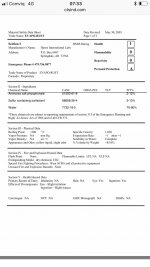
Hi all. Sorry for bumping an old topic but I find this very interesting. Have been restoring old rusty machines for quite a while and Evaporust is a really great product. It made me wonder how it works and of course if would be possible to do it yourself :).
I found an old MSDS that contained this info:
IMG_1381.JPG

Could this be of help of determining if your findings are correct?


Skickat från min iPhone med Tapatalk
 

AR1911

Active member
Joined
Jun 30, 2011
Messages
26
Nothing that I've heard of, if you need to keep tools from rusting, I greatly recommend ballistol. Its a extremely good lubricant and protectant for firearms so it should be just as great for tools as well.

I restore machine tools for a hobby. Everything is in an unheated steel building, so I have fought rust for years. I discovered pure lanolin about 10 years ago and I no longer have rust scabs appearing on my nice tools.

Now I see that there is a lanolin-based product called Fluid Film that comes in everything from aerosol cans to gallon buckets. Sounds like just what I need.
 

Muzzer

New member
Joined
Sep 1, 2023
Messages
4
Old thread this but for the chemists out there, this patent makes interesting reading. Although it lists several proprietary derusters and their constituents, possibly including Evaporust, none of them appear to include Na4 EDTA.
 

Attachments

  • GB2535131B deruster patent.pdf
    2.2 MB · Views: 20
To avoid these ads, REGISTER NOW!
Top Bottom