To avoid these ads, REGISTER NOW!

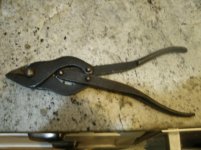
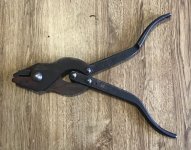
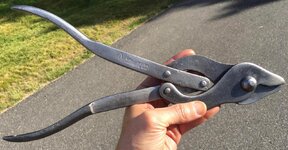
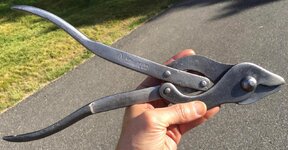
George Plumpton Ltd. British World War l Military wire cutters

woody 73

Well-known member
Joined
Apr 14, 2009
Messages
11,540
Location
The Great State Up North
In my many tool hunts around central Ohio sometimes I am very amazed at the tools that I find. This tool has traveled from the shores of England to my home town, indeed that has been a very long road to travel.

Because the tool was so very rusty and I did not want to touch the original patina, it has taken me two weeks in order to free it up and still preserve the patina. Plus the fact when I first bought it I thought it was some kind of clipper for pruning roses! How wrong I was it took me a lot of searching and it turns out it was a World War l trench tool for cutting through all that nasty barb wire.

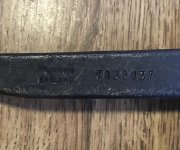
I did find a link showing that it was for the first World War in case someone might have thought it was for the second World War. (although it is stamped with a 1917 mark on it).

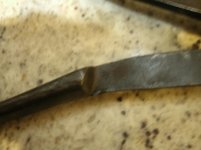
I apologize for the pictures but it took me forever and a day just to make out the name and the other hall marks, so it will be very hard to see all those tiny marks stamped into the tool itself.

Now this next part is a partial History of the company and I will need all the help from our GJ brothers/sisters living in England to give me some insight in the next few questions.

I found a ton of these wire trench tools and many of them were the exact same copy only under different company names.

First question did they not have any patent infringement laws in England to protect the original first patent? Or had the idea run out ?

Did the British Government need these in a hurry and maybe they gave their designs to many companies in order to produce them?

What is a British War Department accept Stamp (Broad arrow) as stamped into the tool ?

Next question as I write the story it would seem there were two companies involved the first company was the George Plumpton company that was part of the Herbert Plumpton company were they brothers?

Ok the story in question...

From what I could find George Plumpton Ltd, was a maker of telephone requisites.

Thewlis, Griffith, and Edelsten Ltd, maker of Lancashire files (est. 1813), and Lancashire Tool Co. was part of the Herbert/Plumpton Company.

Herbert Plumpton was a tool and plier manufacturer of 171 Liverpool Road, Warrington.

In 1920 both were Incorporated into Sheffield Steel Products Ltd (SSP).

In 1959 they became part of Arusha Industries Ltd.

In 1970 George Plumpton added counting machines to its range of tools.

I found some very nice links that you might find very interesting should you get the chance to look them over.

No information about either Man in Question I apologize for that, and again the pictures of all the stamps is very hard if not impossible to make out.

http://www.midlifexpress.com/i-was-a-world-war-1-wire-cutter-what-were-you/

https://www.ozwrenches.com/vintage-military.htm

http://www.deactivated-guns.co.uk/i...ton/prod_3204.html?_a=viewProd&productId=3204

https://www.gracesguide.co.uk/Sheffield_Steel_Products

https://www.gracesguide.co.uk/George_Plumpton

https://www.gracesguide.co.uk/Herbert_Plumpton
 

Attachments

  • GEDC7129.jpg
    GEDC7129.jpg
    114.2 KB · Views: 88
  • GEDC7131.jpg
    GEDC7131.jpg
    114.5 KB · Views: 82
  • GEDC7135.jpg
    GEDC7135.jpg
    89.9 KB · Views: 66
  • GEDC7140.jpg
    GEDC7140.jpg
    78.2 KB · Views: 60
  • GEDC7142.jpg
    GEDC7142.jpg
    74.1 KB · Views: 55
  • GEDC7154.jpg
    GEDC7154.jpg
    84.4 KB · Views: 57
  • GEDC7176.jpg
    GEDC7176.jpg
    120.6 KB · Views: 62
Last edited:
To avoid these ads, REGISTER NOW!

Farmer J.

Well-known member
Joined
Sep 18, 2016
Messages
1,995
Location
UK, Cornwall/Hertfordshire.
Farmer J. A super big thank you, today I learned something new.:beer::thumbup::thumbup:

It's a pleasure Woody.

I don't know why these were made all the same by many different people though. I suppose the Govt sent out orders to have them made. Maybe someone better at research can progress with this question.
I have no more information on George Plumpton Ltd, either.

50 years ago wire cutters like these were not unusual plenty of them still around (like people who survived WW1) but now they are pretty rare. Last set I saw were for sale in an antique store.

It's neat the way they fold, and they can be carried in a pocket easily. People riding horses in the English countryside sometimes carry them in case the horse gets loose old bits of wire caught around it's legs.
 

Farmer J.

Well-known member
Joined
Sep 18, 2016
Messages
1,995
Location
UK, Cornwall/Hertfordshire.
Lee Enfield rifle with a wire cutter attachment, although the design of the cutters aren't the same it must have saved a lot of scratches being able to cut the wire at a distance.
 

Attachments

  • 1697965037_leeenfieldwirecutter.jpg.5985f511567a1672f4c0b4ceaba4277e.jpg
    1697965037_leeenfieldwirecutter.jpg.5985f511567a1672f4c0b4ceaba4277e.jpg
    122.8 KB · Views: 52

Dave455

Well-known member
Joined
Mar 19, 2013
Messages
5,796
Location
Sussex, England
Hi Woody, I can contribute a bit about this, but only from personal knowledge, I haven’t done any research.

The wire cutters you show certainly did originate as far back as the First World War. The issued tools at the start of the war, including the attachment for the Rifle, Short, Magazine, Lee Enfield, No. 1, Mk III (to give it it’s War Office designation - No. 1 rifle or SMLE to everybody else) were infamous for not working. Well, they did work, but only on British wire, not German. There were stories of soldiers writing home and asking for wire cutters to be sent out, which I believe.

The pattern shown were introduced during the war. I don’t know anything about the origins of the design, but the War Dept. would simply have put the order out to as many contractors as they wanted. I have never come across anything that originated in the War Dept that was patented. They didn’t bother.

The “Broad Arrow” mark (sometimes called a Pheon) was used for centuries to donate government property. It was believed to be originally chosen because it could be marked simply with 3 strokes of a chisel. Ordnance Survey (publishers of British maps) surveyors still used it until very recently to denote a “benchmark” - a mark on buildings used in surveying.

I have never come across Herbert Plumpton. I know a lot of the Second World War contractors, as many of the companies remained in business for so long, but many of the First World War names are less well known today. I have a fair amount of First World War equipment scattered around the house (and the loft, and the workshop, and the workshop loft). My late Grandfather was a great purchaser of surplus, and bought loads in the 20’s and 30’s, but not any of these cutters. I suspect they were not declared surplus till much later.

The reason for so much confusion about these cutters, is that they continued to be made, relatively unchanged, for decades! The same tools were made in the Second World War as well, and even beyond I believe.

In the 1990”s a surplus tool dealer that I frequented had acquired some ex Ministry of Defence tool boxes (100’s of ‘em). Each box had a cutter of the same style in, but obviously of much later manufacture. They were being sold off at £5 / pair so I bought a couple. Mine are shown below.

I believe these to be post war (second world war) manufacture. The design is slightly different from the older cutters, the steel and heat treatment appears better and the maker (Wilkinson’s) was a popular government contractor for this sort of tool in the post war years. Unusually, these are not dated, and I don’t know why. I can only guess that the original spec was so old, that it predated the requirement for the date mark.

These are actually pretty decent cutters. In fact, I haven’t found better for certain tasks. You would need to move up to bolt croppers to see an improvement, and they don’t fold! A lot of local farmers use these for fencing, and I know for certain that if I wanted another pair, I could pick them up locally for probably little more than I paid in the ‘90’s. A local used tool dealer has 2 or 3 pairs hanging up, and probably more “out the back”!

I kept one pair of mine in my “road box” for years, till I made a bit of an effort to reduce the weight I was carrying!
 

Attachments

  • B42CD734-8159-436E-9AA4-47866C8876A3.jpg
    B42CD734-8159-436E-9AA4-47866C8876A3.jpg
    149.7 KB · Views: 40
  • 03D4398B-715E-428A-A7C0-075E090FA914.jpg
    03D4398B-715E-428A-A7C0-075E090FA914.jpg
    156 KB · Views: 36
  • 31DBEF0B-8EE6-4784-9E59-0405B46C5CD0.jpg
    31DBEF0B-8EE6-4784-9E59-0405B46C5CD0.jpg
    158.4 KB · Views: 47
Last edited:
OP
W

woody 73

Well-known member
Joined
Apr 14, 2009
Messages
11,540
Location
The Great State Up North
Thank you everyone for all your help, a very interesting read. :thumbup::thumbup: I found a different design on the web that went on the rifle end, oh my gosh they were asking over $2000.00 dollars.:eek::eek::eek:
 
To avoid these ads, REGISTER NOW!

Dave455

Well-known member
Joined
Mar 19, 2013
Messages
5,796
Location
Sussex, England
Thank you everyone for all your help, a very interesting read. :thumbup::thumbup: I found a different design on the web that went on the rifle end, oh my gosh they were asking over $2000.00 dollars.:eek::eek::eek:

Those are relatively common, if it’s the design I’m thinking of.

They only sell for about £50 to £100 normally, so I can’t see any fetching $2000, unless they are a particularly rare design, and someone really wants them!
 

bargainhuntingking

Well-known member
Joined
Nov 22, 2013
Messages
434
Location
The Amazing Pacific Northwest
Chillngton Tool Works version from 1940, just cleaned up with a wire wheel on the angle grinder and wiped with Ballistol. Was just using them to cut wire fencing.
ae42a50322dd3866ed0afe51a1c20bcc.jpg7a9e783389e48a0ed66c1c87724adbe1.jpg
 

Attachments

  • ae42a50322dd3866ed0afe51a1c20bcc.jpg
    ae42a50322dd3866ed0afe51a1c20bcc.jpg
    188.4 KB · Views: 8
  • 7a9e783389e48a0ed66c1c87724adbe1.jpg
    7a9e783389e48a0ed66c1c87724adbe1.jpg
    209.4 KB · Views: 27
Last edited:

BJT17

New member
Joined
Mar 15, 2022
Messages
1
In my many tool hunts around central Ohio sometimes I am very amazed at the tools that I find. This tool has traveled from the shores of England to my home town, indeed that has been a very long road to travel.

Because the tool was so very rusty and I did not want to touch the original patina, it has taken me two weeks in order to free it up and still preserve the patina. Plus the fact when I first bought it I thought it was some kind of clipper for pruning roses! How wrong I was it took me a lot of searching and it turns out it was a World War l trench tool for cutting through all that nasty barb wire.

I did find a link showing that it was for the first World War in case someone might have thought it was for the second World War. (although it is stamped with a 1917 mark on it).

I apologize for the pictures but it took me forever and a day just to make out the name and the other hall marks, so it will be very hard to see all those tiny marks stamped into the tool itself.

Now this next part is a partial History of the company and I will need all the help from our GJ brothers/sisters living in England to give me some insight in the next few questions.

I found a ton of these wire trench tools and many of them were the exact same copy only under different company names.

First question did they not have any patent infringement laws in England to protect the original first patent? Or had the idea run out ?

Did the British Government need these in a hurry and maybe they gave their designs to many companies in order to produce them?

What is a British War Department accept Stamp (Broad arrow) as stamped into the tool ?

Next question as I write the story it would seem there were two companies involved the first company was the George Plumpton company that was part of the Herbert Plumpton company were they brothers?

Ok the story in question...

From what I could find George Plumpton Ltd, was a maker of telephone requisites.

Thewlis, Griffith, and Edelsten Ltd, maker of Lancashire files (est. 1813), and Lancashire Tool Co. was part of the Herbert/Plumpton Company.

Herbert Plumpton was a tool and plier manufacturer of 171 Liverpool Road, Warrington.

In 1920 both were Incorporated into Sheffield Steel Products Ltd (SSP).

In 1959 they became part of Arusha Industries Ltd.

In 1970 George Plumpton added counting machines to its range of tools.

I found some very nice links that you might find very interesting should you get the chance to look them over.

No information about either Man in Question I apologize for that, and again the pictures of all the stamps is very hard if not impossible to make out.

http://www.midlifexpress.com/i-was-a-world-war-1-wire-cutter-what-were-you/

https://www.ozwrenches.com/vintage-military.htm

http://www.deactivated-guns.co.uk/i...ton/prod_3204.html?_a=viewProd&productId=3204

https://www.gracesguide.co.uk/Sheffield_Steel_Products

https://www.gracesguide.co.uk/George_Plumpton

https://www.gracesguide.co.uk/Herbert_Plumpton
Thank you for those photos, Woody! I came across your post via google, as I was looking for info on George Plumpton tools-- he is my Great Grandfather! Sorry that I don't have any details to add tho 😌
 

Private Lugnutz

Well-known member
Joined
Mar 30, 2012
Messages
30,449
Location
The Authentic Jersey Shore
I spotted these folding British military wire cutters at the flea market this morning. These are the WWII version, they fold up differently than their predecessors, and I don't know if Plumpton made them (I don't know that I have ever seen a mfgr identified, perhaps @Farmer J. or @Dave455 know), but there really isn't a more appropriate thread, and I don't think @woody 73 will mind.

Like all the examples I have ever seen online, they have the same model number ("256"), a date (these were "1944"), and the WD broad arrow marking. I have seen them marked "ENGLAND" and "MADE IN ENGLAND". These had no such marking or it was worn off.

I didn't take a photo with the handles folded out, but if it's not apparent, those knurled tabs are used to pull them out from inside the other part of the handle. There's also a hook clasp on the flip side to keep them folded. Plenty of photos online.

I've been hoping to run into a pair for many years. Alas, the seller was more informed than I had hoped, and the price was steeper than I was willing to pay. Posting for posterity.
 

Attachments

  • 20251024_101801.jpg
    20251024_101801.jpg
    603 KB · Views: 12
  • 20251024_101745.jpg
    20251024_101745.jpg
    1.6 MB · Views: 15

Dave455

Well-known member
Joined
Mar 19, 2013
Messages
5,796
Location
Sussex, England
I spotted these folding British military wire cutters at the flea market this morning. These are the WWII version, they fold up differently than their predecessors, and I don't know if Plumpton made them (I don't know that I have ever seen a mfgr identified, perhaps @Farmer J. or @Dave455 know), but there really isn't a more appropriate thread, and I don't think @woody 73 will mind.

Like all the examples I have ever seen online, they have the same model number ("256"), a date (these were "1944"), and the WD broad arrow marking. I have seen them marked "ENGLAND" and "MADE IN ENGLAND". These had no such marking or it was worn off.

I didn't take a photo with the handles folded out, but if it's not apparent, those knurled tabs are used to pull them out from inside the other part of the handle. There's also a hook clasp on the flip side to keep them folded. Plenty of photos online.

I've been hoping to run into a pair for many years. Alas, the seller was more informed than I had hoped, and the price was steeper than I was willing to pay. Posting for posterity.
I’ve seen a few pairs of these around, but far less than the style Woody and I posted. I’m afraid I don’t know the manufacturer.

If I recall correctly, I’ve only seen dates of 1944 and 1945 on these, which would suggest they were only manufactured for a short time.

They are high quality tools, but note that they cut with a cropping action, rather than a shearing action. I don’t know for what purpose they were introduced, but I suspect there was one.

You refer to the other pattern as being “their predecessors”. The other pattern certainly predates these, having been introduced in the first world war, but also post dates these, having been produced relatively unchanged I believe into the 1970’s. And with only a slightly different finish into I think the 1990’s.
 
Last edited:

Private Lugnutz

Well-known member
Joined
Mar 30, 2012
Messages
30,449
Location
The Authentic Jersey Shore
You refer to the other pattern as being “their predecessors”
Coarsely, referring only to the most basic of observable facts. Both tools are British military wire cutters, a tool that has been issued and used by Infantry and combined arms in warfare for hundreds of years, also engineers, ordnance, sappers, etc. Both have folding handles, which seems to be unique to the British WD among a superset of military wirecutters. But the Plumpton is from WWI, preceding the 256s, from WWII. If anyone knows more, or has documentation, I am eager to see it.
 

Dave455

Well-known member
Joined
Mar 19, 2013
Messages
5,796
Location
Sussex, England
Coarsely, referring only to the most basic of observable facts. Both tools are British military wire cutters, a tool that has been issued and used by Infantry and combined arms in warfare for hundreds of years, also engineers, ordnance, sappers, etc. Both have folding handles, which seems to be unique to the British WD among a superset of military wirecutters. But the Plumpton is from WWI, preceding the 256s, from WWII. If anyone knows more, or has documentation, I am eager to see it.
Yes, that is correct.

The other, more common, pattern can be said to be both predecessors and successors to the style you have.

They will have been made by many different contractors over the 70+ years (at least) they have been in production, so while I can’t tell you when, specifically Plumpton, produced them, It’s a relatively straightforward matter to note the dates on examples that one sees. Although, in a departure from the norm, many examples are not dated.

Plumpton are not familiar to me, so I suspect that they produced them in the First World war only.

With regard to the cutters you saw, my suspicion is that they saw very limited service. I have never seen any dates on these other than 1944 or 1945, and an awful lot of the examples that have turned up have obviously seen little or no use.
 
Last edited:
To avoid these ads, REGISTER NOW!
Top Bottom