To avoid these ads, REGISTER NOW!

Getting into Solar

Paulski

Well-known member
Joined
Sep 29, 2017
Messages
119
I'm learning all about solar to make a grid tied with battery back up system, and checking to see if my thinking is right on the wiring between the meter and inverter

I have a Siemens 200A combo meter Load center MC20240B1200EFC, the inverter and battery would need to be mounted about 70' aways from the meter combo panel.

For a solark 15k hybrid inverter - The line wires go from the meter to the solark, then the solark back to the combo panel main breaker. Essentially 350' of 2/0 wire and 140' of 1.5" conduit (L1,L2,N to the Solark, than L1,L2 back to the load center) I think this is called a line side tap?

If that is correct, I'm trying to compare that cost to an Enphase set up that uses a meter collar that goes behind the meter to disconnect from the grid. The wiring would be 70' of control wire to the combiner box, than 8g wire back to the load center to a 40amp breaker at the top of the bus bar.

The enphase system uses micro inverters, which could cost more than the solark single hybrid inverter, but the wire cost may offset that, plus be easier to build because i have a spare 3/4" conduit I can use coming out of the load center. The two 1.5" conduit runs will require breaking out the stucco wall to tie into the recessed load center


One other question - is the combo meter load center even rated/legal (UL, NEC etc) to add the inverter between the meter and bus bar?

Also, I'm not set on sol ark or enphase, so I'm open to other suggestions. System will be ~7-8kw


Attachments

  • Screenshot 2026-04-03 at 4.57.03 PM.png
    Screenshot 2026-04-03 at 4.57.03 PM.png
    588.4 KB · Views: 28
  • Screenshot 2026-04-03 at 4.59.02 PM.png
    Screenshot 2026-04-03 at 4.59.02 PM.png
    467.9 KB · Views: 28
Last edited:
To avoid these ads, REGISTER NOW!

wyliesdiesels

Well-known member
Joined
Aug 14, 2012
Messages
19,991
Location
Modesto, CA
you need to backup here. your PoCo and AHJ will have requirements on how they want the system connected.

here, the PoCo installs a separate meter between 2 discos that only reads what the inverter is outputting into the main service panel.

you need to reach out to your PoCo and AHJ
 
Last edited:

Codyboy

Well-known member
Joined
Jan 31, 2019
Messages
1,637
Location
S.E. TEXAS
you need to backup here. your PoCo and AHJ will have requirements on how they want the system connected.

here, the PoCo installs a separate meter between 2 discos that only reads what the inverter is outputting into the main service panel.

you need to reach out to your PoCo and AHJ
Yes exactly. I would not spend any money or order anything before getting with the POCO.

Here the ATS and all wiring have to be "approved" .
For the switches they have a list and if its not on the list you cannot use it.
 
OP
P

Paulski

Well-known member
Joined
Sep 29, 2017
Messages
119
I do plan to get with the power company and city before buying, just trying to learn the different equipment so I can take a plan with me, also trying to figure out the most cost effective way to install everything with what I have.
I saw that my power company lists that they approve the use of the Enphase meter collar. But the collar just came out, so was wondering how solar has been wired without it for so many years. I think tesla also makes a meter collar transfer switch, but they do not seem to sell to DIY projects.
 

wyliesdiesels

Well-known member
Joined
Aug 14, 2012
Messages
19,991
Location
Modesto, CA
But the collar just came out, so was wondering how solar has been wired without it for so many years.

That meter collar is for backup power ie. generators NOT solar. It has a receptacle on it. You dont plug an inverter into a meter with a cord and plug.

Solar inverters are wired into the main panel (or subpanels) via a branch breaker.
 

jlv03

Well-known member
Joined
Jan 19, 2020
Messages
344
Location
SE IA
From what I can tell from the Enphase spec sheets, seems like the collar is some sort of control/islanding device to allow for the home to run off grid when needed.


I agree with the others, contacting the power company and local inspectors first should be done to know what you can do.


Personally, if there is no net-metering, I'd go down the path of an off grid solar inverter with batteries and pick some loads to put on a critical load subpanel.
 

walta

Well-known member
Joined
Jan 13, 2017
Messages
2,309
Location
Dutzow Missouri
From a cost effective point of view on grid with battery backup make no sense and is bordering on laughable unless you have some crazy utility rates and some places do. Batteries are very expensive and tend to have very small capacities. If you can get net metering from your utility, they provide an almost perfect battery with almost unlimited capacity for 20-$50 a month. That is chump change compared to buying a $10,000 battery that maybe dead in 3 years and certainly done in 10 years.

As a DIY project the permit and utility people are both going to be uncomfortable. This is not the place to be making mistakes. If you get it wrong the guy plugging in the meter gets an explosion in his face.

I think it is crazy to run all that expensive wire out to the meter just to hook up the solar.

Make room in the panel for two 50 Amp breaker in the panel put one on an interlock to feed the generator and back feed the solar with the other.

Walta
 

reader2580

Well-known member
Joined
Dec 31, 2014
Messages
14,516
Location
Minneapolis, MN
Enphase batteries are warrantied for 15 years. I have seen other batteries warrantied for ten years. I don't know any modern batteries that are going to die in three years unless they are cheap junk.
 

mm08822

Well-known member
Joined
Jan 13, 2012
Messages
5,868
Location
NJ
From a cost effective point of view on grid with battery backup make no sense and is bordering on laughable unless you have some crazy utility rates and some places do. Batteries are very expensive and tend to have very small capacities. If you can get net metering from your utility, they provide an almost perfect battery with almost unlimited capacity for 20-$50 a month. That is chump change compared to buying a $10,000 battery that maybe dead in 3 years and certainly done in 10 years.

As a DIY project the permit and utility people are both going to be uncomfortable. This is not the place to be making mistakes. If you get it wrong the guy plugging in the meter gets an explosion in his face.

I think it is crazy to run all that expensive wire out to the meter just to hook up the solar.

Make room in the panel for two 50 Amp breaker in the panel put one on an interlock to feed the generator and back feed the solar with the other.

Walta
Need to know what the state has established with its POCO'S for consumer solar generation.

Some are 1:1 on the cost/credits the end-user currently pays while others may only give a discounted rate credit for the generation component.
 
To avoid these ads, REGISTER NOW!

walta

Well-known member
Joined
Jan 13, 2017
Messages
2,309
Location
Dutzow Missouri
Enphase batteries are warrantied for 15 years. I have seen other batteries warrantied for ten years. I don't know any modern batteries that are going to die in three years unless they are cheap junk.
Any of the car manufacturers warranty there EV battery for 15 years? I think not. Maybe the plan is to go out of business when the warranty costs get too much.
 

pembol

Well-known member
Joined
Feb 13, 2014
Messages
268
Any of the car manufacturers warranty there EV battery for 15 years? I think not. Maybe the plan is to go out of business when the warranty costs get too much.
There are plenty of Prius out there with 20 year old batteries (including our old one), and those are using older technology in a much harsher environment than a home battery. My camper LiFePO4 battery is approaching 14 years old and still tests out at >90% capacity.

I am not really that worried about the longevity of home batteries with a BMS that coddles them for a hundred partial cycles a year.
 

aggie113

Well-known member
Joined
Jul 22, 2015
Messages
470
Location
San Antonio, TX
https://diysolarforum.com/ is a good place for info. I am looking at an EG4 based system with a Gridboss and Flexboss setup. The Gridboss would be installed out at the pole/meter area and then would have a connection back to the detached garage where the Flexboss (inverter) would be along with some batteries (in the future). The Gridboss would handle the offgrid switchover if power went out and I could also hook up a generator to it for extended outages (250gal propane tank available). My poco would require a meter for incoming and one for outgoing power, but they do offer 1:1 buyback up to whatever you use that billing cycle.
 

jmdirk

Well-known member
Joined
May 4, 2015
Messages
695
yeah its for a generator hookup NOT grid connected solar....

I don't even think it's that. I think all it does is provide an automated disconnect to grid power. Their version of a automated transfer switch I guess.

There's no connection on that for a generator. And the diagrams in the docs all show the solar/battery connected via a circuit on the main panel.
 

dcg9381

Well-known member
Joined
Jun 20, 2018
Messages
11,627
Location
Austin, TX
yeah its for a generator hookup NOT grid connected solar....
That's generally right, but if I understand what he's doing, which is "grid tie solar" with an option for grid-down backup power on the existing panel, he needs a collar on the meter (which shows power in/out) and additionally needs a means to automatically (and likely manually per his POC) disconnect meter in the case of a grid loss event.

The POC will definitely have an opinion.
The more simple way to set this up is Grid -> Inverter -> Loads. But your total loads have to be within bounds of the inverter. That usually requires more than one inverter.

From a cost effective point of view on grid with battery backup make no sense and is bordering on laughable unless you have some crazy utility rates and some places do. Batteries are very expensive and tend to have very small capacities. If you can get net metering from your utility, they provide an almost perfect battery with almost unlimited capacity for 20-$50 a month. That is chump change compared to buying a $10,000 battery that maybe dead in 3 years and certainly done in 10 years.
I generally agree with this, but the OP wants "backup power" without going to a dedicated load panel, he wants to use the existing panel.
It CAN make financial sense with time-of-use rates, you can essentially "buy low" and discharge high, so the payback structure is more complicated than straight "what's the net meter arrangement" and array size.

Doing power backup by dual-feeding an existing panel definitely a more advanced project. I haven't done one, but I've been studying them. The complication has kept me from being too interested. You cannot allow a potential grid back feed, that's what makes it complicated. And I'll bet some POCs are hard no on it if you dual feed the panel. That's roll-your-own costs using 48V "server rack" batteries. And the "battery communications" are complicated / have to play nice with the inverter.

Batteries are about $1k for 5kWh. $10k would buy you 50kWh, which is "decent backup".. Supplemented with solar charge, it might last a while depending on your power draw, but almost everywhere you can get 3-days of overcast.
 
Last edited:

MKSJ

Active member
Joined
Apr 1, 2018
Messages
34
Location
Tucson, AZ
So having looked and installed battery backup system recently and also a friend with who went with the Sol-Ark system and EG4 battery cabinet, there are a few things to consider. I am not outlining this as an installer but a knowledgeable homeowner who has reviewed some of the power backup options as well as done some electrical installs. My friend and I already had Enphase microinverts on ~8.6 kW solar arrays before adding batteries, microinverters are simple, each panel works independently and you are not limited by a central DC to AC inverter. They also have a longer lifespan then central DC to AC inverters. With the Sol-Ark there are also some total power limits as to the capacity of the unit, batteries kW, etc. The POCs have approved electrical components, and some do not allow meter collars, the Tesla system has had a lot of issues specific to their power ring and also locks you into their system topology. Enphase also has their IQ meter collar (this can be installed at the meter or separate and then does not fall under the POCs review), but also locks you into their system/batteries, and I am not aware that either can be used with any other manufactures systems. I would recommend contacting a local electrician to look at your panel and evaluate your best option for a grid disconnect. This is a major factor in what system you will go with.

Other factors to consider are the type of batteries used, the depth of discharge, the peak capacity (as in motor starting as for AC), and also if they have dark start ability (i.e. can the system restart after the batteries are drained). Current battery technology favors lithium iron phosphate (LiFePO 4 ) batteries as being more robust and having more deep drain/charge cycles relative to previous lithium or lead acid batteries. Many manufactures warranty them for either 7+ years or a specific thoughput. You also need to look at thoughput efficiency. Franklin batteries are based on thoughput, I figured 15-20 years of life/under warranty on my current electrical usage.

Given that I already had a solar array system with Enphase micro-inverters, I was preimarily interested in backup power when the grid went down as well as eliminating power consumption durring peak demand hours which typically was after the sun went down. I was not interested in selling power back to the POCs during this time for revienue, but depends on your power company billing structure. I ended up going with a Fkanklin WH system which is a simpler AC coupled system with modular 15kW LiFePO 4 battery that allow very high short term current ratings as well as dark start ability. I went with two 15 kW batteries, and along with solar generation I almost never draw power from the POCs except for overcast days. I spoke to several installers and they all recommended the Fkanklin WH system, and they were also installers of Tesla and Enphase systems. The downside is cost, but I was able to take a significant tax deduction in 2025. In 2026 it is a bit different and in 2026 probably recommend the Sol-Ark with at least 30 kW LiFePO 4 battery cabinet and Enphase microinverters on the panels.

Main Panel is 400A, 200A breaker was the main panel and an additional 200A to a separate panel. Electrician used one of the 200A breakers from the grid to go to the Franklin WH controller, and a from the Franklin WH a both electrical panels were connected. If I ever build a separate shop I can use the second 200A service breaker for that.
20250812_085948.jpg

Franklin WH control panel which includes transfer switch rated at 200A. Solar and batteries and output from solar combiner box are directly connected here, system app gives continuous readouts of consumption/generation and allows different power usage algorithms. I find it much better than the Enphase for whole house, but still ues the Enphase installer app for solar panel/microinverter information. It is also possible to add a 200A service connect breaker from the grid/meter to this controller, the connect that to your breaker panel depedning on your electrical codes.
1775610688926.jpeg

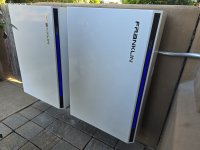
Battery modules 15 kW with built in AC inverters.
20250805_184242.jpg
 

Cougar

Well-known member
Joined
Mar 22, 2011
Messages
3,326
Location
Wisconsin A little south of the Frozen Tundra
So having looked and installed battery backup system recently and also a friend with who went with the Sol-Ark system and EG4 battery cabinet, there are a few things to consider. I am not outlining this as an installer but a knowledgeable homeowner who has reviewed some of the power backup options as well as done some electrical installs. My friend and I already had Enphase microinverts on ~8.6 kW solar arrays before adding batteries, microinverters are simple, each panel works independently and you are not limited by a central DC to AC inverter. They also have a longer lifespan then central DC to AC inverters. With the Sol-Ark there are also some total power limits as to the capacity of the unit, batteries kW, etc. The POCs have approved electrical components, and some do not allow meter collars, the Tesla system has had a lot of issues specific to their power ring and also locks you into their system topology. Enphase also has their IQ meter collar (this can be installed at the meter or separate and then does not fall under the POCs review), but also locks you into their system/batteries, and I am not aware that either can be used with any other manufactures systems. I would recommend contacting a local electrician to look at your panel and evaluate your best option for a grid disconnect. This is a major factor in what system you will go with.

Other factors to consider are the type of batteries used, the depth of discharge, the peak capacity (as in motor starting as for AC), and also if they have dark start ability (i.e. can the system restart after the batteries are drained). Current battery technology favors lithium iron phosphate (LiFePO 4 ) batteries as being more robust and having more deep drain/charge cycles relative to previous lithium or lead acid batteries. Many manufactures warranty them for either 7+ years or a specific thoughput. You also need to look at thoughput efficiency. Franklin batteries are based on thoughput, I figured 15-20 years of life/under warranty on my current electrical usage.

Given that I already had a solar array system with Enphase micro-inverters, I was preimarily interested in backup power when the grid went down as well as eliminating power consumption durring peak demand hours which typically was after the sun went down. I was not interested in selling power back to the POCs during this time for revienue, but depends on your power company billing structure. I ended up going with a Fkanklin WH system which is a simpler AC coupled system with modular 15kW LiFePO 4 battery that allow very high short term current ratings as well as dark start ability. I went with two 15 kW batteries, and along with solar generation I almost never draw power from the POCs except for overcast days. I spoke to several installers and they all recommended the Fkanklin WH system, and they were also installers of Tesla and Enphase systems. The downside is cost, but I was able to take a significant tax deduction in 2025. In 2026 it is a bit different and in 2026 probably recommend the Sol-Ark with at least 30 kW LiFePO 4 battery cabinet and Enphase microinverters on the panels.

Main Panel is 400A, 200A breaker was the main panel and an additional 200A to a separate panel. Electrician used one of the 200A breakers from the grid to go to the Franklin WH controller, and a from the Franklin WH a both electrical panels were connected. If I ever build a separate shop I can use the second 200A service breaker for that.
20250812_085948.jpg

Franklin WH control panel which includes transfer switch rated at 200A. Solar and batteries and output from solar combiner box are directly connected here, system app gives continuous readouts of consumption/generation and allows different power usage algorithms. I find it much better than the Enphase for whole house, but still ues the Enphase installer app for solar panel/microinverter information. It is also possible to add a 200A service connect breaker from the grid/meter to this controller, the connect that to your breaker panel depedning on your electrical codes.
1775610688926.jpeg

Battery modules 15 kW with built in AC inverters.
20250805_184242.jpg
Nice setup.
The batteries are weatherproof?
 

MKSJ

Active member
Joined
Apr 1, 2018
Messages
34
Location
Tucson, AZ
Yes the aPower 2 batteries and inverter are weatherproof, completely sealed units with back fins on the inverters. The batteries face east and are shaded most of the day. This is an AC coupled system with no central DC to AC inverter as in the Sol-Ark. The battery units are modular 15 kWh usable energy per module, up to 225kWh per aGate. Transfer time on aGate on grid power outage is almost instantaneous (~16ms) which is far better than the mechanical transfer switch when I had a backup generator. Evidently the battery units have an additional reserve power for a dark start if the batteries are totally discharged. This is an issue with some other battery backup systems that the control system stops operating if the batteries completely discharged. Many backup battery systems have a minimum power reserve setting, but I have heard of this occurring in some of the Tesla systems.

The biggest issue/limitation I ran into as well as others is how to incorporate the grid disconnect in particular if the meter and electrical panel are integrated into one panel, as well as the main power beaker bolted to the breaker buss and meter connections. Since I had a 400A service I thought I would need a service entrance 400A transfer switch with breaker (service disconnect), and this also would have been quite expensive in addition to the the installation cost. The system installer recommended using just one of the 200A main panel breakers and tied both electrical panels to aGate control system power buss. I also have the second 200A breaker should I want to add a separate ADU/shop at some future point. The aGate sits on the other side of the wall of my main panel, so very simple install, everything was done and running the same day, about 7 hour install time. Being able to take the tax deduction made it doable for me, and we are in an area where they will shut down the power for fires on a regular bases, and I was concerned because we have an electric gate system, pumps, etc.

aPower 2 battery unit per module
10 kW continuous output
15 kW peak output (10 seconds)
8 kW charge rate
AC-coupled design for maximum compatibility
Lithium Iron Phosphate (LFP) chemistry 15-year warranty, or 60 MWh of guaranteed power throughput, whichever comes first.
 
To avoid these ads, REGISTER NOW!
Top Bottom