To avoid these ads, REGISTER NOW!

Getting power to a distant detached garage

armorerr

Member
Joined
May 7, 2012
Messages
22
Location
Pittsburgh, PA
My electrician "friend" has pretty much bailed on getting power down to my
detached garage and, according to every electrician I've had come look, left me with quite a mess. In brief, the trench distance between the buildings is ~300 feet, the run inside the house from power out to the trench is another 90' or so, making the total run ~400'. The trench has 3" PVC for the electric but the trench has been partially filled in on the advice of the now-gone electrician and since it's been open for 5 months (!), other parts have collapsed in, making it mostly buried.

Several electricians I called flat-out said they couldn't fix it (single person
operation), one said he could if I dug it all up but hasn't called back with an
estimate after coming out to inspect it, and the only one to actually give me a quote started at $16,843.65 and after moving some of the labor to me is down to $9,000. Given that online pricing of aluminum wire comes in under $3,000, that still seems pretty high given that I will be doing all the work to completely uncover the trench, in effect allowing them to start over and use direct burial wire they just unwind into the hole!

Which brings me to the question: what size wire do I need to run 200 amp service that 400' distance? I've gotten different answers from everyone and I cannot decipher the NEC book and voltage drop calculators on my own. I *think* it should be 4/0 copper or 500 mcm aluminum, but I am not sure of the corresponding ground sizes (I know they can be downsized from the conductors but that's all). I am also not clear on whether I can run the 500 mcm aluminum in my existing 3" conduit and LB boxes since I will need 2 hot, a neutral, and the ground for a total of four wires. I think I can per the NEC chart as the ground is not a conductor, right? I know a pull would be very tough but since I have to dig it up, I may be feeding it through one section at a time and reassembling the conduit over the wire. Aluminum is preferred here due to the cost; 1600' of 500mcm is under $3k, the same in 4/0 copper is almost double that!

I clearly need professional help but aside from the ONE guy who wrote something down, everyone else appears to be a complete *****. I'm willing to pay a fair price and if it's $9,000 then it's $9,000, but it's hard to know when I only have one quote!

Before anyone panics, I have NO plans to hook this up myself. :shocking: I will get a pro in for that but since it seems like the solution involves hand-feeding wire through plastic pipe, it is time intensive but unskilled - perfect for me to do, not economical to pay for.
 
To avoid these ads, REGISTER NOW!

wyliesdiesels

Well-known member
Joined
Aug 14, 2012
Messages
19,996
Location
Modesto, CA
What equipment will u be running/using? AC, large welder, elec WH or heater, etc.? Is this a one man shop? I bet 200a is overkill!!
 

Speedy Petey

Well-known member
Joined
Apr 22, 2012
Messages
1,430
Location
NY State
I'm with the others. 200A to a detached residential "shop" is more than likely overkill.

Also, pulling wire is not exactly "unskilled" work. There is a skill and art to it, ESPECIALLY with larger wire. Ask anyone with no experience who has tried it.
 

rangerintexas

New member
Joined
Jul 15, 2013
Messages
2
Have you considered having your power company set a second meter on this garage?
It might be worth investigating.
 
OP
A

armorerr

Member
Joined
May 7, 2012
Messages
22
Location
Pittsburgh, PA
The building is pretty sizable; 1200 sq ft shop floor and 640 sq ft on the second floor. I am planning to finish this garage as the last one I will ever build, so plans include a lift, big welders, plasma cutter, compressor, and whatever other toys I am able to acquire, in addition to all the regular grinders, cutoff tools, drills, etc. that I already have. Heat is currently planned to be electric, 2 big heaters downstairs and two small ones upstairs, plus an a/c unit upstairs, full size fridge, "instant" hot water heater, etc. I may end up with a full HVAC system, that part isn't finalized 100% yet - power is a more immediate need, and this isn't the forum to figure out HVAC options.

We plan to be here for a while so I've got the time since this won't all appear overnight. But, I want to make sure I can use it all as I know I will have others "borrowing" space/tools/equipment time.
 
OP
A

armorerr

Member
Joined
May 7, 2012
Messages
22
Location
Pittsburgh, PA
Also, pulling wire is not exactly "unskilled" work. There is a skill and art to it, ESPECIALLY with larger wire. Ask anyone with no experience who has tried it.

I didn't say pulling wire was unskilled, or at least that's not what I meant. This appears to be coming down to me cutting the conduit apart and sliding it over the wire piece by piece and re-glueing it back together. That doesn't seem to be too skilled, but extremely time intensive.
 
OP
A

armorerr

Member
Joined
May 7, 2012
Messages
22
Location
Pittsburgh, PA
Have you considered having your power company set a second meter on this garage?
It might be worth investigating.

I looked into that first; I was told I would still be responsible for the trenching and everything else, the power company would just make the connection. The transformer is on the far side of the house from the detached garage, doubling the trench distance and requiring me to trench across either the septic line and my driveway, or my water line, well control/power line, and buried propane line. Since I am so far out, I have no options to come from the other side of the property (would involve new poles and crossing a state route, sure to be expensive).

I think I now know why such a nice building never got power put in by the
previous owners.
 

wyliesdiesels

Well-known member
Joined
Aug 14, 2012
Messages
19,996
Location
Modesto, CA
Ok since u do have the big draw items and possibly multiple people using the shop at the same time, then the next thing i would do is a load calc to make sure youre sizing the feeders correctly!

Another issue that may come up is the size of your main service...it may be too small to support your shop and house. What size is your service? You may be better off with a separate service drop to the shop!
 

landyacht

Well-known member
Joined
Mar 26, 2011
Messages
71
Location
Langley BC
Did I miss something. Why do you have to dig up the pipes to feed wire through them? Are they damaged? If not why not get rope and a tugger. You may have to still do sections, but I've pulled 300' before. Just needed to blow a string through to get started, use the string to pull the rope and then used the tugger and rope to pull the cable (and lots of lube)
 

Speedy Petey

Well-known member
Joined
Apr 22, 2012
Messages
1,430
Location
NY State
I didn't say pulling wire was unskilled, or at least that's not what I meant. This appears to be coming down to me cutting the conduit apart and sliding it over the wire piece by piece and re-glueing it back together. That doesn't seem to be too skilled, but extremely time intensive.
Well for one you say that the conduit is mostly buried at this point which eliminates that practice, and not that it matters to some folks, but it IS a code violation to do it the way you suggest. The conduit MUST be complete and in place and the conductors pulled in after.
 
OP
A

armorerr

Member
Joined
May 7, 2012
Messages
22
Location
Pittsburgh, PA
Did I miss something. Why do you have to dig up the pipes to feed wire through them? Are they damaged? If not why not get rope and a tugger. You may have to still do sections, but I've pulled 300' before. Just needed to blow a string through to get started, use the string to pull the rope and then used the tugger and rope to pull the cable (and lots of lube)

I would love to do it this way, but no one wants to or is able to answer my actual question as to whether I can fit/pull 500 mcm aluminum through 3" conduit. I am only going on what the various "pros" who have come to look at the mess I have been left with have told me - and again, that mess was left by a "pro", a card carrying union member. All the estimators have said it needs to be dug up due to the number of bends, some say upsize to 4" conduit, others say just use direct burial.

Including here, I have yet to get the same answer twice, which is why I am so frustrated. I thought that was the point of code, there is a right way and then every other way, but I can't determine what is right!
 
OP
A

armorerr

Member
Joined
May 7, 2012
Messages
22
Location
Pittsburgh, PA
Well for one you say that the conduit is mostly buried at this point which eliminates that practice, and not that it matters to some folks, but it IS a code violation to do it the way you suggest. The conduit MUST be complete and in place and the conductors pulled in after.

Everyone that came out wants it dug up, so I have resigned myself to un-burying it.

However, I did not know that method was against code. It was how the "pro" who gave me the estimate said he would've done it from the beginning, so I assumed it was ok. Yay, more conflicting information!! :mad:
 

sands35

Well-known member
Joined
May 29, 2012
Messages
936
Location
St. Joseph, MI
The building is pretty sizable; 1200 sq ft shop floor and 640 sq ft on the second floor. I am planning to finish this garage as the last one I will ever build, so plans include a lift, big welders, plasma cutter, compressor, and whatever other toys I am able to acquire, in addition to all the regular grinders, cutoff tools, drills, etc. that I already have. Heat is currently planned to be electric, 2 big heaters downstairs and two small ones upstairs, plus an a/c unit upstairs, full size fridge, "instant" hot water heater, etc. I may end up with a full HVAC system, that part isn't finalized 100% yet - power is a more immediate need, and this isn't the forum to figure out HVAC options.

We plan to be here for a while so I've got the time since this won't all appear overnight. But, I want to make sure I can use it all as I know I will have others "borrowing" space/tools/equipment time.
As others have suggested. you may not need 200 amps. Perhaps if you went to propane or gas heat, that would take a major load off your service.

For AC, minisplits don't typically require high amp draw, which might also control amp draw and reduce the cost of the run to the garage.
 

Thumper68

Well-known member
Joined
May 16, 2013
Messages
5,134
Location
Duluth MN
When I did mine (only 200 feet) I used direct burial and that's how I would do it again. Personaly I would not run through the house dig the trench around to where the main panel is and go in there.
 

justsam

Well-known member
Joined
Aug 20, 2010
Messages
1,267
Location
Penngrove, California
Including here, I have yet to get the same answer twice, which is why I am so frustrated. I thought that was the point of code, there is a right way and then every other way, but I can't determine what is right!

I feel your frustration! In a past life I did some work in an international standards body, (mostly wireless standards), and we had this expression that "the beauty of standards is there are so many to choose from".

There are no doubt many ways to implement what you, the paying customer desire and that sounds like a 200 Amp service. I have about the same size garage as you however have no heat or AC, and I am fine with 100 Amp. I also live in a temperate climate.

Whether it winds up being 100 or 200 Amp the task is basically the same. Sounds like you have been let down by a professional "moonlighter" so I would call a full service company for the job and let them stand behind it. If you are good with the $9k bid than so be it.

The suggestion to have a separate meter and let the PoCo do the job may well make sense. I have two underground 200 Amp services to my home, with meters collocated. One service is for the main house, and the second for a "granny" house which also feeds my garage.
 

VHF

Well-known member
Joined
Oct 27, 2008
Messages
420
Location
NW Wisconsin
Hopefully a knowledable pro here will have definitive answer of whether you can (and should!) run three 500mcm AL wires + ground in a 3" conduit.

...All the estimators have said it needs to be dug up due to the number of bends...

If pulling the whole run at once seems problematic, how about breaking the run into two or three sections to make the pull easier? The proper way would be to use a sweep 90 to come above ground to a large junction box of some sort or use two LBs back-to back. When all done you hide the above ground part with a shrubry or put a plastic boulder over it.

With that approach you would only need to dig in one or two places--the rest of your buried 3" conduit can be used as is.

Also, finding an electrician that has a proper pulling winch might help with a difficult pull. I've seen setups that mount into the receiver hitch on the electrican's truck and have radio control on each end--the guy feeding the wires and the guy at the pulling end both have to step on a deadman pedal for the winch to run--if either steps off it stops.

Before completley filling in the trench, you might want to run an additional conduit for low voltage wires (Internet, cable TV, security cameras, alarm system, intercom, etc.) I would probably use a 1 1/2" conduit to make sure you've got ample room to run whatever you want in the future. Because it is low voltage, it does not need to be the full 18" deep (and in fact keeping it 6" or more away the power cables will reduce the potential for any interference.)
 

theoldwizard1

Well-known member
Joined
Feb 22, 2011
Messages
43,132
Location
SE MI
Another issue that may come up is the size of your main service...it may be too small to support your shop and house. What size is your service? You may be better off with a separate service drop to the shop!

Yep, unless you have 400A service to the house, forget it !


BTW, the electric heat is what is making your power requirement so high. If you went to another heat source, possibly even a multi-zone mini-split, and are willing to run only your compressor (3HP about 30A) and one other big load, 100A would likely be adequate. Worst case, turn off the compressor when welding. (Obviously you can't do that if you are using a plasma cutter.)

Why aren't you considering direct burial cable ? I might put a 1" conduit in the trench, but that would be for low voltage.
 
Last edited:
OP
A

armorerr

Member
Joined
May 7, 2012
Messages
22
Location
Pittsburgh, PA
Yep, unless you have 400A service to the house, forget it !

BTW, the electric heat is what is making your power requirement so high. If you went to another heat source, possibly even a multi-zone mini-split, and are willing to run only your compressor (3HP about 30A) and one other big load, 100A would likely be adequate. Worst case, turn off the compressor when welding. (Obviously you can't do that if you are using a plasma cutter.)

Why aren't you considering direct burial cable ? I might put a 1" conduit in the trench, but that would be for low voltage.

I do have 400amp service at the house, and I'm not willing to make this a compromise installation. I want enough power there no matter what I might want to do with this building now or in the future. I would consider direct burial cable if I have to dig it all up anyway and I already have a 2" conduit in the trench for low voltage.

I have spoken to a few more electricians and I may not be as screwed as I thought. It appears 250 aluminum would actually be less than 5% drop, which is the goal. I am waiting on a call back from the township electrical code guy/inspector. I figure what he tells me is ok as that's the person whose opinion matters most!
 

sparky36000

Well-known member
Joined
Dec 25, 2012
Messages
116
Location
North Dakota
500MCM seemed large for 200amp at 400', that's what load calcs are for. 250's in 3" should be doable even if your maxed out(or a little over on bends). An experienced electrician with the right pulling equipment should be able to do that. The key is in the rigging. PVC can cause problems if if it's a tough pull and and whoever rigs it doesn't do it correctly(not enough lube, head connection to rope is too large, pull rope is too small etc...). If it's forced and you burn thru a 90, now you've got more problems.
 
To avoid these ads, REGISTER NOW!

hh76

Well-known member
Joined
Nov 9, 2010
Messages
3,443
Location
NE Wisconsin
I can't see why you would need to uncover the entire length? Was the conduit properly glued? Is there debris in the pipe? Did it get crushed?

I would just put in a pull box halfway if I were worried about too many bends. I'm not sure you need 500mil wire either, I'd think 300 would be plenty. I'd never say that this pull would be easy, but I wouldn't sweat it one bit.
 

sberry

Banned
Joined
Jun 18, 2005
Messages
35,747
Location
Brethren, Michigan
This is a classic case of over estimating real need which would be about 60A wide open. How much is 4/0 from the box store?
 
Last edited:

theoldwizard1

Well-known member
Joined
Feb 22, 2011
Messages
43,132
Location
SE MI
I do have 400amp service at the house, ...]
Good, yo are at least starting at the right place !


This is a classic case of over estimating real need which would be about 60A wide open. How much is 4/0 from the box store?

Depending on which online calculator I use, I get different answers, so ...

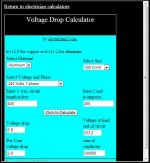
With this one, 4/0 AL (like MHF) would give a 16V (6.7%) voltage drop @ 400' and 200A. At a more realistic 100A load, it would be an 8V (3.3%) drop.


... and I'm not willing to make this a compromise installation. I want enough power there no matter what I might want to do with this building now or in the future.

It's your money !
 

Attachments

  • Capture.JPG
    Capture.JPG
    55.2 KB · Views: 47
Last edited:

pattenp

Well-known member
Joined
Jun 4, 2008
Messages
10,175
Location
Virginia - USA
I suggest #400 for your service feed. Using #400 with a 100% non continuous load of 160A (80% of 200A) the VD is a little below 3%. Now the problem is 3 conductors of #400 and 1 smaller for the equipment ground may or may not fit in 3" conduit. It all depends on the wire type. Some wire has compacted stranding and you can get more conductors in the conduit. As an example compacted conductors of #400 THWN-2 is 5 conductors in 3" Sch 40 PVC conduit, but #400 RHW-2 is 3 conductors in 3" Sch40 PVC conduit.
 

Speedy Petey

Well-known member
Joined
Apr 22, 2012
Messages
1,430
Location
NY State
Can you guys tell me where theses load calc numbers are coming from???? 160A demand load in a one man shop???
 
OP
A

armorerr

Member
Joined
May 7, 2012
Messages
22
Location
Pittsburgh, PA
For those that might find this on a Google search trying to answer a similar question, I spoke to the local code guy today. Apparently, code in my locale calls for 2/0 copper, 4/0 aluminum, or two sets of 1/0 aluminum. There is no code minimum voltage drop. So all the electricians are meeting minimum code, as they claimed.
 

theoldwizard1

Well-known member
Joined
Feb 22, 2011
Messages
43,132
Location
SE MI
armorerr said:
For those that might find this on a Google search trying to answer a similar question, I spoke to the local code guy today. Apparently, code in my locale calls for 2/0 copper, 4/0 aluminum, or two sets of 1/0 aluminum.


Depending on which online calculator I use, I get different answers, so ...

With this one, 4/0 AL (like MHF) would give a 16V (6.7%) voltage drop @ 400' and 200A. At a more realistic 100A load, it would be an 8V (3.3%) drop.

armorerr said:
There is no code minimum voltage drop. So all the electricians are meeting minimum code, as they claimed.


Then go with 4/0 MHF !
 
Last edited:

pattenp

Well-known member
Joined
Jun 4, 2008
Messages
10,175
Location
Virginia - USA
When you talked to the code guy did you specify 200A service or 200A branch feed? 4/0 Al is okay for a 200A service but only 180A as a branch feeder.

For those that might find this on a Google search trying to answer a similar question, I spoke to the local code guy today. Apparently, code in my locale calls for 2/0 copper, 4/0 aluminum, or two sets of 1/0 aluminum. There is no code minimum voltage drop. So all the electricians are meeting minimum code, as they claimed.
 

theoldwizard1

Well-known member
Joined
Feb 22, 2011
Messages
43,132
Location
SE MI
When you talked to the code guy did you specify 200A service or 200A branch feed? 4/0 Al is okay for a 200A service but only 180A as a branch feeder.

Shhhhh !!! Don't tell him ! You are assuming he wants to maintain a 3-5% voltage drop. I already said that 4/0 @ 400 ft would give a 6.7% voltage drop.
 

pattenp

Well-known member
Joined
Jun 4, 2008
Messages
10,175
Location
Virginia - USA
I'm not talking VD. I talking about over current protection. You aren't to use a 200A breaker on 4/0 Al when used as a branch feed. 180A is the max OCP on 4/0 Al when used as a branch feeder.

Shhhhh !!! Don't tell him ! You are assuming he wants to maintain a 3-5% voltage drop. I already said that 4/0 @ 400 ft would give a 6.7% voltage drop.
 

LEVE

Well-known member
Joined
Jun 23, 2008
Messages
1,727
Location
On the Willapa
Be real careful of the type of wire you buy. Some wire is rated OK for direct bury and entering into the structure to the Service. Some wire is OK for bury in a conduit but NOT rated for entering into a structure where the service box is inside the structure. It's not the wire size that's the concern, but the insulation type around the wire.

Have you been to Home Depot or Lowes? Sometimes they have Electricians on staff who can help you with the design.
 

wyliesdiesels

Well-known member
Joined
Aug 14, 2012
Messages
19,996
Location
Modesto, CA
Be real careful of the type of wire you buy. Some wire is rated OK for direct bury and entering into the structure to the Service. Some wire is OK for bury in a conduit but NOT rated for entering into a structure where the service box is inside the structure. It's not the wire size that's the concern, but the insulation type around the wire.

Have you been to Home Depot or Lowes? Sometimes they have Electricians on staff who can help you with the design.

Sure, wire size isnt a concern if u want to kill equipment, melt the wire and start a fire.(w/ the wrong size breaker) :willy_nil
 

McKay

Well-known member
Joined
Apr 16, 2010
Messages
111
You are going overkill on this. But whatever. And yes I am an electrical contractor. Also for others wanting to know you could have easily pulled three 500's and your ground in a 3" with the proper tugging equipment. I am currently building a 13,000 square foot shop behind my 9000 square foot house. Main panel on the new shop will be 300' away and am only giving it a 200A feed. (House only has a 200A service) and I am very doubtful there will be any problems and that I will need to upgrade to a 400A main service on my house. You will be seeing $1000 plus power bills a month before you need to upgrade to a 400A service.
 

justsam

Well-known member
Joined
Aug 20, 2010
Messages
1,267
Location
Penngrove, California
You are going overkill on this. But whatever. And yes I am an electrical contractor. You will be seeing $1000 plus power bills a month before you need to upgrade to a 400A service.

Read post #19, the OP already has 400 Amp service.

I think many of us feel overkill here, but if ever needed now is certainly the time to do it. Sounds like electric heat is planned as well as a well equipped shop, and a space above the shop. For all any of us know some type of electric kiln, or heat treat device is in his future plans. (Let the 3 phase recommendations then begin).

I think the OP is looking for one consistent answer to his existing situation so he can implement and move on. Perhaps that doesn't exist.
 

Stevie-Ray

Well-known member
Joined
Jul 23, 2013
Messages
2,894
Location
Michigan's Sunrise Side
Did I miss something. Why do you have to dig up the pipes to feed wire through them? Are they damaged? If not why not get rope and a tugger. You may have to still do sections, but I've pulled 300' before. Just needed to blow a string through to get started, use the string to pull the rope and then used the tugger and rope to pull the cable (and lots of lube)
I've done that many times myself, even 600' runs, but it was always at least aluminum pipe, and much of the time, steel. I've never used a tugger on plastic pipe, and wonder about the logic of that. But then, it's been many years since I used a tugger.:dunno:
 

LEVE

Well-known member
Joined
Jun 23, 2008
Messages
1,727
Location
On the Willapa
Sure, wire size isnt a concern if u want to kill equipment, melt the wire and start a fire.(w/ the wrong size breaker
I wasn't making myself clear... of course, wire size is important to carry the load, however insulation type must also be paid attention to....
 

J Persons

Well-known member
Joined
Jul 27, 2010
Messages
640
Location
Louisiana
I had to use a second meter for the shop, and had to bury the cable in conduit, since overhead service couldn't be connected economically. The length was around 200' from the pole. The contractor used 3" conduit and aluminum wire, but I'm not sure of the size. The trench and laying the conduit and cable ran me about $1400.00. When the power company came out to hook it up, they decided that their pole needed to be replaced, so I got a new pole and service into my house as well as hooking up my shop power.
 
To avoid these ads, REGISTER NOW!
Top Bottom