To avoid these ads, REGISTER NOW!

GFCI in Ceiling Receptacles

jaw22w

Well-known member
Joined
Dec 28, 2019
Messages
195
Location
indiana
I am planning the electrical system in my new pole barn. I'm pretty well there except for the GFCIs for ceiling receptacles for lights. The lights are 3 rows of (4) 8 foot, 75 watt LEDs on (3) 14/2 wire -15amp circuits. I have found an older thread on here discussing the subject. What I gathered, if IIRC, from that was that GFCI were not required until NEC2017 on ceiling receptacles. Indiana, one of two states in the nation, uses NEC2008. Does that mean that GFCI are not required in the ceiling light circuits under NEC2008?
The only other way that I know of to do it is to use a GFCI circuit breaker x at least 3 circuits.
What about soffit lights and exterior floodlights? GFCI required under NEC2008?
I think I will go for it and install standard trip breakers and see if they slide by the inspector. Change them if I have to.
Anybody have any insight on old regulations? (It figures Indiana would be about 15 years behind!)
 
To avoid these ads, REGISTER NOW!

alfredeneuman

Well-known member
Joined
Mar 3, 2011
Messages
4,587
Location
Fullerton, CA
Does that mean that GFCI are not required in the ceiling light circuits under NEC2008?
Ceiling receptacles could have anything plugged into them (power tools, etc.)
2008 NEC 210.8

(2) Garages, and also accessory buildings that have a floor
located at or below grade level not intended as habitable
rooms and limited to storage areas, work areas,
and areas of similar use
 

olytdi

Well-known member
Joined
Dec 3, 2011
Messages
2,202
Location
Olympia, Washington
^^^^^
This

And you only need a GFCI receptacle as the first in the branch circuit. But you cannot put GFCI where you can't reasonably reach it to reset it without a ladder. I just went through this.

I had a GFCI as the first receptacle in a branch circuit of 6 receptacle locations. That first receptacle was up at one of my liftmasters. They made me bring it down to ground level then I could continue the circuit to the box where the GFCI was origionally but using a regular receptacle at the Liftmaster location.
 

Shiftless

Well-known member
Joined
Mar 9, 2014
Messages
14,555
Location
East Bay SFO
OH! Well! That's easy enough. Does that make it legal without GFCI? And would the same thing go for ceiling fans and OH door openers?
Hard wired lights don’t require GFCI. Only receptacles.
Ceiling fans are hard wired so they don’t. Garage door openers are ordinarily plugged in to receptacles so code requires a GFCI. It’s that easy. :)
 

beemerphile

Well-known member
Joined
Jul 9, 2021
Messages
727
Location
Danielsville, GA USA
If you feed your ceiling outlets from wall mounted GFCI outlets you will find them easier to reset from the than from a ladder.
But you run the risk of tripping the breaker with a hand tool in the lower outlet and leaving yourself in the dark. A blank face lower GFCI or hard-wired lights eliminates this potential.

Regarding the garage door opener, it is the receptacle and not the device that triggers the requirement for GFCI protection. If the opener is designed by the manufacturer to allow direct wiring, then GFCI would not be required. Most commercial openers are designed for direct wiring. Most home openers are designed for cord connection. Some home openers can be wired either way. Wall mounted jackshaft openers are more likely to be direct wire capable than suspended trolley openers. A good defense argument to the inspector that the opener is designed for direct wiring is to save the installation manual which would show direct wire instructions.
 

ycgoat

Well-known member
Joined
Mar 28, 2020
Messages
971
Location
S.E. Va
I am hardwiring my lights (No GFCI), but I am putting outlets in the ceiling for retractable reels and will use a GFCI breaker. Putting a GFCI outlet down low is a good idea, but I didn’t route my conduit for that.
 
OP
J

jaw22w

Well-known member
Joined
Dec 28, 2019
Messages
195
Location
indiana
Hey, thanks a lot for the help, guys. My electrician will get power from the 400-amp distribution box to the main in the barn, and I will complete the wiring inside. I'm pretty comfortable with doing the installation. I have some experience, and this is very rudimentary wiring. Receptacles, lighting, a couple of fans, and a couple of door openers.
One last GFIC question. I need a 30-amp circuit for the air compressor and a 50-amp circuit for the welder. Do the 50 and 30 amp breakers need to be GFIC? I have noticed that those are pretty expensive. I could hard wire the compressor, but I have 3 different welders that all need to plug into the same welder plug at different times. Thanks
 

exranger06

Well-known member
Joined
Aug 9, 2015
Messages
1,686
Location
CT
The current code says that 240V receptacles also need GFCI, but that didn't start until the 2020 NEC, I believe. 2017 and prior only required it on 120V receptacles.

The compressor should probably be hardwired regardless (I'm assuming this is a large, not portable unit). Receptacles are generally only rated for 3 HP max, so if your compressor is more than 3 HP, you pretty much have to hardwire it. There isn't any point in using a receptacle on a large compressor anyway. Receptacles are more for portable tools/appliances that you bring with you wherever you need it, and plug in to any nearby receptacle. You're not doing that with a large stationary compressor; it's going to stay in whatever location you install it. Using a receptacle on a large compressor is like using a receptacle on a central air conditioner; it doesn't make any sense.

There is also a totally different set of rules when it comes to wiring up compressors too. Article 430 of the NEC is all about motor circuits, which is what you need to follow to determine the correct wire size and breaker size.
 
OP
J

jaw22w

Well-known member
Joined
Dec 28, 2019
Messages
195
Location
indiana
The current code says that 240V receptacles also need GFCI, but that didn't start until the 2020 NEC, I believe. 2017 and prior only required it on 120V receptacles.

The compressor should probably be hardwired regardless (I'm assuming this is a large, not portable unit). Receptacles are generally only rated for 3 HP max, so if your compressor is more than 3 HP, you pretty much have to hardwire it. There isn't any point in using a receptacle on a large compressor anyway. Receptacles are more for portable tools/appliances that you bring with you wherever you need it, and plug in to any nearby receptacle. You're not doing that with a large stationary compressor; it's going to stay in whatever location you install it. Using a receptacle on a large compressor is like using a receptacle on a central air conditioner; it doesn't make any sense.

There is also a totally different set of rules when it comes to wiring up compressors too. Article 430 of the NEC is all about motor circuits, which is what you need to follow to determine the correct wire size and breaker size.
Good! As Indiana operates under 2008 NEC, I won't need GFCI breakers.
Yes, It is a larger compressor. 5HP. It came new as a plug in but could easily be hardwired.
 

wyliesdiesels

Well-known member
Joined
Aug 14, 2012
Messages
20,054
Location
Modesto, CA
But you run the risk of tripping the breaker with a hand tool in the lower outlet and leaving yourself in the dark. A blank face lower GFCI or hard-wired lights eliminates this potential.

Regarding the garage door opener, it is the receptacle and not the device that triggers the requirement for GFCI protection. If the opener is designed by the manufacturer to allow direct wiring, then GFCI would not be required. Most commercial openers are designed for direct wiring. Most home openers are designed for cord connection. Some home openers can be wired either way. Wall mounted jackshaft openers are more likely to be direct wire capable than suspended trolley openers. A good defense argument to the inspector that the opener is designed for direct wiring is to save the installation manual which would show direct wire instructions.
bingo
 

wyliesdiesels

Well-known member
Joined
Aug 14, 2012
Messages
20,054
Location
Modesto, CA
Hey, thanks a lot for the help, guys. My electrician will get power from the 400-amp distribution box to the main in the barn, and I will complete the wiring inside. I'm pretty comfortable with doing the installation. I have some experience, and this is very rudimentary wiring. Receptacles, lighting, a couple of fans, and a couple of door openers.
One last GFIC question. I need a 30-amp circuit for the air compressor and a 50-amp circuit for the welder. Do the 50 and 30 amp breakers need to be GFIC? I have noticed that those are pretty expensive. I could hard wire the compressor, but I have 3 different welders that all need to plug into the same welder plug at different times. Thanks
we need to back up here. what is the HP rating on the compressor motor? (not the tank label)....
 

wyliesdiesels

Well-known member
Joined
Aug 14, 2012
Messages
20,054
Location
Modesto, CA
Good! As Indiana operates under 2008 NEC, I won't need GFCI breakers.
Yes, It is a larger compressor. 5HP. It came new as a plug in but could easily be hardwired.
does the motor plate say 5HP or SPL?

a 5HP motor would not come from the factory with a nema cord cap aka plug as they arent rated for more than about 3HP....
 
OP
J

jaw22w

Well-known member
Joined
Dec 28, 2019
Messages
195
Location
indiana
does the motor plate say 5HP or SPL?

a 5HP motor would not come from the factory with a nema cord cap aka plug as they arent rated for more than about 3HP....
I just looked and I can't read the label anymore. It is just over 40 years old. It is an Ingersol-Rand and says 5 HP on the label on the tank. It has been running on a 10/2, 30 amp circuit with a plug the whole time in the same spot. I know that doesn't mean it is right. I will hard wire it into the new shop.
 
To avoid these ads, REGISTER NOW!

wyliesdiesels

Well-known member
Joined
Aug 14, 2012
Messages
20,054
Location
Modesto, CA
I just looked and I can't read the label anymore. It is just over 40 years old. It is an Ingersol-Rand and says 5 HP on the label on the tank. It has been running on a 10/2, 30 amp circuit with a plug the whole time in the same spot. I know that doesn't mean it is right. I will hard wire it into the new shop.
model #?
 
OP
J

jaw22w

Well-known member
Joined
Dec 28, 2019
Messages
195
Location
indiana
Sorry it took this long to get back to you. In the mean time I remembered the motor has been replaced a few years back. I was able to clean the tag up to read it. This is a US Motors. the only numbers I found were 22922 and 156060, but they were not marked as model numbers. The one number I thought might be informative was MTR REF: T63BVCHU-1978. It is marked HP: 5@3450rpm. So, it is 5HP.

I have another question concerning the original topic. The thought occurs to me that the lights I have been looking at are capable of being hard wired. The manufacturer provides a pigtail just for that. However, the light end of the pigtail is a specialty plug that plugs directly into the end of the light, so technically there is a plug in the circuit. So now does that mean that we're back to GFCI required?
 

wyliesdiesels

Well-known member
Joined
Aug 14, 2012
Messages
20,054
Location
Modesto, CA
Since it is a true 5hp motor 10/2 is technically too small and you need 8/2 or #10 in conduit

Also, a nema plug and receptacle wont work as the arent rated for 5HP
 
Last edited:

mcbane

Well-known member
Joined
Jul 23, 2017
Messages
794
Location
California
One more reason to direct wire the compressor: you dont want to create the opportunity for someone to accidentally plug a welder or powder coat oven into a 50 amp receptacle that is at the end of #10 wire with 50 amp breaker.
 

wyliesdiesels

Well-known member
Joined
Aug 14, 2012
Messages
20,054
Location
Modesto, CA
One more reason to direct wire the compressor: you dont want to create the opportunity for someone to accidentally plug a welder or powder coat oven into a 50 amp receptacle that is at the end of #10 wire with 50 amp breaker.
a 5hp compressor shouldnt even be on a 50a receptacle
 

dave*99

Well-known member
Joined
May 5, 2009
Messages
4,272
Location
Coastal NJ
Your state also has options on accepting or rejecting parts of the code. For example, here in NJ, my house was built to NEC 2014 code. But I have a number of dedicated circuits in the garage and laundry room that do not have GFCI protection. In each case, they are dedicated single receptacles (not duplex) on their own breakers. The Washer, Gas Dryer and Garage door openers are fed in this fashion.
I asked the electrical inspector about this and he said GFCI is required in the code - but that article was not accepted here. NJ recently accepted the 2017 code. I don't know if they rejected any articles.
 

dave*99

Well-known member
Joined
May 5, 2009
Messages
4,272
Location
Coastal NJ
One more reason to direct wire the compressor: you dont want to create the opportunity for someone to accidentally plug a welder or powder coat oven into a 50 amp receptacle that is at the end of #10 wire with 50 amp breaker.
Welder circuits are subject to duty cycle considerations. Since many welders have a duty cycle limit that is significantly less than 100%, smaller gauge wires can be employed.

There are situations where a #10 wire (especially THHN in conduit) on a 50A breaker and receptacle is legit. I had Miller Thunderbolt with a 20% duty cycle. This would apply. Since my run from the panel to the welder receptacle was exactly 1 foot, I used #6 wire. But I could have used smaller gauge wire.

The circuit should be adequately marked so a powder coat oven is not pugged into it.
 

mcbane

Well-known member
Joined
Jul 23, 2017
Messages
794
Location
California
Welder circuits are subject to duty cycle considerations. Since many welders have a duty cycle limit that is significantly less than 100%, smaller gauge wires can be employed.

There are situations where a #10 wire (especially THHN in conduit) on a 50A breaker and receptacle is legit. I had Miller Thunderbolt with a 20% duty cycle. This would apply. Since my run from the panel to the welder receptacle was exactly 1 foot, I used #6 wire. But I could have used smaller gauge wire.

The circuit should be adequately marked so a powder coat oven is not pugged into it.
You are correct re: many hobbyist welders being low duty cycle and NEC allowing smaller wire. In my shop, I sized conductors for the duty cycle on a heavier welder so I can use it at any receptacle. Obviously I spent a bit more on wire than the cost of "watch out" labels on outlets where I didnt originally plan to plug it in.
 

Innovate1

Well-known member
Joined
Jul 28, 2014
Messages
4,291
Location
Illinois near St. Louis, Missouri
You should check with the AHJ to see if they require GFCI for ceiling receptacles. I built in 2004 and put GFCI protection on the garage receptacles (first one was GFCI) but also put receptacles in the ceiling for lights without GFCI and it passed with no issue. Don't recall any discussion about it but from more recent discussions I think GFCI was required by national code for them all. And the inspector was pretty through so I don't think they just missed it. Local officials can modify the national code. On a more recent build I hard wired the lights but put a ceiling receptacle for a cord reel with another one on the wall with the GFCI for both.
 

dave*99

Well-known member
Joined
May 5, 2009
Messages
4,272
Location
Coastal NJ
You are correct re: many hobbyist welders being low duty cycle and NEC allowing smaller wire. In my shop, I sized conductors for the duty cycle on a heavier welder so I can use it at any receptacle. Obviously I spent a bit more on wire than the cost of "watch out" labels on outlets where I didnt originally plan to plug it in.
If you sized the wires for a heavier duty cycle (greater than 20% but less than 100%) then you also used smaller wire than would be required in a general purpose branch circuit. Or you sized it like a branch circuit. Either will work as you know.

Article 630 in the NEC gives guidance on this as does the owners manual of the welders. It's common to see a 60% duty cycle at full output on a larger machine. Of course they will run at 100% up to some limit and duty cycle drops as you go to max output. And this would still permit a smaller wire gauge than what would be required for a normal branch circuit. Welder circuit requirements have their own special place in the NEC.
 
Last edited:

alfredeneuman

Well-known member
Joined
Mar 3, 2011
Messages
4,587
Location
Fullerton, CA
but also put receptacles in the ceiling for lights without GFCI and it passed with no issue.
The first mention of GFI in garages was in the 1999 NEC.
All States don't adopt the Code the year that they're published. Some are several editions back
Also..Just because it passed an inspection doesn't mean it's right.
 

wyliesdiesels

Well-known member
Joined
Aug 14, 2012
Messages
20,054
Location
Modesto, CA
Your state also has options on accepting or rejecting parts of the code. For example, here in NJ, my house was built to NEC 2014 code. But I have a number of dedicated circuits in the garage and laundry room that do not have GFCI protection. In each case, they are dedicated single receptacles (not duplex) on their own breakers. The Washer, Gas Dryer and Garage door openers are fed in this fashion.
I asked the electrical inspector about this and he said GFCI is required in the code - but that article was not accepted here. NJ recently accepted the 2017 code. I don't know if they rejected any articles.
That exception for a non-GFCI single receptacle was removed from the NEC
 

alfredeneuman

Well-known member
Joined
Mar 3, 2011
Messages
4,587
Location
Fullerton, CA
Was the exception there in the 2014 code?
No. I can't find it in the 2008 NEC either it only says:
Exception No. 2 to (5): A single receptacle or a duplex
receptacle for two appliances located within dedicated
space for each appliance that, in normal use, is not easily
moved from one place to another and that is cord-and-plug
connected

2005 NEC
Exception No. 1 to (5): Receptacles that are not readily
accessible.
 
Last edited:

dave*99

Well-known member
Joined
May 5, 2009
Messages
4,272
Location
Coastal NJ
No. I can't find it in the 2008 NEC either it only says:
Exception No. 2 to (5): A single receptacle or a duplex
receptacle for two appliances located within dedicated
space for each appliance that, in normal use, is not easily
moved from one place to another and that is cord-and-plug
connected

2005 NEC
Exception No. 1 to (5): Receptacles that are not readily
accessible.
Thanks - that confirms my statement - my house was built under 2014 code which required GFCI on my dedicated single receptacles, yet the AHJ sill allows those receptacles without GFCI.

We are always dealing with the code itself, the elements that are accepted or rejected by the AHJ, and the inspector that shows up that day.
 
OP
J

jaw22w

Well-known member
Joined
Dec 28, 2019
Messages
195
Location
indiana
Since it is a true 5hp motor 10/2 is technically too small and you need 8/2 or #10 in conduit

Also, a nema plug and receptacle wont work as the arent rated for 5HP
OK. So, no plug, hardwire only with 8/2 on a dedicated circuit. Still on a 30 amp breaker?
Thanks for the heads-up!
 

sparky 1971

Well-known member
Joined
Oct 9, 2018
Messages
7,988
Location
Central Iowa
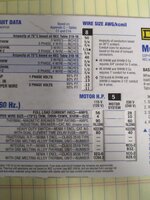
It's been years since I've done a motor calculation, and then it was for either a class or test. My little Square D cheater card calls for a 60, so that's what I use. Plus it's a helluva lot easier to come up with a 260 than a 270.
 

Attachments

  • 16759035478994065905607143712958.jpg
    16759035478994065905607143712958.jpg
    585 KB · Views: 9
To avoid these ads, REGISTER NOW!
Top Bottom