Bighead38
Well-known member
I’m American-Irish and love my Leatherman lol.I never got the Robogrip thing. Most of my friends love 'em - not me. Leatherman's, too.
Must be an Irish thing.

I’m American-Irish and love my Leatherman lol.I never got the Robogrip thing. Most of my friends love 'em - not me. Leatherman's, too.
Must be an Irish thing.
Is there really that much demand for "one size fits all" tools? I guess there are a few that are considered standard. Pipe wrenches. Adjustable wrenches. But it seems a lot of the worst tools are supposed to replace half the tool box. Like that universal nut driver. The pin socket. Those stupid universal wrenches from the 80s. There actually IS a use for those. I used to keep one around when I was younger and often didn't own the right tool. Sometimes I just didn't have the right size socket or wrench and so e of those times it work and get my car back on the road without having to buy the right tool. Now, I just have the right tools.If you have a weakness for nutdrivers you can’t leave one of these one size fits all models behind but I promise that I’ll never use it.
-Don
That's what that y shaped bit in your "101 piece" super super has everything set is for.Got into a heated debate not too long ago on "gimmick" tools. Don't call anything a gimmick if someone thinks it's a legitimate tool! Them's fightin' words!
It seems that a lot depends on what your particular opinion on what "gimmick" means. I think it's often construed as some clever contraption or trick that has little practical value, and so the term "gimmick" generally has a negative connotation. However, coming from a salesman's background, I see it from the broader definition of an attention-getting novel or unconventional device or method designed to promote and sell a product or service (which also happens to be one of the legitimate standard dictionary meanings for the term). To me, that's not necessarily a negative thing.
Take fishing reels for example. There was the conventional casting reel, the basic design which goes back a long ways. Then came the 'gimmick' of the spinning reel that used a rotating head to wind line. Later came the closed-face spincast reel first marketed by the Zero Hour Bomb Company (or Zebco). These were unquestionably gimmicks in their day that were manufactured and sold with the specific intent of generating sales from their novelty, but ultimately proved to be of practical use. Lots of other reel gimmicks have come and gone because the design simply proved impractical or unprofitable, or solved a problem that too few consumers cared about spending money for that particular solution. Even today, casting reels are often called "conventional" reels as opposed to the unconventional 'gimmicky' spinning and spincasting reels (Alvey reels get honorable mention).
The tool industry has seen lots of gimmicks, and like fishing lures, the field seems to invite and encourage them. Interchangeable sockets was a gimmick. Adjustable wrenches were a gimmick. Channellocks were a gimmick. Combination wrenches were once a gimmick. Even the ratchet was a gimmick. Just because the market eventually judges a novel device to be such a practical innovation as to become mainstream does not negate its gimmicky origins. There are many more tool gimmicks that have gone away that were either impractical or had too small a following to make them commercially viable. Mechanics laugh at those one-size-fits-all sockets with the spring-loaded pins inside, but I had a job once where I had to run out a bunch of eye screws of varying sizes--best hand tool socket ever made for that job!!! It would be stupid to start an argument about it with those who think it's junk just because I happen to find that contraption useful at times. If it had a widely recognized usefulness, all the tool companies would be making them. But regardless to whether a novel tool proves to be successful or not, its origin was still a gimmick.
Pipe wrenches and Stilson wrenches are adjustables that I wouldnt call gimicky. There's really no better tool for turning a round object.I was taught that all adjustable wrenches are gimmicky wrenches
I have one of these and I love it for removing oil drain plugs. It doesn't get a lot of use, but there have been a few times it has come in real handy where nothing else would work.I bought this several years ago thinking it was a very cool idea. The handle rotates to turn the head, and it operates as a regular fine tooth ratchet. One of the few Chinese tools I own. I have never used it, but can see how it could be handy in the right situation. Bonus feature is the quick release.

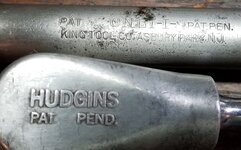
I agree about the motivation. Probably true of most of what made it here. The Husky can be ratcheted by turning the handle either direction. Is the Hudson’s the same? In other words, you can rock back and forth and still progress in the same direction.Here are two US made ratchets - separated by 60 years, and a couple thousand miles - that demonstrate the same concept (turning fasteners in close quarters, when there is no space to swing a handle) and use the same mechanism (beveled gears).
The "ONLI-1" (1,385,214/1920, and 1,420,635/1921), the brainchild of August Klopper, was made by the King Tool Company in Asbury Park, NJ. It is 7/16-inch hex drive. It was marketed for hard to reach spots. That button at the top of the head retracts the drive plug, disengaging the gears, so you can use it like an L-handle if you have room to swing it. It came in an embossed metal case with several sockets and an extension. You can read more about it in a GJ thread on the subject here.
"Hudgins" (4,311,072/1982) refers to the last name of the inventor, from Cedar Crest, NM. There is an older version (4,086,829/1978) that actually had a little crank at the **** end of the hollow handle actuating a shaft inside, just like the Onli-1. The example I have is an improvement, because the entire handle rotates, actuating the gears inside. But as you can see, the head is a little large, certainly larger than RJ's Chinesium Husky-branded version. Like the Husky, you can also use it like a regular ratchet. The Hudgins is US, though, not easy to find, and kind of nifty considering the era it was made. It is 3/8-inch square drive. You can read more in a GJ thread on the subject here.
Like some of the other tools on this thread (Williams original dogbone, for example), I don't consider either one to be classically gimmicky, a term that does commonly have a negative connotation, often implying superficial trickery with little to no intrinsic value, with the main objective being sales, and almost exclusively for sales' sake.
I don't think either inventor was motivated by gimmickry.
I'm not sure I understand what you're asking, sorry.The Husky can be ratcheted by turning the handle either direction. Is the Hudson’s the same? In other words, you can rock back and forth and still progress in the same direction.
I understand. The Husky will tighten or loosen, depending on choice, whichever way you rotate the handle, so you can oscillate back and forth with the handle and the ratchet will move the fastener in one direction. It moves the fastener when you rotate left and when you rotate right. Not sure how it works, but I thought it was cool.I'm not sure I understand what you're asking, sorry.
It has a gear and a switch to change directions, actuating a spring-loaded batman pawl inside, just like a routine ratchet. And it will work like any routine ratchet, by swinging the handle/drive stud against a fastener right (on) or left (off), and ratcheting into a new bite on the backswing in the other direction. It also has a set of beveled offset gears. Those actuate the main gear by rotating the handle (turning it in its own axis), but only in the direction the pawl is switched for.
If you click on the link in my previous post, there are several patent diagrams and I also took it apart to fix and lube it, so you can see the internals.
Sounds really cool. The mechanism almost sounds like the adjustable socket made by Bonney that 3bay and I have. You can turn it in either direction and the walls of the socket will close, then open, close, then open, continuously. No matter which direction you turn. It will only stop when it acquires resistance (such as the fastener).Not sure how it works, but I thought it was cool.


I believe that that is a Thorsen puck wrench, just an earlier version.Anybody recognize this palm-grip wheel ratchet?


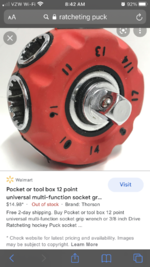


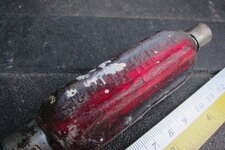


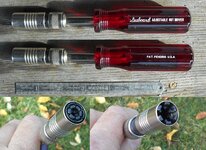


RTM:
The "Jerrold" unit was made BY Seaform for Jerrold. I looked that one up. Can't remember what "Jerrold" does, but it's not making tools
Actually the robogrip pliers work great for me. I use them all the time for nuts.The version of the Skil wrench for sale today is pretty but of the poorest quality. The weak point in the design is the slide for size selection. They break easily from what I've heard from those who have tried out the wrench. I have zero hands on experience with the tool so take my 3rd party review with this in mind.
The sweet spot for the gimmick tool era was the late 90s when Craftsman tried to sell you every sort of nutty tool that Bob Vila could pitch. Robogrip, while being nifty for certain tasks, is what most people will recognize from that awkward time.
Pre battery powered tools many electricians used these for putting in outlets etc. They are actually pretty handy. I have, but not tried to use, a slotted screwdriver, the Phillips point ones work well though.Nice one! A 'speed wrench screwdriver'..
Does the handle actually rotate freely? Or is it just fixed like a normal screwdriver handle?
Can't imagine it would stay in the screw slot for long before it slips out and gouges in to whatever.
RTM" said:Yes, want clear about that, was i? Jerrold was Cable TV stuff in the early days
I got one just like that a week or so ago. Obviously not used much. But interesting nonetheless.The common themes among most gimmick tools are (Type 1) one tool fits all sizes and (Type 2) multiple functions on one tool. There aren't that many times where what must have been enthusiastic inventors pulled it off.
Here's a Type 1 gimmick from my father's old tools, as I clean out his workbench thirty years after he passed. Given how little this has been used I'll bet my brother or I gave it to him as a gift, probably in the early 1970s. This Stanley Hex-a-Matic adjustable nut driver is pretty well made, and works reasonably well. It's still not as convenient as carrying a driver handle and a few sockets or the dedicated nut drivers.
I have a couple that I recently picked up, two that size and one larger one. And one standard one I've had for years.Oooo, I like those Crescent folding T handles, Otg. Those are legit in my book. Same principle as the high hex nut shanks that Smith, Tobrin, Ryan and others put on heavy duty screwdrivers for grabbing and turning with a wrench. But built in. Not easy to find, either. I have never seen one in the wild in about 10 years of flea prowling. Congrats.
I have carried and used a number of the pocket multitools, Leatherman, SOG, Gerber etc.Well, in the spirit of full disclosure, I did buy a Leatherman once. And gave it to my wife..... so she could have some small tools at work.
You should try the Super Tool 300, it's like hooking a boat anchor on your belt.I have carried and used a number of the pocket multitools, Leatherman, SOG, Gerber etc.
They have saved me miles of walking and climbing up and down ladders to grab a real tool.
I keep one of the cheaper ones in the truck and a better one in my wife's car trunk just in case.
I used to carry a Leatherman Wave all the time. Then the Surge came out and stole my heart.
But alas, as I got older the weight of them, and a cell phone, as well as my *** shrinking makes it hard to keep my pants from falling down.
I also spend more time at work sitting in front of a computer screen instead of running around the shop fixing things.
I still take a Surge and auxiliary bits along when I travel. And I also keep one in my emergency bag just in case I need a tool and don't have any available.
I don't fly anymore if I can avoid it, hell, I don't even travel unless work or my wife makes me.
Can you tell I'm stuck at home today and bored?
This is the third or fourth reply to just this thread I've made today...
 buffalo-tools.com
I have one of those too, but never really enjoyed it because of the handle design. And you are right, its stout.You should try the Super Tool 300, it's like hooking a boat anchor on your belt.
, as well as my *** shrinking makes it hard to keep my pants from falling down.
I've always been skinny, just getting worse the older I get. Too much nervous energy and constant fidgeting will do that.How did you manage that. Mine just keeps growing. With a sturdy belt I ought to be able to hold up the entire contends of my roll around.
The pocket socket was the tool all of us junior electricians coveted at my first Coast Guard unit in the early 80s. It was a super handy tool for our tasks. It seems to me that the NSN was a dead-end when we tried to order them. It seems to me there was an amber handled example as well but with the "in between" sizes not on the red handled ones.Here's another Type 1 gimmick (fits-more-than-one-size) tool that while kind of gimmicky is also surprisingly useful. This Pocket Socket four-in-one nut driver came to me a few years ago when my nonogenarian neighbor passed and his family gave me a few boxes of tools from his garage. It probably dates from the 1960s. The sliding tube has two sizes, the fixed tube another two. So it's a four-in-one nut driver, with a single moving part, non-removable. It's kind of beat up, but it's sturdily made. This one lives in my house painting/stripping tray and gets used once in a while.
The sizes on the Pocket Socket are 1/4", 5/16". 3/8", and 7/16".
Let me introduce you to my old friend Pizza, he'll fix you right upI've always been skinny, just getting worse the older I get. Too much nervous energy and constant fidgeting will do that.
Yeah. I have two sizes of the Matco brand I bought decades ago as a young mechanic.I actually just threw my craftsman robo-grips away.

