To avoid these ads, REGISTER NOW!

gluing pressure treated lumber

Mainiac Mat

Well-known member
Joined
Sep 2, 2020
Messages
405
Location
Maine
Hey all,

I'm doing an on site glue-lam type build up with three rows of PT 2x10 with rips of PT plywood between each one.

We frequently do these at work with SPF sticks and CDX rips and use generic white glue (and a boat load of nails).

Anyone ever do any substantial glueing of PT lumber?

What glue would you recommend?
> A PVA like Tight Bond 2?
> Or a Polyurethane like Gorilla Glue?
> Or a construction adhesive like PL Premium 3X?

This is all for the stick built deck upon which I'm errecting my 3-season porch TF.
 
To avoid these ads, REGISTER NOW!

The Bean

Well-known member
Joined
Dec 24, 2021
Messages
1,828
Location
Delaware Valley (SE PA)
I just used this for the first time to attach my exterior sill repair. But as to your situation, i would use construction adhesive.
 

Attachments

  • 17310987273213532621004867402892.jpg
    17310987273213532621004867402892.jpg
    568.8 KB · Views: 3

rlitman

Well-known member
Joined
Oct 18, 2010
Messages
24,667
Location
Long Island
PVA glue (generic white glue) isn't gap filling. It's fine for a tight wood on wood joint that's properly jointed, but not ideal for construction lumber's poor surface. Polyurethane glue does foam, but the foam has just about zero strength, so it too is not gap filling.

If your lumber has a really good surface, then Titebond III should be fine (I'm not a fan of II for outdoors), but if you don't have 100% good contact, go with a polyurethane based construction adhesive. I'd recommend PL 8x or PL Pro, along with a lot of hot dipped galvanized nails.
 

RegeSullivan

Well-known member
Joined
Mar 30, 2014
Messages
695
Location
Canonsburg Pennsylvania (South of Pittsburgh)
I would not count on pva or polly glue for load bearing members. It's great to stop creeks and pops but for long term streangth you'll need to find a construction glue load bearing approved. Personally I'd use pva but use a mechanical attachment method.
 

rlitman

Well-known member
Joined
Oct 18, 2010
Messages
24,667
Location
Long Island
I would not count on pva or polly glue for load bearing members. It's great to stop creeks and pops but for long term streangth you'll need to find a construction glue load bearing approved. Personally I'd use pva but use a mechanical attachment method.
On a well jointed surface, yellow wood glue (modified PVA) will easily be stronger than the wood. Titebond II is at least as strong as the non-water-resistant type, and III is stronger still. ALL of these have the potential to be stronger than construction adhesive, both in shear as well as in tension. The big issue is as I said above, all about gap. Most construction lumber has a sanded finish, and sanding erodes spring grain preferentially to summer wood, leaving a washboarded finish that is inappropriate for thin adhesives. Construction adhesive has some gap filling abilities to handle this, but is not actually structurally as strong.

For a counter example, when assembling a knock-down boxed staircase, the wedges, treads and risers (all machine finished surfaces) will be much stronger if glued with Titebond III than with construction adhesive. But if you're gluing treads down to circular saw cut stringers, you'll want a construction adhesive (and need to be very particular about what you use here).
 

RegeSullivan

Well-known member
Joined
Mar 30, 2014
Messages
695
Location
Canonsburg Pennsylvania (South of Pittsburgh)
On a well jointed surface, yellow wood glue (modified PVA) will easily be stronger than the wood. Titebond II is at least as strong as the non-water-resistant type, and III is stronger still. ALL of these have the potential to be stronger than construction adhesive, both in shear as well as in tension. The big issue is as I said above, all about gap. Most construction lumber has a sanded finish, and sanding erodes spring grain preferentially to summer wood, leaving a washboarded finish that is inappropriate for thin adhesives. Construction adhesive has some gap filling abilities to handle this, but is not actually structurally as strong.

For a counter example, when assembling a knock-down boxed staircase, the wedges, treads and risers (all machine finished surfaces) will be much stronger if glued with Titebond III than with construction adhesive. But if you're gluing treads down to circular saw cut stringers, you'll want a construction adhesive (and need to be very particular about what you use here).
While I can't argue with anything you said regarding streangth of pvc glues I don't believe you will find an engineer that would approve pva for structural members. Even if it was approved there is alot of controversy about long term creep that would convince me to use mechanical fastners and glue for added stiffness.
 

dcg9381

Well-known member
Joined
Jun 20, 2018
Messages
11,924
Location
Austin, TX
Anyone ever do any substantial glueing of PT lumber?
Around here, I often end up with "wet" pressure treated lumber. I wouldn't count on any adhesive to stick to it.

My go-to "structural" adhesive is epoxy, because I keep a lot of it in the shop.... But I wouldn't design an engineered structure around depending on it. Then again, we build boats out of wood and epoxy which hold up to quite a beating... dunno...
 

mike93lx

ALLIANCE MEMBER
Joined
Dec 9, 2013
Messages
37,916
Location
Richmond, VA
Around here, I often end up with "wet" pressure treated lumber. I wouldn't count on any adhesive to stick to it.

My go-to "structural" adhesive is epoxy, because I keep a lot of it in the shop.... But I wouldn't design an engineered structure around depending on it. Then again, we build boats out of wood and epoxy which hold up to quite a beating... dunno...
Polyurethane glue seta with water. A match made in heaven!
 
To avoid these ads, REGISTER NOW!

rlitman

Well-known member
Joined
Oct 18, 2010
Messages
24,667
Location
Long Island
While I can't argue with anything you said regarding streangth of pvc glues I don't believe you will find an engineer that would approve pva for structural members. Even if it was approved there is alot of controversy about long term creep that would convince me to use mechanical fastners and glue for added stiffness.
Creep is not an issue with a tight glue joint, because creep requires a thick plastic layer. That's also why creep is potentially an issue with construction adhesives. Particularly with the cheap stuff. There's a reason I called out two specific adhesives (and suggested using them in combination with nails).

PVA is frequently used in structural laminations. Partly because as I said above, it produces a glue joint that's stronger than the wood, and also because in a commercial setting it can be inexpensively cured rapidly using radio frequency radiation. Modern PVA adhesives can easily give a stronger and more water resistant joint than toxic glues of the past such as phenol-resorcinol.

Keep in mind that there's nothing special about gunnable construction adhesives. The typical solvent based stuff isn't much more than a low-foaming moisture cure polyurethane with a filler which could be as simple as silica or sawdust, and the water based stuff isn't useful for structural purposes at all.

Let's also be clear here. No engineer is going to call out ANY adhesive as sufficient for DIY structural lamination. On-site glue-lamination of structural wood is not a simple business. You can't just recommend an adhesive and expect it to work as intended, because the adhesive choice is the smallest issue here.

Polyurethane glue seta with water. A match made in heaven!
I don't think the amount of water that a moisture cure adhesive takes up will make much of a dent in the hydrostatic pressure at the surface of thoroughly wet wood opposing any adhesion.
 

coldh2o

Well-known member
Joined
May 21, 2013
Messages
1,443
Location
Ontario, Canada
Is the glue even necessary? I understand it adds little to the vertical loadbearing strength of a beam constructed with the proper nailing pattern. Around here we don't see it in laminated beams, especially for PT decks.
 

CraigStu

Well-known member
Joined
May 22, 2014
Messages
4,057
Location
Blacksburg, Va
The problem I see w/ depending on any glue is 2 fold. 1- PT lumber is usually pretty wet so not sure how any glue works w/ that. 2- PT lumber is usually the most warped, bent, spiraled stuff at the store. So how will glue stick between 2 pieces that are not flat when held together w/ nails? I'd look up codes covering construction screw types, brands, and layout. I'd want something that will actually pull 2 or 3 pieces of warped wood together. Maybe even bolts and nuts. I haven't built any deck type stuff in 15+ years but I know that the deck built on our 5yr old house has a lot of attachment hardware that I have never seen before.
 

Hank11

Well-known member
Joined
Aug 19, 2019
Messages
1,159
Location
Tennessee
Using KDAT (kiln dried after treatment) lumber would help, but you still have a problem with fit of the pieces. If this assembly is exposed to any weather, it will be subject to failure unless you have built it for that purpose.
 
OP
M

Mainiac Mat

Well-known member
Joined
Sep 2, 2020
Messages
405
Location
Maine
Unrelated to the glue, but unless you need to hit a width, skip the plywood as it doesn't help with strength
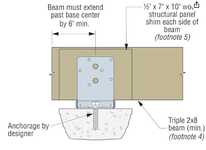
1.) I need to hit 5-1/2" width to fit a Simpson ABU66Z, so three layers of 2x and two of 1/2" ply. They recommend gussets on both sides, but I want a continuous smooth wood surface on the outside faces.
1731339861571.png

2.) As menstioned, we do layered SPF 2x & CDX build ups at work for oversized crate construction and our experience is that the plywood adds considerable stiffness. We glue and nail the build up. All my numbers were run based on three 2x10s, so I'm good to go with or without the plywood. But since I'm using it anyways, I'm looking to maximize the benefit.
 
Last edited:

Hank11

Well-known member
Joined
Aug 19, 2019
Messages
1,159
Location
Tennessee
Is this inches off the ground as it appears in your drawing?

Is any portion of this beam exposed to weather?
 

MovingAlong

Well-known member
Joined
Aug 17, 2013
Messages
1,258
Hey all,

I'm doing an on site glue-lam type build up with three rows of PT 2x10 with rips of PT plywood between each one.

We frequently do these at work with SPF sticks and CDX rips and use generic white glue (and a boat load of nails).

Anyone ever do any substantial glueing of PT lumber?

What glue would you recommend?
> A PVA like Tight Bond 2?
> Or a Polyurethane like Gorilla Glue?
> Or a construction adhesive like PL Premium 3X?

This is all for the stick built deck upon which I'm errecting my 3-season porch TF.
Because you're using pressure treated, I'm going to assume a certain amount of moisture is anticipated. Without significant compression to ensure "only" glue exists between the boards (like a real glue lam would be), I'd be a little concerned about water getting trapped between the boards with nowhere to escape...
 
OP
M

Mainiac Mat

Well-known member
Joined
Sep 2, 2020
Messages
405
Location
Maine
Plan is now to use an 'S' patter of PL 3X Premium down the middle 1/3 of the boards, and to rip the plywood to 9" to allow for shink on the 2x10s. Each layer will get peppered with a zig-zag pattern of galvanized nails.

1731340824346.png

As noted... I'm meeting all my structural requirements with the trippled up 2x10. The additional rigidity/strength provided by the plywood is icing on the cake.
 
OP
M

Mainiac Mat

Well-known member
Joined
Sep 2, 2020
Messages
405
Location
Maine
Is this inches off the ground as it appears in your drawing?

Is any portion of this beam exposed to weather?

The graphic is from Simpson's catalog... I'm installing the ABU66Z on a 12" diameter pier that stands 12" proud of a prepared gravel surface.

The PT header will be elevated 1" off the concrete pier by the ABU66Z and will have siding and trim covering the exposed exterior surface. This is the platform for a covered 3-season porch, so the only part of the PT header and joists exposed is the underside, which is a well vented, prepared gravel surface with a vapor barrier.

This deck will never see standing water after construction is complete.
 

rlitman

Well-known member
Joined
Oct 18, 2010
Messages
24,667
Location
Long Island
PL 3x hardens about as much as a shoe sole. It's way too rubbery to add anything here. PL MAX hardens about as much as a bowling ball. 8x is somewhere in between.

I'd say 3x is fine for a line between joists and subfloors to eliminate squeak, but I wouldn't use it to bed the ends of structural wood or for sistering.
 
To avoid these ads, REGISTER NOW!
Top Bottom