To avoid these ads, REGISTER NOW!

GOOD Drill Bits on a Tight Budget?

Wamsutta

Well-known member
Joined
Jan 8, 2014
Messages
10,875
Location
Amarillo, Texas
LEARN TO SHARPEN BITS:
For the many, many recommendations towards learning to sharpen bits... message received. However I have no bench grinder as (until recently) I had no bench. Learning to sharpen is an obvious necessity (I already have to sharpen knives, chainsaw chains, etc). But it can't be solved immediately given the constraints that make having a drill press impossible (for the time being). But I WILL get there. In the interim I need some good bits. Maybe I can practice sharpening the bits I've already dulled? I've just been doing it by hand (on spade bits and augers) with various files.


Sharpening a drill bit on a bench grinder is no easy task. I don't have the patience for it myself. Too many variables involved. I'm planning on hanging onto the dull drill bits and buying new ones until I get a Drill Doctor.
 
To avoid these ads, REGISTER NOW!

PugetDude

ALLIANCE MEMBER
Joined
Mar 13, 2013
Messages
22,379
Location
Superstition Mountains, AZ
Until you can afford to upgrade, use the "off-size" HF bits for most of the grunt work, then step up to the exact size you want. It will make those bits last a lot longer.
Buy a drill doctor, you can sharpen bits on your kitchen table if you don't have a shop to work in.
Also, using a big clunky 1/2" d-handle spade drill for 1/4" holes is almost guaranteed to break a 1/4" bit, regardless of the manufacturer. Use a smaller drill so you can "feel" the bit working, and back off a bit as it breaks through.
Good luck.
 

alwaysFlOoReD

Well-known member
Joined
Sep 24, 2013
Messages
2,398
Location
Airdrie, Alberta, Canada
I didn't finish reading your reply, I need to write before I forget {getting old *****...}. Using a pilot drill of the same diameter as the flat on the drill is a good idea. Starting with 1/8 is good for smaller bit sizes.
BUT
Do NOT drill by 1/64" increments, you dull the outer cutting surface much too quickly. The bits cutting edge needs to contact the metal for the full face of the cutting edge. So only 2 bits are needed, the pilot bit and the final hole size bit. If you need close tolerance then a third reaming bit would be used but that's outside of my knowledge.

Edit;
I see the drill your using and it's overkill for the job. But you know that now too. A variable speed drill is a very good idea even if it's bigger than you need. I would buy the drill offered with your savings, the savings from putting together your own set.

The other reason to use just the 2 bits is that the outer edge of the bit doesn't catch and break, as you seem to have done at least twice. The only time the bit, if used properly, will catch is when your'e starting to break thru the other side. That's when you should back off pressure and sometimes increase speed.

Edit #2;
I wish I could see the other side of your drill, I'm sure there should be a place to put a handle. Don't get rid of it, it's a good drill for a different job.
 
Last edited:
OP
H

Hoopy Frood

Well-known member
Joined
Sep 17, 2016
Messages
56
Location
Maine, USA
Until you can afford to upgrade, use the "off-size" HF bits for most of the grunt work, then step up to the exact size you want. It will make those bits last a lot longer.

Good idea, thanks! The HF ones have now been put through the ringer, so I'm not sure if they'll be effective at all in steel. But we shall see! I'm certainly not worried to TRY to sharpen them. Even if I trash a few... the 29-bit set cost just $12.

Buy a drill doctor, you can sharpen bits on your kitchen table if you don't have a shop to work in.

Wow that's a pretty impressive device! A bit pricey, though. I have mechanically inclined friends that have sharpened drill bits, always by hand using a grinder. I have not yet had the chance to grill them on that. I'll do so and also research the Drill Dr more, too.

Also, using a big clunky 1/2" d-handle spade drill for 1/4" holes is almost guaranteed to break a 1/4" bit, regardless of the manufacturer. Use a smaller drill so you can "feel" the bit working, and back off a bit as it breaks through.
Good luck.

You'd be surprised how nimble that drill can be! I had zero drilling issues (apart from crappy, dull bits) until I reached the sizes between 3/8" and 7/16". My smaller drill was overheating due to the dullness of the HF bits (even making around 1/8" holes), so I had to use the heavy duty drill...

I estimated it took two minutes to do the first 1/8" hole through the 3/8" plate using a BRAND NEW HF bit. The equivalent DeWalt bit (almost brand new, used only on wood) took like 4-5 seconds to cut the same kind of hole. Same drill (light duty), same operator. The HF Warrior bits just should not be used on steel, I think... :confused:

But 100% agree on the importance of feel! I'm getting it! I just need to practice :)
 
OP
H

Hoopy Frood

Well-known member
Joined
Sep 17, 2016
Messages
56
Location
Maine, USA
I didn't finish reading your reply, I need to write before I forget {getting old *****...}. Using a pilot drill of the same diameter as the flat on the drill is a good idea. Starting with 1/8 is good for smaller bit sizes.
BUT
Do NOT drill by 1/64" increments, you dull the outer cutting surface much too quickly. The bits cutting edge needs to contact the metal for the full face of the cutting edge. So only 2 bits are needed, the pilot bit and the final hole size bit. If you need close tolerance then a third reaming bit would be used but that's outside of my knowledge.

LMAO! And I have to sign off cuz I'm getting too old, too :)

I'm not sure what you mean by "the flat of the drill." I just like 1/8" holes because I can apply significant pressure (usually) without worry of snapping the bit.

I had never that you don't want to cut in increments! I have one friend who does it exactly as you suggest (only two bits) and he said he figured he was doing it wrong. I had no idea! I'm just trying to get projects done and learn as I go :drool:

But if you think the two-step method is the right one (I had never considered the cutting face of the head) then I will have to start doing that!

I've never had a good drill and good bits to practice with. Now I do (soon). And I will be sure to research (and then practice) the non-incremental cutting more!

Thank you for the tips!
 

alwaysFlOoReD

Well-known member
Joined
Sep 24, 2013
Messages
2,398
Location
Airdrie, Alberta, Canada
I'm not using the correct terminology - memory again....
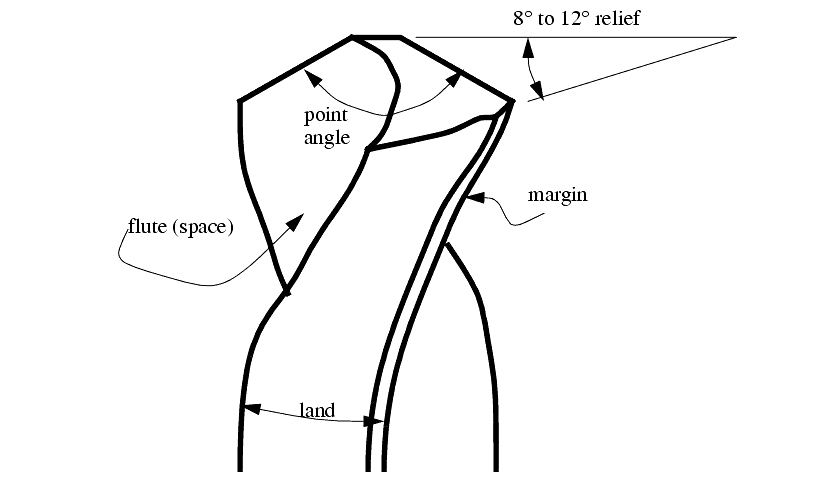
The flat is the portion that would hit the table if in a vertical [perpendicular to the surface being drilled] drilling position.
The cutting edge is the angled portion.
I thought I had some good online resources on drilling but I can't find them. I'll look more.

Edit; I can't find any resources on my computer. Sorry.
 
Last edited:

Professional Tool User

Well-known member
Joined
Apr 9, 2018
Messages
1,835
Location
BC
For your budget, I would probably go with Norseman bits. Your mileage may vary, but I find cobalt bits to be too brittle for my liking. You'll also want some means of sharpening your drill bits like a bench grinder or a grinder hooked up to a vice.
 
To avoid these ads, REGISTER NOW!

ssdave

Banned
Joined
Apr 11, 2015
Messages
2,913
Location
Eastern Oregon
I'm with alwaysFlOoReD on the two bit method. A large bit needs to ride on the entire cutting surface to not overfeed and grab. You might as well use the whole cutting surface; you've paid for it. The outside grabs and chips or breaks if you drill in small increments.

I actually almost never drill using a pilot hole. I just drill with the full size bit. I like the hole to hold oil; the pilot hole drains it through. What he meant by the "flat of the bit" is the area in the center, that's a straight line on the center before the angled portion of the tip. Like this:

drilling11.gif
 

ssdave

Banned
Joined
Apr 11, 2015
Messages
2,913
Location
Eastern Oregon
I've never found cobalt bits to be particularly brittle; they seem about the same to me as high speed steel, and less brittle than carbon steel bits. I use cobalt bits quite heavily; the only HSS I use are ones I get for free, sharp and ready to go, in tool assortments. If I buy new, it's cobalt.
 
OP
H

Hoopy Frood

Well-known member
Joined
Sep 17, 2016
Messages
56
Location
Maine, USA
I'm with alwaysFlOoReD on the two bit method. A large bit needs to ride on the entire cutting surface to not overfeed and grab. You might as well use the whole cutting surface; you've paid for it. The outside grabs and chips or breaks if you drill in small increments.

I actually almost never drill using a pilot hole. I just drill with the full size bit. I like the hole to hold oil; the pilot hole drains it through. What he meant by the "flat of the bit" is the area in the center, that's a straight line on the center before the angled portion of the tip. Like this:

drilling11.gif

What a HUGE help! I had no idea there WAS a flat. Shows how ignorant I am! I really like your point about a pilot hole letting the oil out. I'll still use one as I'm practicing, but I'm now convinced in skilled hands they are not needed.

I found a couple of YT videos that really drove all your points home about drilling slow and using a lot of pressure. They talk about chip load which is something I had not heard of before, too. VERY helpful real time feedback!

1/2" through 1/4" mild steel, no pilot, no oil, vertical position

Does a great job contrasting "done right" with common mistakes. He perfectly recreates some of my mistakes with a nice video (and audio!) record.

To do my project properly (with what I have) I should have set up some kind of a step stool thing to get my feet a couple of feet off the ground. Then I could have drilled much more effectively... the drill D handle was above my shoulder drilling in the vertical position... as I said very awkward!

It's also starting to look like the variable speed drill should probably become a goal.

In the interim I have heard some folks reduce the RPMs of drills like mine by feathering the trigger. That's going to cause "wear" on the switch contacts, but it's probably a good stopgap technique to practice until I can get that variable speed drill.

Again I am blown away by the GJ community! :bowdown:

Thank you so much!
 
Last edited:
OP
H

Hoopy Frood

Well-known member
Joined
Sep 17, 2016
Messages
56
Location
Maine, USA
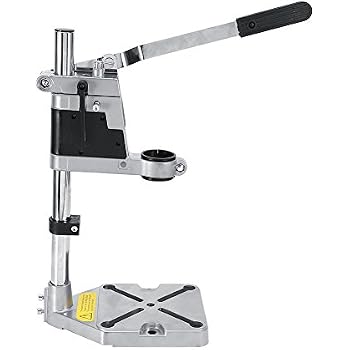
I drilled a lot with a drill stand when I was a boy, before my dad bought a used Rockwell drill press. Not perfect, but it will help you drill square to the metal. Our was a Craftsman , but it was similar to this:

415URTki4HL._SL500_AC_SS350_.jpg


https://www.amazon.com/dp/B077MTRKPW/?tag=atomicindus08-20

A drill stand is a great idea, I didn't even know that was a thing! Much more budget and space friendly. I would want something a little more robust than that guy, but the idea is awesome.

We have a great used tool store in the region and I've got a lot of friends that fabricate. I'll put some feelers out there and see if something comes up!

Non sequitur:
Would the 135 degree split point HSS Norseman bits be good to use on wood? Would hardwood or softwood make a difference? Or should I stick with a "pointier" bit for wood like the HF 118 degree tip?
 
To avoid these ads, REGISTER NOW!
Top Bottom