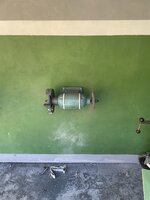
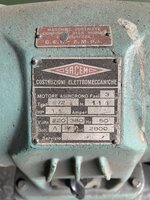
Countless manufacturers all over Europe. I'd search for anything three phase from the 70's or older. That pretty much always means an industrial machine. Comparing quality between those is a moot point, it's a brushless three phase motor on two bearings... Swap the bearings and it'll last another 20-30 years of industrial use, or last forever for home use. Added photos of an Italian one I recently attached to a wall (so nice for cleaning underneath... yeah I know, not really that clean on the photo

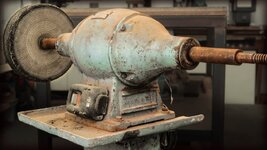
). And another photo of my big Italian cast iron pedestal grinder. Sadly don't have a better photo, I hope I'll remember to take one when I get home. I don't know the brand names either. I think the one on the wall is 1kW, and the self standing one does not have a badge but it must be more powerful. You generally won't stop either unless you push a really fat bar of steel into it. That cast iron pedestal is a really beautiful casting, with some nice fins and curves, very italian
I bought both together more than a decade ago for something like 50€. Didn't even need to swap the bearings. Dont dismiss really old stuff, a new comparable grinder would be ridiculously expensive. But three phase is way better. If you don't have the socket, it's worth it to get a VFD to run it off a single phase (and you can even regulate RPM that way, awesome for polishing...).
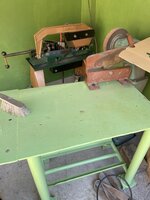
Edit: also attached a photo of the ~70's pedestal grinder they have in some factory workshop at work. Actually looks way more impressive in person than on the photo, but you can see how puny the bench grinder next to it looks, and that one isn't that weak either (I assume something 0.6-0.7kw). Not sure how powerful it is but it was made by Prvomajska (I think that makes it Croatian). It eats up anything you push at it
Must be more than 3kw, perhaps Prvomajska even just modified a 6kw motor off of one of their lathes (that was their main product).
And I'm sure some casting or forging factories needed even larger grinders, especially in the past. Italians made many due to that (Italians are known for their quality alloy castings, they had many foundries), but there are certainly plenty from all countries since most of Europe used to be very industrial.