To avoid these ads, REGISTER NOW!

Gosiger Drill Press and Sheldon Lathe

OP
B

bigcreek

Well-known member
Joined
May 11, 2013
Messages
387
Location
Idaho
The
Here are a couple interesting pages on buying old lathes. "How to buy a lathe" is about inspecting a used lathe before purchase. "In praise of klunkers" is about using a lathe with some wear, and still being able to make decent parts. I started out with a 9 inch South Bend from 1936 that had a lot of wear. With a bit of practice, I was able to make some useful stuff with it. It was also lots of fun and fulfilled a bucket list item of learning to run a lathe.


Enjoy!
Thank you for that info I will definately look that over. I am excited as heck to get this up and running and do some learning on it.
 
To avoid these ads, REGISTER NOW!
OP
B

bigcreek

Well-known member
Joined
May 11, 2013
Messages
387
Location
Idaho
Don't know them very well, but do have one that is waiting on restoration. I had to split mine due to the height and where things are being stored.
If you are going to use a forklift to pick it up, take that cage **** off the top and the front cover. The cover is cast steel and is quite heavy. Take it off and put it somewhere safe for the move. Use straps around the arms on the upper casting to pick it up by. The table section will cause it to be a bit front heavy, but with some careful arrangement of your straps, it should lift ok. Don't lift or secure it by the table as you will destroy the elevating screw.
When I picked it up I used the forest service forklift which had a hydraulic fork positioner so I picked it up with the forks tight against the upright right below the cage. They let me operate their forklift but they would not load it which I was surprised they would let me run their lift. Then when I dropped it off at the auction I had them put their forks in the same spot but I chained the ends of their forks together to keep them from spreading and hitting anything to the sides and it worked good. Hopefully that was all right to lift it at that spot. It did scratch the paint where the forks were but thats a crappy paint job anyway and not the original so whatever.
 

RoninB4

Well-known member
Joined
Jul 22, 2020
Messages
3,610
Location
Under My House
Hope that move to your shop goes well. That's one top-heavy piece to move as is and momentum of mass lurks at every bump, curve, or just because. You can't be over cautious when moving machinery. Good luck.
 

RoninB4

Well-known member
Joined
Jul 22, 2020
Messages
3,610
Location
Under My House
I read an interesting book on this subject

When the machine stopped: A cautionary tale from industrial America
Author Max Holland

I'd recommend it to anyone interested in the subject. Not hard to find an inexpensive used copy on ebay, Abe books etc.

Way OT-Probably a great read but I watched all that unfold in front of me with several companies from the 70's until this year when I retired. I used to feel bad for the demise of a great American industry and all those it affected. I still do somewhat but have opened fault up to include management, the workforce, and the consumers of said products. Everybody had a part to play in the demise (including me in my youthful ignorance) although not all equally. I now find it difficult to feel bad for manufacturing in America with how most companies are operated now. Rant over, I'll go sit down in the back row now.
 
OP
B

bigcreek

Well-known member
Joined
May 11, 2013
Messages
387
Location
Idaho
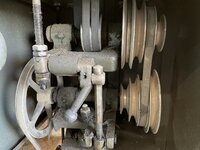
I noticed a broken tooth on one of the gears. I cant figure out what this gear is for. The gear it drives I cant figure out what purpose it serves. Also the drive belts are shot. They look like they could be a real pain to change out, has anybody ever changed these belts out before? The only belt that looks good is the one attached to the motor but if Im changing belts I may as well change that one to. As for the broken tooth how might that affect the lathes operation? Moving it by hand feels smooth and I cant tell its missing but that may not mean much. I am wondering if this broken tooth makes it a piece of junk that I shouldnt bother with or if it may be all right? I dont want to go throught the time and effort of changing out those drive belts if the broken tooth makes it no good.
 

Attachments

  • sheldon lathe 027.JPG
    sheldon lathe 027.JPG
    488.2 KB · Views: 17
  • sheldon lathe 028.JPG
    sheldon lathe 028.JPG
    374.3 KB · Views: 14
  • sheldon lathe 029.JPG
    sheldon lathe 029.JPG
    415.1 KB · Views: 14
  • sheldon lathe 021.JPG
    sheldon lathe 021.JPG
    438.9 KB · Views: 15

RoninB4

Well-known member
Joined
Jul 22, 2020
Messages
3,610
Location
Under My House
If I'm not mistaken that's the "back/bull gear" that often gets broken teeth. It's used for the very low speeds used when cutting threads with a single point tool. It often gets damaged when people needed to lock the spindle in place for removing the chuck, large diameter turning (SFPM), or hand tapping large holes. Is the lathe damaged? Yes. Is it worthless? Can't say just yet. Repair of the gear is likely possible. Should you do it now? No. You need to fully determine if it makes a difference. You need to lube ALL the spindle bearings at the designated locations, rotate the spindle several times to get lube all around the surfaces and THEN test the spindle under power in all the speeds, listening for noise and feeling for vibration. Rig the electric (safely) as temporary until testing is done. No need to make anhy permanent measures or decisions until you've evaluated the machine. I'd leave the back/bull gear for last, you may not even feel a need to use the low speed back/bull gear. Most of the work done on a lathe is done at higher speeds anyway. Do the testing before you even change belts, there won't be any load on if you're not cutting anything. Don't operate any feeds (saddle or cross slide) either until everything has been properly cleaned and lubed. Report back and we'll go from there.
 
Last edited:
OP
B

bigcreek

Well-known member
Joined
May 11, 2013
Messages
387
Location
Idaho
If I'm not mistaken that's the "back/bull gear" that often gets broken teeth. It's used for the very low speeds used when cutting threads with a single point tool. It often gets damaged when people needed to lock the spindle in place for removing the chuck, large diameter turning (SFPM), or hand tapping large holes. Is the lathe damaged? Yes. Is it worthless? Can't say just yet. Repair of the gear is likely possible. Should you do it now? No. You need to fully determine if it makes a difference. You need to lube ALL the spindle bearings at the designated locations, rotate the spindle several times to get lube all around the surfaces and THEN test the spindle under power in all the speeds, listening for noise and feeling for vibration. Rig the electric (safely) as temporary until testing is done. No need to make anhy permanent measures or decisions until you've evaluated the machine. I'd leave the back/bull gear for last, you may not even feel a need to use the low speed back/bull gear. Most of the work done on a lathe is done at higher speeds anyway. Do the testing before you even change belts, there won't be any load on if you're not cutting anything. Don't operate any feeds (saddle or cross slide) either until everything has been properly cleaned and lubed. Report back and we'll go from there.
Got it, thank you. Wiring a vfd up to it today and will report back.
 
To avoid these ads, REGISTER NOW!

rustyzman

Well-known member
Joined
May 7, 2015
Messages
772
Location
Chicagoland
If I'm not mistaken that's the "back/bull gear" that often gets broken teeth. It's used for the very low speeds used when cutting threads with a single point tool. It often gets damaged when people needed to lock the spindle in place for removing the chuck, large diameter turning (SFPM), or hand tapping large holes. Is the lathe damaged? Yes. Is it worthless? Can't say just yet. Repair of the gear is likely possible. Should you do it now? No. You need to fully determine if it makes a difference. You need to lube ALL the spindle bearings at the designated locations, rotate the spindle several times to get lube all around the surfaces and THEN test the spindle under power in all the speeds, listening for noise and feeling for vibration. Rig the electric (safely) as temporary until testing is done. No need to make anhy permanent measures or decisions until you've evaluated the machine. I'd leave the back/bull gear for last, you may not even feel a need to use the low speed back/bull gear. Most of the work done on a lathe is done at higher speeds anyway. Do the testing before you even change belts, there won't be any load on if you're not cutting anything. Don't operate any feeds (saddle or cross slide) either until everything has been properly cleaned and lubed. Report back and we'll go from there.
Like RoninB4 said, that is the back gear for low speed work. People tend to engage the back gear without releasing the shot pin on the larger front gear to "lock up" the spindle in order to unthread and thread on a new chuck, faceplate, etc. If the chuck is stuck, or if you have to use a bit of hammer force to break it free, those teeth will break off. I do that too, but my stuff is not stuck in place. Still I am playing with fire a bit doing it.

If you determine it is worth going forward...

With careful work, you can fix a broken tooth. I just made a complete new tooth on my new-to-me arbor press pinion. There are a lot of methods out there from machining a new gear, to pinning, welding or brazing. Options abound.

Replacing the spindle belts properly requires you to disassemble and remove the spindle itself. Since you have a tooth to fix (should you choose to) that will kill two birds with one stone. You can fix or replace the damaged gear while the spindle is apart. Alternately, if you don't want to take apart the spindle, and wish to leave the gear as is, you can cut off the old ones and replace those belts with Fenner Drive style Link-Belts.

Pics of mine for reference (they have been on there for many years now and one was rubbing a casting at first so they don't look perfect). I retrofitted this E drive to mine as the original Walking Stick W drive was missing completely when I got the lathe. It just had the two original belts hanging off the spindle and an empty cabinet. I ran those belts for a couple years until one came completely apart. That is where the link belts came in. IMG_5133.jpgIMG_5134.jpg
 

larry_g

Well-known member
Joined
Apr 28, 2007
Messages
16,893
Location
oregon
Not to difficult to repair that broken tooth. Weld up the area and cut or file the tooth back to shape. I have a repaired gear on my Sheldon that was repaired 15 years ago and it is still working. There is a Sheldon users group on the internet, https://groups.io/g/sheldonlathe , Join up and learn lots.

lg
no neat sig line
 

Packard V8

Well-known member
Joined
Mar 16, 2009
Messages
7,380
Location
Spokane, WA
I read an interesting book on this subject

When the machine stopped: A cautionary tale from industrial America
Author Max Holland

It is primarily about the Bergmaster Corp, a machine tool company that specialized in turret drills but much of the book features the changes following the take over by Houdaille Industries and eventual failure in the 80s.
Houdaille acquired several American tool companies in the 1960s and 70s including Logan and Powermatic. Although its focus is on one brand it details the issues faced by many US machine tool companies and their response to changing industrial needs and overseas competition, mostly Japan and Taiwan in the 1970s-80s.

I'd recommend it to anyone interested in the subject. Not hard to find an inexpensive used copy on ebay, Abe books etc.

Thanks for the recommendation. I just ordered a copy.

jack vines
 
OP
B

bigcreek

Well-known member
Joined
May 11, 2013
Messages
387
Location
Idaho
Well the vfd is wired up and the lathe ran great forward and reverse. There is some chatter from the gear with the broken tooth. It isnt bad but I know it is louder than it should be, but no surprise since the tooth is broke off. I am going to leave it as is for now. Perhaps down the road I will change it out but for now I will leave it and just change the belts. Last night I actually joined that Sheldon usergroup so I will be spending time on there for sure. The top part looked like it would be easy enough to take apart to get the belts off but the bottom part by the motor looked a little tougher to me. However I know things can often be much more difficult than what they first seem. Ive not seen those link belts before. I just looked them up on youtube and putting those on looks a whole heck of alot easier than taking the lathe apart!! I am going to buy some link belts and go that route for the two main drive belts. Thanks for all the info folks!
 
OP
B

bigcreek

Well-known member
Joined
May 11, 2013
Messages
387
Location
Idaho
My first two things I ever made on a lathe! These items serve no useful purpose whatsoever but I thought it was super awesome I was able to easily take a 5/8" piece of round stock and shave the metal off of it to form these shapes. I was going to wait to use it until I changed the belts but I just couldnt. Figured if one broke I was right there to shut it off and somewhat surprisingly neither one broke. Yet. However changing belts is at the top of my to do list. I did oil everything up good before starting. I still need to clean it up good though. I took a picture of the number stamped on it with the crossed cannons which someone said means it was military. I know you guys can look at the parts and see all the things I am doing wrong in my turning and I know I am as well but with that being said it is still pretty dang neat. From watching youtube videos I see two things. One is the ******* left over denotes the cutting piece (not sure as to its proper name) was not centered perfectly to the work piece is that right? Secondly the small lines in the work piece would show chatter or vibration of the work piece while cutting correct? I can see how that could have been an issue since the round stock was only 5/8" diameter and I had it sticking out of the jaws 6" to 8". The cutting piece may not have been the correct shape and angle Im not sure.
 

Attachments

  • lathe parts 011.JPG
    lathe parts 011.JPG
    209.1 KB · Views: 13
  • lathe parts 021.JPG
    lathe parts 021.JPG
    435.4 KB · Views: 13
  • lathe parts 005.JPG
    lathe parts 005.JPG
    182.1 KB · Views: 13

RoninB4

Well-known member
Joined
Jul 22, 2020
Messages
3,610
Location
Under My House
Yep, figured you couldn't resist the temptation to take it for a drive. Just means you're human. To answer a couple of your questions:

1) Yes the "******/***" shows 1/2 the height your tool bit cutting edge was below center. Some insist that the cutting edge be only .005-.010 below center. It really doesn't matter that much unless you're facing, single point threading, or cutting off something. As long as you're within .030 below the center it just puts a bit more downward cutting pressure on the tool. Many folks make a small block at exactly the height of the center of the spindle, put the block on the bed next to the cutting edge and there's a fast way to get the proper height. Above center is not good as the tool will dig in and/or rub below the cutting edge. There are several methods for setting center height, pick one.

2) Yes the marks show excessive chatter from vibration. That's because you had the work out too far from the chuck allowing it to flex in/out from cutting pressure. If the workpiece is small enough diameter and out of the chuck far enough it can even whip around on top of the cutter, very dangerous situation. Keep the cutting within 1"-2" of the chuck unless it's a massive piece that can't flex or you're using the tailstock or a steady rest/follow rest to support the work. The tool holder and the cutting bit itself should also be kept as close to the mounting point as possible because they vibrate also. The only solid thing you have is the machine itself. Marks like that and the noise it made are your first indicators of the work not being properly supported or it's being run too fast (discolored chip). When you have a long shaft to work on you work on a short section at a time and bring the workpiece out as you go, supported by the tail stock, steady/follow rest. Too many situations to cover them all but chatter marks says bad results, change something.

3) Can't speak to the crossed cannons but I've seen other items with similar markings that had a military connection. You should post those photos on the Sheldon owners group, they'd love to see them and may have a better answer than I do. The serial number will be year made.

4) Was it cool to cut metal? Sure was, even more so when you make your first piece that gets used in something. Congratulations, be safe.
 
Last edited:

rustyzman

Well-known member
Joined
May 7, 2015
Messages
772
Location
Chicagoland
Your joy at turning metal is very encouraging. Turning metal is quite addictive. Glad you got to use it a bit.
 
To avoid these ads, REGISTER NOW!
Top Bottom