Getting ready to start my garage build here in a few weeks. I need to start leveling my ground this weekend so I'm ready. The ground is almost perfectly flat, just a couple small holes need to be filled, will laser the whole area. My question is what size of base Gravel and house thick will I need to put down? I plan on putting insulation and heated floor after the garage is put up. I'm in Northern Missouri and garage will be a 40x72 14ft tall if that makes a difference.


You are using an out of date browser. It may not display this or other websites correctly.
You should upgrade or use an alternative browser.
You should upgrade or use an alternative browser.
Gravel base
- Thread starter 70staged
- Start date
jack stand
Well-known member
Pole building?
Perfectly flat is handy, but this would cause me to elevate the building so that you have positive drainage to a point well away from the structure, like at least 20'. That roof water needs to go away.
More to your question, typically you don't want to build on topsoil and that is generally removed. With post frame construction the only consideration is for the slab sub grade and I wouldn't advise you on this. Talk to your concrete guy or builder. Dirt & frost particulars is a local thing to ask a local guy.
Perfectly flat is handy, but this would cause me to elevate the building so that you have positive drainage to a point well away from the structure, like at least 20'. That roof water needs to go away.
More to your question, typically you don't want to build on topsoil and that is generally removed. With post frame construction the only consideration is for the slab sub grade and I wouldn't advise you on this. Talk to your concrete guy or builder. Dirt & frost particulars is a local thing to ask a local guy.
Tman
Well-known member
What type of base is available in your area? Around here we have crushed limestone OR a river mix that has some clay binders in it. Both work well. I have poured over both as well as using both on the driveway.
jrsavoie
Well-known member
I'd run a compactor after removing the topsoil. Around here I like 12" thick clean gravel. 5/8 works
Clean fill. Not road mix. Clean rock does not compact on itself.
Clean fill. Not road mix. Clean rock does not compact on itself.
Last edited:
Top soil was removed to the hardpan. The new pole (24x40x12) building's pad was 37 ton of #2 crushed stone installed with 3 lifts. Pad was 30x46 as per the builder. Compacted each lift with a Wacker Hyrdostatic plate . Nasty machine, about 850 lbs, but it worked good. Re- graded the pad after the building was up and before the concrete floor pour. This pad ended up a few inches higher than the original grade which should help shed the water/sno melt.
theoldwizard1
Well-known member
Around here river rock/gravel is smooth round stone. They do NOT pack well.What type of base is available in your area? Around here we have crushed limestone OR a river mix that has some clay binders in it. Both work well. I have poured over both as well as using both on the driveway.
theoldwizard1
Well-known member
That would be 320 CUBIC YARDS !I'd run a compactor after removing the topsoil. Around here I like 12" thick clean gravel. 5/8 works
At least 3 lifts.
theoldwizard1
Well-known member
That would be 320 CUBIC YARDS !
WNYflyer
Well-known member
Have no idea on the type of construction you are utilizing for your building.......post framed (pole barn), stick built, etc. ? and thus the type of foundation your are anticipating.
Regardless personally I would probably figure elevations out based on the finished floor elevation being like 8" above what you figure the highest exterior finished grade is going to be. We have lots of snow and snow melt around here so I like slabs reasonably up. Do yourself a favor and do a rough sketch of the cross section of your anticipated foundation/slab/insulation to figure out the depths of construction and work that with what you think your existing subgrade will look like elevation wise after stripping your topsoil.
Concerning the aggregate (stone) base to use........well I would look at using road subbase material aka "Aggregate Base Course" ? per Missouri DOT? Looks like Type 5 aggregate under your DOT spec 304 and material spec 1007 would be the ticket . At least that is what I would look at first and I would probably take a trip to your county engineering/highways office and run it by them and they would probably be able to pull some drawings for reference and also give idea on local availability. Probably put in a minimum of 4" compacted to 95% under the slab but the final depths would need to be figured out based on that sketch. If you need more than 6" of stone I would compact the stone in no more than 6" layers.
Regardless personally I would probably figure elevations out based on the finished floor elevation being like 8" above what you figure the highest exterior finished grade is going to be. We have lots of snow and snow melt around here so I like slabs reasonably up. Do yourself a favor and do a rough sketch of the cross section of your anticipated foundation/slab/insulation to figure out the depths of construction and work that with what you think your existing subgrade will look like elevation wise after stripping your topsoil.
Concerning the aggregate (stone) base to use........well I would look at using road subbase material aka "Aggregate Base Course" ? per Missouri DOT? Looks like Type 5 aggregate under your DOT spec 304 and material spec 1007 would be the ticket . At least that is what I would look at first and I would probably take a trip to your county engineering/highways office and run it by them and they would probably be able to pull some drawings for reference and also give idea on local availability. Probably put in a minimum of 4" compacted to 95% under the slab but the final depths would need to be figured out based on that sketch. If you need more than 6" of stone I would compact the stone in no more than 6" layers.
Tman
Well-known member
In most places that is true. This particular river mix compacts like concrete, very important since the Black Hills are ringed by a layer of Shale called the Niobrara formation. Really unstable stuff. I prefer the river mix over the crushed limestone that is more commonly used in this area.Around here river rock/gravel is smooth round stone. They do NOT pack well.
jamesDC
Member
Curious what type of aggregate you ended up using? We use 3/4" clean (or 'washed') gravel for the garage pads we pour around here (southeast PA). They say it's 95% compacted straight out of the truck. This video gives a close up of it getting spread on one of our jobs:
Tman
Well-known member
That is some serious foundation work! And, the base you use is damn nice stuff. Nothing like that around here.Curious what type of aggregate you ended up using? We use 3/4" clean (or 'washed') gravel for the garage pads we pour around here (southeast PA). They say it's 95% compacted straight out of the truck. This video gives a close up of it getting spread on one of our jobs:
Real nice video as well!
Washed stone will not compact, it's physically impossible. Hell, it's hard enough to get 93% out of good asphalt on the highway, beatin' on it with five rollers!Curious what type of aggregate you ended up using? We use 3/4" clean (or 'washed') gravel for the garage pads we pour around here (southeast PA). They say it's 95% compacted straight out of the truck. This video gives a close up of it getting spread on one of our jobs:
JWILLIE1977
Well-known member
Washed, clean stone does "compact". .in the simplest of ways. . But it's very minimal at best. Due to the rounded nature of the particles, "compaction" efforts are more like particle alignment efforts. Think of marbles in a mason jar. The rounded surfaces always give you approximately the same void spacing, no matter how you stack them.Washed stone will not compact, it's physically impossible. Hell, it's hard enough to get 93% out of good asphalt on the highway, beatin' on it with five rollers!
I'm always leary of using thick lifts of clean stone as a structural layer. If the clean stone becomes unconfined. . . The potential for settlement increases.
Also, in some situations I have seen water levels fluctuate with season. . the bring silts and clays into the voids of the clean stone. . Resulting in settlement issues. If using clean stone as a substitute for structural fill. . Be sure appropriate precautions are taken.
Cheepbeer: if they need 5 rollers to get 93% compaction on asphalt . . They might be doing it wrong... 93% is the minimum in my state. My customers have minimal issues with two rollers. Gravel or crushed stone.
matt_i
Well-known member
I'd use 3/4" nominal, crushed, washed limestone (angular). Plate compact in 2 directions and then that's it.
Filling stone with a laser is tough because you have at minimum 1 stone to move out or place and that's a lot of displacement compared to the precision of a laser. I was lucky that mine had a "coarse" setting that made it less sensitive when leveling stone.
I would never do anything with rounded stone. Think of the load carrying capacity of a pile of ball bearings....
Some people fill with sand because its fast, simple to level, however I think its a compromise when you come to max loads and its definitely a compromise in vapor/water permeation as nothing has the voids like the angular stone with which to help break surface tension with the bottom of the slab.
Filling stone with a laser is tough because you have at minimum 1 stone to move out or place and that's a lot of displacement compared to the precision of a laser. I was lucky that mine had a "coarse" setting that made it less sensitive when leveling stone.
I would never do anything with rounded stone. Think of the load carrying capacity of a pile of ball bearings....
Some people fill with sand because its fast, simple to level, however I think its a compromise when you come to max loads and its definitely a compromise in vapor/water permeation as nothing has the voids like the angular stone with which to help break surface tension with the bottom of the slab.
racecougar
Well-known member
1" minus here (mid-Missouri). Easy to compact and forms an extremely solid base.
WNYflyer
Well-known member
Probably this stuff1" minus here (mid-Missouri). Easy to compact and forms an extremely solid base.

racecougar
Well-known member
It likely fits that criteria, but it's straight limestone here. There isn't any sand, gravel, or asphalt mixed in.Probably this stuff
WNYflyer
Well-known member
FWIW, We typically spec the "Type 2" 2" minus backfill under slabs-on-grade for local commercial construction. This is typically recommended by our local Geo-tech guys. New York State DOT approved stuff that of course compacts great.


JWILLIE1977
Well-known member
Agree with WNYflyer.FWIW, We typically spec the "Type 2" 2" minus backfill under slabs-on-grade for local commercial construction. This is typically recommended by our local Geo-tech guys. New York State DOT approved stuff that of course compacts great.
Altho I have had some issues with the "Crushed Hard Head l" material from the supplier shown. The gradation on the CHH material is usually too coarse for a std/mod proctor. Nuke density tests for compaction usually fail, due to the coarse gradation. Most engineers/inspectors don't know any different. Recommend a relative density test instead.
I'm a big fan of -2" roc . . At the right moisture content, it's bulletproof. . assuming your subgrade is sound.
theoldwizard1
Well-known member
You are thinking of "river rock". Smooth with rounded edges.Washed stone will not compact, it's physically impossible.
I would still like to see a plate compactor run over it.
johnharris
Well-known member
We've always used 3/4" limestone under slabs. Rock is so sharp my hands bled holding it once. Crusher Run is good to fill in larger driveway gravel but not for slab pouring.
Take that jar of marbles, tamp them then turn the jar over, they'll fall out. Try it with a bucket of 57's, they'll fall out too.That's why road beds aren't built out of washed stone. It's used to bed drainage, water lines etc. You put it around basement walls to relieve the pressure of shifting earth.Things you don't want crushed or broken. The earth can move and the underground won't break.Washed, clean stone does "compact". .in the simplest of ways. . But it's very minimal at best. Due to the rounded nature of the particles, "compaction" efforts are more like particle alignment efforts. Think of marbles in a mason jar. The rounded surfaces always give you approximately the same void spacing, no matter how you stack them.
I'm always leary of using thick lifts of clean stone as a structural layer. If the clean stone becomes unconfined. . . The potential for settlement increases.
Also, in some situations I have seen water levels fluctuate with season. . the bring silts and clays into the voids of the clean stone. . Resulting in settlement issues. If using clean stone as a substitute for structural fill. . Be sure appropriate precautions are taken.
Cheepbeer: if they need 5 rollers to get 93% compaction on asphalt . . They might be doing it wrong... 93% is the minimum in my state. My customers have minimal issues with two rollers. Gravel or crushed stone.
Roller coverage is usually determined by the speed and the width of the paver. Iffn I remember, been retired for five years, density in Ohio here is like 92.5 to 96.5%. The asphalt plants like to maintain that 93% because they use less ac which in turn saves mucho bucks over multimillion tons of asphalt produced.
Back to the original point...no fined, no compaction.
Mike
Nope...washed limestone, ohio spec 3/4", item 6/57. Not much river rock in nothern ohio.You are thinking of "river rock". Smooth with rounded edges.
I would still like to see a plate compactor run over it.
Mike
jrsavoie
Well-known member
I backfill the first foot of exterior walls with clean rock.Take that jar of marbles, tamp them then turn the jar over, they'll fall out. Try it with a bucket of 57's, they'll fall out too.That's why road beds aren't built out of washed stone. It's used to bed drainage, water lines etc. You put it around basement walls to relieve the pressure of shifting earth.Things you don't want crushed or broken. The earth can move and the underground won't break.
Roller coverage is usually determined by the speed and the width of the paver. Iffn I remember, been retired for five years, density in Ohio here is like 92.5 to 96.5%. The asphalt plants like to maintain that 93% because they use less ac which in turn saves mucho bucks over multimillion tons of asphalt produced.
Back to the original point...no fined, no compaction.
Mike
rburke65
Well-known member
In that video, that stone looks much larger than 3/4”!
jamesDC
Member
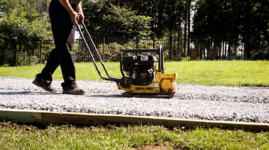
By washed stone, I mean crushed aggregate with the fines washed out of it. I would have to disagree with you on that...here's a photo we took at one of our jobs that definitely shows some compaction happening to lock the stone in place. You can see the difference between what's been hit by the compactor and what's still loose.Washed stone will not compact, it's physically impossible. Hell, it's hard enough to get 93% out of good asphalt on the highway, beatin' on it with five rollers!
jamesDC
Member
I should clarify...by "washed stone" I'm referring to crushed aggregate that has been washed of the 'fines'. It sounds like you're referring to real gravel or "river rock"...in that case you are correct that there is very little, if any, compaction.Washed, clean stone does "compact". .in the simplest of ways. . But it's very minimal at best. Due to the rounded nature of the particles, "compaction" efforts are more like particle alignment efforts. Think of marbles in a mason jar. The rounded surfaces always give you approximately the same void spacing, no matter how you stack them.
I'm always leary of using thick lifts of clean stone as a structural layer. If the clean stone becomes unconfined. . . The potential for settlement increases.
Also, in some situations I have seen water levels fluctuate with season. . the bring silts and clays into the voids of the clean stone. . Resulting in settlement issues. If using clean stone as a substitute for structural fill. . Be sure appropriate precautions are taken.
Cheepbeer: if they need 5 rollers to get 93% compaction on asphalt . . They might be doing it wrong... 93% is the minimum in my state. My customers have minimal issues with two rollers. Gravel or crushed stone.
jamesDC
Member
This is a still from the video at the end of this article if you want to see the compaction in real-time (skip to minute 22:30).By washed stone, I mean crushed aggregate with the fines washed out of it. I would have to disagree with you on that...here's a photo we took at one of our jobs that definitely shows some compaction happening to lock the stone in place. You can see the difference between what's been hit by the compactor and what's still loose.
The video is of a shed foundation install, but it's the same stone we use under concrete pads.
haveissues
Well-known member
Around here 3/4 minus is called item 4. When I prepped for my building I found a guy that had 'recycled' item 4. It's basically 3/4 minus made from the paver plant that did not make the cut. Item 4 is $20 a ton here, so about $30 a yard and I bought the recycled for $20 a yard delivered. Wet it, compacted it, and a few months later after my building was up I dug around the inside perimeter for foam. That stuff locked so tight it was difficult to dig.
NWOhioChevyGuy
Well-known member
I used 3/4 minus crusher run (Unwashed)
plate compacted with some water and it is firm and hard
paid $17.50/ton delivered here @ OH/MI line
plate compacted with some water and it is firm and hard
paid $17.50/ton delivered here @ OH/MI line