To avoid these ads, REGISTER NOW!

Grease Intermediate Steering Shaft (Not U-Joints)

YoshiMoshi3

Well-known member
Joined
Nov 2, 2022
Messages
506
Is there any benefit in adding grease where the two shafts meet, in the splines? In this area.
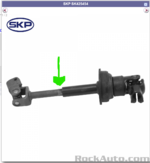
1721416807865.png
When I got a new part, it looked like there was some sort of clear grease on the splines, like silicone grease. I don't know if it is like a strut that allows it to expand and contact, in which case it's not a good idea to get grease or contaminants in there?

Let me know, and thanks.
 
To avoid these ads, REGISTER NOW!

2ndGearRubber

Well-known member
Joined
Mar 24, 2014
Messages
14,185
Location
Pittsburgh
Yes, it slides in and out, so it does have grease applied from the factory. Typically if its interior to the car it's just an exposed joint, no real issue or maintenance required. If it's exterior it typically has a wiping seal and again has no maintenance required.
 
OP
Y

YoshiMoshi3

Well-known member
Joined
Nov 2, 2022
Messages
506
Yes, it slides in and out, so it does have grease applied from the factory. Typically if its interior to the car it's just an exposed joint, no real issue or maintenance required. If it's exterior it typically has a wiping seal and again has no maintenance required.
Got it thanks. Periodically good to regrease than I guess after several years

Is there a specific tool to assist in forcing the part off of the power steering rack or the other end that connects to the steering wheel? Last time I attempted it seemed pretty much seized on the splines on the two ends where the part gets fastened to.
 

2ndGearRubber

Well-known member
Joined
Mar 24, 2014
Messages
14,185
Location
Pittsburgh
Got it thanks. Periodically good to regrease than I guess after several years

Is there a specific tool to assist in forcing the part off of the power steering rack or the other end that connects to the steering wheel? Last time I attempted it seemed pretty much seized on the splines on the two ends where the part gets fastened to.

Not really much need to regrease. It doesn't move very much at all - it's just their to make the column collapsible in a wreck and allow install. The one inside the car is just taking up the slack from the tilt of the wheel adjustment, the one outside the car is only absorbing the flex between the column mounting area to the rack/gearbox mounting area. Not much movement.


To disconnect a steering shaft that's inside the car, you can typically just rock it back and forth and it will come off. For connections outside the car I prefer to rattle them free with an air hammer.
 

jsaw

Well-known member
Joined
Oct 11, 2008
Messages
1,794
Location
Geneva, N.Y.
A few years ago GM had issues with intermediate steering shaft clunk. There was ever so slight of a clearance on the splines that You could barely feel, if You had the shaft in Your hands, but since the steering wheel was farther from the center of the shaft, You would feel/hear the clunk while turning and driving over bumps. At first the recommended removing the shaft and stroking it to redistribute the grease. It would fix it for a while. The next step they said to remove it from the vehicle and apply a special grease that they supplied. The kit came with a syringe of grease and a rubber stopper You used to plug the hole while You stroked the shaft to distribute the grease. After a year or so, the start clunking again. The next fix was to replace the shift.

Adding grease might be a good idea.
 
Last edited:

2ndGearRubber

Well-known member
Joined
Mar 24, 2014
Messages
14,185
Location
Pittsburgh
A few years ago GM had issues with intermediate steering shaft clunk. There was ever so slight of a clearance on the splines that You could barely feel, if You had the shaft in Your hands, but since the steering wheel was farther from the center of the shaft, You would feel/hear the clunk while turning and driving over bumps. At first the recommended removing the shaft and stroking it to redistribute the grease. It would fix it for a while. The next step they said to remove it from the vehicle and apply a special grease that they supplied. The kit came with a syringe of grease and a rubber stopper You used to plug the hole while You stroked the shaft to distribute the grease. After a year or so, the start clunking again. The next fix was to replace the shift.

Adding grease might be a good idea.

I've seen similar on driveshafts. Numerous brands have bulletins to retorque axle nuts or apply moly grease if an audible "click" occurs when changing from forward to reverse movement. Too much slop.

As you said the correct fix always ends up being a new shaft or wheel bearing, depending which is made of softer metal. I did this on more than a few hyundais with the issue, axle was softer so the hubs weren't damaged. So long as one member is sufficiently softer than the other it's not a huge deal, replace the one with the damage.

IIRC Ford had a similar issue on the ecoboost F150s, like the 1st gen, with the two piece driveshaft splines wearing. You could reassemble with new grease and get 6 months. When the customer's found the price of a new OEM driveshaft they universally decided any vibration or noise concern was no longer a concern.

IMO servicing the part isn't the solution. It's designed incorrectly and will fail as a result.
 

dchawk81

Well-known member
Joined
Jul 31, 2014
Messages
14,434
I would grease it a little because the slip joint on my semi seized up after 30 years and made it a nightmare to remove for new ujoints.
 

dchawk81

Well-known member
Joined
Jul 31, 2014
Messages
14,434
I've seen similar on driveshafts. Numerous brands have bulletins to retorque axle nuts or apply moly grease if an audible "click" occurs when changing from forward to reverse movement. Too much slop.

As you said the correct fix always ends up being a new shaft or wheel bearing, depending which is made of softer metal. I did this on more than a few hyundais with the issue, axle was softer so the hubs weren't damaged. So long as one member is sufficiently softer than the other it's not a huge deal, replace the one with the damage.

IIRC Ford had a similar issue on the ecoboost F150s, like the 1st gen, with the two piece driveshaft splines wearing. You could reassemble with new grease and get 6 months. When the customer's found the price of a new OEM driveshaft they universally decided any vibration or noise concern was no longer a concern.

IMO servicing the part isn't the solution. It's designed incorrectly and will fail as a result.
This logic doesn't make sense to me. You're saying don't bother to grease a moving part because you'll have to replace it eventually anyway if you don't grease it.

Do you take the same stance with greasable ball joints?

I would MUCH rather throw a little grease into a slip joint to keep it sliding than beat it with an air hammer later on down the line. Especially a relatively skinny steering shaft.
 

Junkdrawer Dog

Well-known member
Joined
Jan 14, 2019
Messages
1,460
Location
LV NV
I had a car that would develop a noticeable click when the steering shaft slip joint would dry out. I used spray type motorcycle chain lube on the splines to cure it. Get the kind that sprays on thin then sets up sticky. This allows it to penetrate into the splines. I was able to lube in place. No disassembly required.
 

2ndGearRubber

Well-known member
Joined
Mar 24, 2014
Messages
14,185
Location
Pittsburgh
This logic doesn't make sense to me. You're saying don't bother to grease a moving part because you'll have to replace it eventually anyway if you don't grease it.

Do you take the same stance with greasable ball joints?

I would MUCH rather throw a little grease into a slip joint to keep it sliding than beat it with an air hammer later on down the line. Especially a relatively skinny steering shaft.

No amount of grease is going to be able to be shoved past the wiping seal. Unless you mean attempting to disassemble the shaft, grease, and reassemble. It's not an inherently serviceable part like a zerk fitting. It's like trying to put grease into a sealed ujoint. Not all.of the shafts come apart either like a driveshaft.

If it's already making noise or having an issue, grease is a temporary bandaid.
 
To avoid these ads, REGISTER NOW!

2ndGearRubber

Well-known member
Joined
Mar 24, 2014
Messages
14,185
Location
Pittsburgh
This logic doesn't make sense to me. You're saying don't bother to grease a moving part because you'll have to replace it eventually anyway if you don't grease it.

Do you take the same stance with greasable ball joints?

I would MUCH rather throw a little grease into a slip joint to keep it sliding than beat it with an air hammer later on down the line. Especially a relatively skinny steering shaft.

Fwiw the air hammer isn't to make it slide, that's always easy. They don't really ever bind up.

The air hammer is to break the rusty spline connection to the gearbox or another shaft. A good wiggle gets them moving freely on non rusted interior connections.
 

PMD1966

Well-known member
Joined
Dec 26, 2013
Messages
182
Location
Lake Orion, Michigan
A few years ago GM had issues with intermediate steering shaft clunk. There was ever so slight of a clearance on the splines that You could barely feel, if You had the shaft in Your hands, but since the steering wheel was farther from the center of the shaft, You would feel/hear the clunk while turning and driving over bumps. At first the recommended removing the shaft and stroking it to redistribute the grease. It would fix it for a while. The next step they said to remove it from the vehicle and apply a special grease that they supplied. The kit came with a syringe of grease and a rubber stopper You used to plug the hole while You stroked the shaft to distribute the grease. After a year or so, the start clunking again. The next fix was to replace the shift.

Adding grease might be a good idea.
I had that problem with a GMC pick-up. After 2 trips to the dealer, I drilled and tapped a hole in the outside part of the shaft. I installed a grease fitting. When the clunk came back, I would open the hood and insert some grease. Quicker than a trip to the dealer.
 
OP
Y

YoshiMoshi3

Well-known member
Joined
Nov 2, 2022
Messages
506
Thanks for the feedback, I just put some silicone grease on it.

Why is it that people say to use silicone based grease instead of petroleum based, for example when greasing guide pins, when coming into contact with rubber products, like bushing on guide pins.

But then on ball joints, which have a rubber boot, people don't use silicone grease, but petroleum based grease?

Does anyone know how to disassemble the u joints here from the yokes?
1721522077673.png
There appears to be no snap rings to remove that are visible from the outside, just four indented pieces of metal, one every 90 degrees
 

david3921

Well-known member
Joined
Apr 22, 2014
Messages
445
Location
Wyoming, Michigan
They aren't ment to be disassembled, just replaced as an assembly. I worked on a relative's Toyota Avalon where the joint came apart and the needle bearings fell out. The assembly had to be replaced. There weren't U joints available even if we were able to get it apart.
 

2ndGearRubber

Well-known member
Joined
Mar 24, 2014
Messages
14,185
Location
Pittsburgh
They're staked u-joints, essentially unservicable unless you can modify the shaft to accept another joint and add a retention method. Buy a shaft for what that would cost to engineer.

Certain types of rubber will not accept exposure to petroleum based greases. Some brands, like toyota, will have the slide pin rubber puff up like a balloon from this. Thus silicone grease. Ball joints and ujoints I have never seen or heard of anyone having such an issue. If the joint is not serviceable with a zerk, then it really doesn't matter what kind of rubber they use. I've seen some cheap end-links have reaction issues to oil leaks contacting the rubber boots. For greaseable joints most chassis/HP grease has a petroleum component so I imagine they simply spec a sufficient material for the boot.
 
OP
Y

YoshiMoshi3

Well-known member
Joined
Nov 2, 2022
Messages
506
Hey thanks. Is there anyway to force grease into this type of u joints without zerk fittings?

Ball joints you can puncture the boot and use a needle adapter for a grease gun.

For exposed bearings you can force grease by hand packing.

Anyway to add grease to the needle bearings in a u joints without a zerk fitting?
 
OP
Y

YoshiMoshi3

Well-known member
Joined
Nov 2, 2022
Messages
506
What about drilling a hole towards the end of the shaft for a zerk? Than I can grease the telescoping shaft that way, and ensure it gets completely greased up?
 
To avoid these ads, REGISTER NOW!
Top Bottom