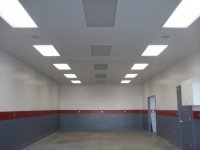
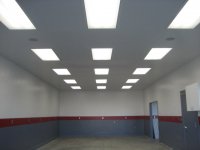
Here is the part in the article on lighting efficiency, I would suggest that people re-read it. If you aren't going to be doing woodworking or something else dusty, you can multiply the number of lights needed by 0.8.
ESTIMATING HOW MANY FIXTURES ARE NEEDED
The first step is to decide what lighting level you want. As previously noted I recommend 100 footcandles unless you are under the age of 25 and will be performing work that is not demanding and is easy to see. If that’s the case you may get by with 50 fc or less. Since 100 fc is a more common recommendation that is the value we will use in this example.
Next let’s calculate how many lamps will be needed using the simplified rule of thumb method which says that 50% of the fixture lumens will reach the work plane when installing open fixtures like strips or industrials in rooms with fairly light colored ceilings and walls. If using enclosed fixtures, which I generally don’t recommend for shops, the figure is closer to 40%. Why only 50%? There are several reasons. First, not all of the light gets out of the fixture. Some hits fixture surfaces where it is absorbed and lost. Some light hits the walls and other building surfaces where it, too can be absorbed. That loss can easily be 25% or more. And over time the light output of a fluorescent lamp decreases due to a deterioration of the light producing phosphors and a buildup of tungsten which evaporates from the cathodes and deposits on the bulb wall. On average we can expect the typical T8 system to lose 10% to 15% of its initial output due to depreciation within the lamp.
Another significant loss occurs from the buildup of dirt on fixture and lamp surfaces. If you doubt this simply wipe a lamp that has been operating in a workshop for a year or more with a white cloth. Over time you can easily lose an additional 10% to 20% even in a relatively clean shop. Dirt accumulation on walls and ceilings accounts for additional losses.