Hi,
A number of you have asked us via PM or by calling about grinding and prep advice so we thought we would repost some helpful info. We also own a large surface prep company so we have real-world experience with prep work.
Generally for a standard, non sealed, non coated bare concrete floor acid etching works just fine. We have tens of thousands of our Armorclad Kits installed this way with excellent results.
If your floor has a sealer, previous coating or other issue, then mechanical surface prep is a good idea.
At the less expensive end of the spectrum is renting a Diamabrush from a rental place or Home Depot. These pads have spring mounted diamond pads on them and fit on a floor buffer. They work well for scratching up and profiling the floor, but do very little 'grinding' easily. There isn't enough downward weight to grind much. They also can be hard to control, and unless you make a dust shroud, create tons of dust. Photos of the Diamabrush pads vs. standard diamond pads are below. Make sure if you rent to check the usage and age of the pads as only the edge gets much use and they tend to wear out fast, so need changing often. Don't rent an old beat up set.
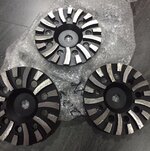
The next step is using an actual diamond floor grinder. These can usually be rented from tool rental stores and some home centers. They are heavier, have dust shrouds, and use much larger diamond pads that are thick and wear down evenly so as they wear new diamonds are exposed so a set that is half worn down is just as good as a brand new set, unlike Diamabrush diamonds. Hard concrete should use 'soft bond' tooling as the metal wears away faster exposing the more diamonds. Soft older concrete should use 'hard bond' tooling which wears slower keeping the diamonds exposed properly and not prematurely wearing out. Diamond floor grinders attach to vacuums that should be designed for this usage, as inexpensive shop vacs will plug up fast and you will lose suction and have a very dusty job. Try to rent the proper vac with a grinder. Examples of diamond floor grinder tooling pads a re shown below. They come in different grits from very aggressive to super fine used for concrete floor polishing. For general use a #40 or #80 works well. Finally the much higher downward weight of a grinder allows for more actual grinding and smoothing to get accomplished.
We don't recommend shot blasting in a garage since these are very aggressive and in the hands of a novice user can create a lot of damage.
Lastly if you mechanically prep we strongly urge the use of epoxy primer as prepping makes the floor more porous, so it needs priming with the appropriate matched primer so that the expensive epoxy doesn't soak in and leave an uneven, blotchy result.
We hope this is helpful. Please email us at [email protected] if we can assist further. Many thanks!
A number of you have asked us via PM or by calling about grinding and prep advice so we thought we would repost some helpful info. We also own a large surface prep company so we have real-world experience with prep work.
Generally for a standard, non sealed, non coated bare concrete floor acid etching works just fine. We have tens of thousands of our Armorclad Kits installed this way with excellent results.
If your floor has a sealer, previous coating or other issue, then mechanical surface prep is a good idea.
At the less expensive end of the spectrum is renting a Diamabrush from a rental place or Home Depot. These pads have spring mounted diamond pads on them and fit on a floor buffer. They work well for scratching up and profiling the floor, but do very little 'grinding' easily. There isn't enough downward weight to grind much. They also can be hard to control, and unless you make a dust shroud, create tons of dust. Photos of the Diamabrush pads vs. standard diamond pads are below. Make sure if you rent to check the usage and age of the pads as only the edge gets much use and they tend to wear out fast, so need changing often. Don't rent an old beat up set.
The next step is using an actual diamond floor grinder. These can usually be rented from tool rental stores and some home centers. They are heavier, have dust shrouds, and use much larger diamond pads that are thick and wear down evenly so as they wear new diamonds are exposed so a set that is half worn down is just as good as a brand new set, unlike Diamabrush diamonds. Hard concrete should use 'soft bond' tooling as the metal wears away faster exposing the more diamonds. Soft older concrete should use 'hard bond' tooling which wears slower keeping the diamonds exposed properly and not prematurely wearing out. Diamond floor grinders attach to vacuums that should be designed for this usage, as inexpensive shop vacs will plug up fast and you will lose suction and have a very dusty job. Try to rent the proper vac with a grinder. Examples of diamond floor grinder tooling pads a re shown below. They come in different grits from very aggressive to super fine used for concrete floor polishing. For general use a #40 or #80 works well. Finally the much higher downward weight of a grinder allows for more actual grinding and smoothing to get accomplished.
We don't recommend shot blasting in a garage since these are very aggressive and in the hands of a novice user can create a lot of damage.
Lastly if you mechanically prep we strongly urge the use of epoxy primer as prepping makes the floor more porous, so it needs priming with the appropriate matched primer so that the expensive epoxy doesn't soak in and leave an uneven, blotchy result.
We hope this is helpful. Please email us at [email protected] if we can assist further. Many thanks!
Attachments

Last edited: