To avoid these ads, REGISTER NOW!

Ground rods and wire for shop

Codyboy

Well-known member
Joined
Jan 31, 2019
Messages
1,726
Location
S.E. TEXAS
I will be installing power to my shop. All steel shop.

I bought 2, 8ft ground rods that I will install. How far apart should the ground rods be ?

I also bought lugs to attach to the building steel.

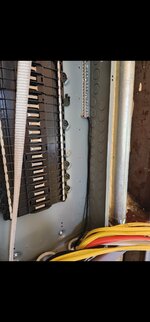
My plan is to come out of the panel (separate ground bar and not the neutral bar) hit the lug screwed into the I beam , then outside to the ground rod.
Do both need to hit a lug on the I beam or is one good. It was a 2 pack. But whatever.

Ground wire will be #6
 

Attachments

  • Screenshot_20250709_184212_Gallery.jpg
    Screenshot_20250709_184212_Gallery.jpg
    673.7 KB · Views: 75
To avoid these ads, REGISTER NOW!

mm08822

Well-known member
Joined
Jan 13, 2012
Messages
6,061
Location
NJ
You could run the gec out of the panel through the ground lug tapped in to the building steel and proceed through the sheathing to each ground rod. I try pass the gec through the first ground rod connector and then attach it directly to the 2nd rod.

Rods should be a minimum of 6' apart. More is ok.
 
OP
C

Codyboy

Well-known member
Joined
Jan 31, 2019
Messages
1,726
Location
S.E. TEXAS
You could run the gec out of the panel through the ground lug tapped in to the building steel and proceed through the sheathing to each ground rod. I try pass the gec through the first ground rod connector and then attach it directly to the 2nd rod.

Rods should be a minimum of 6' apart. More is ok.
Ok. Yes I was thinking out of the panel, tap the lug on the building steel then outside to the ground rod.
So you're saying i can use one GEC out to hit both ground rods?
I was thinking I needed 2 GECs out , one for each ground rod.
I was also thinking to have the ground rods 20 ft apart.
He'll idk. I'm just a retired lineman.

/ plumber/electrician/homeowner/ trim carpenter/AC installer/ everything else . Lol

As a lineman I never payed much attention to the sparky side of things other than it was wired correctly and the customer had a ground rod down.
Eta. Before the meter. I never cared what was after the meter mostly. Unless it was something obviously unsafe.
 

mm08822

Well-known member
Joined
Jan 13, 2012
Messages
6,061
Location
NJ
Ok. Yes I was thinking out of the panel, tap the lug on the building steel then outside to the ground rod.
So you're saying i can use one GEC out to hit both ground rods?
I was thinking I needed 2 GECs out , one for each ground rod.
I was also thinking to have the ground rods 20 ft apart.
He'll idk. I'm just a retired lineman.

/ plumber/electrician/homeowner/ trim carpenter/AC installer/ everything else . Lol

As a lineman I never payed much attention to the sparky side of things other than it was wired correctly and the customer had a ground rod down.
Eta. Before the meter. I never cared what was after the meter mostly. Unless it was something obviously unsafe.
Yup, only 1 gec to the first rod needed. The second rod can either be through an extension from the conductor used for the first rod or a completely separate jumper between the 2 rods.

20' apart is fine.

No doubt about the rest.
 

Torque&Recoil

Well-known member
Joined
Dec 13, 2015
Messages
435
Location
NE Ohio
I'm no sparky, but I'm pretty sure that one wire is fine. At least, that's how my place is done. 20' spacing is not required, but heck, probably a lot better than 6'. OK - seriously - grounding effectiveness depends a lot on the soil. I used to work a bit in S.W. TX, and you're in a pretty dry state. Which means non-conductive. I think your idea of a wider spacing is a good idea. Where you live, the rods are probably much more important than the wire. Just my opinion.
 

BillK

Well-known member
Joined
Aug 24, 2006
Messages
9,368
Location
Beautiful Southern Maryland
I just want to add that bottom line whatever you do will need to be approved by your local inspector. I would call him and ask him which way he wants it. 50 people on the internet can tell you how they would do it but that really does not matter. The inspector has to be happy with it. Period.
 

mike93lx

ALLIANCE MEMBER
Joined
Dec 9, 2013
Messages
37,961
Location
Richmond, VA
I just want to add that bottom line whatever you do will need to be approved by your local inspector. I would call him and ask him which way he wants it. 50 people on the internet can tell you how they would do it but that really does not matter. The inspector has to be happy with it. Period.
The inspector needs to follow code. What they want doesn't really matter.

I'm not saying go to war with an inspector, but I don't get the angle of worrying about what they "want"
 

BillK

Well-known member
Joined
Aug 24, 2006
Messages
9,368
Location
Beautiful Southern Maryland
The inspector needs to follow code. What they want doesn't really matter.

I'm not saying go to war with an inspector, but I don't get the angle of worrying about what they "want"
Because there might be different local codes that we don't know about. And as much as nobody wants to "go to war" with the inspector, it makes life a lot easier if you know what they want.
 

mike93lx

ALLIANCE MEMBER
Joined
Dec 9, 2013
Messages
37,961
Location
Richmond, VA
Because there might be different local codes that we don't know about. And as much as nobody wants to "go to war" with the inspector, it makes life a lot easier if you know what they want.
Those codes should be documented and readily available.

Asking an inspector about local code modifications is different than asking what he wants.
 

reader2580

Well-known member
Joined
Dec 31, 2014
Messages
14,571
Location
Minneapolis, MN
A lot of the NEC is open to interpretation by the inspector.

My understanding, which may be wrong, is that the wire to the ground rods needs to be continuous. I run from the panel or service entrance to the first ground rod to the second ground with a continuous wire.
 
OP
C

Codyboy

Well-known member
Joined
Jan 31, 2019
Messages
1,726
Location
S.E. TEXAS
We don't have inspections or an AHJ around here for unincorporated areas.
But I will follow what was recommended here.
Thanks
 

mike93lx

ALLIANCE MEMBER
Joined
Dec 9, 2013
Messages
37,961
Location
Richmond, VA
If you don't already own a Sds demo hammer, this would be a good project to either rent or buy one. Makes it way easier to install rods.

You can buy them pretty cheap on amazon

Also, you can use your trench to get a head start on the rod install. 2' less of driving can help a lot in hard or rocky soil
 

Chuckster in NJ

Well-known member
Joined
Jan 26, 2010
Messages
2,326
Location
Hunterdon County NJ
A lot of the NEC is open to interpretation by the inspector.
TOTAL BS! ^
Open up the NEC and read it because the code is clearly written and there are no "gray areas" and don’t forget that ALL codes are minimum standards.
I use to hear all the time "That’s your interpretation and NOT the code" and I would say "OK, then let’s read the code and read it together" and the genius would reply "I don’t have a code book" or "I have done it that way for 20 years" or "my friend is a Union electrician and he told me that this is code"….. I always wrote the code section on failure notices.

An inspector is there to enforce the adopted code and not make up his/her own standards or tell you how to do the work. In NJ we have a state wide uniform construction code so no matter where you work in the state it is the same code……… Any licensed inspector who wants to play games making up "fake codes" or not enforcing the code will get a visit from NJ regulatory affairs and they will straighten them out.

My best advice is to open the code book and read it instead of getting your information off Internet forums.…… Tons of misinformation on the net.
 

mike93lx

ALLIANCE MEMBER
Joined
Dec 9, 2013
Messages
37,961
Location
Richmond, VA
TOTAL BS! ^
Open up the NEC and read it because the code is clearly written and there are no "gray areas" and don’t forget that ALL codes are minimum standards.
I use to hear all the time "That’s your interpretation and NOT the code" and I would say "OK, then let’s read the code and read it together" and the genius would reply "I don’t have a code book" or "I have done it that way for 20 years" or "my friend is a Union electrician and he told me that this is code"….. I always wrote the code section on failure notices.

An inspector is there to enforce the adopted code and not make up his/her own standards or tell you how to do the work. In NJ we have a state wide uniform construction code so no matter where you work in the state it is the same code……… Any licensed inspector who wants to play games making up "fake codes" or not enforcing the code will get a visit from NJ regulatory affairs and they will straighten them out.

My best advice is to open the code book and read it instead of getting your information off Internet forums.…… Tons of misinformation on the net.
"subject to damage" and workmanship clauses are legit grey areas.
 

Chuckster in NJ

Well-known member
Joined
Jan 26, 2010
Messages
2,326
Location
Hunterdon County NJ
"subject to damage" and workmanship clauses are legit grey areas.
VERY TRUE! ^
I use to get complaints from contractors about other contractors who did ****** work and they would say "I don’t know why you passed them because their workmanship is horrible!"…….. I would tell them that they do ****** work and that is THEIR standard of workmanship and not mine.
The "workmanship" is something that is never enforced because it is an ugly world out there and I don’t know any inspector who "writes" that one.…….. Hell, even the over zealous code Nazis don’t enforce it.

"Subject to damage" is simple……. Is the wiring or equipment "easily damaged" by normal every day living. EG: Opening car doors in a garage, running wires across "cat walks" in an attic, service equipment adjacent to a side walk or driveway to name a few.
 

SouthernIllinois

Well-known member
Joined
Jan 14, 2024
Messages
1,701
I had a pole barn built last year and had to move the meter that supplies the house and the new pole barn.

The meter is now much closer to the pole barn.

Had a licensed electrician do the electrical work.

He only put one ground rod about 4’ from the new free-standing meter.

Is that a problem?

I live in an unincorporated, rural area. No permits or inspections.
 

mm08822

Well-known member
Joined
Jan 13, 2012
Messages
6,061
Location
NJ
Unless he proved there was 25 ohms or less to ground, then it is not meeting current code.

Easy enough to drive a second rod 6+ feet away from the first and add a jumper between them.

Call him back!

Added:
Does the house and barn each have 2 ground rods driven?
 
Last edited:
To avoid these ads, REGISTER NOW!

mike93lx

ALLIANCE MEMBER
Joined
Dec 9, 2013
Messages
37,961
Location
Richmond, VA
Subject to damage" is simple……. Is the wiring or equipment "easily damaged" by normal every day living. EG: Opening car doors in a garage, running wires across "cat walks" in an attic, service equipment adjacent to a side walk or driveway to name a few.
Its simple until it's not... Your lists shows how subjective it can be.

How about leaning something tall against a wall? The bike that you have on a hoist in the garage? Tall shelving.
 

SouthernIllinois

Well-known member
Joined
Jan 14, 2024
Messages
1,701
Unless he proved there was 25 ohms or less to ground, then it is not meeting current code.

Easy enough to drive a second rod 6+ feet away from the first and add a jumper between them.

Call him back!

Added:
Does the house and barn each have 2 ground rods driven?
I don’t know about the house but I know the barn only has one.
 

reader2580

Well-known member
Joined
Dec 31, 2014
Messages
14,571
Location
Minneapolis, MN
Its simple until it's not... Your lists shows how subjective it can be.

How about leaning something tall against a wall? The bike that you have on a hoist in the garage? Tall shelving.
Some inspectors will say anything above eight feet in a garage is not "subject to damage". Others will require anything exposed in a garage be protected from damage.

Workmanship is a huge one where the inspector decides what passes.
 

Chuckster in NJ

Well-known member
Joined
Jan 26, 2010
Messages
2,326
Location
Hunterdon County NJ
Its simple until it's not... Your lists shows how subjective it can be.

How about leaning something tall against a wall? The bike that you have on a hoist in the garage? Tall shelving.
Simple! Everything was "good" when I was there……. "WHAT IF" is not in the code and we can’t regulate what an idiot would do.
EG: Wiring in a basement becomes a clothing hanging rack, the furnace draft works great for a quick spray paint job. 🤪
 

wyliesdiesels

Well-known member
Joined
Aug 14, 2012
Messages
20,089
Location
Modesto, CA
I just want to add that bottom line whatever you do will need to be approved by your local inspector. I would call him and ask him which way he wants it. 50 people on the internet can tell you how they would do it but that really does not matter. The inspector has to be happy with it. Period.
the inspector cannot make you do something that isnt NEC code or a local WRITTEN amendment. has nothing to do with making the inspector happy. dont bend over for the inspector

several people have already stated the code permissive method for installing a GEC.
 

wyliesdiesels

Well-known member
Joined
Aug 14, 2012
Messages
20,089
Location
Modesto, CA
A lot of the NEC is open to interpretation by the inspector.
incorrect. almost all of the NEC is pretty clear. inspectors like to interpret things and make up their own code but that can land them in hot water.
My understanding, which may be wrong, is that the wire to the ground rods needs to be continuous. I run from the panel or service entrance to the first ground rod to the second ground with a continuous wire.
to the first rod yes, to the second no.
 
OP
C

Codyboy

Well-known member
Joined
Jan 31, 2019
Messages
1,726
Location
S.E. TEXAS
Ok thats done. GEC from Ground bar down to the steel I-beam and tapped with that copper lug in the op. Lug is through bolted with a 1/4-20 with washers (scraped the mill scale before bolting it on). From there drilled through the metal siding and hit the first ground rod, then the 2nd ground rod 16ft away. One continuous wire.
 

Attachments

  • Screenshot_20250710_123930_Gallery.jpg
    Screenshot_20250710_123930_Gallery.jpg
    1.1 MB · Views: 59
  • Screenshot_20250710_123948_Gallery.jpg
    Screenshot_20250710_123948_Gallery.jpg
    1.1 MB · Views: 56
  • Screenshot_20250710_124013_Gallery.jpg
    Screenshot_20250710_124013_Gallery.jpg
    1.6 MB · Views: 68

JohnX14

Well-known member
Joined
Jun 2, 2014
Messages
614
Location
Boston 'burbs
TOTAL BS! ^
Open up the NEC and read it because the code is clearly written and there are no "gray areas" and don’t forget that ALL codes are minimum standards.
I use to hear all the time "That’s your interpretation and NOT the code" and I would say "OK, then let’s read the code and read it together" and the genius would reply "I don’t have a code book" or "I have done it that way for 20 years" or "my friend is a Union electrician and he told me that this is code"….. I always wrote the code section on failure notices.

An inspector is there to enforce the adopted code and not make up his/her own standards or tell you how to do the work. In NJ we have a state wide uniform construction code so no matter where you work in the state it is the same code……… Any licensed inspector who wants to play games making up "fake codes" or not enforcing the code will get a visit from NJ regulatory affairs and they will straighten them out.

My best advice is to open the code book and read it instead of getting your information off Internet forums.…… Tons of misinformation on the net.
I agree with most of this statement. I was actually going to reply similarly until I read this. But it's not all black and white. A lot of highly qualified code experts disagree on occasion. But I'd say/ agree that most of the gray areas you mention are due to people not reading or understanding the NEC.
 

nadogail

Well-known member
Joined
Jan 23, 2009
Messages
32,061
Location
Coronado, CA
I agree with most of this statement. I was actually going to reply similarly until I read this. But it's not all black and white. A lot of highly qualified code experts disagree on occasion. But I'd say/ agree that most of the gray areas you mention are due to people not reading or understanding the NEC.
IMHO, A code book at the job site is a requirement.

Don't get into a argument with the Inspectors, a P.O.'d Inspector can make your life miserable; i might ask them to explain a requirement and suggest an alternative, but I have learned that cooperating wins.
 

Chuckster in NJ

Well-known member
Joined
Jan 26, 2010
Messages
2,326
Location
Hunterdon County NJ
IMHO, A code book at the job site is a requirement.

Don't get into a argument with the Inspectors, a P.O.'d Inspector can make your life miserable; i might ask them to explain a requirement and suggest an alternative, but I have learned that cooperating wins.
These are a must have tool for code "debates" with the inspector or co workers……….. Small and very handy that fits into your glove box.

TIP! NEVER be a "code genius" without a code book available and know how to use it.
IMG_2988.jpeg
 

sparky 1971

Well-known member
Joined
Oct 9, 2018
Messages
8,027
Location
Central Iowa
I can't remember how it's worded but in the ordinances we have it basically says the inspector is always right so even if he's wrong, there's no point in arguing. I've never had a problem with them and have only had one failed inspection that was my fault. Once again, I wasn't paying enough attention at the update class and I was dinged for not having WR receptacles outside, something I didn't know even existed at the time.
 

Cruzan80

Well-known member
Joined
Jul 22, 2015
Messages
4,327
Location
Denver, CO
Only inspection I have had fail (not my work, but contractors) was because the disconnect they used had breakers, and the documentation on the mini-split only had the word "fuse". So even though it was the same amperage, he wanted them to swap it. Called them up, an hr later and they were done

When I asked the inspector for details (not argumentative, just learning), he said that he had to match the manufacturer's instructions and because they didn't say fuse or breaker, he had to go with what was listed. Guessing it has to do with fault level/speed?
 

reader2580

Well-known member
Joined
Dec 31, 2014
Messages
14,571
Location
Minneapolis, MN
The electrical inspector my city contracted with in 2016/2017 refused to allow homeowners to install their own solar systems. The state allows homeowners to do their own electrical, including solar. I could have pursued things further with the state, but I didn't want to ruin my relationship with the electrical inspector. Someone I know is an electrician in the solar trade so he did the electrical portion of my solar system for really, really cheap. He made some extra money by selling me surplus solar supplies he had been allowed to take home over the years.

The inspector retired, and the new guy allowed me to do my own solar. I failed for my inspection, for the only time ever, because I didn't have enough conduit clamps. Nothing was wired wrong.
 

wyliesdiesels

Well-known member
Joined
Aug 14, 2012
Messages
20,089
Location
Modesto, CA
Only inspection I have had fail (not my work, but contractors) was because the disconnect they used had breakers, and the documentation on the mini-split only had the word "fuse". So even though it was the same amperage, he wanted them to swap it. Called them up, an hr later and they were done

When I asked the inspector for details (not argumentative, just learning), he said that he had to match the manufacturer's instructions and because they didn't say fuse or breaker, he had to go with what was listed. Guessing it has to do with fault level/speed?
Breakers and fuses trip/blow at different rates

Fuses were required because they provided the correct protection for the unit
 
To avoid these ads, REGISTER NOW!
Top Bottom