To avoid these ads, REGISTER NOW!

Grounding Electrical Service Question

jmd4j

New member
Joined
May 20, 2014
Messages
3
Good morning All,

I had a quick question. I tried running this by my utility company and electrician, but can't seem to reach them yet this morning.

I am installing 200 amp service onto an old cabin, but the service later on will be ran to a tractor shed...but I needed to go ahead and get the service put in at this location. I have a question on grounding. I am using an outdoor breaker box, which is installed just under the meter base. I am confused on which box...or both, is connected to the grounding rod.

Do I
1. Bond the meter base (ground AND neutral that is coming in from the underground service), to the ground/neutral bar in the breaker box then on to the grounding rod.
2. Bond only the meter base (ground AND neutral) to the grounding rod.
3. Bond only the grounding and neutral bar from the breaker box, to the grounding rod since the neutral is attached to the ground/neutral bus in the box anyway.

I attached a pic with scenario 1 drawn out that I mentioned above.

I am waaay overthinking and confusing myself, so I thought I'd ask here first since I can't seem to reach anyone here at this time.

Thanks!!
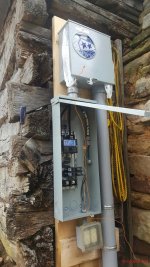
 

Attachments

  • 20161227_105006.jpg
    20161227_105006.jpg
    153.2 KB · Views: 107
To avoid these ads, REGISTER NOW!

tyme2par4

Well-known member
Joined
May 16, 2016
Messages
571
Location
NH
Only the meter base should be connected to the ground rod. Only the neutral from the meter base should be connected to the neutral in the panel. The ground and neutral bars in the panel should be bonded inside the panel. In your case, it looks like you only have 1 bar, so just make sure it is bonded to the panel box itself.
 

wyliesdiesels

Well-known member
Joined
Aug 14, 2012
Messages
19,983
Location
Modesto, CA
Good morning All,

I had a quick question. I tried running this by my utility company and electrician, but can't seem to reach them yet this morning.

I am installing 200 amp service onto an old cabin, but the service later on will be ran to a tractor shed...but I needed to go ahead and get the service put in at this location. I have a question on grounding. I am using an outdoor breaker box, which is installed just under the meter base. I am confused on which box...or both, is connected to the grounding rod.

Do I
1. Bond the meter base (ground AND neutral that is coming in from the underground service), to the ground/neutral bar in the breaker box then on to the grounding rod.
2. Bond only the meter base (ground AND neutral) to the grounding rod.
3. Bond only the grounding and neutral bar from the breaker box, to the grounding rod since the neutral is attached to the ground/neutral bus in the box anyway.

I attached a pic with scenario 1 drawn out that I mentioned above.

I am waaay overthinking and confusing myself, so I thought I'd ask here first since I can't seem to reach anyone here at this time.

Thanks!!

Only the meter base should be connected to the ground rod. Only the neutral from the meter base should be connected to the neutral in the panel. The ground and neutral bars in the panel should be bonded inside the panel. In your case, it looks like you only have 1 bar, so just make sure it is bonded to the panel box itself.

Actually that all depends on the PoCo. Some allow the grounding electrode conductor to be terminated in the meter base others do not.

Since the OP cant get ahold of the PoCo the safest bet is to terminate the GEC on the neutral bar in the panel. Either location will work fine.

ALso, 2 rods are required unless 25 ohms or less to earth can be proven.
 

joel63

Well-known member
Joined
Oct 9, 2012
Messages
1,907
Location
Central FL
Actually that all depends on the PoCo. Some allow the grounding electrode conductor to be terminated in the meter base others do not.

Since the OP cant get ahold of the PoCo the safest bet is to terminate the GEC on the neutral bar in the panel. Either location will work fine.

ALso, 2 rods are required unless 25 ohms or less to earth can be proven.


How is the 25 ohms measured/proved?
 

Infinia

Banned
Joined
Oct 2, 2016
Messages
845
Location
SoCal
[/COLOR]

How is the 25 ohms measured/proved?
25 ohms from here to china:lol_hitti
electricians don't know so they double up, but IMO that's unlikely to meet spec if 2 are badly done.

that panel cabling looks mighty small for 200A, future upgades will be planned by going into the PoCo meter housing?
 
Last edited:

rockwithjason

Well-known member
Joined
Jan 8, 2006
Messages
2,633
Location
Las Vegas
[/COLOR]

How is the 25 ohms measured/proved?

an earth ground resistance test is performed. the equipment is expensive so its much cheaper and easier to run two rods connected with an unbroken length of solid copper wire, usually #6.
 

Infinia

Banned
Joined
Oct 2, 2016
Messages
845
Location
SoCal
an earth ground resistance test is performed. the equipment is expensive so its much cheaper and easier to run two rods connected with an unbroken length of solid copper wire, usually #6.
why? I could do a test easy. Connect a power supply between two identically driven rods.
measured voltage drop divided by 2x the measured current for an average resistance per rod. Of course this measured value depends on distance, the time year, other variables mostly soil type and moisture. A couple of tests in your areas soil will gain confidence to drive a single rod.
 
Last edited:

Norcal

Well-known member
Joined
Mar 16, 2008
Messages
13,751
why? I could do a test easy. Connect a power supply between two identically driven rods.
measured voltage drop divided by 2x the measured current for an average resistance per rod. Of course this measured value depends on distance, the time year, other variables mostly soil type and moisture. A couple of tests in your areas soil will gain confidence to drive a single rod.

Not going to pass muster from inspection authorities, you need proper test equipment & need to be qualified to use the testing equipment, way cheaper & easier to drive a 2nd rod & be done with it.
 
OP
J

jmd4j

New member
Joined
May 20, 2014
Messages
3
Thanks for everyone's replies. I went ahead and drove in two grounding rods with at least the minimum distance between the two per code, and left enough of the bare wire to terminate at either box. Hopefully I'll be in contact with the PoCo tomorrow.

The panel cabling from the meter socket lugs to breaker box is 2/0 copper. I do not for see ever needing anything more. This will never be lived in and very rarely used, so it should be plenty. I know everyone always says that never thinking they will expand, but I highly doubt I will ever at this location. I have seperate service about 200 feet away anyway if the need ever arises.

Sent from my SM-N920V using Tapatalk
 

mm08822

Well-known member
Joined
Jan 13, 2012
Messages
5,847
Location
NJ
why? I could do a test easy. Connect a power supply between two identically driven rods.
measured voltage drop divided by 2x the measured current for an average resistance per rod. Of course this measured value depends on distance, the time year, other variables mostly soil type and moisture. A couple of tests in your areas soil will gain confidence to drive a single rod.

Aside from the cost of the test equipment, a validated procedure needs to be followed. There needs to be documentation for the correct set-up, a witness for the test, proof of operator training, and current calibration certificates submitted for the test equipment. This was told to me by an inspector - without all of this don’t waste his time or your own.

So by the time you get all of that done and paid for, another rod and 6 ft more of copper is the way to go. If by the above method you test out at more than 25 ohms, then you still have to remediate to get it below 25 and show successful retest. So, driving a second rod is the quickest way to be done with the job and have no second guessing. This is an exception in the code that gives everyone an easy way out.
 
To avoid these ads, REGISTER NOW!

wyliesdiesels

Well-known member
Joined
Aug 14, 2012
Messages
19,983
Location
Modesto, CA
Thanks for everyone's replies. I went ahead and drove in two grounding rods with at least the minimum distance between the two per code, and left enough of the bare wire to terminate at either box. Hopefully I'll be in contact with the PoCo tomorrow.

The panel cabling from the meter socket lugs to breaker box is 2/0 copper. I do not for see ever needing anything more. This will never be lived in and very rarely used, so it should be plenty. I know everyone always says that never thinking they will expand, but I highly doubt I will ever at this location. I have separate service about 200 feet away anyway if the need ever arises.

Sent from my SM-N920V using Tapatalk

Is this service for a dwelling?

What is the main breaker size? 200a

If 200a and its NOT for a dwelling then 2/0 CU is too small for 200a.

U will need 3/0 to be up to code.
 
Last edited:

Infinia

Banned
Joined
Oct 2, 2016
Messages
845
Location
SoCal
So, driving a second rod is the quickest way to be done with the job and have no second guessing. This is an exception in the code that gives everyone an easy way out.[/COLOR]
I can see this debated in the code adoption meetings already.
good stuff... fingers crossed, practical intelligence loses :bowdown:

Still no one has answered the question how is the ground tested? They should made that more easy to validate, rather than compromising the purpose of the whole thing.
 
Last edited:

Infinia

Banned
Joined
Oct 2, 2016
Messages
845
Location
SoCal
thanks for the link, the author doesn't explain why there is only one way to make a measurement. this article is mumble jumble speak, where's the beef? No wonder everybody's confused and he's not helping, read below excepts of the link.
Impact of power quality. Believe it or not, nearly all electronic equipment will operate properly without the benefit of a low-resistance GES.

yes we all know this, this is not the purpose of earth grounding on the customers PoE receiving end. . I assume "power quality" is defined as lower numbers of customer complaints? Power surges can still happen w/o an earths reference on this end.
Power quality site surveys have shown that in situations where the grounding electrode resistance is between 5 ohms and 105 ohms, it doesn't affect equipment. However, you can trace most problems to poor quality connections on the equipment-grounding system. Therefore, you should pay less attention to the GES measurement and more to the impedance of the equipment-grounding system and the verification of low-resistance bonding connections between grounding planes
Where are these grounding planes and what about grounding rods, are they not the connections in lieu of planes. This summary sounds contradictory to my level. I will research >fall-of-potential method with a three-terminal, earth ground resistance tester
 
Last edited:

mm08822

Well-known member
Joined
Jan 13, 2012
Messages
5,847
Location
NJ
why cant you, the user of the code?

Why would I even think of wasting my time trying to recall something explained to me from many years ago that I'm sure methods and equipment has progressed for the better and which I know I don't remember it all or care to either.
Here is a readily available document that is put together by those who make their living at it.

I simply comply with the code and use the available exception.

But a real fart smellar like yourself probably can tell us all something new and wrong with the current theory/practice.
 

UberA3

Member
Joined
Aug 9, 2013
Messages
16
Location
Las Vegas
why cant you, the user of the code?

You don't need to know and understand every aspect and theory of the NEC by memory. A good electrician understands that it is reference guide and knows how extract what he needs when in doubt.
 

wyliesdiesels

Well-known member
Joined
Aug 14, 2012
Messages
19,983
Location
Modesto, CA
why cant you, the user of the code?

How many parts of the NEC can u explain?

Its really not the job of the electrician to KNOW and explain every minute detail of the code.

That is the job of electrical engineers and code making panels is it not?

Why such the angst against earth ground testing and driving a second rod?

There is proven methods of doing so with specialized expensive equipment the likes of which most contractors dont have a need to spend money on.
 

ard

Well-known member
Joined
Feb 16, 2015
Messages
4,391
Location
Sierra Foothills... California
infinia-

the simple FACT is that the code only allows one rod if you prove the resistance.

While I can appreciate your statistically based approach- to somehow collect enough data that- at some point- you can presume that the rod you just installed does (with some statistically derived confidence)meet the 25 ohm limit.

I would submit that there isnt enough repeatablilty in soils or installation to EVER allow such a conclusion.

So it is just easier to drive two rods.

;)

PS and this conclusion is independent of the method used to test grounding

PPS Agree the ecmweb article is poor- at best
 

Infinia

Banned
Joined
Oct 2, 2016
Messages
845
Location
SoCal
infinia-

the simple FACT is that the code only allows one rod if you prove the resistance.

While I can appreciate your statistically based approach- to somehow collect enough data that- at some point- you can presume that the rod you just installed does (with some statistically derived confidence)meet the 25 ohm limit.

I would submit that there isnt enough repeatablilty in soils or installation to EVER allow such a conclusion.

So it is just easier to drive two rods.

;)

PS and this conclusion is independent of the method used to test grounding

PPS Agree the ecmweb article is poor- at best
The Politics and building Codes
Making all electricians drive two rods which may or maybe not good earth connection and everybody goes away satisfied. sweet
The NEC should of paid somebody ( independent of the test eq. industry) to take the scientist studies and turn it into a practical test/s (not a product). Sure one resistance number for pass/ fail will never work ( Ergo expensive tests gear ) but that's what the lawyers wanted. Better yet they could of got together and make a real good grounding system by design in the building codes for new construction. Lets face it good grounds in poor/ dry soils cost bigger bucks. Do two rods work for everything IDK but somebody does aint they paid to? .

I see all the experts of this forum making regular folks install these new code grounds many times in old code buildings blindly*. This is very little added value and in some cases may cause more issues** than it solves. Why not add a whole house surge suppressor while doing a earth ground upgrade.

*not asking about the OP bout his scenario (has there ever been any "power quality issues" at the location?, does the area may have low probability of lightning strikes , is the service underground and so forth)
**issues > it all starts with real estate deals and PoCo /city contractors officials noticing new wires and other panel mods.
The safety aspect is highly debatable for low amperage legacy builds, aint gonna argue that, look at the data for yourself..look for a Underwriter Labs "listed' sticker, know about Class I and II consumer gear.
I know I know its easer to just follow the rules, have a beer afterwords and feel we made the world safe again. :beer:
 
Last edited:
To avoid these ads, REGISTER NOW!
Top Bottom