To avoid these ads, REGISTER NOW!

grounding question

bdog

Well-known member
Joined
Oct 17, 2007
Messages
227
I recently bought a place and it has two electric meters. One for the house and one for the barn which is several hundred feet from the house. Everything is underground. The barn meter is attached to a pedestal of some sort that was placed by the power company and is about 4' from the edge of the barn. This pedestal thing is fiberglass about 12" square, green and 3' tall and is locked shut with power company stickers on it. The barn has very minimal wiring inside it - two outlets and two lights.

They have a small breaker panel in the barn. It has three 4AWG wires running to the meter encased in a flexabile rubber conduit. Two hots & one neutral. The neutral and ground are bonded in the panel. They then have #6 bare wire running outside of the conduit from the ground bus in the panel to a lug in the meter base that is connected to the nuetral. I see no ground rod anywhere, there is definitely not one on the panel, or meter base but there may be one that is buried and connected inside this locked green box I don't know.

So I am wondering if this is correct, or if I need to add a ground rod?

If I need to add it how do I connect it? To the panel or the meter base?

Does the current ground wire need to be there? It is essentially running in parallel to the neutral wire as they are connected together at the meter base and in the panel.
 
To avoid these ads, REGISTER NOW!

dugger10

Well-known member
Joined
Dec 12, 2009
Messages
50
bdog here's my opinion, others might disagree but thats life,
What you have will work just fine, most likely you won't have any computers of sensitive equipment in your garage that you really need protected by a completely isolated ground. I probably would not worry about driving a ground rod but it would provide you some protection, I would connect to the breaker box panel with #6 copper wire. Ground rods in my opinion provides limited protection if not installed correctly. They are desgin as a back up ground and neutral in the event a neutral is lost, they also provide some lightning protection when power lines are struck. Don't make the mistake so many folks do by using a metal water pipe in place of the ground rod, big misatake even though some codes allow. We have run into several case over the years were water comimg out of the tap was actually energized do to an opening in the metal pipe, its doesn't happen often but why take the chance. Code in my area of Texas states connect rod to breaker box, use to be in meter box, really doesn't matter I guess but I wouldn't sweat what you have unless its bothers you, if so drive the rod and sleep better at night. Good luck
 

sberry

Banned
Joined
Jun 18, 2005
Messages
35,747
Location
Brethren, Michigan
They are desgin as a back up ground and neutral in the event a neutral is lost, they also provide some lightning protection when power lines are struck. Don't make the mistake so many folks do by using a metal water pipe in place of the ground rod, big misatake even though some codes allow. We have run into several case over the years were water comimg out of the tap was actually energized do to an opening in the metal pipe, its doesn't happen often but why take the chance.
The code REQUIRES (this is not a "mistake" the electric system to be bonded to metal water system and underground metal pipe to be used as the ground, the rods are secondary. The reason the water had voltage on it was something missing, likely a ground at the water heater.
It seems the OP has a good concept of alternate pathways for neutral currents (not a good thing) and proper bonding at the secondary panel. Technically there is sposed to be a ground rod or means at any separate building as well as at the service. Do we understand that the extra wire is running along side the conductors? It is sposed to be in same pipe, raceway or cable but if it was in close proximity I might buy removing the bond and using this as the grounding conductor provided it was sized right and not subject to physical damage that could interrupt it. Either that re-run it down the pipe ideally or disconnect it and leave the bond. .
Code in my area of Texas states connect rod to breaker box, use to be in meter box, really doesn't matter I guess but I wouldn't sweat what you have unless its bothers you, if so drive the rod and sleep better at night. Good luck
Where it is connected, ideally the neutral bar at the main probably isn't much of an issue as long as there is metal piping from meter to service box, if its plastic then definitely at the main panel.
The post above this is correct in that the rods are for lightening but not for neutral issues. They are also there to keep potentials the same as the ground you are standing on.
 
Last edited:

MrMark

Well-known member
Joined
Jan 25, 2010
Messages
4,626
Location
Southern Cal.
Where I live you can't use a water pipe as the grounding means. You must use a ground rod or UFER at the entrance. The metal piping has to be bonded to the grounding system though.
 
OP
B

bdog

Well-known member
Joined
Oct 17, 2007
Messages
227
Thanks for the replies. No water at the building so no issues there.

At first the barn has been wired like this for about 12 yrs with no problems so it is probably ok as dugger10 stated but the rod, wire, and clamp to make it right would only cost me about $15 so I would like for it to be right.

To clarify the meter is attached to this pedestal thing and then a short maybe 4' long piece of rubber flexible tubing runs from the meter to the barn, through the wall and to the main panel. The three #4 wires are inside this tube, and the bare #6 ground is out side of it. Right now the bare ground runs from a small lug on the neutral bar in the meter to the ground bar in the panel. The ground bar is connected to the neutral bar in the panel.

To be correct I should disconnect the ground wire from the meter and connect it to the ground rod, and leave the neutral and ground conncected at the main panel?
 
OP
B

bdog

Well-known member
Joined
Oct 17, 2007
Messages
227
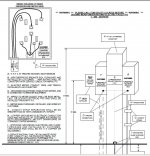
I found this picture online (not from my power company). I kind of illustrates what I have except that my main panel is not on the same post it is 4' away on a barn wall. In the picture it looks like they are saying to run the ground wire to both the meter socket and the main panel and connect both to the ground rod.

If this is the case I guess I would leave the ground wire connected as it is between the the meter socket and main panel and get a little slack and slip that into the ground rod clamp?

Still confused a bit. :headscrat
 

Attachments

  • panel.jpg
    panel.jpg
    125.4 KB · Views: 41

rodnok1

Well-known member
Joined
Jan 27, 2005
Messages
853
Location
NC
Code here was to ground meter box to panel, then panel to ground.
Don't disturb what is already there, run a ground wire from the panel to a rod and be done with it.
 

MrMark

Well-known member
Joined
Jan 25, 2010
Messages
4,626
Location
Southern Cal.
Thanks for the replies. No water at the building so no issues there.

At first the barn has been wired like this for about 12 yrs with no problems so it is probably ok as dugger10 stated but the rod, wire, and clamp to make it right would only cost me about $15 so I would like for it to be right.

To clarify the meter is attached to this pedestal thing and then a short maybe 4' long piece of rubber flexible tubing runs from the meter to the barn, through the wall and to the main panel. The three #4 wires are inside this tube, and the bare #6 ground is out side of it. Right now the bare ground runs from a small lug on the neutral bar in the meter to the ground bar in the panel. The ground bar is connected to the neutral bar in the panel.

To be correct I should disconnect the ground wire from the meter and connect it to the ground rod, and leave the neutral and ground conncected at the main panel?

You have rubber pipe, you said. You need that ground wire running from the inside panel to the service entrance. I would want it in the pipe too. This will give you grounding from that panel to the entrance. I would then drive one or two spaced ground rods (especially if you are in a lightning prone area) at the entrance and connect a ground wire from the incoming service neutral bus bar (the bar connected to the lug on the entrance) to the ground rod(s)

I question the bond of the neutral to the ground at the panel you have. Others will have to address that. The concept I have in my mind is that you want separate neutral and ground paths for as long as possible so that an open neutral will not unexpectedly energize the ground wires connected downstream.

That is why ground and neutral are only tied together at the service entrance. I don't know whether your panel is considered part of the service entrance.
 

dugger10

Well-known member
Joined
Dec 12, 2009
Messages
50
bdog, folks can argue code all day and all night. I've been with a power company for thity years and have done electrical work on the side as a licend (SP) electrician for several years when my kids were young. Bottom line IMHO is this, what you have is working fine, if it makes you fell better drive the ground rod and connect to the breaker box. Its there as a measure of safety to protect you from a touch potential in case a neutral is lost by the power co. or on your side. Yes it could be an alternative neutral path if both ground and neutral are bonded. I would not concern myself with that, I would prefer to have that rather than no back up ground. We see lost neutrals all the time, lights will dim and go bright depending on what load is being used and the condition of the ground rod or water pipe ground. Personaly I would never subject my water pipes as a possible return path for electrical current. Power compnays never run more than 3 wires to a single phase customer, a ground rod is a great ideal as a means of protection from lightning or loss of neutral, don't worry about alternative paths of return unless your running delicate computer equipment. I guess the OP will want to discuss Fair residance next, bring it.
 
To avoid these ads, REGISTER NOW!

MrMark

Well-known member
Joined
Jan 25, 2010
Messages
4,626
Location
Southern Cal.
The reason for the ground rod is not to clear faults. There is no way enough current is going to flow thru the earth's surface back to the center tap of the transformer to trip a breaker so a fault can be identified and then cleared. The ground rod is there to protect against lightning and to tie the neutral to the same reference voltage at the entrance as it is at the pole. The reasons the lights dim and such without the ground rod is because you have no common reference on the neutral and it floats at the house. The voltage moves around without the stable reference of an earthed neutral.

I don't like bonding to the water pipe either but it is required. I don't like it because it is a path for fault current from somewhere else into my pipe, and up through my ground wire to my service neutral and back to the transformer. I would like to isolate my house at the water main so that no fault current can come my way. Maybe a plastic bushing like the Gas Company uses.

I also question what is "rubber pipe." I have never heard of or seen "rubber pipe."
 
Last edited:

oleguy

Well-known member
Joined
Nov 22, 2009
Messages
273
the rubber pipe is probably some liquid tite.wether bonded or non bonded.
 
OP
B

bdog

Well-known member
Joined
Oct 17, 2007
Messages
227
Rubber pipe LOL sorry about that. I just did not know what it is called. It is a flexibile conduit of some sort. It looks like a hydraulic hose but it is grey and appears to be all rubber with no metal in it.
 

sberry

Banned
Joined
Jun 18, 2005
Messages
35,747
Location
Brethren, Michigan
As far as I understand this thread there is a bare wire providing an alternative pathway for neutrals from the base to the box, not good, all N currents should be going down the correct insulated N wire within the raceway. I would likely clip it from the meter and tie it to a stake.
 
OP
B

bdog

Well-known member
Joined
Oct 17, 2007
Messages
227
As far as I understand this thread there is a bare wire providing an alternative pathway for neutrals from the base to the box, not good, all N currents should be going down the correct insulated N wire within the raceway. I would likely clip it from the meter and tie it to a stake.

Thank you. Lots of interesting discussion in this thread but that is a clear explanation of my situation of what to do.

This grounding / bonding stuff is so confusing. I totally understand what you are saying but then at the same time since the neutral is bonded to the case at both the meter and the main box this ground wire I have is really no different than a metal pipe (conduit) between the two would be. Take away my ground wire and connect the meter base to the main box with metal conduit doesn't that become an alternate pathway for neutrals?
 

oleguy

Well-known member
Joined
Nov 22, 2009
Messages
273
leave bond/ground at meter.needs to be there.run a ground from panel to ground rod and be done with it.
 

sberry

Banned
Joined
Jun 18, 2005
Messages
35,747
Location
Brethren, Michigan
Right, it probably doesn't make squat either way. When piped there is something about it being that the pipe surrounds the conductors, etc, stuff way over my head. It might be interesting to put amp meter on the bare wire just for giggles when things are operating, measure the difference between it and the N??? As someone said, its working and no shocks, must be ok. As far as I know the N is bonded to can of meter base?
All this is probably mental ************ at best,,, ha
 
To avoid these ads, REGISTER NOW!
Top Bottom