To avoid these ads, REGISTER NOW!

Guy at Lowes had no clue.

edcantu9

Well-known member
Joined
Mar 2, 2013
Messages
607
Location
Southeastern Iowa
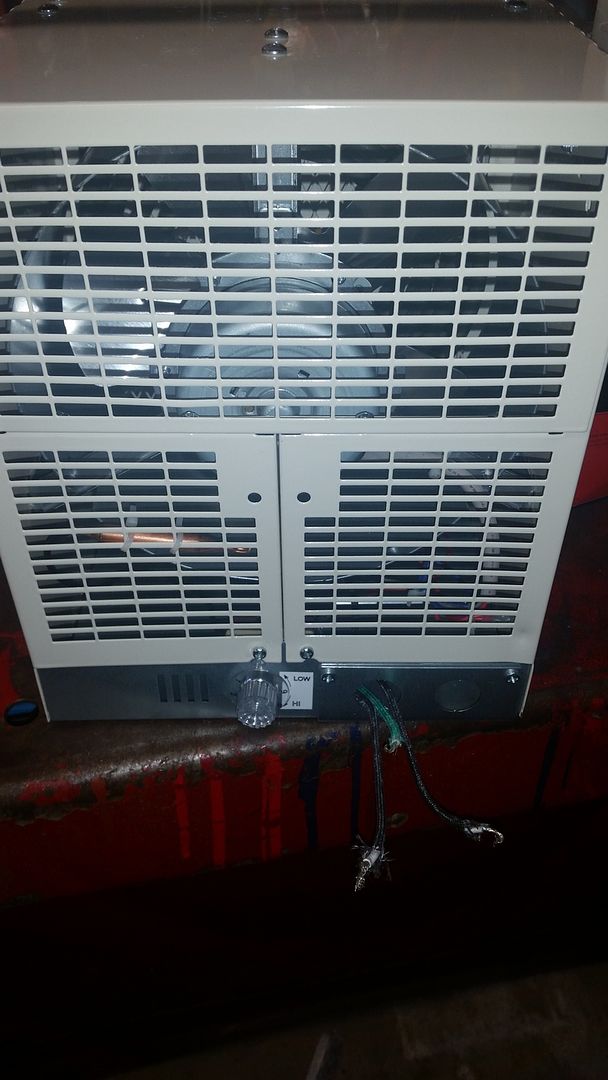
Hi all. Looking to set up this New Air G73 heater. Went to Lowes, guy said he did not know what I needed to hook it up. Here is a picture of the outlet I have in my garage and the three wires coming out of the heater. Two are black, one is green.

If you could list or better yet link to what I need that would be awesome, love this community for all the help it provides and the DIY guy it has made me!

Also I found this wire in my shed. It looks to be a dryer cord with the original head cut off and replaced with a head that will fit this outlet. I tried wiring it to my heater, it would run but the knob to control off and on would not work it would just run constantly.

v


Last edited:
To avoid these ads, REGISTER NOW!

coralnut

Banned
Joined
Jun 16, 2015
Messages
444
Location
Chicagoland
Seems pretty straightforward. This is a 220VAC device right? Black and Black are the two sides of transformer hot, Green is Ground. I don't like how the wires pass through the chassis.
 
OP
E

edcantu9

Well-known member
Joined
Mar 2, 2013
Messages
607
Location
Southeastern Iowa
Seems pretty straightforward. This is a 220VAC device right? Black and Black are the two sides of transformer hot, Green is Ground. I don't like how the wires pass through the chassis.

Hey thanks for taking the time to provide some help. Correct, it is 220v. I did the two black wires on the side and the middle as ground on the dryer cord. A spark came from it, but it ran, but I quickly unplugged it to check what was wrong.

When I plug it back in it runs but seems to be running full speed and the control knob on it should be able to turn it off and or lower the speed it is running at, but it does nothing. Did I hook it up right? Or did I mess it up using this cord?
 

Charles (in GA)

Well-known member
Joined
Jan 11, 2006
Messages
12,489
Location
50 mi south of Atlanta
Is this a NewAir G56? Cannot find any reference to a G53 on the web site, but do find a G56.

What are the specs on the heater? What is the rating of the circuit breaker supplying the circuit? What gauge wire is supplying the receptacle? Is it all the same size throughout the run?

The receptacle you show is an old school range or dryer receptacle that DOES NOT have a ground pin. Grounds in receptacles (regular blade type) are always round or D shaped, NEVER flat. That middle pin is a Neutral. Does the circuit even have a ground wire? or is it so old that there is none.

Code defines electric heat as continuous (always) and the code also limits heating circuits to 60 amps max. As a continuous load, the load on a 60 amp circuit is limited to 48 amps.

In any event, it is impossible to get safe advise on connecting this without all of the info.

While the people at the big box stores are usually helpful, and many are knowledgeable of the areas they work in (I have run into a couple of retired electricians working part time in Home Depot stores, very helpful people), you cannot expect ever one of them to know exactly what to do, and it might be a liability issue for the employees to give out detailed information on something like this.

Charles
 
Last edited:
OP
E

edcantu9

Well-known member
Joined
Mar 2, 2013
Messages
607
Location
Southeastern Iowa
Is this a NewAir G56? Cannot find any reference to a G53 on the web site, but do find a G56.

What are the specs on the heater? What is the rating of the circuit breaker supplying the circuit? What gauge wire is supplying the receptacle? Is it all the same size throughout the run?

The receptacle you show is an old school range or dryer receptacle that DOES NOT have a ground pin. Grounds in receptacles (regular blade type) are always round or D shaped, NEVER flat. That middle pin is a Neutral. Does the circuit even have a ground wire? or is it so old that there is none.

Code defines electric heat as continuous (always) and the code also limits heating circuits to 60 amps max. As a continuous load, the load on a 60 amp circuit is limited to 48 amps.

In any event, it is impossible to get safe advise on connecting this without all of the info.

Charles

Apologize it is a G73.

http://www.amazon.com/dp/B000TK2SWO/?tag=atomicindus08-20
 

Charles (in GA)

Well-known member
Joined
Jan 11, 2006
Messages
12,489
Location
50 mi south of Atlanta
Still looks like you need a 30 amp circuit.

Model: G73
Product Type: Electric Garage Heater - Safe and Reliable Heat
Product Dimensions: 9.00" x 9.50" x 14.00"
Product Weight: 15.00 lbs.
Product Color: White
Application: For heating garages, workshops, warehouses, job sites, and more
Type: Garage Heater
Fuel Type: Electric
Coverage Area: 500 square feet
Voltage: 240 volts
Watts: 5000 watts
Amps: 20.8 amps
Certifications: UL , CUL
Heating Capacity: 17060 BTUs
Construction: Stainless Steel
Air Flow: 200 CFM
Adjustable Louvers: Yes
Installation Type: Hardwired
Built-In Thermostat: Yes
Thermostat Type: Single Pole
Wall Mountable: Yes
Ceiling Mountable: Yes
Includes Mounting Bracket: Yes
Heating Element: Stainless steel
Automatic Shut-Off: Yes
Carrying Handle: Yes
Includes Plug: No
Alarm: No
Automatic Temperature Control: Yes
Fan Delay Function: No
Hardwired: Yes
 

Charles (in GA)

Well-known member
Joined
Jan 11, 2006
Messages
12,489
Location
50 mi south of Atlanta
newair-g73-parts-m.jpg


Wire connections are made INSIDE the heater and a cord or cable, with a proper clamp or strain relief is installed in one of the knockouts in the silver cover which is then installed on the heater.

LINK to PDF copy of the manual.

ELECTRICAL CONNECTION
WARNING: Consult local electrical codes in addition to the following
requirements:
1. Turn off main power supply at the electrical panel.
2. Route supply wires from circuit breaker to an approved junction box,
located near compact unit heater. These supply wires must be two
conductor non-metallic sheath cable with ground wire. Each heater should
be on an individual, properly fused circuit.
3. Route supply wires from junction box to G73. These supply wires must be
two conductor metallic sheath (BX) cable with ground wire. Alternatively,
appropriate conduit can be used.

4. Remove junction box cover of G73 and remove one knockout hole. Insert
approved bushing into hole and feed wire cable through. Tighten bushing
around cable.
5. Make electrical connection to G73 according to relevant wire diagram.
Make connections using approved wire nut connectors and secure the
grounding wire to the ground screw on the heater chassis.
6. Replace junction box cover of G73.
 
Last edited:
OP
E

edcantu9

Well-known member
Joined
Mar 2, 2013
Messages
607
Location
Southeastern Iowa
newair-g73-parts-m.jpg


Wire connections are made INSIDE the heater and a cord or cable, with a proper clamp or strain relief is installed in one of the knockouts in the silver cover which is then installed on the heater.

LINK to PDF copy of the manual.

I do have a double 30 amp circuit. I do not know if it makes a difference but when I connect that dryer cord it runs but the knob that controls speed does not affect it. It just runs at full speed anyone else have this issue before?
 
OP
E

edcantu9

Well-known member
Joined
Mar 2, 2013
Messages
607
Location
Southeastern Iowa
The heater will run after you turn it off, to cool it self off.

I see what you're saying, but I plug it in, then try to switch it off less than 20 seconds later, should it have to cool after that short of a period?

A concern I have is that the first time I plugged it in in made a spark near the knob that controls the speed and on and off function and it tripped the breaker. I switched the breaker back and the furnace ran but could not turn it off.

I then inspected inside of it and there is some burn marks inside the unit by the knob unit on the inside. Could it be I fried the knob function? The knob on the inside has three wire connections to it. Where one wire is connected there is burn marks probably from the spark.
 

Lx460

Well-known member
Joined
Oct 9, 2014
Messages
1,306
Location
Central Florida, USA
Did you take the plug apart to see how it's actually wired inside? Since you "found" it laying around I wouldn't assume it is necessarily wired correctly.
 

Brian_WK

Well-known member
Joined
Jun 30, 2015
Messages
1,177
Location
NE South Dakota
Looks like that control knob is the thermostat. It won't speed up or slow down the fan just cycle the heating elements on off. But even still in the off position it should turn it off unless the points welded for some reason (faulty?). Usually then there is a bi-metal snap acting switch that cycles the fan when the element gets warm/cools off. Also if wired incorrectly wouldn't cause it to burn up with that (maybe the wall plug is wired wrong?) It would how ever supply 120v to the chassis of the heater and make for some shocking times if touched. This would also only supply 120V to the heater making fan run around half speed and the element to only partially work.

If you aren't pretty familiar with electricity and electrical codes I would definitely hire someone to do this.
 
OP
E

edcantu9

Well-known member
Joined
Mar 2, 2013
Messages
607
Location
Southeastern Iowa
The outlet is already wired, I am guessing that is the hard part. I just need to install the wire to the heater. I will take it in to Home Depot or Menards, hopefully one of them can tell me what I need.
 
To avoid these ads, REGISTER NOW!

James-W

Well-known member
Joined
Feb 3, 2013
Messages
12,432
Location
Southeastern Wisconsin
One of my brothers had a similar heater hanging from the ceiling in his garage, it was there when he bought the house. His was hard wired using conduit instead of a power cord.
 

finn

Well-known member
Joined
Mar 27, 2005
Messages
16,252
Location
The UP, God's country
If you saw sparks, you probably fried the thermostat (I assume it's integral with the on-off switch). Typical symptom is that it will run continuously, based on the baseboard heater experience I had.

It only takes a microsecond.
 

zmaxmotorsports

Well-known member
Joined
Jan 11, 2013
Messages
11,948
Location
South of omaha
If you saw sparks, you probably fried the thermostat (I assume it's integral with the on-off switch). Typical symptom is that it will run continuously, based on the baseboard heater experience I had.

It only takes a microsecond.

Id say the sparks were from connecting it to the power while it was under a load.;)
 

volaredon

Well-known member
Joined
Oct 7, 2012
Messages
1,620
Location
IL
"guy at Lowe's has no clue".... and that's a surprise? typical at my local store no matter what you are there for.
 
To avoid these ads, REGISTER NOW!
Top Bottom