
You are using an out of date browser. It may not display this or other websites correctly.
You should upgrade or use an alternative browser.
You should upgrade or use an alternative browser.
hacksaws?
- Thread starter tom coffey
- Start date
Private Lugnutz
Well-known member
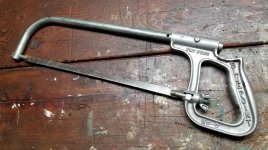
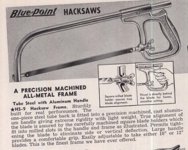
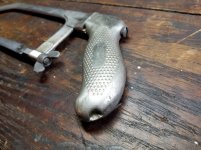
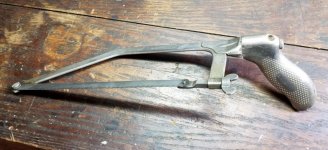
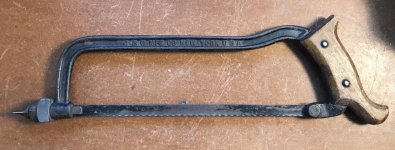
Happy to bump this thread with this rigid non-adjustable 10" pistol gripper found at the flea market this morning. And even happier to report that it's a Sears, Roebuck & Co economy line "MERIT" brand, probably from the 1930's. I have no notes or references on a "BP" code.
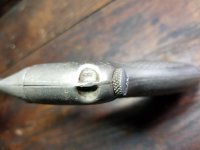
I'm a little bemused by the construction. I was wondering what the knurled screw head was for (see Pics 4 & 5), and why it was knurled when it has a slot for a slot-tip screwdriver, and then, when I removed it and discovered that it was holding the frame and the handle together along with the four pins mated with the four openings, I was wondering why they built it like this to begin with.
But I like it. Neat piece.
I'm a little bemused by the construction. I was wondering what the knurled screw head was for (see Pics 4 & 5), and why it was knurled when it has a slot for a slot-tip screwdriver, and then, when I removed it and discovered that it was holding the frame and the handle together along with the four pins mated with the four openings, I was wondering why they built it like this to begin with.
But I like it. Neat piece.
Attachments




Farmer J.
Well-known member
Can the handle be fitted at different positions, to avoid obstructions and skinned knuckles?
Stillgottimefor1
Well-known member
Can the handle be fitted at different positions, to avoid obstructions and skinned knuckles?
Bet you are right!
Sent from my iPhone using Garage Journal
d42jeep
Well-known member
Can the handle be fitted at different positions, to avoid obstructions and skinned knuckles?
That’s what it looks like to me. Kind of a clever design.
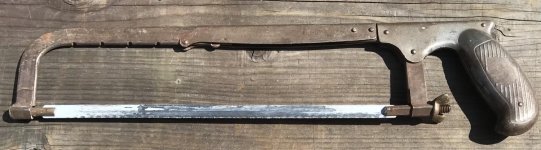
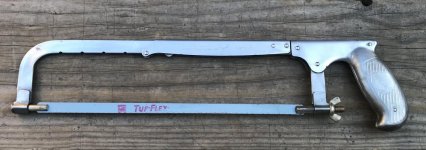
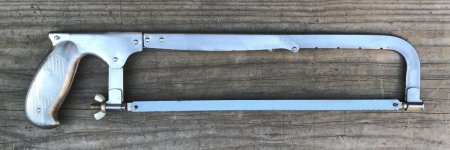
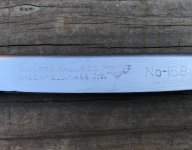
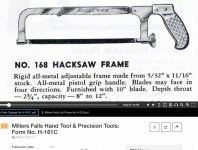
I posted this one in the Millers Falls thread. I found it Saturday at an estate sale. The Nickel plating cleaned up nicely.
-Don
Last edited:
Private Lugnutz
Well-known member
DOH!Can the handle be fitted at different positions, to avoid obstructions and skinned knuckles?

Good on you, mate! Somebody had their thinking cap on!

Attachments


Modern Garage
Well-known member
I'm a little curious about the divot at the bottom of the handle. Is that where the two halves of the handle are spot welded?
Joe
Joe
Provincial
Well-known member
I've seen many knurled screws with slots. It allows quick adjustment when you don't use a tool to tighten, and gives the option to get it really tight with a tool.
RTM
Well-known member
Or more likely for me, to loosen it after a gorilla tightened it, or rust grabbed it.
Miss the Pontiacs
Well-known member

Private Lugnutz
Well-known member
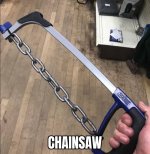
That's hilarious....for rough cuts.
Me too, Jock, hence my initially reported befuddlement. It should've been a big hint, but only made my denseness on this one even more dense! You don't have to pull the screw all the way out to turn the frame, just loose enough to free the four little pins. A simple twist of the handle 90* to the left or right for side cuts, or 180* for bottom cuts, reseat the pins, tighten the screw with your index and thumb and you're in business again. Screwdriver if you must.I've seen many knurled screws with slots. It allows quick adjustment when you don't use a tool to tighten, and gives the option to get it really tight with a tool.
I've gone from wondering why they made it that way to wondering why everyone else didn't! And it adds more significance to identifying who "BP" is!
EDIT: Has anyone else ever seen any hacksaw with a similar adjustment? Of any design? Any mfgr? The typical approach - and the one that won out in the end - is the ability to turn just the blade 4 ways. It achieves the same result. But this design has more clearance on a underneath cut.
Yessir. There are three pairs of them. I'll post some photos later. Off to my Friday flea.I'm a little curious about the divot at the bottom of the handle. Is that where the two halves of the handle are spot welded?
Joe
Last edited:
Private Lugnutz
Well-known member


Provincial
Well-known member
BridgePort?
65ranchero
Well-known member
Bi Polar?
Sevenhills1952
Well-known member
Bandaid Proven
Sent from my SM-S205DL using Tapatalk
Sent from my SM-S205DL using Tapatalk
Private Lugnutz
Well-known member
MERIT was a Sears, Roebuck, & Co economy brand in parallel to Craftsman, and MERIT tools often bear the same codes as the Craftsman tools, which were not phonetic, acronymic, or abbreviations. Consider the well-known and established example. New Britain = (H) & BE. Vlchek = BT. Billings & Spencer = AF. Etc. MERIT wrenches often have BT and AF codes. But neither lauver's list or AA's guide contains a "BP".BridgePort?
oldmachinenut
Well-known member
I just picked up my third power hacksaw today... while small they still take up more room then the manual versions.
I thought it was just me, I have 2 Keller 3B’s
Last edited:
dutchgray
Well-known member
Good thread.
I generally don't collect hacksaw frames unless they meet WWII specs (straight wood handle, break-down adjustable 8"-12", thumbnut tensioner at the end from 1942-1944, composite pistol grip in 1945), or they are unusual in some way!
I like this type of hacksaw and do most hacksaw work with one over a modern ergonomic type, firstly because I find I cut straight with them and secondly you can buy old stock good quality 10" hacksaw blades for pennies per blade and 10" is enough blade for pretty much anything I want to cut by hand.
Mine are all English and are usually bought for one or two pounds second hand as no one seems to want them.
Farmer J.
Well-known member
DOH!
Good on you, mate! Somebody had their thinking cap on!
Ha ha, at 2:43am I was wearing a knitted wool hat that one of my daughters made, it's freezing cold in this house at night recently! It's a lifelong habit to wake up at night and check livestock giving birth, or regulate the temperature of malting barley grain in store, so I had a cup of tea and checked the vintage tools too. Nice hacksaw, looks a useful design and good for tight spots, I like it.
Lesserstore
Well-known member
Lugz, Union Hardware was granted the patent for that saw in 1938 and applied for it in 1936. It was listed from spring 1937- spring 1938 Sears catalogs and only the spring 1937 catalog had as a Merit brand and after that it was branded as a Dunlap.
https://patents.google.com/patent/U...=filing:19380101&after=filing:19350101&page=1
https://patents.google.com/patent/U...=filing:19380101&after=filing:19350101&page=1
Attachments


Private Lugnutz
Well-known member
Strange how some good ideas just don't last no matter how good they are. There are those who automatically ascribe obsolescence to logic, a sort of 'Survival of the Fittest' view of the evolution of the tool industry. I am not one of them. In fact, there is a whole thread for 'Tools We Wish Were Still Made' (or something like that) up on the General Discussion board.Nice hacksaw, looks a useful design and good for tight spots, I like it.
It's the same in my part of the US, dutchgray. Vintage plain straight wood-handled break-down hacksaw frames and blades are cheap and plentiful at flea markets. And I have moved quite a few of them along to WWII GMTK collectors who don't live in those kinds of areas, because that was the spec.I like this type of hacksaw and do most hacksaw work with one over a modern ergonomic type, firstly because I find I cut straight with them and secondly you can buy old stock good quality 10" hacksaw blades for pennies per blade and 10" is enough blade for pretty much anything I want to cut by hand. Mine are all English and are usually bought for one or two pounds second hand as no one seems to want them.
Excellent work, Lesserstore. Thanks for the full 411. And good to know that Union Hardware = BP. Ironically, Union Hardware hacksaws of the standard type dutchgray and I were just discussing above are a very popular choice with WWII GMTK collectors. I would get mine and take a photo, but Don has several posted upthread. See Post #51 (and also for a good wordplay chuckle). In April 1945, just as the war was ending, the Army updated their spec to metal pistol grips.Lugz, Union Hardware was granted the patent for that saw in 1938 and applied for it in 1936. It was listed from spring 1937- spring 1938 Sears catalogs and only the spring 1937 catalog had as a Merit brand and after that it was branded as a Dunlap.
https://patents.google.com/patent/U...=filing:19380101&after=filing:19350101&page=1
cchamelin
Active member
Now I’m wondering why all hacksaws don’t have this capability....brilliant!
four.cycle
Well-known member
RE: "BP":
Is Mr. Lauver still active here and on papaws? I have to wonder if he might have some little tidbit to confirm that.
Not a hacksaw, but a coping saw with a tubular bow, through which ran a cord affixed to each end, which allowed the operator to change the direction of the blade without having to back the saw out of the cut.
Unfortunately I cannot find the listing now!
(* Pretty sure the seller was VintageViseWorks, but I cannot find it now! *)
Is Mr. Lauver still active here and on papaws? I have to wonder if he might have some little tidbit to confirm that.
Private Lugnutz said:Has anyone else ever seen any hacksaw with a similar adjustment? Of any design? Any mfgr?
Not a hacksaw, but a coping saw with a tubular bow, through which ran a cord affixed to each end, which allowed the operator to change the direction of the blade without having to back the saw out of the cut.
Unfortunately I cannot find the listing now!
(* Pretty sure the seller was VintageViseWorks, but I cannot find it now! *)
Last edited:
Lesserstore
Well-known member
Glad I could help Lugz. I was already doing some research on some tools from that era because my uncle passed away a few months ago and he had my great grandfather's tools who was a machinist and it's just this great assortment of brands from the 1930s-80s. I'll be doing a thread on those soon-ish.
RTM
Well-known member
Dang, I poked thru DATAMP ‘s hacksaw category and found nothing. I was hoping it wasn’t under some catalog, and now that I have a ## courtesy of LS, I can confirm that it is not in DATAMP.
Private Lugnutz
Well-known member
You save me hours of research, and those Craftsman catalogs are not in the public domain, so it was indispensable. Looking forward to your thread.Glad I could help Lugz. I was already doing some research on some tools from that era because my uncle passed away a few months ago and he had my great grandfather's tools who was a machinist and it's just this great assortment of brands from the 1930s-80s. I'll be doing a thread on those soon-ish.
I don't know about papaw's but he hasn't been here in awhile. I have a printout of his nifty color-coded list & timeline in a sleeve in one of my hobby notebooks that I would update with a pen from time to time after checking in with him on GG, last update EDIT: 2018, and it does not include a "BP."RE: "BP":
Is Mr. Lauver still active here and on papaws? I have to wonder if he might have some little tidbit to confirm that.
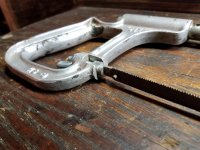
Valid question, which I wondered myself upthread. I don't have any modern hacksaws to see if this is still true, but I suspect the more-or-less standard ability to rotate the blade 4 ways on vintage hacksaws (see Pics) sufficed with enough users, or at least enough merchandising people. Think about it this way - I am so used to that feature even 70+ years later that it completely blinded my intuition on this Morris Patent Union Hardware design even after taking it apart! But it is not the same. It takes a lot more fiddling and time to loosen both ends, re-hook the blade, and re-tighten both ends, for one thing. And more significantly, rotating the entire frame from the handle provides much more clearance - the entire height of the frame, in fact, which is 4 inches. A rotated blade is still in-line with the frame. This mid-30's Union/MERIT hacksaw really is amazing.Now I’m wondering why all hacksaws don’t have this capability....brilliant!
Attachments

Last edited:
Stillgottimefor1
Well-known member
Nice Find, twosheds!
Touchet
Sent from my iPhone using Garage Journal
Touchet
Sent from my iPhone using Garage Journal
j.t.d.
Well-known member
I believe that is a dehorning saw Two sheds, cool.
I believe that is a dehorning saw Two sheds, cool.
I did some web searching, and it looks like you nailed it. Somebody substituted a hacksaw blade. For five bucks it still looks interesting on the saw rack.
My Old Tools
Well-known member
I just picked up my third power hacksaw today... while small they still take up more room then the manual versions.
I only have two....
Username already in use
Well-known member
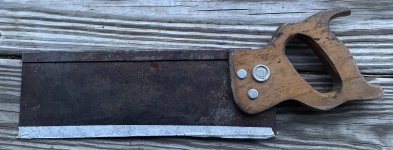
Not a hacksaw, but a BACKsaw. Tennon saw, dovetail saw... Not a thread for them, but hey, it's just one letter off. Maybe I can slide it in here without you guys giving me too much grief. 
Found this old Disston backsaw at the goodwill store yesterday. Was worth the $3 to bring it home.
Found this old Disston backsaw at the goodwill store yesterday. Was worth the $3 to bring it home.
Attachments

Modern Garage
Well-known member
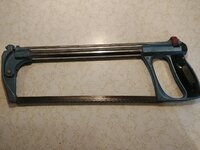
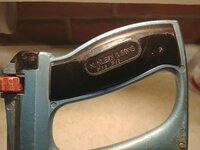
Not a lot of activity in this thread lately, but I was happy enough to find this saw at the Restore yesterday that I took the time to photograph and post it. Happily I was alone and didn't have to explain why I need ANOTHER hacksaw..
Joe
Joe
Attachments
tombell572
Well-known member
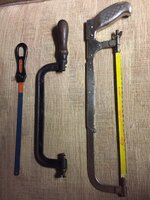
Glad to see this thread back up again--it caused me to include my accumulation, not a formal collection. The Millers Falls #99 was my Dad's, the other hand saws from tag sales. The Covell power saw from the estate sale of a retired machinist. I mounted it on a set of Logan lathe legs. The small cast iron saw handle carries a patent date of Aug. 28, 1877 but no maker, the 8" straight handle saw with star emblems is perhaps Millers Falls, and the big M/F #14 "***********" saw I've read was commonly used for cutting railroad rails. The chrome M/F #99 may have been bought by my Dad in the 1940's-50's.
Tom B.
Tom B.
Attachments


Lesserstore
Well-known member
I got this in an NOS Easco set which I think was military or government surplus. It's a very basic saw with a simple cast aluminum grip with no plastic inserts, and the length is adjustable by simply pulling a pin out and putting it in one of two holes. The model is 21-075, and was made in the late 70s to early 80s.
Attachments


Joe Huld
Well-known member
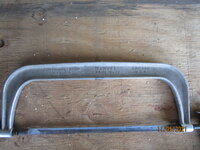
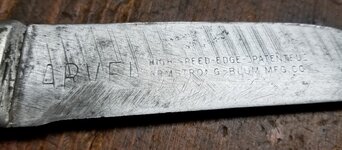
I am a hacksaw junkie and I marvel that the number of variations there are. Speaking of Marvels here is my latest acquisition. This is my second Marvel, the first is a circa 1912 No. 1 line shaft driven power hacksaw. This one is a Marvel Frame No 12 marked patent applied for. I was unaware that Armstrong Blum ever made hand hacksaw frames much less such a weird and wonderful one like this. The blade is worn out and is not the recommended "Unbreakable Marvel Blade No 1218N" so I'll have to use one of my several dozen NOS blades until I can locate an "Unbreakable Marvel Blade No 1218N"
Attachments


RTM
Well-known member
Think you are right.. The small cast iron saw handle carries a patent date of Aug. 28, 1877 but no maker, the 8" straight handle saw with star emblems is perhaps Millers Falls, and the big M/F #14 "***********" saw I've read was commonly used for cutting railroad rails.

Millers Falls Company : Catalogue B : Millers Falls Co. : Free Download, Borrow, and Streaming : Internet Archive
84 p., illus., 28.2 cm (image size), trade catalog
archive.org
Private Lugnutz
Well-known member
Haha. Clever.and I marvel that the number of variations there are.
That makes two of us! Nice find, Joe!I was unaware that Armstrong Blum ever made hand hacksaw frames much less such a weird and wonderful one like this.
The closest I can come to a Marvel hacksaw is my favorite knife, homemade, out of a Marvel automatic hacksaw blade, with a lead handle.
Attachments

Stillgottimefor1
Well-known member
I am pretty sure that was made in a prison workshop, Uncle Bob was right proud of that, and sent me pictures.
four.cycle
Well-known member
that's "trench art" for the politically correct nouveau riche crowd.