To avoid these ads, REGISTER NOW!

Hammer ID needed

454cid

Well-known member
Joined
Oct 5, 2014
Messages
72
Location
West Michigan
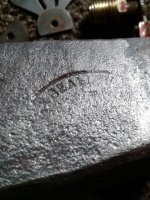
I've had this hammer for quite a number if years now. I bought it at either a garage sale or auction. It needs a new handle, but I've always used it as is. The marking appears to indicate it's a 6 pound hammer, but I haven't weighed it.

I found, and wire wheeled what looks like a partial brand identification stamping. Anyone recognize it?
 

Attachments

  • 20180829_172255.jpg
    20180829_172255.jpg
    135.5 KB · Views: 69
  • 20180829_172243.jpg
    20180829_172243.jpg
    155.1 KB · Views: 60
  • 20180829_172117.jpg
    20180829_172117.jpg
    131.4 KB · Views: 61
To avoid these ads, REGISTER NOW!

Private Lugnutz

Well-known member
Joined
Mar 30, 2012
Messages
30,589
Location
The Authentic Jersey Shore
That's an interesting catalog. According to the April 19, 1917 edition of The Iron Age, Beall Brothers was bought out by Hubbard & Company, of Pittsburgh, PA. Link here. They were to operate as a branch of Hubbard, under their original name (a smart move by Hubbard), but I am surprised to see that there is no mention of Hubbard at all on the catalog, not even in fine print, as late as 1920.

By the 1930's Hubbard was branding tools made in the Beall plant with both names. Some us own the quirky SPEEDEE-RATCH, which was made in the Beall plant in Alton, Illinois. GJ thread link here.
 
OP
4

454cid

Well-known member
Joined
Oct 5, 2014
Messages
72
Location
West Michigan
So I think I'm going get this hammer in better shape. I've already wire wheeled the whole thing, and then washed it, and it looks a lot better. My question is what to do with it now? Wax? Oil? Paint?

My first thought was wax, but this hammer will be used in the garage, and I don't typically keep my tools waxed. I'm much more likely to oil them with WD40 or something else in a spray can. It helps to pull the grease off after work on something. So I think wax is out.

I could just oil it. That would be easy, and allow the partial Beall Bros. stamping to be seen. The downside is that apart from a new handle it may just look like any old hammer.

Paint, will make it look a bit more special, but probably fill in the makers mark. It will also get scratched, although I do have some old TSC oil based paint, in International Red, that should do pretty well. I've used that on a mattock, and it's worn, but still red.

Is it just personal preference, or are there other things to consider?
 

DadsTools

Well-known member
Joined
Jul 27, 2017
Messages
1,852
So I think I'm going get this hammer in better shape. I've already wire wheeled the whole thing, and then washed it, and it looks a lot better. My question is what to do with it now? Wax? Oil? Paint?

My first thought was wax, but this hammer will be used in the garage, and I don't typically keep my tools waxed. I'm much more likely to oil them with WD40 or something else in a spray can. It helps to pull the grease off after work on something. So I think wax is out.

I could just oil it. That would be easy, and allow the partial Beall Bros. stamping to be seen. The downside is that apart from a new handle it may just look like any old hammer.

Paint, will make it look a bit more special, but probably fill in the makers mark. It will also get scratched, although I do have some old TSC oil based paint, in International Red, that should do pretty well. I've used that on a mattock, and it's worn, but still red.

Is it just personal preference, or are there other things to consider?
Most collectors feel that once you take a bench grinder wire wheel to a tool, you've turned it into a user instead of a collectible. No harm done here, since you say you intend to keep it as a user. So I don't think you need to be concerned with trying to preserve any collectible value to it. I think that at this point it's just a question of personal preference. After all, you know in your own mind what it is no matter how you treat the surface. Enjoy it....better than it sitting on a dark shelf somewhere collecting dust.
 
OP
4

454cid

Well-known member
Joined
Oct 5, 2014
Messages
72
Location
West Michigan
Most collectors feel that once you take a bench grinder wire wheel to a tool, you've turned it into a user instead of a collectible. No harm done here, since you say you intend to keep it as a user. So I don't think you need to be concerned with trying to preserve any collectible value to it. I think that at this point it's just a question of personal preference. After all, you know in your own mind what it is no matter how you treat the surface. Enjoy it....better than it sitting on a dark shelf somewhere collecting dust.

Hmm, I would not have thought a wire wheel would be considered destructive to a collector tool, unless the idea is to leave it as found. It's not like "sand" blasting that changes the surface. I often see restorations on Youtube where someone completely grinds and polishes something like an axe or hammer and it makes me cringe.

It won't matter for this hammer, but assuming collector tools can be cleaned up at all, what are the preferred methods? Chemical such as vinegar or Evaporust? Electrolysis? I do have some old stuff that really probably should remain retired. Some I've tried wire wheeling over the years. I've also wire wheeled some things I've put on ebay, and I wonder if that hurt my sale.
 
To avoid these ads, REGISTER NOW!

Private Lugnutz

Well-known member
Joined
Mar 30, 2012
Messages
30,589
Location
The Authentic Jersey Shore
What DadsTools said. If you're going to use it, it doesn't matter. If you're going to preserve and display it in a collection, you'd want to recreate the original finish (see catalog), some of which you likely removed with the wire wheel, and seal it with paste wax.
 

DadsTools

Well-known member
Joined
Jul 27, 2017
Messages
1,852
Hmm, I would not have thought a wire wheel would be considered destructive to a collector tool, unless the idea is to leave it as found. It's not like "sand" blasting that changes the surface. I often see restorations on Youtube where someone completely grinds and polishes something like an axe or hammer and it makes me cringe.

It won't matter for this hammer, but assuming collector tools can be cleaned up at all, what are the preferred methods? Chemical such as vinegar or Evaporust? Electrolysis? I do have some old stuff that really probably should remain retired. Some I've tried wire wheeling over the years. I've also wire wheeled some things I've put on ebay, and I wonder if that hurt my sale.
There's no way you can take an old piece of steel or iron to a bench grinder wire wheel and not remove some of the metal. It also removes any of the remaining original finish, if any. It will also remove any of the surface that is degraded slightly from the oxidation process. The result will often be a bare surface severely pitted as in your photos. It also changes the appearance of the metal to a darker gray, almost like a pewter color. None of this matters if the value of the tool is in its use. If someone's going to make it a user, getting rid of the rust with a wire wheel is perhaps the most efficient and expedient way.

Wire wheel--yep, it can hurt the sale value. I remember reading a thread somewhere where a few people were talking about that. "I can spot a wire wheeled tool a mile away!" They recognize when that was done to a tool. The general consensus is they know it was a rusty old junker that someone tried to clean it up so it would look like something it was not.

As for preserving its collector's value, that's all relative. A severely rusted tool may have no collector's value no matter what it is because of the condition--unless, that is, if you can prove it was from George Washington's carriage house. My own criteria in considering this is to examine an artifact to determine if I'm dealing with "what it is" as opposed to what it was." If someone tells me "this here is a such and such" and it look like it was left outside in the rain for 20 years, I tell them, "No, that's what it once was. It isn't that anymore." So for me, the deciding factor is if there is enough of it left of its structure and finish to clearly see what they are, then it needs to be just cleaned carefully and preserved in some way. If it's beyond that, then I'm dealing with what it once was but isn't anymore. These are candidates for users. Or complete restoration, since there's no way you can destroy its collector's value at that point, so restoration will increase its value. In some cases, it should just simply be thrown out, instead of hanging on to it just because of what it once was.
 
Last edited:
OP
4

454cid

Well-known member
Joined
Oct 5, 2014
Messages
72
Location
West Michigan
There's no way you can take an old piece of steel or iron to a bench grinder wire wheel and not remove some of the metal. It also removes any of the remaining original finish, if any. It will also remove any of the surface that is degraded slightly from the oxidation process. The result will often be a bare surface severely pitted as in your photos. It also changes the appearance of the metal to a darker gray, almost like a pewter color.

So what are considered safe process's by collectors? Most processes seem to change the item being cleaned in my experience. I have yet to try Evaporust, but I hear it will strip black oxide coatings.

Wire wheel--yep, it can hurt the sale value. I remember reading a thread somewhere where a few people were talking about that. "I can spot a wire wheeled tool a mile away!" They recognize when that was done to a tool. The general consensus is they know it was a rusty old junker that someone tried to clean it up so it would look like something it was not.

For me, it's not about looking like something it's not, it's about looking like whatever it is, without the rust and grime. Also, I often can't tell what something is until I do some cleaning. Although, maybe some of those tools would be considered in too poor of condition for a collector any way.
 

Private Lugnutz

Well-known member
Joined
Mar 30, 2012
Messages
30,589
Location
The Authentic Jersey Shore
So what are considered safe process's by collectors?
The safest process for steel is an electrolysis tank, but some guys, including me, don't like the idea of a charged tank of water and battery leads around children and pets. The non-acid bath solutions like Evaporust or Metal Rescue are very safe. Any of the acid-based solutions (muriatic, oxalic, even vinegar) will damage steel if left unchecked for too long, and when used briefly, will almost immediately promote a thin fuzz of rust on the de-rusted tool as soon as it is exposed to the air unless you hit it with a preservative (oil, etc) and paste wax immediately.

454cid said:
I have yet to try Evaporust, but I hear it will strip black oxide coatings.
It will, but this knock on Evaporust is a little misleading. Anything that strips rust (iron oxide) will strip black oxide. It's an oxide.
 

DadsTools

Well-known member
Joined
Jul 27, 2017
Messages
1,852
For me, it's not about looking like something it's not, it's about looking like whatever it is, without the rust and grime. Also, I often can't tell what something is until I do some cleaning. Although, maybe some of those tools would be considered in too poor of condition for a collector any way.

There you have it. You wondered if having wire-wheeled a tool for resale could have hurt the value. I gave my opinion on that. Yep....sometimes it will. Doesn't matter if it's not your intention to make it look like something it's not. You asked if it might hurt sales at times. If you're concerned about resale value, then it doesn't matter what your intention is, it only matters how a potential buyer will perceive the item. In sales then, your intention is to please the buyer.

And yes, if it's so crusty that it has no collector value, then it doesn't matter.
 
OP
4

454cid

Well-known member
Joined
Oct 5, 2014
Messages
72
Location
West Michigan
There you have it. You wondered if having wire-wheeled a tool for resale could have hurt the value. I gave my opinion on that. Yep....sometimes it will. Doesn't matter if it's not your intention to make it look like something it's not. You asked if it might hurt sales at times. If you're concerned about resale value, then it doesn't matter what your intention is, it only matters how a potential buyer will perceive the item. In sales then, your intention is to please the buyer.

I'm not a tool seller specifically, I sell all kinds of stuff. They've been slow sellers for me, and now I have an idea why. Until this thread I never would have guessed wire wheeling would hurt the value. My outlook probably comes from being more of a user than a collector.

I guess I'll have to not use the wire wheel anymore on tools I'm going to sell. Maybe I'll finally give Evaporust a shot.... I've got a gallon of it.

Thanks for taking the time to respond.
 
OP
4

454cid

Well-known member
Joined
Oct 5, 2014
Messages
72
Location
West Michigan
The safest process for steel is an electrolysis tank, but some guys, including me, don't like the idea of a charged tank of water and battery leads around children and pets.

You don't' worry about the hydrogen embrittlement? I haven't tried it in a number of years... maybe it's not really a problem with hand tools, since they're not run at high speeds. It will pull coatings (paint) off... does it hurt plating? I seem to remember getting a very dirty part after, too.


The non-acid bath solutions like Evaporust or Metal Rescue are very safe. Any of the acid-based solutions (muriatic, oxalic, even vinegar) will damage steel if left unchecked for too long, and when used briefly, will almost immediately promote a thin fuzz of rust on the de-rusted tool as soon as it is exposed to the air unless you hit it with a preservative (oil, etc) and paste wax immediately.

Yes, I've etched a cast iron pan before with vinegar.
 
To avoid these ads, REGISTER NOW!
Top Bottom