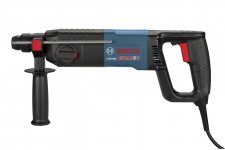
I agree a rotary hammer would be much-better for all-round use. My advice is to forget anything battery-powered, they don't have the longevity to keep working, maybe a hammer drill to hang a shelf, or some moly anchors or a handful of plastic anchor shields. Any aspirations of doing dozens of holes 1/4" or larger, and of being able to use it to break-up an old pour, or to drill in stone, use a rotary hammer.
I bought a HFT rotary hammer and impact drill for <$100 on sale. It's an SDS-MAX, and the extra capacity is an asset for heavier work. I've used it to break-up poured slabs in several bathrooms, to drill 5/8" holes to anchor sill plates to a slab for a single-car garage, and miscellaneous other jobs that a hammer drill, which I also have, would be hard-pressed to complete.
I watched the guys who were hired to do the sill-plate fastening to a slab try to use DeWalt battery-powered tools. They couldn't drill consecutive holes, and they couldn't run-down the hex nuts on the wedge-its repeatedly. After watching them do it half-assed I fired them, and did it myself. I did it much-quicker w/my HFT SDS-MAX than they attempted, and I did it right.
I bought the HFT drill set and the set of paddle bits, needle bits etc. and also bought a Bosch wide paddle bit for when I broke the wide HFT paddle bit. Some people run-down the quality of the HFT drill bits for rotary hammer use, but they have drilled OK when I've used them.
The Harbor Freight SDS-MAX tool I have has been superceded, but mine is still working whenever I need it. I always fill the grease vault when I put it away, that way it's ready for the next use. The tool paid for itself the second day I used it, compared to rental fees at the Big Orange Box Store.