BarryWells
Well-known member
There ya go.............heat between studs with a real torch if they don't come with a little hammering.

There ya go.............heat between studs with a real torch if they don't come with a little hammering.
Can always do the bolt and nut combo through the caliper bracket if you don't want to hammer.
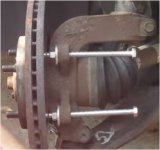
Watch the above video but here is a snap shot (shorter, fatter bolts would be better).
After 6 or 8 turns on each bolt, losen them, turn the rotor about 1/4 turn and repeat. It will leave a mark on the rotor. E Z !
Until you break an ear off the knuckle. Then you get to find out the ball joints are also stuck in the tapers, the suspension bolts are rusted solid, etc.
It does happen.
Until you break an ear off the knuckle. Then you get to find out the ball joints are also stuck in the tapers, the suspension bolts are rusted solid, etc.
It does happen.
My numbers used the speed of the hammer head. The length of the hammer handle is irrelevant. As long as the hammer head achieves the speed I said, it will impart that 90,000 pounds of force into the rotor - no matter if it has a 1" handle or a 100".If the hammer used for the test had a 2 foot handle, and the typical hammer of that weight has a 1 foot handle, than claiming 90k lbs of force doesnt make sense. It's 90k lbs of force, when the hammer hits. I can get a lot more power with a longer handle, vs. a little handle
Bump-stops are still typically compliant rubber. They're very high durometer, but they're still compliant. You also cannot ignore all the "give" the suspension components have, especially in a long duration event like hitting a pothole. When you factor in the give of the tire, the wheel, the suspension bushings, the springs, the bump-stops, etc... you will never see that kind of force in a car suspension in normal driving. If you do, stuff gets ripped off.90k lbs is our hammer hit spec. When the bump-stop bottoms, the effective spring rate is infinite. .... If we ignore the chassis and how it will flex to take impact load, a fully compressed suspension, when receiving more compression force, is equivalent to a metal rod
You just have to look up typical tapered rolling bearing specs (granted most new cars don't use tapered roller bearings anymore) to see that no bearing in the typical size for auto applications is rated for 90,000 pounds of load.90k lbs of force - on a bearing which may be rated to receive 100k every day of its life with no complaints. Without having any information or other specs, 90k lb is a worthless figure. For all we know the bearing sees that every day.
Whenever I do brakes I coat the entire hub where the rotors sits with anti-seize, next time removing them is certainly easier.
It's not irrelevant, it was showing that automotive wheel bearings are not rated for anywhere near 90,000 pounds of force. It was just that particular bearing was very easy to find data on, since vehicles that used tapered roller bearings tend to use standard parts. Modern integrated unit hubs will have similar ratings, but are harder to find information on.So.... that data is irrelevant. Since one would.never hammer off a rotor mounted to a tapered roller bearing hub? Because the rotor and the hub which holds the bearings are the same piece?
It will keep compressing until you extrude the rubber out of the sides. Then when the bump-stop bottoms out, you have all of the suspension arms and bushings that will start deflecting. You're neglecting the time aspect of this. It takes time for the suspension to compress. It takes time for that bump-stop to bottom out. It takes time for that wheel to travel over a bump.A compressed bumpstop is no longer compliant. It has compressed fully, to protect the damper from internally bottoming out. It is now a rigid structure. It cant just compress infinitely.
...and most cars don't require the rotor to be beaten as hard as you can with a sledge to take them off. How many bearings have you disassembled and checked for brinelling after hammering off a rotor? A bearing that's been damaged by brinelling isn't likely to fail instantly, but it has been compromised and will fail sooner than it would have.As I said, ive seen zero evidence of this ever occurring. Plenty of cars hit 150k+ miles with factory wheel bearings and many rotors changed.
It's not irrelevant, it was showing that automotive wheel bearings are not rated for anywhere near 90,000 pounds of force. It was just that particular bearing was very easy to find data on, since vehicles that used tapered roller bearings tend to use standard parts. Modern integrated unit hubs will have similar ratings, but are harder to find information on.
Additionally, many many vehicles have tapered rolling bearings and removable rotors.
It will keep compressing until you extrude the rubber out of the sides. Then when the bump-stop bottoms out, you have all of the suspension arms and bushings that will start deflecting. You're neglecting the time aspect of this. It takes time for the suspension to compress. It takes time for that bump-stop to bottom out. It takes time for that wheel to travel over a bump.
The time it takes that stuff to happen is nearly 2 orders of magnitude longer than the impact duration of a sledge into a rotor. The protracted duration of hitting a bump means the peak forces are much much lower.
This is why I can press a shaft out of a pulley with a 10 ton press and the shaft won't get damaged, but if I hammer on it with a 3 pound sledge, the shaft will instantly mushroom. The instantaneous peak force of that hammer blow is orders of magnitude higher than the press.
...and most cars don't require the rotor to be beaten as hard as you can with a sledge to take them off. How many bearings have you disassembled and checked for brinelling after hammering off a rotor? A bearing that's been damaged by brinelling isn't likely to fail instantly, but it has been compromised and will fail sooner than it would have.

Or Big Nasty (tm). There's no match for Big Nasty:
Wish my winters were as easy as Michigan's, I used an 8lb hammer for a good hour and had to use the bolt trick at the same time to finally get the front rotors off.I live in Michigan. When working on 4x4 or AWD brakes I use an 8 pound hammer. one hit and they pop off.
I'll add to the forum hearsay. My wheels didn't make a sound until after doing the brakes. The pads and rotors needed their first change at 98k miles, within 500 miles of doing the brakes which required repeated blows with an 8lb hammer that left the rotors completely dimpled the front wheel started making some noise. I assumed it was pad rub though resetting the brakes 4 times over the course of the next few thousand miles made no difference. It was only when the wheel bearing was pulled and replaced that the noise disappeared. The balls inside the bearing were noticeably heat damaged and discolored. My online research suggested that a late model Mazda 5 wheel bearing failing before 120k miles was rare as most should make it well past that. Hammering on the rotor would seem to have been the issue.As I said, ive seen zero evidence of this ever occurring. Plenty of cars hit 150k+ miles with factory wheel bearings and many rotors changed.


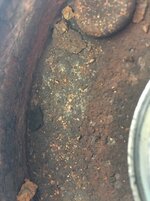





Then stop being cheap and buy a Astro 78830 Hub and Rotor Puller.
It's not irrelevant, it was showing that automotive wheel bearings are not rated for anywhere near 90,000 pounds of force.
...and most cars don't require the rotor to be beaten as hard as you can with a sledge to take them off. How many bearings have you disassembled and checked for brinelling after hammering off a rotor? A bearing that's been damaged by brinelling isn't likely to fail instantly, but it has been compromised and will fail sooner than it would have.
Wish my winters were as easy as Michigan's, I used an 8lb hammer for a good hour and had to use the bolt trick at the same time to finally get the front rotors off.
I'll add to the forum hearsay. My wheels didn't make a sound until after doing the brakes. The pads and rotors needed their first change at 98k miles, within 500 miles of doing the brakes which required repeated blows with an 8lb hammer that left the rotors completely dimpled the front wheel started making some noise. I assumed it was pad rub though resetting the brakes 4 times over the course of the next few thousand miles made no difference. It was only when the wheel bearing was pulled and replaced that the noise disappeared. The balls inside the bearing were noticeably heat damaged and discolored. My online research suggested that a late model Mazda 5 wheel bearing failing before 120k miles was rare as most should make it well past that. Hammering on the rotor would seem to have been the issue.
I done hundreds of brakes, do not own one and is still no substitute for a torch. As was noted above usually done before others could get the tools out.Not only pulls hubs, but also drums and rotors !
What makes no sense about it? It's f=ma. If your hammer of X mass is going Y velocity, and comes to a complete stop making a dent Z deep, you can easily calculate the force it applied to whatever you hit.Dude just stop. This number you keep throwing around makes no sense. It's a straw man of your own making.
You accuse me of making a straw-man and then your comeback is a tu quoque, attacking me?How many wheel bearings have YOU removed and taken apart to check for brinelling after hammering off a stuck brake rotor?
What makes no sense about it? It's f=ma. If your hammer of X mass is going Y velocity, and comes to a complete stop making a dent Z deep, you can easily calculate the force it applied to whatever you hit.
You accuse me of making a straw-man and then your comeback is a tu quoque, attacking me?
Bearings do not like to be hammered on. Period. The peak force from a 3-pound sledge going full-send is astronomical.
You can determine the impulse time simply by looking at how deep the dent in the rotor is based on the initial starting speed of the hammer. I chose the speed and dent-depth as conservative "real-world" values to give as an EXAMPLE of the sort of forces that can be achieved with a simple hammer. The harder the rotor material, the shorter the impulse duration and the higher the peak forces.I fully understand the physics, but you're using a velocity you pulled out of a hat, and an impulse time that you can't know, because when you pick those numbers it makes your argument sound really good.
The shorter the impulse duration, the less all that compliance matters. It's why things like dead-blow hammers exist. They increase the impulse duration to drop the peak force, while still transferring the same amount of energy into an object. When you slam that 8 pound sledge into a rotor, you're delivering all of that energy in about ~1/10,000 of a second. The peak forces you exert through the rotor, into the wheel hub are enormous.But in this particular instance, we're not talking about hammering on a bearing- we're taking about hammering on something that's attached to something else that's then attached to a bearing, while the whole assembly is hanging from some other stuff that's all mounted with compliant mounts. This is not the same as hitting a bearing race with a ball peen hammer.
My argument was that he can't possibly know he's not causing damage without taking them apart. Your counter was how could I be sure that hammering on them is causing damage if I've never taken them apart. You're trying to invalidate my statement by claiming some sort of hypocrisy on my part. What I have, or have not done does not make my statement untrue.I'm not 'attacking' you. It's not personal. You made the exact same appeal in the previous post- it either works for you and for me, or it works for neither of us. You can't have it both ways.
What makes no sense about it? It's f=ma. If your hammer of X mass is going Y velocity, and comes to a complete stop making a dent Z deep, you can easily calculate the force it applied to whatever you hit.
Very true, and valid points.You can calculate, or maybe estimate, the peak force at the point of impact. The force lowers the further you get from that point because the mass and elasticity of the assembly reduces the peak deceleration. When you hit the end of a shaft why is it only the end that deforms?
There's always a time and place for a hammer. Some mild tapping with a hammer is fine. If you get to the point where you're denting the rotor, it's time to come up with another approach.And FWIW I agree that hammering on rotors does carry some risk. But is it really worth taking extra time, or employing equally risky methods such as heat, to avoid it? Hammer size also comes into play here. A few love taps with a 3# engineers hammer isn't likely to hurt anything. If that doesn't work and you start eyeballing the sledge it might be time to stop hammering and try something else.
You can determine the impulse time simply by looking at how deep the dent in the rotor is based on the initial starting speed of the hammer.
Which is why I use the two bolts method !You were the one calling the $40 synthetic oil change a "rip off".
I live in Phoenix, what is this rust you speak of?