Tucko
Well-known member
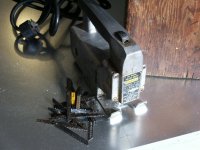
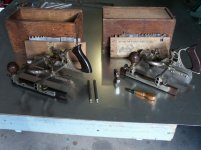
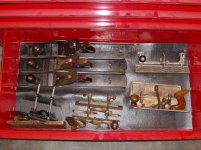
Here's a couple of Stanley's with 2 sets of cutters, etc. and an old saw. They belonged to my wife's grandpa, and her aunt and uncle decided that they should be mine...

Those are nice, Do you have all the cutters?
I think they are worth some money.
Do you do woodworking?


I'm pretty sure I have all the cutters. My woodworking skills aren't the greatest or the worst, but I sure love these planes. They're functional works of art. My local hardware store has a #45 for sale w/ original box, etc. for over $800...
Yeah, that's about right if they're in newish condition.
Yours are at least worth half that. The Stanley 45 is one of the most collectible planes out there.

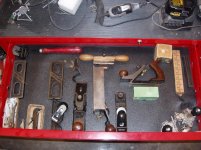
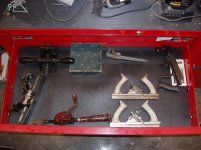
Very nice . The handles are even in great shape. Whatever you do, don't try to clean or restore them ... reduces the value. I have also attracted some nice planes over the years. I even use some of them from time to time. They just feel good in your hands. Some day I might inherit all the hand tools my FIL is holding onto that were his cabinetmaker father's. Here's mine :
Edit : check this site http://www.jonzimmersantiquetools.com/tools/tool_ind.html
Here's a couple of Stanley's with 2 sets of cutters, etc. and an old saw. They belonged to my wife's grandpa, and her aunt and uncle decided that they should be mine...
Hi Tucko,
You have a couple nice Stanley #45 combination planes there. Stanley manufactured the #45 between 1883 and 1962. Over the years, there were little changes that occurred to the plane, and various distinctions that can be made between models if one knows what to look for. If you're interested in finding out more about your planes, the BEST resource I've seen regarding the #45 is a book that was written by David Heckel, entitled, The Stanley "Forty-Five" Combination Plane, History, Identification, Value. I think it was published in 2002. That book is the final word regarding the #45.
As you can see, the basic #45 included several small parts and cutters. Other accessories and cutters could be had for an additional cost. Various standard models included as few as 18 cutters, while others included as many as 23 cutters, depending on when the plane was manufactured. The earliest models were finished with a black japanning (1883 - 1889), while the later models were nickel plated (1890 - 1962). The #45 was certainly a "contraption" of sorts, but when set up properly, and with a little practice, it will cut exceptionally well, and deliver results the are much more than just satisfactory. I hope you're able to test your #45s out in your shop. Let us know how it goes.
Jim C.

The #45 was certainly a "contraption" of sorts, but when set up properly, and with a little practice, it will cut exceptionally well, and deliver results the are much more than just satisfactory.
It was more than that. It was THE contraption. Supposed to replace all the molding planes in a builder's toolbox, with nothing else but saws and chisels, you could build anything in a home.