To avoid these ads, REGISTER NOW!

Hand Scraping

vanapplebomb

Well-known member
Joined
Jul 2, 2019
Messages
385
Location
Holland, MI
Anyone here get into scraping? It’s a bit of a lost art.

I have been doing flat work for a little bit, as shown in the photo.

I started with a homemade ground HSS scraper, but currently have a 25mm wide Sandvik scraper, which is great for flat parts, but it is a bit bulky for small dovetails. I would like to get into more intricate work in the future. What do you prefer for getting into smaller spaces?
 

Attachments
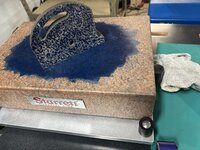
  • IMG_2760.jpeg
    IMG_2760.jpeg
    900.7 KB · Views: 334
Last edited:
To avoid these ads, REGISTER NOW!

speed bump

Well-known member
Joined
May 28, 2008
Messages
6,317
Location
Butte Montana
Kind of a necessity in my line of work (lot of big rotating equipment). All of our scrapers are C.S. Osbourne. Really becoming a dieing art, last oem rep we had out couldn't believe we had multiple guys who knew how to scrape bearings.
 

paulsomlo

Well-known member
Joined
Jul 16, 2013
Messages
3,857
Location
Northern Colorado
Anyone here get into scraping? It’s a bit of a lost art.

I have been doing flat work for a little bit, as shown in the photo.

I started with a homemade ground HSS scraper, but currently have a 25mm wide Sandvik scraper, which is great for flat parts, but it is a bit bulky for small dovetails. I would like to get into more intricate work in the future. What do you prefer for getting into smaller spaces?
Have you checked out the "Machine Reconditioning, Scraping, and Inspection" subforum over on Practicalmachinist.com?
 

Caa311

Well-known member
Joined
Jan 2, 2016
Messages
758
Location
Virginia
I did enough of that back in the day to not really have any interest in doing it again.
 

2oolhound

Well-known member
Joined
Dec 18, 2010
Messages
5,918
Location
BC Canada
There's quite a bit of coverage on this topic on youtube. Everything from surface plates to surface mills plus bearings.
 

KnurledNut

Well-known member
Joined
Jan 28, 2011
Messages
8,067
Location
n/a
Did some training on it when studying for industrial mechanics.
Much respect for those skilled at it.
Only flatness scraper I own is a custom-made carbide flat with a slight convex.
 

MushCreek

Well-known member
Joined
Jan 14, 2015
Messages
9,737
Location
Upstate South Carolina
I did a fair amount of it years ago. Like a lot of my other skills, I learned it because I couldn't afford to pay someone else to do it, or buy new machine tools. I learned by scraping three 36" square cast iron surface plates. There's a rotation technique using three plates that ends up with all three being flat. It was a LOT of work!

I went to a one week jig grinder class at Moore Special Tools in CT. Touring the plant was amazing. The young guys did the 'rough scraping' to a tolerance of .0001 to .0002"! They had a couple old timers that did the final work, bringing them into millionths of an inch. The lead screws were ground, and then hand lapped to the final tolerance of 25 millionths of an inch, over their entire length. Those guys had mad skills. It's interesting that they used all cast iron surface plates, made in-house. They claimed that granite plates can absorb moisture ad swell out of tolerance.
 
OP
V

vanapplebomb

Well-known member
Joined
Jul 2, 2019
Messages
385
Location
Holland, MI
That’s really cool to see manufacturers work their magic. I watched one of the guys from Wells Index scrape in the column and knee of their 847 mill. Craftsman. They had some cool custom jigs/indicators to measure size and parallelism of dovetails, etc. It was a few years ago. I wish I paid more attention to the size/type of scrapers they were using on the dovetails. What is cool is that they scrape their knees just out of square to account for clearance in the column ways when properly adjusted, so that the saddle/table is square to the column.
 
Last edited:
To avoid these ads, REGISTER NOW!

Firebrick43

Well-known member
Joined
May 12, 2015
Messages
13,973
Location
West central Indiana
I used a biax for the bulk of my scraping. Sanvik was also my go to when finishing large flats.

For small dovetail areas a piece of 1/4” or 3/16” thick steel 3/8” wide and 12-14” long.

Then cut a small 60 degree cut out in the end with a hacksaw and clean up with a trisquare file.

We would then silver braze with oxy/fuel torch a common 21.51 TPMT or TPGT carbide insert into the cut out.

Refine the shape slightly with you low speed diamond wheel and the final sharpen with diamond lapping paste.

For a handle we would just mill a groove the width and thickness of the shank in a piece of white oak 1/2 thick and epoxy on another 1/2” thick white oak piece around the shank and clamp. After the epoxy cured shape the wood to suite with a belt sander and soak in linseed oil to seal.

Some made handles out of brass but I preferred wood.
 
OP
V

vanapplebomb

Well-known member
Joined
Jul 2, 2019
Messages
385
Location
Holland, MI
I used a biax for the bulk of my scraping. Sanvik was also my go to when finishing large flats.

For small dovetail areas a piece of 1/4” or 3/16” thick steel 3/8” wide and 12-14” long.

Then cut a small 60 degree cut out in the end with a hacksaw and clean up with a trisquare file.

We would then silver braze with oxy/fuel torch a common 21.51 TPMT or TPGT carbide insert into the cut out.

Refine the shape slightly with you low speed diamond wheel and the final sharpen with diamond lapping paste.

For a handle we would just mill a groove the width and thickness of the shank in a piece of white oak 1/2 thick and epoxy on another 1/2” thick white oak piece around the shank and clamp. After the epoxy cured shape the wood to suite with a belt sander and soak in linseed oil to seal.

Some made handles out of brass but I preferred wood.

That’s not a bad idea. I have quite a few TPG style inserts on the shelf. Might have to give it a shot. They aren’t that expensive.
 

Firebrick43

Well-known member
Joined
May 12, 2015
Messages
13,973
Location
West central Indiana
That’s not a bad idea. I have quite a few TPG style inserts on the shelf. Might have to give it a shot. They aren’t that expensive.
We found that because we were grinding the coating off anyways when sharpening that even the cheap ones work as well as the expensive ones.

Some of the guys used large 3 or 4 size inserts instead of a sandvik for open area scraping but I found the sandvik to really save time because you could have several inserts pre sharpened and just flip them.
 

GeoBruin

Well-known member
Joined
May 5, 2018
Messages
3,732
I have done lots of scraping old gasket material. I never use power tools. Cast iron is forgiving. Aluminium is not tolerant of aggressive cleaning. I have a set of SK scrapers. They can be destructive, so proceed with care and caution. A sharp scraper is easier to control. Practice your best angle on a piece on scrap.
I am lucky to have a lathe that can handle small fuel system parts from International Harvester LB engines. I was able to chuck the fuel mixers and remove the baked on gasket material. I was able to remove less than .0001" of aluminium.
We appreciate your skills, but I believe the OP started this thread about hand scraping as it refers to flattening precision surfaces like surface plates, squares, machine ways, etc., not removing gasket material.
 
OP
V

vanapplebomb

Well-known member
Joined
Jul 2, 2019
Messages
385
Location
Holland, MI
This machine way was beat to ****. You can see where I took a carbide burr in a die grinder on the right hand side to it. There was a ~.040” step on that edge from wear. This machine is over 100 years old, and has some bad scoring still visible in the ways. Going to take several more passes before all the scoring is gone, I’m sure. Some of it is 0.002” deep yet.

IMG_5114.jpeg
 
OP
V

vanapplebomb

Well-known member
Joined
Jul 2, 2019
Messages
385
Location
Holland, MI
A slight tweak in the carbide insert geometry resulted is this, which I like better. I think I may reduce the radius a little more yet.

 
To avoid these ads, REGISTER NOW!
Top Bottom