To avoid these ads, REGISTER NOW!

Has anyone done ICFs

WEmeigh

Member
Joined
Oct 21, 2014
Messages
6
Location
Buckeye, AZ
Has anyone on here built there shop with ICF? Insulated Concrete Forms
Please any links. I am looking at this as an option to reduce radiant heat that metal buildings get here in AZ.
Any regrets? Savings? Thickness you chose? Do it yourself?

I am in Phoenix, and would prob go with http://buildblock.com/


Any help or direction would be awesome. Thanks :beer:
 
To avoid these ads, REGISTER NOW!

klassenl

Well-known member
Joined
Feb 20, 2016
Messages
713
Location
Southern Alberta
I have worked on many houses that used ICF for basements. As.As far as I know it's a good product and a good system but it costs more than more traditional methods.
 

MEngineer

Well-known member
Joined
Apr 13, 2015
Messages
345
Location
Everett, Wa
my FIL built his entire house with ICF back about 15 years ago. Also you can check out the thread labeled the Concrete Underground.

CAUTION: if you begin to read about the Concrete Underground, expect to spend a day reading it or dedicating the same amount of hours over a period of time. The workmanship is phenomenal and the thread is engaging.

If you have the money, do it. You will have an amazing facility that is practically inert to the elements.
 

ssdave

Banned
Joined
Apr 11, 2015
Messages
2,913
Location
Eastern Oregon
I've built two ICF's. After the first one, I said I wouldn't do it again. Then, the second one the lot slope made it the best option, so i did it again.

I wouldn't put the money into a shop that an ICF would add. You have more options than just metal building and ICF. Stick frame with 2x6 walls and well insulated will be a lot more economical and do what you want. The difficulties with attaching anything to an ICF wall, and the problems with getting walls straight and plumb make it a less desirable product. The wall thickness is also a bit of a disadvantage; you don't get as much inside square footage for the same footprint on the lot.

Another thing in Phoenix; the ICF will absorb radiant heat during the day and transfer it to your garage overnight. ICF isn't as good an insulator in very hot or very cold climates; where it works best is in high temperature swing climates where it's hot in the day and cold at night. The heat absorption and transfer moderates the heat and effectively acts as a storage medium to add heat at night and keep it down in the daytime. In your climate, there's very little advantage to adding heat at night.

Bottom line is I wouldn't do ICF in your circumstances.
 

Falcon67

Well-known member
Joined
Jun 11, 2009
Messages
18,371
Location
Merkel, TX
It gets hot here too. My west wall is exposed to the sun most of the day and when painted "barn red" would reach 160~180F surface temp. I agree with ssdave - I'd go 2x6 wall, OSB, reflective board on max sun exposed sides - or just reflective decking under the siding. I use TechSheld decking and it cuts 20~30F temp between the gray 3 tabs and the underside. My west wall is HardiPanel, no OSB, 2x4, R13. Painted light gray now, surface temp runs 130F in summer with an inside wall temp around 90F. I may one day strip that wall and cover it with TechShield and replacement Hardi.
 

matt_i

Well-known member
Joined
Mar 14, 2008
Messages
10,725
Location
SE Michigan
I did it for my foundation stem walls. 8" thick x approx 54" tall. DIY- very easy to do. I think its possible that the job could be done less expensively with removable forms but I didn't have to rely on anyone else, it came out great and I learned quite a bit too. It has rebar every 16" vertically and horizontally that I put in during the form assembly, seems strong enough. I haven't started actively heating it to see if any difference can be noted from the other part of the shop which is not ICF. I would do it again for the simplicity of assembly and not having to rely on any other trades.
 

gnpenning

Well-known member
Joined
Jan 25, 2015
Messages
2,754
Location
I have more questions than answers.
I live in Montana. I have worked on a number of ICF homes and have lived in one for over 10 years. We have more than a couple below zero winter days and many high 90s and some 100 plus days. Some of the responses here don't bear out my experiences with ICF. I realize you get far more and hotter days. My basement and main floor are ICF.

I have around 4500 sqft I heat. My gas bill for the year is under$600 which includes my dryer. Other than running a thermostatic controlled attic fan I have no cooling costs. I open the windows at night and close them in the morning. It maybe 63° in the house and I can come home on the hottest day of the year and it may have climbed up to 67°. If I needed any cooling I would take the cold air in the basement and circulate it up stairs.

You don't get warm or cold air transfer through the walls. Wind shear is not a problem.

ICF does great with both high and low temperatures maintaining temperatures.

My walls are laser straight. A little work up front with proper bracing and adjustments make all the difference in the world. I've seen some poorly done ICF walls. Installing errors not product.

Comfort is the best way to describe living in a ICF home

My next place will be ICF including the shop as well.
 

Voi

Well-known member
Joined
Oct 10, 2010
Messages
5,140
Location
Western South Dakota

ssdave

Banned
Joined
Apr 11, 2015
Messages
2,913
Location
Eastern Oregon
I had an ICF house in South Dakota, and my experience was similar to gnpenning's for energy efficiency. Problem is, for a 4200 sf house and 1200 sf shop, the premium paid for ICF construction was about $80,000 once all was said and done. A well built stick built building will use about 25% more energy; and won't be quite as comfortable. But, you will never make up $80,000 in initial construction costs.

I am building a new house at the moment, and am doing frame. It is sealed airtight; insulated in the wall cavities with high density, high R value insulation, and has exterior foam insulation under the siding. I expect the energy performance to be similar to ICF; it will not be as durable. I estimate the difference in cost would have been $50,000 or maybe a bit more to build it ICF. With $800 a year heat bills going to maybe $600, it would definitely not be worth it. The property taxes on the extra square footage to get the same net square footage might add up to that much. So, ICF would be an expensive luxury, not cost effective.

I had an ICF house in Southern Utah, and it had considerable heat gain on the south and west walls by the end of the day. I did not see that gain in South Dakota, even when the temperature was 100 degrees. A big part of that is the difference in solar input, more than the air temperature, in my opinion.

I like ICF, and feel it is a great material. But, it is a premium material, and has its disadvantages, and its costs. In my opinion, it is not worth the additional costs and disadvantages for a shop in a warm climate. If you want the best and can afford it, price it out and lay it out on your lot and see how it works for you. You will be the one that ultimately has to decide if it is worth it.
 

cosmo52

Well-known member
Joined
Jul 19, 2015
Messages
89
Location
Alberta Canada
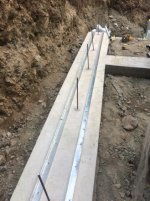
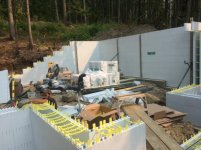
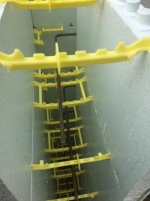
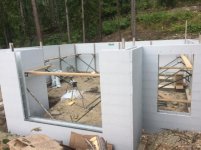
I am building a walkout basement for an 850 sq ft cabin. Certainly a different application. The walls are laser straight and I will hang my gyprock right on the styrofoam. The yellow tabs on the spacers will hold sheetrock screws very well. It is more expensive than a conventional cement basement, however it was installed on the footings and walls poured in 2 days. I hired a contractor to do it, it is plumb, level and square with no blowouts. The styrofoam is 2" thick, cement is 8" thick. This basement is a quadlock system. There is rebar every course of styrofaom. The contractor was very fussy about the slump and pumping/pouring it in about 2.5 foot levels so that the walls did not shift or bulge. They were constantly checking the walls for out of plumb during the pour. I would do it again for this application, and I would use an experienced contractor with references to do it. The concrete pumper and the building inspector had some horror stories about botched jobs. This basement is suitable for diy but I wanted to minimize any risk of failure. The contractor had the proper braces, scaffold ledgers, screws, rebar benders and experience with placing the cement with minimal vibrating.
 

Attachments

  • IMG_3069 (480x640).jpg
    IMG_3069 (480x640).jpg
    58.6 KB · Views: 54
  • IMG_3072 (640x480).jpg
    IMG_3072 (640x480).jpg
    50.2 KB · Views: 55
  • IMG_3075 (480x640).jpg
    IMG_3075 (480x640).jpg
    32.9 KB · Views: 52
  • IMG_3081 (640x480).jpg
    IMG_3081 (640x480).jpg
    47.3 KB · Views: 51
  • IMG_3097 (480x640).jpg
    IMG_3097 (480x640).jpg
    44.3 KB · Views: 50

gnpenning

Well-known member
Joined
Jan 25, 2015
Messages
2,754
Location
I have more questions than answers.
Amvic and Logix are the most common block manufacturers here that have been used with good results. Others have come and gone for good reason. Not all block is the same. My place is Amvic which I was very happy with. It's 2.5" of insulation both inside and out.

I was able to buy all my block, rebar, and cement for my main floor and basement for what my bid was just for the basement foundation. The basement bid included labor. I did it myself so no labor was included. But I also saved on framing materials and insulation for the basement and main floor. Well worth it for me.

Here the 2 dealers aren't trying to retire off a couple sales and are very competitive priced. Different parts of the country have wildly different pricing for the exact same product. Many dealers mark up is a joke. Funny Dave mentioned southern Utah. I hunt southern Utah and happened to be there when a lumber store was doing a grand opening. We swung in, and I talked to the ICF rep that was there. The prices were higher than I can buy the same thing here. Utah has a distribution center and that's where the block sold here comes from. Even with the extra trucking we can buy it cheaper. It's all about mark up.
 
Last edited:
To avoid these ads, REGISTER NOW!

Firebrick43

Well-known member
Joined
May 12, 2015
Messages
14,015
Location
West central Indiana
I used amvic but considered buildblock and logix very good as well. Picked amvic more because of the great local dealer.

I did not pay anywhere near a premium like Dave did? Nor do I understand his property tax issues? Hell my property taxes total are about 800$ total.
 

MushCreek

Well-known member
Joined
Jan 14, 2015
Messages
9,763
Location
Upstate South Carolina
I built our ICF house, using Fox Blocks. The walls came out perfect- better than most conventional homes. As said, it is very energy efficient and strong. It's also very quiet, but that's not much of a factor in a shop. It is a good DIY method, but there's a lot to learn. I paid a contractor (with ICF experience) to actually fill the blocks. I paid roughly $10K for enough blocks to do our basement and main floor- 1400 sq ft each. I'd have to look it up see what I paid to have them filled. If you hire everything out, I've heard horror stories about people being gouged by plumbers, electricians, etc. It's no harder or slower than other methods, but you do have to plan ahead, and know the tricks of the trade(s).
 

ConCretin

Well-known member
Joined
Jan 20, 2011
Messages
3,378
Location
Central Maine
Most of what I can offer has already been said but I'll try to be brief. ICF's definitely offer some advantages when it comes to energy efficiency, strength, fire resistance and quiet but it comes with a cost. Depending on the experience and competition in your market that cost can be very significant.

These costs often extend beyond the structure itself. Drywall, trim, plumbing, electrical, etc can all cost more in an ICF house. It isn't that much more difficult but a subcontractor who has never done an ICF house is likely to cover his **** when offering a fixed price.

As an aside, I don't believe ICF's are worthwhile for work below grade such as frost walls where you would typically use concrete anyway. Based on my experience, it is less expensive to place conventional wall and apply a layer of rigid insulation.

I wouldn't generally consider ICF's a DIY undertaking (Unless you are GJ'er - we'll tackle anything) They look like Lego's but a quality installation requires skill and experience. Getting your ICF wall with all it's openings, corners and other details plumb, square and true is one thing. Keeping it that way when those foam blocks start shaking from 4000 lbs per cubic yard of concrete dropped through 100' of pump boom is another.

You'll definitely want to rent braces to align your ICF walls if you or your contractor don't have them.

ICF's require more planning. All of your finish details from sheetrock to electrical can be achieved with ICF but the methods will vary. You'll need to do your research and adapt all your construction details accordingly.

With the advances in spray insulation and structural framing systems, ICF's advantage gap has certainly lessened. Unless you live in an area with contractors of all types experienced in ICF construction, you can probably build a traditional structure with similar performance for a LOT less money. You can put the money you save into things you will notice more than what is behind your sheetrock.

With that said, living in an incredibly strong, quiet, energy efficient and fire resistant structure provides amazing peace of mind. If you value these things more than a fancy kitchen, ICF's might be for you. Just my opinion.
 
Last edited:

wssix99

Well-known member
Joined
Mar 2, 2011
Messages
5,158
Location
Chicago, IL
In addition to the folks here, I've built a 4 story ICF house and Firebrick43 also has a great build thread.

I'd echo LLWillysfan's comments regarding the method. The marketing materials from the ICF companies belie the true construction times, increased labor costs, and planning/logistics over other concrete methods. (ICF looks like a do-it-yourself thing. It's not.) That being said, there is a place in the world for them.

If you just want concrete - there are FAR better ways to get that. If you want foam involved, then that brings ICF into the conversation. If this is just for a garage, then I would probably lean towards insulated tilt-up construction or other ways of insulating.

If you don't have both a heating and cooling season, that may also tilt the economics for you. What is your plan for HVAC in this building? Can you confirm that you will not be heating the space?

^ As LLWillysfan points out, concrete can't be beat in a number of respects. If you want to go that way, I would start by confirming your insulating strategy before choosing the construction method.

For example, if you are NOT heating or cooling the inside and want a passive design, ICF (foam on both sides) could work against you and make the building hotter. (The foam would trap heat inside the wall and would make the core hotter than the outside temperature at night.) In this situation, putting foam on the inside only might perform better for you.
 
Last edited:

Boilerhouse

Well-known member
Joined
Mar 20, 2012
Messages
1,320
Location
Muskoka

03ranger

Well-known member
Joined
Mar 4, 2010
Messages
260
Location
Wickenburg, AZ
ICF’s have been used here in the Valley of the Sun (Phoenix, AZ) for many years, they were better known as “Rastra” built home’s. Rastra is a trade name for a particular insulating concrete form (ICF) and has been in use since the mid 1970’s.

If you Google “insulating concrete form phoenix”, you’ll find that there have been an increase in use of ICF buildings being built .There are several recent new, well known buildings built in the valley using ICF’s.

You will need to price out construction (stick, vs ICF’s vs steel) and operating cost (HVAC) as always to determine which is best for you.

When we built our house three years ago, I looked into Rasta’s block construction and determine that the cost was too high due the travel cost associated with construction to make it worthwhile to do. People who knew how to build using ICF would need to travel 50 to 75 miles one way to the construction site. We ended up building a stick house with no regrets; 2 x6 construction with fiberglass between the studs and two inches of rigid foam on the outside of the house wrap.
 

theoldwizard1

Well-known member
Joined
Feb 22, 2011
Messages
43,125
Location
SE MI
ICF are definitely a DIY do-able job. There are several traps you can fall into. Bracing is required as well as scaffolding with safety railing are a must. These can cost a lot.

Make sure you have a pumping crew that is EXPERIENCED with pouring an ICF wall !

I would use it for a basement in my climate, but I think there are more cost effective solution above ground.
 

850xpeps

Well-known member
Joined
Aug 6, 2017
Messages
1,365
We build with icfs often. I will build my shop with them regardless of cost difference but with the rising cost of lumber it is making them more affordable.

They are easy to get straight and avoid blowouts with simple 1x4 strapping. We do not plywood corners or any weak spots because the icfs will settle slightly and the plywood will stop that spot from settling. Corners get a strap each direction inside and out on each course. Windows get straps across them and screwed to the window bucks. We try to set the braces on the inside if we can. I like to string the tops and keep the walls tipped towards the braces slightly and the once the walls are full I straighten them by adding pressure with the braces. It controls it better because it is difficult to pull a wall with the braces.

Many different brands I like logix as it’s easier to avoid breaks all the way down the wall. We just finished a 40x80 shop with 13’6” high icf walls. And a 1700sq ft house basement 10’ walls. The benefits of no air infiltration make them a first choice for me. My house will also be icfs. I believe the 2.5” foam each sides provides r24 ish with no thermal bridging.
 

rsanter

Well-known member
Joined
Dec 22, 2007
Messages
18,505
Location
visalia ca
We have an ICF building at work and it is my favorite building. They are awsome.
If I could I would build a house out of one
 

MushCreek

Well-known member
Joined
Jan 14, 2015
Messages
9,763
Location
Upstate South Carolina
Although ICF is rated around R-24, it can perform much higher during certain conditions due to the thermal mass in the core. I read a study that found that it performed as high as R-66 during the spring and fall seasons. We've gone for several months at a time without using HVAC at all.

That leads me to an important point for anyone considering a high performance building envelope. Make SURE that your HVAC guy does the proper calcs when sizing your system. I had a 'pro' tell me (over the phone!) that I would need a minimum 2-1/2 ton HVAC system. How can you size a system over the phone? I bought a $50 program (HVACCalc) and did my own. Our total cooling load in the summer is 9,000 BTU, or just 3/4 ton. The heating load is 12K BTU. We heat and cool our entire house with a 12K mini-split, with a second smaller one in the master suite 'just in case'. We've only run both a few times when it got extremely cold (single digits). A 2-1/2 ton system would have been way, way too big, costing more to buy and operate, and not working very well to boot. Many old-school contractors can't wrap their head around the idea that a building could perform that well. At Thanksgiving, when we had 12 people in the house, we had to open the windows despite it being cool out. Active people put out up to 500 BTU's, so we had somewhere around 5-6,000 BTU's in 'people heat', the equivalent of a space heater.
 

wssix99

Well-known member
Joined
Mar 2, 2011
Messages
5,158
Location
Chicago, IL
Although ICF is rated around R-24, it can perform much higher during certain conditions due to the thermal mass in the core. I read a study that found that it performed as high as R-66 during the spring and fall seasons. We've gone for several months at a time without using HVAC at all.

This is true and my experience has been the same.

However, in the absence of an HVAC system or a spring/fall season, the ICF can work negatively. (The summer heat would soak into the concrete core over time and not be let out at night. The building would want to be the average temperature all the time. Cooler than the max temperature during the day - but much warmer than the low temperature at night.)

So, if the OP is not going to cool the building, ICF is probably not the best choice. (Insulation on the inside-only should perform better in that condition.)


That leads me to an important point for anyone considering a high performance building envelope. Make SURE that your HVAC guy does the proper calcs when sizing your system.

I also had a similar experience. The EPA also has some software for this. However; our local code requires that we follow ASHRAE guidelines, which don't allow for our condition - so we had to over-size. So we had to size our system for what we needed and than add a throw-away boiler for extra radiant heat, which we'll throw away at some point. :(
 
To avoid these ads, REGISTER NOW!
Top Bottom