
You are using an out of date browser. It may not display this or other websites correctly.
You should upgrade or use an alternative browser.
You should upgrade or use an alternative browser.
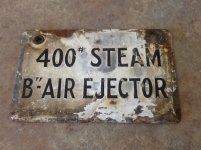
Has anyone seen something like this?
- Thread starter Apache3057
- Start date
Sam'sAutoParts
Well-known member
No idea what it's from, but it is very cool.
My dad was a sign painter and collector of old signs, so I have a soft spot for them.
My dad was a sign painter and collector of old signs, so I have a soft spot for them.
OP
Apache3057
Well-known member
That's why I got it. Thought it was interesting. Just fascinated with things that survive time.
jimreed2160
Well-known member
My WAG is some sort of boiler plant. Water needs to go into the boiler ("air injector") and obviously steam comes out ("steam"). It is important to know which line is which.
ssdave
Banned
400# seems a bit high of pressure, but otherwise I would guess it came off of a ship. An Air Ejector is a venturi, that uses high pressure air or water to **** up and blow out fluid.
You hook up air or steam to a pipe with an air ejector on it, put the intake side down into a puddle of water, turn it on and it vacuums up the water and spits it out the end of the pipe.
Used on a ship to clean out bilge water and such.
You hook up air or steam to a pipe with an air ejector on it, put the intake side down into a puddle of water, turn it on and it vacuums up the water and spits it out the end of the pipe.
Used on a ship to clean out bilge water and such.
MercLSU
Well-known member
The only thing that comes to mind is this:
Very cool. Me, I'd put it on the wall right by the handle on my guest bathroom toilet
Very cool. Me, I'd put it on the wall right by the handle on my guest bathroom toilet
slip knot
Well-known member
400lb steam is a bit high. we used to run 250lb steam in the industrial plants.
ddawg16
Well-known member
400 Lbs of steam is a lot of pressure....and pretty good heat.
It might have come off a ship....you wouldn't see that kind of pressure on shore
It might have come off a ship....you wouldn't see that kind of pressure on shore
RivennHewn
Well-known member
Doing a remodel in downtown Seattle, we hit a pipe coming out of the basement wall.
We were about 20' below the sidewalk. The pipe wasn't labeled.
During demo, a board came down and knocked the pipe. It immediately started filling the basement with steam. In about 2 minutes, a 100' X 100' room with 20' ceilings was completely filled with steam. You couldn't see more than about 3'.
I was surprised to learn just how many buildings in downtown Seattle still use steam heat.
Seattle Steam came out and fixed the pipe. Lucky for us, it was no where near 400 lbs.
We were about 20' below the sidewalk. The pipe wasn't labeled.
During demo, a board came down and knocked the pipe. It immediately started filling the basement with steam. In about 2 minutes, a 100' X 100' room with 20' ceilings was completely filled with steam. You couldn't see more than about 3'.
I was surprised to learn just how many buildings in downtown Seattle still use steam heat.
Seattle Steam came out and fixed the pipe. Lucky for us, it was no where near 400 lbs.
Furd50
Well-known member
The company I used to work for had a test site that used air ejectors to simulate a high altitude condition. I was never there but I knew several people that had run the plant. As I recall it used 400 psi steam and the chamber could simulate an altitude of about 50,000 feet above sea level.
Are you trying to tell us that shoreside power plants all run below 400 psi or that an air ejector in a shoreside plant would not use that high a pressure?It might have come off a ship....you wouldn't see that kind of pressure on shore
Most of them in the core business district use steam from the central station on Western Avenue, right next to the viaduct. Seattle Steam Corp. makes a LOT of steam, several hundred-thousands of pounds (weight) per hour during the winter. The distribution is, as I recall, at 125 psi and every building has a pressure reducing valve that drops it to between 5 and 25 psi for use. They even run steam to Capital Hill to the hospitals.I was surprised to learn just how many buildings in downtown Seattle still use steam heat.
Sawdustmaker
Well-known member
When I was working on the steam train (fireman/engineer) at Disneyland (yes, they made me take steam courses and join Operating Engineer's Union) there was one of my counterparts that had worked on ships in England. I remember him saying that they ran their boilers at 400 psi, or as he put it 27.2 atmospheres. With that said I would say it is from a ship. BTW The locomotives at DL run at 125 to 150 psi. At 150 psi the pop off valve blows and is quite loud.
Sawdustmaker
Well-known member
Doing a remodel in downtown Seattle, we hit a pipe coming out of the basement wall.
We were about 20' below the sidewalk. The pipe wasn't labeled.
During demo, a board came down and knocked the pipe. It immediately started filling the basement with steam. In about 2 minutes, a 100' X 100' room with 20' ceilings was completely filled with steam. You couldn't see more than about 3'.
I was surprised to learn just how many buildings in downtown Seattle still use steam heat.
Seattle Steam came out and fixed the pipe. Lucky for us, it was no where near 400 lbs.
Forgive me for being a bit technical here. What filled the room was vapor, not steam. Live steam is invisible and extremely dry. If live steam at 100 psi hit you, not only would you get cooked, it could well cut you in half. Check a tea kettle next time it is whistling. Between the hole in the cap and the vapor you will see a space between the hole and the vapor that forms which will be live steam. Don't touch it!

SuperCat
Well-known member
Apache, that would go great with a collection of antique tea pots. Nice find.
Nice find.Furd50
Well-known member
In the 1970s there were American ships running 1200 psi steam pressure. Nonetheless, it would be unusual for an air ejector to use much more than 200 psi steam for removing the air and non-condensable gases from the condenser.When I was working on the steam train (fireman/engineer) at Disneyland (yes, they made me take steam courses and join Operating Engineer's Union) there was one of my counterparts that had worked on ships in England. I remember him saying that they ran their boilers at 400 psi, or as he put it 27.2 atmospheres. With that said I would say it is from a ship. BTW The locomotives at DL run at 125 to 150 psi. At 150 psi the pop off valve blows and is quite loud.
RivennHewn
Well-known member
Forgive me for being a bit technical here. What filled the room was vapor, not steam. Live steam is invisible and extremely dry. If live steam at 100 psi hit you, not only would you get cooked, it could well cut you in half. Check a tea kettle next time it is whistling. Between the hole in the cap and the vapor you will see a space between the hole and the vapor that forms which will be live steam. Don't touch it!
Steam/vapor......."220-221 whatever it takes"

Toothaker
Well-known member
Forgive me for being a bit technical here. What filled the room was vapor, not steam. Live steam is invisible and extremely dry. If live steam at 100 psi hit you, not only would you get cooked, it could well cut you in half. Check a tea kettle next time it is whistling. Between the hole in the cap and the vapor you will see a space between the hole and the vapor that forms which will be live steam. Don't touch it!
I learn the coolest stuff around here. Who knew that live steam was "extremely dry"?
 Or that the clear space between the kettle whistle and the visible water vapor was where "live steam" was present?
Thanks!
ddawg16
Well-known member
The company I used to work for had a test site that used air ejectors to simulate a high altitude condition. I was never there but I knew several people that had run the plant. As I recall it used 400 psi steam and the chamber could simulate an altitude of about 50,000 feet above sea level.
Are you trying to tell us that shoreside power plants all run below 400 psi or that an air ejector in a shoreside plant would not use that high a pressure?
Most of them in the core business district use steam from the central station on Western Avenue, right next to the viaduct. Seattle Steam Corp. makes a LOT of steam, several hundred-thousands of pounds (weight) per hour during the winter. The distribution is, as I recall, at 125 psi and every building has a pressure reducing valve that drops it to between 5 and 25 psi for use. They even run steam to Capital Hill to the hospitals.
400 PSIG would yield a temp over 231 deg F....that is a lot hotter than a typical steam heating system would use. They typically run more around the 160 deg temp.
But I'm not saying it's not possible....
...Very cool. Me, I'd put it on the wall right by the handle on my guest bathroom toilet
Ouch!

crguy
Well-known member
400 Lbs of steam is a lot of pressure....and pretty good heat.
It might have come off a ship....you wouldn't see that kind of pressure on shore
You don't know what you're talking about.
ttpete
Well-known member
400 PSIG would yield a temp over 231 deg F....that is a lot hotter than a typical steam heating system would use. They typically run more around the 160 deg temp.
But I'm not saying it's not possible....
Steam heating systems are low pressure. 5-7PSI.
WWII Navy warships typically used 650PSI at 750F superheat.
Postwar, 1200PSI at 1000F. This was for main propulsion. The first stage turbine blades would run at a red heat and the final stage would run at 28" vacuum at about 80F going into the condensers. That's really getting all the energy out of the steam.
I was surprised to learn just how many buildings in downtown Seattle still use steam heat.
Still used in downtown Hartford, CT, too. Our last major snow storm this year, I noticed where one of the steam lines ran across the road; that was where there was no snow, until we were hours into the storm. Even the, the four manhole covers across the line were snow-free.
ddawg16
Well-known member
You don't know what you're talking about.
Ok....mr expert....educate us......
and I'll just keep quite about all the plant steam systems I've worked with.....
crguy
Well-known member
Ok....mr expert....educate us......
and I'll just keep quite about all the plant steam systems I've worked with.....
My thought is that IF you had Actually worked on plant steam systems you wouldn't have made a statement like that.
Found this today at an estate sale. Person selling said that had no idea what it was off of. It appears to be porcelain. Could it have been military use or industrial? Just curious on its use. If anyone has any info.I would appreciate. Thanks.
Wile E. Coyote