To avoid these ads, REGISTER NOW!

Heat pump/AC question

930dreamer

Super Moderator
Staff member
Joined
Oct 7, 2009
Messages
22,948
Location
Amarillo,TX and Stinnett,TX
We had our unit serviced in March2014(in the attic). The service person disconnected the heat pump portion (outside, wife wanted HOT air in the winter), and replaced the thermostat. Everything worked fine, fast forward into May and we have a large ceiling leak/stain and sheetrock failure.

The same hvac company comes out again and states the drain was clogged and the unit should have a unit catch pan/tray and float with a turn off switch, he unclogs the drain and I search for a sheetrock guy . I ask why the previous person didn't mention this and receive a blank stare. On both service calls I ask for a sales person to call about a new system and no response.

So now the AC unit (in the attic) is leaking again as the temporary clear plastic covering the 5'x5' hole in the ceiling is collecting cold water. I'm not sure if the unit is producing more condensation after the heat pump was disconnected or was always leaking and it took a while to soak through the insulation/sheetrock etc. If I had the sheetrock repaired after the first leak it would be ruined by the second leak. Anyone has some insight on this one?:confused:
 
Last edited:
To avoid these ads, REGISTER NOW!

pattenp

Well-known member
Joined
Jun 4, 2008
Messages
10,175
Location
Virginia - USA
AC's will product a lot of condensate when the humidity is high. Condensation lines need to be kept open to prevent overflow. Every 4 to 6 months I squirt bleach into my condensate line at the air handler to clean out algae growth that will stop up the line. Air handlers installed in an attic area should have a secondary overflow tray with a drain line under the unit.
 

justsam

Well-known member
Joined
Aug 20, 2010
Messages
1,267
Location
Penngrove, California
If this HVAC professional is so incompetent to not observe the issue of improper condensate draining on an attic unit, I certainly would not invite them to do more work.

I would not be replacing the sheet rock until you satisfy yourself that proper draining is in place, either by doing the work yourself, or finding a competent HVAC person.

Ideally the drain should be gravity. Pumps just add another point of maintenance/failure.

As stated there should be a primary, and visible secondary drain.
 

Crimson558

Active member
Joined
Mar 7, 2013
Messages
32
Location
Alabama
Def need an drain pan but you didn't say where it was leaking from. Is it the unit itself or the PVC? As we all know attics **** and he could have accidentally stepped on it causing a joint to come loose or cracked the PVC (not taking up for the tech he def should've told you that you needed the pan. That's part of HVAC install 101). Either way you need a drain pan. If noting else measure the unit and find a local sheet metal company to make you one and install it yourself. I have seen them with and without the sensors but if you want one it is really simple to install in the drain pan. Unless someone is gonna install it for free then I'd probably make it a DIY job and do it myself.
 
OP
9

930dreamer

Super Moderator
Staff member
Joined
Oct 7, 2009
Messages
22,948
Location
Amarillo,TX and Stinnett,TX
It's venting out of the vent line in the main drain( really just a tee piece of pvc with no riser) The auxiliary drain is discharging a bunch of water too.

Update today, the same service man came out again today. He said the main drain isn't draining properly and overflowing. I asked why after 20 years of zero issues are we having problem now. I don't know is the response. I stated if I had repaired the sheetrock last week I'd be doing the job all over again this week.

The service guy is saying the main drain doesn't have enough slope to drain correctly and the attic unit needs to be raised to do this. It's worked just fine all this years and we didn't have any issues until after the spring service call. The unit will need to be raised to install the pan also.

This is a large local hvac company that we've used forever but I don't think they will get my business on a new complete install. The service guy said there are two duct runs that he couldn't get reattached as he was completing the ticket, I said what do you mean and lets go have a look. The two duct pipes are exactly in the area where all the "work" was being done. I held the flashlight so he could try again, all complete now.:dunno:
 
Last edited:

Crimson558

Active member
Joined
Mar 7, 2013
Messages
32
Location
Alabama
It's venting out of the vent line in the main drain( really just a tee piece of pvc with no riser) The auxiliary drain is discharging a bunch of water too.

Update today, the same service man came out again today. He said the main drain isn't draining properly and overflowing. I asked why after 20 years of zero issues are we having problem now. I don't know is the response. I stated if I had repaired the sheetrock last week I'd be doing the job all over again this week.

The service guy is saying the main drain doesn't have enough slope to drain correctly and the attic unit needs to be raised to do this. It's worked just fine all this years and we didn't have any issues until after the spring service call. The unit will need to be raised to install the pan also.

This is a large local hvac company that we've used forever but I don't think they will get my business on a new complete install. The service guy said there are two duct runs that he couldn't get reattached as he was completing the ticket, I said what do you mean and lets go have a look. The two duct pipes are exactly in the area where all the "work" was being done. I held the flashlight so he could try again, all complete now.:dunno:


when you say the aux drain is discharging a lot of water are you meaning its leaking into attic or its doing its job and draining to the outside of house? If it is draining to the outside I'd think it would be running on the same decline/slope as the primary drain so I do not understand him saying primary drain doesn't have enough fall. Sounds like he needs to unclog the primary line. There are several different ways to do this that are very easy. If he isn't capable of doing that then I'd agree with ya and not use the company any longer.

Side note....when I was doing HVAC work the company I worked for wouldn't charge a service call fee if you told them you were needing help since another company couldn't help you. They just looked at it as a way to get more loyal customers. So may not be a bad idea to mention this to whatever other company you may call. May not be free but they may give ya a discount. Can't hurt right haha
 

justsam

Well-known member
Joined
Aug 20, 2010
Messages
1,267
Location
Penngrove, California
I had this type issue when living in Southlake Texas, however the secondary drain did it's job. The secondary was placed above a window and when we saw condensate from iit we knew of the issue, just like it is supposed to!

The primary condensate drain went into the bathroom house drain. The clog was right at that junction where the condensate drain tied into the house drain. Cleared out the rusty muck there, and all was fine.

If all has been working fine, I suspect some form of clog as opposed to suddenly needing to raise the unit.
 

Onewolf

Well-known member
Joined
Mar 15, 2012
Messages
371
Location
East Central Florida
AC's will product a lot of condensate when the humidity is high. Condensation lines need to be kept open to prevent overflow. Every 4 to 6 months I squirt bleach into my condensate line at the air handler to clean out algae growth that will stop up the line. Air handlers installed in an attic area should have a secondary overflow tray with a drain line under the unit.

Don't use bleach. It will cause the condenser to rust prematurely. There are special tablets/liquid which will prevent algae/crud from growing in the condensate drains.

http://www.homedepot.com/p/AC-Safe-Air-Conditioner-Pan-Tablets-6-Pack-AC-912/100665383?keyword=ac+condensate+drain+cleaner

My upstairs bonus room air-handler has an overflow pan with a shutoff float switch that prevents condensate drain pipe backups from spilling over and causing problems. I used to have problems with backups because there were TWO uphill sections in the drain pipe. One in the attic and one under the downstairs air-handler return air box where the drain went into a pipe in the slab for draining outside.
 

sourdough

Well-known member
Joined
Dec 3, 2012
Messages
132
Location
Pe Ell, WA
I agree with Onewolf... no bleach.

Go to your local institutional (as in hospital/school) chem supply store and ask for an enzyme to clean the drain. The foaming type is the best because it will contact all of the interior line surfaces vs. just the bottom half of the line when a liquid enzyme is used (as in our situation). We have very long run (20') from the kitchen to the sanitary tee on the main drain. We are on a septic system (so no garbage disposal) and we are very careful about NOT putting grease/fats down the drain. About 3 years after the house was built we had to have the drain "rooted" and the tech advised to use an enzyme treatment monthly (about 1 cup for a 1.5" line) overnight, so you would need far less, I would think. We have had no problems since (6 years). The enzyme has also seemed to be beneficial to the septic sludge tank chemistry when we got the tanks pumped last summer. One gallon ($20) lasts about a year for our application.

Just my $.02.
 
Last edited:

pop pop

Well-known member
Joined
Apr 1, 2010
Messages
2,859
Location
Virginia
Just an observation, not trying to be sarcastic,
You sound like a typical customer. Don't know what is wrong, but know it's not being handled correctly, and keep calling the same repair guy, and paying the bill.

Your repairman sounds like the typical HVAC hack (not the good ones). They do just what you ask, nothing more including fix what they screw up. Easy call for them and get paid.

There is no hope for you. Move to a condo.

Or... get up in the attic and understand there are two drains. Primary and a back up. The back up is for emergency. When it drains, you will likely soon have a wet ceiling when it stops draining. Remember?

The primary worked for years? Then fix the drain. Don't let the tech leave without showing you he can pour a gallon of water in it at the coil and it drains. Don't pay till it works.
 

pattenp

Well-known member
Joined
Jun 4, 2008
Messages
10,175
Location
Virginia - USA
I was told to use bleach by the installer. The bleach doesn't go into the condenser drip pan. It is poured into the condensation line at the trap. It keeps the trap and line clear.

Edit: I know bleach is hard on aluminum and causes it to oxidize. My air handler coils are all aluminum.

Don't use bleach. It will cause the condenser to rust prematurely. There are special tablets/liquid which will prevent algae/crud from growing in the condensate drains.
 
Last edited:

RM209

Well-known member
Joined
Apr 17, 2009
Messages
892
Location
MD
I agree with Onewolf... no bleach.

Go to your local institutional (as in hospital/school) chem supply store and ask for an enzyme to clean the drain. The foaming type is the best because it will contact all of the interior line surfaces vs. just the bottom half of the line when a liquid enzyme is used (as in our situation). We have very long run (20') from the kitchen to the sanitary tee on the main drain. We are on a septic system (so no garbage disposal) and we are very careful about NOT putting grease/fats down the drain. About 3 years after the house was built we had to have the drain "rooted" and the tech advised to use an enzyme treatment monthly (about 1 cup for a 1.5" line) overnight, so you would need far less, I would think. We have had no problems since (6 years). The enzyme has also seemed to be beneficial to the septic sludge tank chemistry when we got the tanks pumped last summer. One gallon ($20) lasts about a year for our application.

Just my $.02.

Don't mean to hijack, but this is a very interesting thread; it made me realize I've never cleaned the PVC condensate lines in my air conditioner. Is it OK to use bleach in those lines, as they don't contain any aluminum? If not, any brands or trade names you recommend?

Thanks,
RM209
 
To avoid these ads, REGISTER NOW!

pattenp

Well-known member
Joined
Jun 4, 2008
Messages
10,175
Location
Virginia - USA
As I stated above the AC installer said to use bleach to keep the condensation drain lines open. My lines are PVC and I assume since bleach comes in plastic bottles it won't harm PVC at full strength.

Don't mean to hijack, but this is a very interesting thread; it made me realize I've never cleaned the PVC condensate lines in my air conditioner. Is it OK to use bleach in those lines, as they don't contain any aluminum? If not, any brands or trade names you recommend?

Thanks,
RM209
 

sourdough

Well-known member
Joined
Dec 3, 2012
Messages
132
Location
Pe Ell, WA
OP
9

930dreamer

Super Moderator
Staff member
Joined
Oct 7, 2009
Messages
22,948
Location
Amarillo,TX and Stinnett,TX
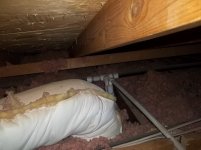
Here's what the problem is, the main drain isn't draining. Is this trap setup correctly? If I pour bleach in the trap will it clear the clog? Notching the rafter is priceless. I think I can shorten the pvc piece going into the drain also, Thanks everyone.:thumbup:

UPDATE: I used the wet vac and sucked out the aux and main P-trap drains, brown nasty water and **** come out. The aux drain outside is dried up for the most part, I'll recheck it after an hour or so.:thumbup:
 

Attachments

  • 101_0755.jpg
    101_0755.jpg
    73.1 KB · Views: 49
  • 101_0756.jpg
    101_0756.jpg
    105.4 KB · Views: 46
  • 101_0757.jpg
    101_0757.jpg
    147.5 KB · Views: 38
Last edited:
OP
9

930dreamer

Super Moderator
Staff member
Joined
Oct 7, 2009
Messages
22,948
Location
Amarillo,TX and Stinnett,TX
I poured a gallon of bleach into the main AC drain, it may need more work. The line goes left into a roof vent and right into the kitchen sink clean out. If I use the theory that the aux drain line shouldn't be draining large volumes of water the main is still blocked.:(
 
OP
9

930dreamer

Super Moderator
Staff member
Joined
Oct 7, 2009
Messages
22,948
Location
Amarillo,TX and Stinnett,TX
Can You block one drain, use the shop vac, then block the other and use the shop vac again?

I shop vac the aux line from outside and the main from the P-trap/main drain line in the attic, I'm guessing the large line that goes to the kitchen drain might be the culprit? It doesn't have much slope to it either.:headscrat
 
Last edited:

Bronson

Well-known member
Joined
Aug 2, 2011
Messages
12,676
Location
Texas panhandle
I shop vac the aux line from outside and the main from the P-trap/main drain line in the attic, I'm guessing the large line that goes to the kitchen drain might be the culprit? It doesn't have much slope to it either.:headscrat

You MIGHT try blowing compressed air back into the drain line from outside. Just a quick shot to see if You feel back pressure there.
 

nsula_country

Well-known member
Joined
May 23, 2013
Messages
1,534
Location
Northwestern Louisiana
Here's what the problem is, the main drain isn't draining. Is this trap setup correctly? If I pour bleach in the trap will it clear the clog? Notching the rafter is priceless. I think I can shorten the pvc piece going into the drain also, Thanks everyone.:thumbup:

UPDATE: I used the wet vac and sucked out the aux and main P-trap drains, brown nasty water and **** come out. The aux drain outside is dried up for the most part, I'll recheck it after an hour or so.:thumbup:


The short answer is "no" to the trap setup correctly. The condensate line (primary) is supposed to be hard piped into the trap, not just dripping into it. The code in my area would have FAILED this. This is most likely where the water was leaking onto your ceiling.

The secondary, or pan drain is to exit to the exterior in an obvious location. This is to prevent water damage in the event the condensate line has a blockage. Also so when the secondary line drains, it is visible. This is the red flag something is wrong.

Finally, a float switch on the overflow pan to shut down the unit if the secondary line blocks. Some codes require one on the condensate (coil) pan as well.

CT
 

wyliesdiesels

Well-known member
Joined
Aug 14, 2012
Messages
19,995
Location
Modesto, CA
Every time Ive seen a condensate drain, the P trap is right near the air handler/evaporator. I would remove it from the main line and plumb a P-trap into the condensate line. The P-trap is needed to prevent sewer gases from flowing into your unit and causing corrosion.

However, Im not a plumber. Im an electrician who's observant!
 

LS6 Tommy

Well-known member
Joined
Dec 27, 2013
Messages
26,162
Location
Northern NJ
Every time Ive seen a condensate drain, the P trap is right near the air handler/evaporator. I would remove it from the main line and plumb a P-trap into the condensate line. The P-trap is needed to prevent sewer gases from flowing into your unit and causing corrosion.

However, Im not a plumber. Im an electrician who's observant!

The P-trap is not to prevent sewer gas backflow. You're not allowed to drain directly into a waste line for exactly that reason. The P-trap creates an air seal so condensate pan will gravity drain properly under negative duct pressure. You only need one when the drain is "upstream" (on the inlet side) of the evaporator blower.

Tommy
 
Last edited:

wyliesdiesels

Well-known member
Joined
Aug 14, 2012
Messages
19,995
Location
Modesto, CA
The P-trap is not to prevent sewer gas backflow. You're not allowed to drain directly into a waste line for exactly that reason. The P-trap creates an air seal so condensate pan will gravity drain properly under negative duct pressure. You only need one when the drain is "upstream" (on the inlet side) of the evaporator blower.

Tommy

Ok got it thx. :thumbup:
 
To avoid these ads, REGISTER NOW!
Top Bottom